
SLIDE 1
Fermented milk through bacterial action.
http://www.foodrecipesworld.com/the-numerous-health-benefits-of-natural-yogurt-for-the-immune-system-cancer-prevention-and-weight-loss/
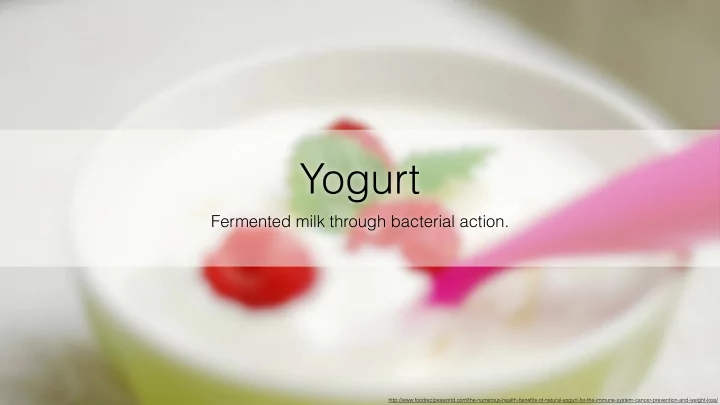
Yogurt Fermented milk through bacterial action. - - PowerPoint PPT Presentation
Yogurt Fermented milk through bacterial action. http://www.foodrecipesworld.com/the-numerous-health-benefits-of-natural-yogurt-for-the-immune-system-cancer-prevention-and-weight-loss/ Toppings Fermented milk yo urt Turkish word for curdled
Fermented milk through bacterial action.
http://www.foodrecipesworld.com/the-numerous-health-benefits-of-natural-yogurt-for-the-immune-system-cancer-prevention-and-weight-loss/
Turkish word for curdled or coagulated, thickened.
Fermented milk Toppings
http://www.makeyourownyogurt.com/make-yogurt/stir-well http://en.wikipedia.org/wiki/File:Yogurtland_Yogurt_High_Res.jpg
Rich in protein, calcium, riboflavin, vitamin B6 and vitamin B12. Eating low-fat yogurt can promote weight loss. Can help keep harmful gut bacteria at bay. May discourage vaginal infections
http://en.wikipedia.org/wiki/Yogurt#Nutritional_value_and_health_benefits
https://microbewiki.kenyon.edu/index.php/File:Lactobacillus_bulgaricus.jpg https://microbewiki.kenyon.edu/index.php/File:Streptococcus_thermophilus.jpg
Streptococcus thermophilus Lactobacillus delbrueckii
together to produce lactic acid. Lactic acid coagulates milk proteins to give yogurt its thick consistency.
compound responsible for the aroma of yogurt.
β-galactosidase metabolizes lactose to glucose. Glucose is metabolized to lactic acid through the Embden- Meyerhof-Parnas pathway. Lactic acid coagulates milk proteins to produce yogurt.
https://microbewiki.kenyon.edu/index.php/File:Emp_pathway.jpg
Enzyme catabolizes lactose into galactose and glucose.
https://microbewiki.kenyon.edu/index.php/File:Lactose_breakdown.jpg
β-galactosidase Galactose (β 1→4) Glucose Lactose Galactose Glucose
Enzymes convert glucose to lactic acid.
http://2012books.lardbucket.org/books/principles-of-general-chemistry-v1.0/s09-07-end-of-chapter-material.html
Glucose Lactic acid
It tastes better. No additives. It’s less expensive. Just because you can.
http://en.wikipedia.org/wiki/File:Yogurtland_Yogurt_High_Res.jpg
1 litre of milk 3 tbsp plain yogurt as starter large pot with lid spoon to stir thermometer
http://www.makeyourownyogurt.com/make-yogurt/what-you-need
You are incubating bacteria! Need to sanitize equipment to prevent contamination. Easiest method: put your stuff in the pot and boil water to steam.
http://www.makeyourownyogurt.com/make-yogurt/sanitize-equipment
Using the thermometer, heat the milk to 80°C for ~10 min. This denatures the milk proteins and yields a smoother texture. Careful not to burn the bottom!
http://www.makeyourownyogurt.com/make-yogurt/add-your-milk
Using the thermometer, cool the milk to 45°C. If too hot, it will kill the bacteria!
http://www.makeyourownyogurt.com/make-yogurt/cool-to-110
Introduce L. d. bulgaricus and S. thermophilus using the starter yogurt. Stir well.
http://www.makeyourownyogurt.com/make-yogurt/pitch-your-yogurt
Now we incubate for 8-12 hours. The longer you wait, the thicker and tangy it gets.
http://www.makeyourownyogurt.com/make-yogurt/stir-cover-warm
Stirring and chilling stops bacteria metabolism.
http://www.makeyourownyogurt.com/make-yogurt/chill-overnight
Enjoy with your favourite flavour 😅
http://commons.wikimedia.org/wiki/File:Dessert_-_Yogurt_e_Lamponi.jpg