
SLIDE 1
Sustainability activities at
- Div. of Bioprocess Engineering
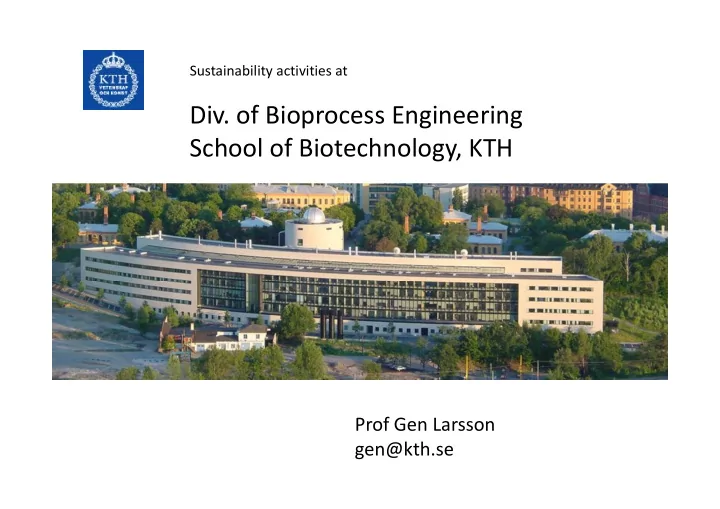
Div. of Bioprocess Engineering School of Biotechnology, KTH Prof Gen - - PowerPoint PPT Presentation
Sustainability activities at Div. of Bioprocess Engineering School of Biotechnology, KTH Prof Gen Larsson gen@kth.se THE DEFINITION OF BIOTECHNOLOGY Biotechnology is the integration of natural sciences and engineering in order to achieve the
Sustainability activities at
THE DEFINITION OF BIOTECHNOLOGY
European Federation of Biotechnology, 1980
3
FUELS ENERGY
Lignocellulose waste SUGARS Thermal decomposition Bioproduction Processing LIGNIN Aromatic compounds Energy Pre‐ treatment
BIOCHEMICALS BIOMATERIAL
CELLULOSE HEMICELLULOSE
non‐BIOTECH PRODUCTS
EXAMPLE OF APPLICATION AREA :MEDICIN SURGICAL MESH POLYMER: polyhydroxybutyrate (PHB)
Curr Opin Biotechnol 2011, 22:758‐767
PTT HA PLA red: dicarboxylic acids yellow: diamines blue: alkenes, dienes purple: carboxylic acids green: diols PHA´s
Time (min) Enzymatic saccharification Glucose (mg/g DS) Xylose (mg/g DS) Arabinose (mg/g DS) Galactose (mg/g DS) Total (mg/g DS) After 313 ± 8 198 ± 11 25 ± 3 18 ± 3 555 ± 25
Saha B., Iten L., Cotta M., Wu V. (2005) Dilute acid pretreatment, enzymatic saccharification and fermentation of wheat straw to ethanol. Process Biochem, 40, 3693‐3700. Yields from dilute acid pretreatment at 140°C and enzymatic saccharification of wheat straw (7.83%, w/v DS)
CELL TYPE 2: sequential growth: glucose>arabinose>xylose CELL TYPE 1: cannot grow on 5‐carbons
Unmodified cell Designed cell
Future: consortium for participation in the Baltic see project (EU) Käppalaverket
P P P P P
P