Y86-64 Instruction Set Byte 0 1 2 3 4 5 6 7 8 9 halt 0 - - PDF document

y86 64 instruction set
SMART_READER_LITE
LIVE PREVIEW

Y86-64 Instruction Set Byte 0 1 2 3 4 5 6 7 8 9 halt 0 - - PDF document

Y86-64 Instruction Set Byte 0 1 2 3 4 5 6 7 8 9 halt 0 0 Computer Architecture: nop 1 0 Y86-64 Sequential Implementation cmovXX rA , rB 2 fn rA rB 3 0 F irmovq V , rB rB V rmmovq rA , D ( rB ) 4 0 rA rB D CSci 2021:


slide-1
SLIDE 1

– 1 – CS:APP3e

Computer Architecture: Y86-64 Sequential Implementation

CSci 2021: Machine Architecture and Organization March 23rd-25th, 2020 Your instructor: Stephen McCamant Based on slides originally by: Randy Bryant and Dave O’Hallaron

– 2 – CS:APP3e

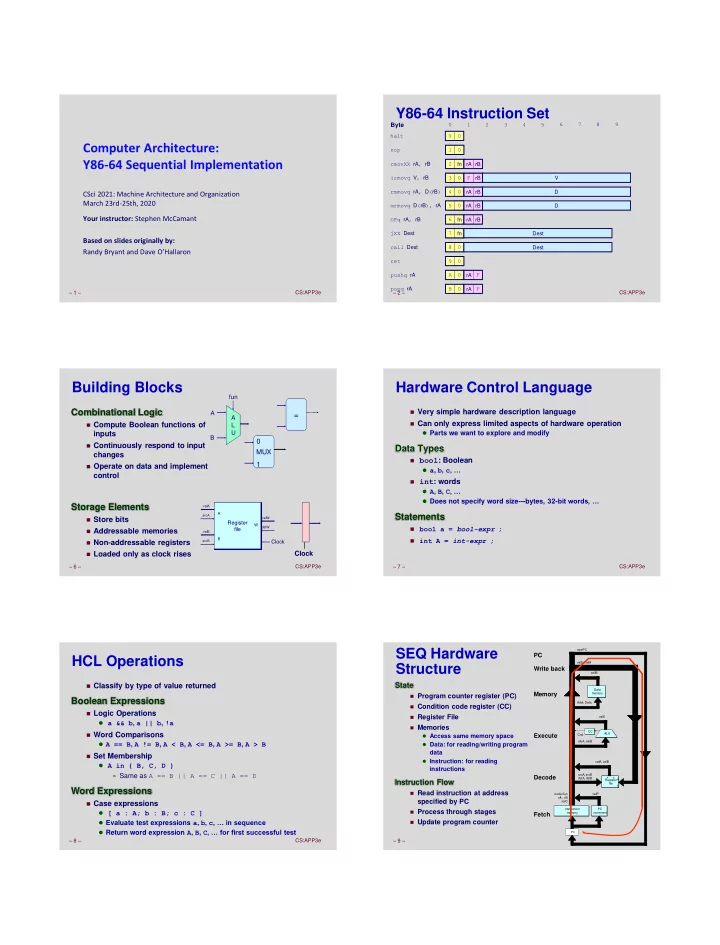
Y86-64 Instruction Set

Byte

pushq rA A rA F jXX Dest 7 fn Dest popq rA B rA F call Dest 8 Dest cmovXX rA, rB 2 fn rA rB irmovq V, rB 3 F rB V rmmovq rA, D(rB) 4 rA rB D mrmovq D(rB), rA 5 rA rB D OPq rA, rB 6 fn rA rB ret 9 nop 1 halt 1 2 3 4 5 6 7 8 9 – 6 – CS:APP3e

Building Blocks

Combinational Logic

 Compute Boolean functions of

inputs

 Continuously respond to input

changes

 Operate on data and implement

control

Storage Elements

 Store bits  Addressable memories  Non-addressable registers  Loaded only as clock rises Register file

A B W dstW srcA valA srcB valB valW

Clock

A L U fun A B

MUX 1

=

Clock

– 7 – CS:APP3e

Hardware Control Language

 Very simple hardware description language  Can only express limited aspects of hardware operation  Parts we want to explore and modify

Data Types

 bool: Boolean  a, b, c, …  int: words  A, B, C, …  Does not specify word size---bytes, 32-bit words, …

Statements

 bool a = bool-expr ;  int A = int-expr ; – 8 – CS:APP3e

HCL Operations

 Classify by type of value returned

Boolean Expressions

 Logic Operations  a && b, a || b, !a  Word Comparisons  A == B, A != B, A < B, A <= B, A >= B, A > B  Set Membership  A in { B, C, D }

» Same as A == B || A == C || A == D

Word Expressions

 Case expressions  [ a : A; b : B; c : C ]  Evaluate test expressions a, b, c, … in sequence  Return word expression A, B, C, … for first successful test – 9 – CS:APP3e

SEQ Hardware Structure

State

 Program counter register (PC)  Condition code register (CC)  Register File  Memories  Access same memory space  Data: for reading/writing program

data  Instruction: for reading instructions

Instruction Flow

 Read instruction at address

specified by PC

 Process through stages  Update program counter

Instruction memory Instruction memory PC increment PC increment CC CC ALU ALU Data memory Data memory

Fetch Decode Execute Memory Write back

icode

,

ifun rA , rB valC Register file Register file

A B M E

Register file Register file

A B M E PC

valP srcA , srcB dstA, dstB valA, valB aluA, aluB Cnd valE Addr, Data valM

PC

valE, valM newPC

slide-2
SLIDE 2

– 10 – CS:APP3e

SEQ Stages

Fetch

 Read instruction from instruction

memory

Decode

 Read program registers

Execute

 Compute value or address

Memory

 Read or write data

Write Back

 Write program registers

PC

 Update program counter

Instruction memory Instruction memory PC increment PC increment CC CC ALU ALU Data memory Data memory

Fetch Decode Execute Memory Write back

icode

,

ifun rA , rB valC Register file Register file

A B M E

Register file Register file

A B M E PC

valP srcA, srcB dstA, dstB valA, valB aluA, aluB Cnd valE Addr, Data valM

PC

valE, valM newPC

– 11 – CS:APP3e

Instruction Decoding

Instruction Format

 Instruction byte

icode:ifun

 Optional register byte

rA:rB

 Optional constant word

valC

5 rA rB D

icode ifun rA rB valC Optional Optional

– 12 – CS:APP3e

Executing Arith./Logical Operation

Fetch

 Read 2 bytes

Decode

 Read operand registers

Execute

 Perform operation  Set condition codes

Memory

 Do nothing

Write back

 Update register

PC Update

 Increment PC by 2

OPq rA, rB 6

fn rA rB – 13 – CS:APP3e

Stage Computation: Arith/Log. Ops

 Formulate instruction execution as sequence of simple

steps

 Use same general form for all instructions OPq rA, rB icode:ifun  M1[PC] rA:rB  M1[PC+1] valP  PC+2 Fetch Read instruction byte Read register byte Compute next PC valA  R[rA] valB  R[rB] Decode Read operand A Read operand B valE  valB OP valA Set CC Execute Perform ALU operation Set condition code register Memory R[rB]  valE Write back Write back result PC  valP PC update Update PC – 14 – CS:APP3e

Executing rmmovq

Fetch

 Read 10 bytes

Decode

 Read operand registers

Execute

 Compute effective address

Memory

 Write to memory

Write back

 Do nothing

PC Update

 Increment PC by 10

rmmovq rA, D(rB) 4 0 rA rB

D

– 15 – CS:APP3e

Stage Computation: rmmovq

 Use ALU for address computation rmmovq rA, D(rB) icode:ifun  M1[PC] rA:rB  M1[PC+1] valC  M8[PC+2] valP  PC+10 Fetch Read instruction byte Read register byte Read displacement D Compute next PC valA  R[rA] valB  R[rB] Decode Read operand A Read operand B valE  valB + valC Execute Compute effective address M8[valE]  valA Memory Write value to memory Write back PC  valP PC update Update PC

slide-3
SLIDE 3

– 16 – CS:APP3e

Executing popq

Fetch

 Read 2 bytes

Decode

 Read stack pointer

Execute

 Increment stack pointer by 8

Memory

 Read from old stack pointer

Write back

 Update stack pointer  Write result to register

PC Update

 Increment PC by 2

popq rA b 0 rA 8

– 17 – CS:APP3e

Stage Computation: popq

 Use ALU to increment stack pointer  Must update two registers  Popped value  New stack pointer popq rA icode:ifun  M1[PC] rA:rB  M1[PC+1] valP  PC+2 Fetch Read instruction byte Read register byte Compute next PC valA  R[%rsp] valB  R[%rsp] Decode Read stack pointer Read stack pointer valE  valB + 8 Execute Increment stack pointer valM  M8[valA] Memory Read from stack R[%rsp]  valE R[rA]  valM Write back Update stack pointer Write back result PC  valP PC update Update PC – 18 – CS:APP3e

Executing Conditional Moves

Fetch

 Read 2 bytes

Decode

 Read operand registers

Execute

 If !cnd, then set destination

register to 0xF

Memory

 Do nothing

Write back

 Update register (or not)

PC Update

 Increment PC by 2

cmovXX rA, rB 2

fn rA rB – 19 – CS:APP3e

Stage Computation: Cond. Move

 Read register rA and pass through ALU  Cancel move by setting destination register to 0xF  If condition codes & move condition indicate no move cmovXX rA, rB icode:ifun  M1[PC] rA:rB  M1[PC+1] valP  PC+2 Fetch Read instruction byte Read register byte Compute next PC valA  R[rA] valB  0 Decode Read operand A valE  valB + valA If ! Cond(CC,ifun) rB  0xF Execute Pass valA through ALU (Disable register update) Memory R[rB]  valE Write back Write back result PC  valP PC update Update PC – 20 – CS:APP3e

Executing Jumps

Fetch

 Read 9 bytes  Increment PC by 9

Decode

 Do nothing

Execute

 Determine whether to take

branch based on jump condition and condition codes

Memory

 Do nothing

Write back

 Do nothing

PC Update

 Set PC to Dest if branch

taken or to incremented PC if not branch

jXX Dest 7

fn Dest

XX XX fall thru: XX XX target:

Not taken Taken

– 21 – CS:APP3e

Stage Computation: Jumps

 Compute both addresses  Choose based on setting of condition codes and branch

condition

jXX Dest icode:ifun  M1[PC] valC  M8[PC+1] valP  PC+9 Fetch Read instruction byte Read destination address Fall through address Decode Cnd  Cond(CC,ifun) Execute Take branch? Memory Write back PC  Cnd ? valC : valP PC update Update PC

slide-4
SLIDE 4

– 22 – CS:APP3e

Executing call

Fetch

 Read 9 bytes  Increment PC by 9

Decode

 Read stack pointer

Execute

 Decrement stack pointer by 8

Memory

 Write incremented PC to

new value of stack pointer

Write back

 Update stack pointer

PC Update

 Set PC to Dest

call Dest 8

Dest

XX XX return: XX XX target:

– 23 – CS:APP3e

Stage Computation: call

 Use ALU to decrement stack pointer  Store incremented PC call Dest icode:ifun  M1[PC] valC  M8[PC+1] valP  PC+9 Fetch Read instruction byte Read destination address Compute return point valB  R[%rsp] Decode Read stack pointer valE  valB + –8 Execute Decrement stack pointer M8[valE]  valP Memory Write return addr. on stack R[%rsp]  valE Write back Update stack pointer PC  valC PC update Set PC to destination – 24 – CS:APP3e

Executing ret

Fetch

 Read 1 byte

Decode

 Read stack pointer

Execute

 Increment stack pointer by 8

Memory

 Read return address from

  • ld stack pointer

Write back

 Update stack pointer

PC Update

 Set PC to return address

ret 9 XX XX return:

– 25 – CS:APP3e

Stage Computation: ret

 Use ALU to increment stack pointer  Read return address from memory ret icode:ifun  M1[PC] Fetch Read instruction byte valA  R[%rsp] valB  R[%rsp] Decode Read operand stack pointer Read operand stack pointer valE  valB + 8 Execute Increment stack pointer valM  M8[valA] Memory Read return address R[%rsp]  valE Write back Update stack pointer PC  valM PC update Set PC to return address – 26 – CS:APP3e

Computation Steps

 All instructions follow same general pattern  Differ in what gets computed on each step OPq rA, rB icode:ifun  M1[PC] rA:rB  M1[PC+1] valP  PC+2 Fetch Read instruction byte Read register byte [Read constant word] Compute next PC valA  R[rA] valB  R[rB] Decode Read operand A Read operand B valE  valB OP valA Set CC Execute Perform ALU operation Set/use cond. code reg Memory [Memory read/write] R[rB]  valE Write back Write back ALU result [Write back memory result] PC  valP PC update Update PC icode,ifun rA,rB valC valP valA, srcA valB, srcB valE Cond code valM dstE dstM PC – 27 – CS:APP3e

Computation Steps

 All instructions follow same general pattern  Differ in what gets computed on each step call Dest Fetch Decode Execute Memory Write back PC update icode,ifun rA,rB valC valP valA, srcA valB, srcB valE Cond code valM dstE dstM PC icode:ifun  M1[PC] valC  M8[PC+1] valP  PC+9 valB  R[%rsp] valE  valB + –8 M8[valE]  valP R[%rsp]  valE PC  valC Read instruction byte [Read register byte] Read constant word Compute next PC [Read operand A] Read operand B Perform ALU operation [Set /use cond. code reg] Memory read/write Write back ALU result [Write back memory result] Update PC

slide-5
SLIDE 5

– 28 – CS:APP3e

Computed Values

Fetch

icode Instruction code ifun Instruction function rA

  • Instr. Register A

rB

  • Instr. Register B

valC Instruction constant valP Incremented PC

Decode

srcA Register ID A srcB Register ID B dstE Destination Register E dstM Destination Register M valA Register value A valB Register value B

Execute

 valE

ALU result

 Cnd

Branch/move flag

Memory

 valM

Value from memory

– 30 – CS:APP3e

SEQ Hardware

Key

 Blue boxes:

predesigned hardware blocks

 E.g., memories, ALU  Gray boxes:

control logic

 Describe in HCL  White ovals:

labels for signals

 Thick lines:

64-bit word values

 Thin lines:

4-8 bit values

 Dotted lines:

1-bit values

– 31 – CS:APP3e

Fetch Logic

Predefined Blocks

 PC: Register containing PC  Instruction memory: Read 10 bytes (PC to PC+9)  Signal invalid address  Split: Divide instruction byte into icode and ifun  Align: Get fields for rA, rB, and valC Instruction memory PC increment

rB icode ifun rA PC valC valP Need regids Need valC Instr valid

Align Split

Bytes 1-9 Byte 0 imem_error

icode ifun

– 32 – CS:APP3e

Fetch Logic

Control Logic

 Instr. Valid: Is this instruction valid?  icode, ifun: Generate no-op if invalid address  Need regids: Does this instruction have a register byte?  Need valC: Does this instruction have a constant word? Instruction memory PC increment

rB icode ifun rA PC valC valP Need regids Need valC Instr valid

Align Split

Bytes 1-9 Byte 0 imem_error

icode ifun

– 33 – CS:APP3e

Fetch Control Logic in HCL

# Determine instruction code int icode = [ imem_error: INOP; 1: imem_icode; ]; # Determine instruction function int ifun = [ imem_error: FNONE; 1: imem_ifun; ]; Instruction memory

PC

Split

Byte 0 imem_error

icode ifun

– 34 – CS:APP3e

Fetch Control Logic in HCL

bool need_regids = icode in { IRRMOVQ, IOPQ, IPUSHQ, IPOPQ, IIRMOVQ, IRMMOVQ, IMRMOVQ }; bool instr_valid = icode in { INOP, IHALT, IRRMOVQ, IIRMOVQ, IRMMOVQ, IMRMOVQ, IOPQ, IJXX, ICALL, IRET, IPUSHQ, IPOPQ };

popq rA A rA F jXX Dest 7 fn Dest popq rA B rA F call Dest 8 Dest cmovXX rA, rB 2 fn rA rB irmovq V, rB 3 8 rB V rmmovq rA, D(rB) 4 rA rB D mrmovq D(rB), rA 5 rA rB D OPq rA, rB 6 fn rA rB ret 9 nop 1 halt

slide-6
SLIDE 6

– 35 – CS:APP3e

Decode Logic

Register File

 Read ports A, B  Write ports E, M  Addresses are register IDs or

15 (0xF) (no access)

Control Logic

 srcA, srcB: read port

addresses

 dstE, dstM: write port

addresses

rB dstE dstM srcA srcB

Register file

A B M E dstE dstM srcA srcB

icode rA valB valA valE valM Cnd

Signals

 Cnd: Indicate whether or not

to perform conditional move

 Computed in Execute

stage

– 36 – CS:APP3e

A Source

int srcA = [ icode in { IRRMOVQ, IRMMOVQ, IOPQ, IPUSHQ } : rA; icode in { IPOPQ, IRET } : RRSP; 1 : RNONE; # Don't need register ]; cmovXX rA, rB valA  R[rA] Decode Read operand A rmmovq rA, D(rB) valA  R[rA] Decode Read operand A popq rA valA  R[%rsp] Decode Read stack pointer jXX Dest Decode No operand call Dest valA  R[%rsp] Decode Read stack pointer ret Decode No operand OPq rA, rB valA  R[rA] Decode Read operand A

– 37 – CS:APP3e

E Desti- nation

int dstE = [ icode in { IRRMOVQ } && Cnd : rB; icode in { IIRMOVQ, IOPQ} : rB; icode in { IPUSHQ, IPOPQ, ICALL, IRET } : RRSP; 1 : RNONE; # Don't write any register ]; None R[%rsp]  valE Update stack pointer None R[rB]  valE cmovXX rA, rB Write-back rmmovq rA, D(rB) popq rA jXX Dest call Dest ret Write-back Write-back Write-back Write-back Write-back Conditionally write back result R[%rsp]  valE Update stack pointer R[%rsp]  valE Update stack pointer R[rB]  valE OPq rA, rB Write-back Write back result

– 38 – CS:APP3e

Execute Logic

Units

 ALU  Implements 4 required functions  Generates condition code values  CC  Register with 3 condition code

bits

 cond  Computes conditional

jump/move flag

Control Logic

 Set CC: Should condition code

register be loaded?

 ALU A: Input A to ALU  ALU B: Input B to ALU  ALU fun: What function should

ALU compute? CC ALU

ALU A ALU B ALU fun. Cnd icode ifun valC valB valA valE Set CC

cond

– 39 – CS:APP3e

ALU A Input

int aluA = [ icode in { IRRMOVQ, IOPQ } : valA; icode in { IIRMOVQ, IRMMOVQ, IMRMOVQ } : valC; icode in { ICALL, IPUSHQ } : -8; icode in { IRET, IPOPQ } : 8; # Other instructions don't need ALU ];

valE  valB + –8 Decrement stack pointer No operation valE  valB + 8 Increment stack pointer valE  valB + valC Compute effective address valE  0 + valA Pass valA through ALU cmovXX rA, rB Execute rmmovq rA, D(rB) popq rA jXX Dest call Dest ret Execute Execute Execute Execute Execute valE  valB + 8 Increment stack pointer valE  valB OP valA Perform ALU operation OPq rA, rB Execute – 40 – CS:APP3e

ALU Oper- ation

int alufun = [ icode == IOPQ : ifun; 1 : ALUADD; ]; valE  valB + –8 Decrement stack pointer No operation valE  valB + 8 Increment stack pointer valE  valB + valC Compute effective address valE  0 + valA Pass valA through ALU cmovXX rA, rB Execute rmmovl rA, D(rB) popq rA jXX Dest call Dest ret Execute Execute Execute Execute Execute valE  valB + 8 Increment stack pointer valE  valB OP valA Perform ALU operation OPl rA, rB Execute

slide-7
SLIDE 7

– 41 – CS:APP3e

Memory Logic

Memory

 Reads or writes memory

word

Control Logic

 stat: What is instruction

status?

 Mem. read: should word be

read?

 Mem. write: should word be

written?

 Mem. addr.: Select address  Mem. data.: Select data

Data memory

Mem. read Mem. addr

read write data out

Mem. data valE valM valA valP Mem. write

data in

icode Stat

dmem_error instr_valid imem_error

stat

– 42 – CS:APP3e

Instruction Status

Control Logic

 stat: What is instruction

status?

Data memory

Mem. read Mem. addr

read write data out

Mem. data valE valM valA valP Mem. write

data in

icode Stat

dmem_error instr_valid imem_error

stat

## Determine instruction status int Stat = [ imem_error || dmem_error : SADR; !instr_valid: SINS; icode == IHALT : SHLT; 1 : SAOK; ];

– 43 – CS:APP3e

Memory Address

OPq rA, rB Memory rmmovq rA, D(rB) popq rA jXX Dest call Dest ret No operation M8[valE]  valA Memory Write value to memory valM  M8[valA] Memory Read from stack M8[valE]  valP Memory Write return value on stack valM  M8[valA] Memory Read return address Memory No operation int mem_addr = [ icode in { IRMMOVQ, IPUSHQ, ICALL, IMRMOVQ } : valE; icode in { IPOPQ, IRET } : valA; # Other instructions don't need address ];

– 44 – CS:APP3e

Memory Read

OPq rA, rB Memory rmmovq rA, D(rB) popq rA jXX Dest call Dest ret No operation M8[valE]  valA Memory Write value to memory valM  M8[valA] Memory Read from stack M8[valE]  valP Memory Write return value on stack valM  M8[valA] Memory Read return address Memory No operation bool mem_read = icode in { IMRMOVQ, IPOPQ, IRET };

– 45 – CS:APP3e

PC Update Logic

New PC

 Select next value of PC

New PC Cnd icode valC valP valM PC

– 46 – CS:APP3e

PC Update

OPq rA, rB rmmovq rA, D(rB) popq rA jXX Dest call Dest ret PC  valP PC update Update PC PC  valP PC update Update PC PC  valP PC update Update PC PC  Cnd ? valC : valP PC update Update PC PC  valC PC update Set PC to destination PC  valM PC update Set PC to return address int new_pc = [ icode == ICALL : valC; icode == IJXX && Cnd : valC; icode == IRET : valM; 1 : valP; ];

slide-8
SLIDE 8

– 47 – CS:APP3e

SEQ Operation

State

 PC register  Cond. Code register  Data memory  Register file

All updated as clock rises

Combinational Logic

 ALU  Control logic  Memory reads  Instruction memory  Register file  Data memory Combinational logic Data memory Register file

%rbx = 0x100

PC 0x014

CC 100

Read ports Write ports Read Write

– 48 – CS:APP3e

SEQ Operation #2

 state set according to

second irmovq instruction

 combinational logic

starting to react to state changes

0x014: addq %rdx,%rbx # %rbx <-- 0x300 CC <-- 000 0x016: je dest # Not taken 0x01f: rmmovq %rbx,0(%rdx) # M[0x200] <-- 0x300 Cycle 3: Cycle 4: Cycle 5: 0x00a: irmovq $0x200,%rdx # %rdx <-- 0x200 Cycle 2: 0x000: irmovq $0x100,%rbx # %rbx <-- 0x100 Cycle 1: Clock

Cycle 1

j l m k

Cycle 2 Cycle 3 Cycle 4

Combinational logic Data memory Register file

%rbx = 0x100

PC 0x014

CC 100

Read ports Write ports Read Write

– 49 – CS:APP3e

SEQ Operation #3

 state set according to

second irmovq instruction

 combinational logic

generates results for addq instruction

Combinational logic Data memory Register file

%rbx = 0x100

PC 0x014

CC 100

Read ports Write ports

0x016

000

%rbx <-- 0x300

Read Write

0x014: addq %rdx,%rbx # %rbx <-- 0x300 CC <-- 000 0x016: je dest # Not taken 0x01f: rmmovq %rbx,0(%rdx) # M[0x200] <-- 0x300 Cycle 3: Cycle 4: Cycle 5: 0x00a: irmovq $0x200,%rdx # %rdx <-- 0x200 Cycle 2: 0x000: irmovq $0x100,%rbx # %rbx <-- 0x100 Cycle 1: Clock

Cycle 1

j l m k

Cycle 2 Cycle 3 Cycle 4

– 50 – CS:APP3e

SEQ Operation #4

 state set

according to addq instruction

 combinational

logic starting to react to state changes

0x014: addq %rdx,%rbx # %rbx <-- 0x300 CC <-- 000 0x016: je dest # Not taken 0x01f: rmmovq %rbx,0(%rdx) # M[0x200] <-- 0x300 Cycle 3: Cycle 4: Cycle 5: 0x00a: irmovq $0x200,%rdx # %rdx <-- 0x200 Cycle 2: 0x000: irmovq $0x100,%rbx # %rbx <-- 0x100 Cycle 1: Clock

Cycle 1

j l m k

Cycle 2 Cycle 3 Cycle 4

Combinational logic Data memory Register file

%rbx = 0x300

PC 0x016

CC 000

Read ports Write ports Read Write

– 51 – CS:APP3e

SEQ Operation #5

 state set

according to addq instruction

 combinational

logic generates results for je instruction

0x014: addq %rdx,%rbx # %rbx <-- 0x300 CC <-- 000 0x016: je dest # Not taken 0x01f: rmmovq %rbx,0(%rdx) # M[0x200] <-- 0x300 Cycle 3: Cycle 4: Cycle 5: 0x00a: irmovq $0x200,%rdx # %rdx <-- 0x200 Cycle 2: 0x000: irmovq $0x100,%rbx # %rbx <-- 0x100 Cycle 1: Clock

Cycle 1

j l m k

Cycle 2 Cycle 3 Cycle 4

Combinational logic Data memory Register file

%rbx = 0x300

PC 0x016

CC 000

Read ports Write ports

0x01f

Read Write

– 52 – CS:APP3e

SEQ Summary

Implementation

 Express every instruction as series of simple steps  Follow same general flow for each instruction type  Assemble registers, memories, predesigned combinational

blocks

 Connect with control logic

Limitations

 Too slow to be practical  In one cycle, must propagate through instruction memory,

register file, ALU, and data memory

 Would need to run clock very slowly  Hardware units only active for fraction of clock cycle