EE 457 Unit 3 Instruction Sets With Focus on our Case Study: MIPS - - PowerPoint PPT Presentation

ee 457 unit 3
SMART_READER_LITE
LIVE PREVIEW

EE 457 Unit 3 Instruction Sets With Focus on our Case Study: MIPS - - PowerPoint PPT Presentation

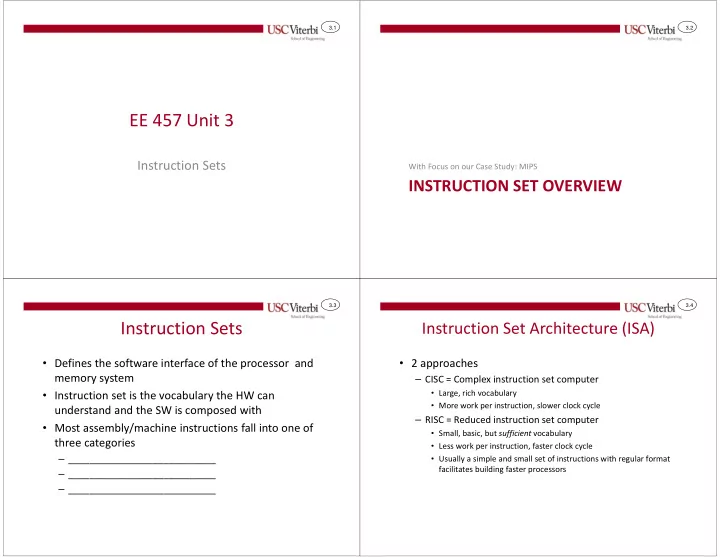
3.1 3.2 EE 457 Unit 3 Instruction Sets With Focus on our Case Study: MIPS INSTRUCTION SET OVERVIEW 3.3 3.4 Instruction Sets Instruction Set Architecture (ISA) Defines the software interface of the processor and 2 approaches memory


slide-1
SLIDE 1

3.1

EE 457 Unit 3

Instruction Sets

3.2

INSTRUCTION SET OVERVIEW

With Focus on our Case Study: MIPS

3.3

Instruction Sets

  • Defines the software interface of the processor and

memory system

  • Instruction set is the vocabulary the HW can

understand and the SW is composed with

  • Most assembly/machine instructions fall into one of

three categories

– ____________________________ – ____________________________ – ____________________________

3.4

Instruction Set Architecture (ISA)

  • 2 approaches

– CISC = Complex instruction set computer

  • Large, rich vocabulary
  • More work per instruction, slower clock cycle

– RISC = Reduced instruction set computer

  • Small, basic, but sufficient vocabulary
  • Less work per instruction, faster clock cycle
  • Usually a simple and small set of instructions with regular format

facilitates building faster processors

slide-2
SLIDE 2

3.5

MIPS ISA

  • RISC Style
  • 32-bit internal / 32-bit external data size

– Registers and ALU are 32-bits wide – Memory bus is logically 32-bits wide (though may be physically wider)

  • Registers

– 32 General Purpose Registers (GPR’s)

  • For integer and address values
  • A few are used for specific tasks/values

– 32 Floating point registers

  • Fixed size instructions

– All instructions encoded as a single 32-bit word – Three operand instruction format (dest, src1, src2) – Load/store architecture (all data operands must be in registers and thus loaded from and stored to memory explicitly)

3.6

MIPS Programmer-Visible Registers

  • General Purpose Registers (GPR’s)

– Hold data operands or addresses (pointers) to data stored in memory

  • Special Purpose Registers

– PC: ______________(32-bits)

  • Holds the _________ of the next

___________ to be fetched from memory & executed

– HI: Hi-Half Reg. (32-bits)

  • For MUL, holds 32 MSB’s of
  • result. For DIV, holds 32-bit

remainder

– LO: Lo-Half Reg. (32-bits)

  • For MUL, holds 32 LSB’s of
  • result. For DIV, holds 32-bit

quotient

MIPS Core PC: $0 - $31 32-bits GPR’s Special Purpose Registers HI: LO: add sub

0xA140

MEM

?? 3.7

MIPS Programmer-Visible Registers

  • Coprocessor 0 Registers

– Status Register

  • Holds various control bits for

processor modes, handling interrupts, etc.

– Cause Register

  • Holds information about exception

(error) conditions

  • Coprocessor 1 Registers

– Floating-point registers – Can be used for single or double-precision (i.e. at least 64-bits wides)

MIPS Core GPR’s $f0 - $f31 64 or more Coprocessor 1 – Floating-point Regs. Coprocessor 0 – Status & Control Regs Status: Cause: PC: Special Purpose Registers HI: LO: $0 - $31 32-bits

3.8

MIPS GPR’s

Assembler Name

  • Reg. Number

Description $zero $0 Constant 0 value $at $1 Assembler temporary $v0-$v1 $2-$3 Procedure return values or expression evaluation $a0-$a3 $4-$7 Arguments/parameters $t0-$t7 $8-$15 Temporaries $s0-$s7 $16-$23 Saved Temporaries $t8-$t9 $24-$25 Temporaries $k0-$k1 $26-$27 Reserved for OS kernel $gp $28 Global Pointer (Global and static variables/data) $sp $29 Stack Pointer $fp $30 Frame Pointer $ra $31 Return address for current procedure

slide-3
SLIDE 3

3.9

General Instruction Format Issues

  • Instructions must specify three things:

– _____________________________ – _____________________________ – _____________________________

  • Example: ADD $3, $1, $2 ($3 = $1 + $2)
  • Binary (machine-code) representation broken into

fields of bits for each part

000000 00000 Arith. Unused OpCode 100000 Add Function Shift Amount 00001 00010 $1 $2

  • Src. 1
  • Src. 2

Dest. 00011 $3

3.10

Historical Instruction Format Options

  • Different instruction sets specify these differently

– 3 operand instruction set (MIPS, PPC)

  • Usually all 3 operands in registers
  • Format: ADD DST, SRC1, SRC2 (DST = SRC1 + SRC2)

– 2 operand instructions (Intel / Motorola 68K)

  • Second operand doubles as source and destination
  • Format: ADD SRC1, S2/D

(S2/D = SRC1 + S2/D)

– 1 operand instructions (Low-End Embedded, Java Virtual Machine)

  • Implicit operand to every instruction usually known as the

______________________ register

  • Format: ADD SRC1

(ACC = ACC + SRC1)

– 0 operand instructions / ___________architecture

  • Push operands on a stack: PUSH X, PUSH Y
  • ALU operation: ADD (Implicitly adds top two items on stack: X + Y

& replaces them with the sum)

3.11

General Instruction Format Issues

  • Consider the pros and cons of each format when performing the set of
  • perations

– F = X + Y – Z – G = A + B

  • Simple embedded computers often use single operand format

– Smaller data size (8-bit or 16-bit machines) means limited instruc. size

  • Modern, high performance processors use 2- and 3-operand formats

Stack Arch. Single-Operand Two-Operand Three-Operand

LOAD X MOVE F,X ADD F,Y SUB F,Z MOVE G,A ADD G,B ADD F,X,Y SUB F,F,Z ADD G,A,B

(+) Smaller size to encode each instruction (+) More natural program style (+) Smaller instruction count

3.12

Addressing Modes

  • Addressing modes refers to how an instruction specifies

_______________ the operands are

– Can be in a ______________, _____________, or in the machine code

  • f the instruction (immediate value)
  • MIPS: All data operands for arithmetic instructions must be in

a register

  • But what about something like: $8 = $8 + A[i]

– Intel instructions would allow: ADD $8,A[i]

  • A[i] is in memory

– MIPS require a ________________ to read data from memory into a register

  • _________________
  • ADD $8,$8,$9
slide-4
SLIDE 4

3.13

Operand Addressing

  • Load/Store architecture

– Load operands from memory into a register – Perform operations on registers and put results back into other registers – Store results back to memory – Because ALU instructions only access registers, the CPU design can be simpler and thus faster

  • Most modern processors follow this approach
  • Older designs

– Register/Memory Architecture (Intel)

  • 1 operand of a ALU instruc. can be in a reg. or mem. but

the other must be in a register

– Memory/Memory Architecture (DEC VAX)

  • Operands of ALU instruc. can be in any combination of

memory or registers

  • ADD addrDst, addrSrc1, addrSrc2

Proc.

1.) Load operands to proc. registers

Mem. Proc.

2.) Proc. Performs operation using register values

Mem. Proc.

3.) Store results back to memory

Mem. Load/Store Architecture

3.14

Load/Store Addressing

  • When we load or store from/to memory how do we

specify the address to use? Do we need sophisticated/exotic address modes (auto-increment, base+scaled index?)

  • Option 1: Direct Addressing

– Constant address: LW $8, 0xA140 – Insufficient! – Would have to translate to:

  • LW $8, 0xA140
  • ___________________________
  • ___________________________

00 00 00 00 A[0] @ 0xA140 MEM A[1] @ 0xA144 A[2] @ 0xA148 A[3] @ 0xA14C i = 0; While(i < MAX) x = x + A[i++];

3.15

Load/Store Addressing

  • Option 2: ________________________

– Put address in a register: $9 = 0xA140 – LW uses variable address in reg.: LW $8,__________ – Increment address via normal ADD instruc. (ADD $9,$9, _____) – Sufficient!

  • Option 3: ______________________________

– Sums a constant offset with variable address in register – Put address in a register: $9 = 0xA140 – LW uses variable address in reg.: LW $8, 0 ($9) [___________] – LW uses variable address in reg.: LW $8, 4 ($9) [___________] – Sufficient!

00 00 00 00 A[0] @ 0xA140 MEM A[1] @ 0xA144 A[2] @ 0xA148 A[3] @ 0xA14C i = 0; While(i < MAX) x = x + A[i++];

3.16

Immediate Addressing

  • Suppose you want to increment a variable (register)

– $8 = $8 + 1 – Where do we get the 1 from?

  • Could have compiler/loader ______________________

__________________ and then load it from memory

  • Constant usage is very common, so instruction sets usually

support a constant to be directly placed ______ ____________________

  • Known as immediate value because it is immediately available

with the instruction machine code itself

  • Example: ADDI $8,$8,1
slide-5
SLIDE 5

3.17

MIPS Instruction Format

  • CISC and other older architectures use a variable size instruction to match

the varying operand specifications (memory addresses, etc.)

– 1 to 8 bytes

  • MIPS uses a FIXED-length instruction as do most RISC-style instruction sets

– Every instruction is 32-bits (4-bytes) – One format (field breakdown) is not possible to support all the different instructions – MIPS supports 3 instruction formats: R-Type, I-Type, J-Type

  • pcode=6

rs=5 rt=5 rd=5 shamt=5 func=6

  • pcode=6

rs=5 rt=5 immed.=16

  • pcode=6

Jump address=26 R-Type I-Type J-Type add $4,$20,$17 lw $8,4($9) addi $5,$5,137 beq $2,$3,0x1200 j 0x40a1c0

3.18

MIPS INSTRUCTIONS

ALU (R-Type) Instructions Memory Access, Branch, & Immediate (I-Type) Instructions

3.19

R-Type Instructions

  • Format

– rs, rt, rd are 5-bit fields for register numbers – shamt = shift amount and is used for shift instructions indicating # of places to shift bits – opcode and func identify actual operation

  • Example:

– ADD $5, $24, $17

  • pcode

rs (src1) 6-bits 5-bits rt (src2) 5-bits rd (dest) 5-bits shamt 5-bits function 6-bits 000000 11000

  • pcode

rs 10001 rt 00101 rd 00000 shamt 100000 func

  • Arith. Inst.

$24 $17 $5 unused ADD

3.20

R-Type Arithmetic/Logic Instructions

C operator Assembly Notes + ADD Rd, Rs, Rt

  • SUB Rd, Rs, Rt

Order: R[s] – R[t]. SUBU for unsigned * MULT Rs, Rt MULTU Rs, Rt Result in HI/LO. Use mfhi and mflo instruction to move results * MUL Rd, Rs, Rt If multiply won’t overflow 32-bit result / DIV Rs, Rt DIVU Rs, Rt R[s] / R[t]. Remainder in HI, quotient in LO & AND Rd, Rs, Rt | OR Rd, Rs, Rt ^ XOR Rd, Rs, Rt ~( | ) NOR Rd, Rs, Rt Can be used for bitwise-NOT (~) << SLL Rd, Rs, shamt SLLV Rd, Rs, Rt Shifts R[s] left by shamt (shift amount) or R[t] bits >> (signed) SRA Rd, Rs, shamt SRAV Rd, Rs, Rt Shifts R[s] right by shamt or R[t] bits replicating sign bit to maintain sign >> (unsigned) SRL Rd, Rs, shamt SRLV Rd, Rs, Rt Shifts R[s] left by shamt or R[t] bits shifting in 0’s <, >, <=, >= SLT Rd, Rs, Rt SLTU Rd, Rs, Rt IF(R[s] < R[t]) THEN R[d] = 1 ELSE R[d] = 0

slide-6
SLIDE 6

3.21

Shift Operations

  • Shifts data bits either left or right
  • Bits shifted out and dropped on one side
  • Usually (but not always) 0’s are shifted in on the other side
  • Shifting is equivalent to multiplying or dividing by powers of 2
  • 2 kinds of shifts

– Logical shifts (used for unsigned numbers) – Arithmetic shifts (used for signed numbers) 0 0 0 0 0 0 1 1 Right Shift by 2 bits:

Original Data Shifted by 2 bits

0 0 0 0 1 1 0 0 0 0 0 0 1 0 1 0 0 0 Left Shift by 2 bits:

Original Data Shifted by 2 bits

0 0 0 0 1 0 1 0 0 0

New bits shifted in… 0’s shifted in… 3.22

Logical Shift vs. Arithmetic Shift

  • Logical Shift

– Use for unsigned or non- numeric data – Will always shift in 0’s whether it be a left or right shift

  • Arithmetic Shift

– Use for signed data – Left shift will shift in 0’s – Right shift will sign extend (replicate the sign bit) rather than shift in 0’s

  • If negative number…stays

negative by shifting in 1’s

  • If positive…stays positive by

shifting in 0’s

Right shift Left shift Right shift Left shift Copies of MSB are shifted in

3.23

Logical Shift

  • 0’s shifted in
  • Only use for operations on unsigned data

– Right shift by n-bits = Dividing by 2n – Left shift by n-bits = Multiplying by 2n

0 0 ... 0 0 1 1 Logical Right Shift by 2 bits: ... 0 1 1 0 0 0 0 0 Logical Left Shift by 3 bits:

0’s shifted in… 0’s shifted in…

0 ... 0 1 1 0 0 = +12 = +3 = +96 0 x 0 0 0 0 0 0 0 C 0 x 0 0 0 0 0 0 0 3 0 x 0 0 0 0 0 0 6 0

3.24

Arithmetic Shift

  • Use for operations on signed data
  • Arithmetic Right Shift – replicate MSB

– Right shift by n-bits = Dividing by 2n

  • Arithmetic Left Shift – shifts in 0’s

– Left shift by n-bits = Multiplying by 2n

1 1 1 ... 1 1 1 Arithmetic Right Shift by 2 bits: 1 ... 1 0 0 0 0 Arithmetic Left Shift by 2 bits:

MSB replicated and shifted in… 0’s shifted in…

1 1 ... 1 1 0 0 = -4 = -1 = -16

Notice if we shifted in 0’s (like a logical right shift) our result would be a positive number and the division wouldn’t work

0 x F F F F F F F C 0 x F F F F F F F F

Notice there is no difference between an arithmetic and logical left shift. We always shift in 0’s.

0 x F F F F F F F 0

slide-7
SLIDE 7

3.25

Logical Shift Instructions

  • SRL instruction – Shift Right Logical
  • SLL instruction – Shift Left Logical
  • Format:

– SxL rd, rt, shamt – SxLV rd, rt, rs

  • Notes:

– shamt limited to a 5-bit value (0-31) – SxLV shifts data in rt by number of places specified in rs

  • Examples

– SRL $5, $12, 7 – SLLV $5, $12, $20

000000 00000

  • pcode

rs 10001 rt 00101 rd 00111 shamt 000010 func

  • Arith. Inst.

unused $12 $5 7 SRL 000000 10100 10001 00101 00000 000100

  • Arith. Inst.

$20 $12 $5 unused SLLV

3.26

Arithmetic Shift Instructions

  • SRA instruction – Shift Right Arithmetic
  • Use SLL for arithmetic left shift
  • Format:

– SRA rd, rt, shamt – SRAV rd, rt, rs

  • Notes:

– shamt limited to a 5-bit value (0-31) – SRAV shifts data in rt by number of places specified in rs

  • Examples

– SRA $5, $12, 7 – SRAV $5, $12, $20

000000 00000

  • pcode

rs 10001 rt 00101 rd 00111 shamt 000011 func

  • Arith. Inst.

unused $12 $5 7 SRA 000000 10100 10001 00101 00000 000111

  • Arith. Inst.

$20 $12 $5 unused SRAV

3.27

I-Type Instructions

  • Format

– rs, rt are 5-bit fields for register numbers – immediate is a 16-bit constant – opcode identifies actual operation

  • Example:

– ADDI $5, $24, 1 – LW $5, -8($3)

  • pcode

rs (src1) 6-bits 5-bits rt (src/dst) 5-bits immediate 16-bits 001000 11000

  • pcode

rs 00101 rt ADDI $24 $5 0000 0000 0000 0001 immediate 20 010111 00011 00101 LW $3 $5 1111 1111 1111 1000

  • 8

3.28

Immediate Operands

  • Most ALU instructions also have an immediate form to be used when one
  • perand is a constant value
  • Syntax: ADDI Rs, Rt, imm

– Because immediates are limited to 16-bits, they must be extended to a full 32- bits when used the by the processor – Arithmetic instructions always _________________ to a full 32-bits even for unsigned instructions (addiu) – Logical instructions always __________________ to a full 32-bits

  • Examples:

– ADDI $4, $5, -1 // R[4] = R[5] + ___________________ – ORI $10, $14, -4 // R[10] = R[14] | __________________

Arithmetic Logical ADDI ANDI ADDIU ORI SLTI XORI SLTIU Note: SUBI is unnecessary since we can use ADDI with a negative immediate value

slide-8
SLIDE 8

3.29

MEMORY ORGANIZATION

Bytes, Half-words, Words, Double-words, yikes!

3.30

MIPS Data Sizes

Integer

  • 3 Sizes Defined

– Byte (B)

  • 8-bits

– Halfword (H)

  • 16-bits = 2 bytes

– Word (W)

  • 32-bits = 4 bytes

Floating Point

  • 3 Sizes Defined

– Single (S)

  • 32-bits = 4 bytes

– Double (D)

  • 64-bits = 8 bytes
  • (For a 32-bit data bus, a

double would be accessed from memory in 2 reads) In MIPS, size matters to memory access instructions, but ALU instructions always perform operation on full 32-bit register values

3.31

Memory & Data Size

Byte operations only access the byte at the specified address

N N-1 N+1 N+2

(Assume start address = N)

Halfword operations access the 2-bytes starting at the specified address

N N+1 N+2 N+3

Word operations access the 4-bytes starting at the specified address

N N+1 N+2 N+3

  • Little-endian memory can be thought of as right justified
  • Always provide the ___________________ of the desired data
  • Size is explicitly defined by the instruction used
  • Memory Access Rules

– Halfword or Word access must start on an address that is a multiple of that data size (i.e. half = multiple of 2, word = multiple of 4)

Byte 31 Half 15 Word 31

LB LH LW

3.32

MIPS Memory Organization

  • In a 32-bit system, addresses are 32-bits which

means we can make 232 = 4 Giga (~billion) addresses

– Recall: 210 = 1K (~103), 220 = 1M (~106), 230 = 1G (~109)

  • If the current instruction is at address

0x0000A140, what address does the next instruction occupy (Recall instructions = 32-bits)

  • But how much data does each address

correspond to…

– A byte (8-bits), a half-word (16-bits), or a word (32-bits)

  • Most systems are byte-addressable meaning

each byte receives a unique address

– ASCII characters = 1-byte – Pixels in an image = 1-byte

Proc.

32 32 A D add sub

0xA140

MEM

??

slide-9
SLIDE 9

3.33

Memory & Word Size

  • If each byte has its own address,

which address should we use for half- words (2-byte chunks) or words (4- byte chunks)?

– Start address = Smallest byte address within the larger chunk

  • If we provide the start address (say

0x4000) to memory, how does it know whether we want the byte, halfword, or word at address 0x4000

– Other control signals indicate how many bytes to access (1=byte, 2=half, or 4=word)

Byte 1 Byte 2 Byte 3 Byte 0

Halfword 0 Halfword 2 Word 0

… … 0x4000 0x4001 0x4002 0x4003 0x4004 0x4005 0x4006 0x4007

Word 0x4000 Word 0x4004

Byte Address

3.34

LOAD/STORE INSTRUCTIONS

Getting data in and out of the processor

3.35

Memory & Data Size

Byte operations only access the byte at the specified address

N N-1 N+1 N+2

(Assume start address = N)

Halfword operations access the 2-bytes starting at the specified address

N N+1 N+2 N+3

Word operations access the 4-bytes starting at the specified address

N N+1 N+2 N+3

  • Little-endian memory can be thought of as right justified
  • Always provide the ___________________ of the desired data
  • Size is explicitly defined by the instruction used
  • Memory Access Rules

– Halfword or Word access must start on an address that is a multiple of that data size (i.e. half = multiple of 2, word = multiple of 4)

Byte 31 Half 15 Word 31

LB LH LW

3.36

Memory Read Instructions (Signed)

LB (Load Byte) Provide address of desired byte LH (Load Half) Provide address of starting byte LW (Load Word) Provide address of starting byte

Sign Extend 31 Byte 7

GPR

Sign Extend 31 Half 15 Word 31

If address = 0x02

  • Reg. = ______________

If address = 0x00

  • Reg. = _____________

If address = 0x00

  • Reg. = _____________

5A 13 7C … 000004 000000 F8 5A 13 7C … 000004 000000 F8 5A 13 7C … 000004 000000 F8

Memory

slide-10
SLIDE 10

3.37

Memory Read Instructions (Unsigned)

LBU (Load Byte) Provide address of desired byte LHU (Load Half) Provide address of starting byte LW (Load Word) Provide address of starting byte

Zero Extend 31 Byte 7

GPR

Zero Extend 31 Half 15 Word 31

If address = 0x01

  • Reg. = ______________

If address = 0x00

  • Reg. _______________

If address = 0x00

  • Reg. = _______________

Memory

5A 13 7C … 000004 000000 F8 5A 13 7C … 000004 000000 F8 5A 13 7C … 000004 000000 F8

3.38

Memory Write Instructions

SB (Store Byte) Provide address of desired byte SH (Store Half) Provide address of starting byte SW (Store Word) Provide address of starting byte if address = 0x02 if address = 0x02 if address = 0x00 Memory

31 Byte 7

GPR

31 Half 15 Word 31

  • Reg. = 0x12345678
  • Reg. = 0x12345678
  • Reg. = 0x12345678

5A 78 7C … 000004 000000 F8 56 78 7C … 000004 000000 F8 12 34 78 … 000004 000000 56

3.39

MIPS Memory Alignment Limitations

  • Bytes can start at any address
  • Halfwords must start on an

__________ address

  • Words must start on an address

that is a ___________

  • Examples:

– Word @ A18C – – Halfword @ FFE6 – – Word @ A18E – – Halfword @ FFE5 –

5A 13 F8 7C … 00A18C Addr Data Control 00FFE4 Valid Accesses Invalid Accesses C1 EA 4B 29 F8 7C … 00A18C Addr Data Control 00FFE4 C1 4B 29 EA 49 CF 5A 13 BD 52

3.40

Load Format (LW,LH,LB)

  • LW Rt, offset(Rs)

– Rt = Destination register – offset(Rs) = Address of desired data – RTL: R[t] = M[ offset + R[s] ] – offset limited to 16-bit signed number

  • Examples

– LW $2, 0x40($3) // R[2] = _______________ – LBU $2, -1($4) // R[2] = _______________ – LH $2, 0xFFFC($4) // R[2] = _______________

5A12C5B7 0x002048 134982FE F8BE97CD 0x002044 0x002040 00002000 R[3] 0000204C R[4]

  • ld val.

R[2]

slide-11
SLIDE 11

3.41

More LOAD Examples

  • Examples

– LB $2,0x45($3) // R[2] = _______________ – LH $2,-6($4) // R[2] = _______________ – LHU $2, -2($4) // R[2] = _______________

5A12C5B7 0x002048 134982FE F8BE97CD 0x002044 0x002040 00002000 R[3] 0000204C R[4]

  • ld val.

R[2]

3.42

Store Format (SW,SH,SB)

  • SW Rt, offset(Rs)

– Rt = Source register – offset(Rs) = Address to store data – RTL: M[ offset + R[s] ] = R[t] – offset limited to 16-bit signed number

  • Examples

– SW $2, 0x40($3) – SB $2, -5($4) – SH $2, 0xFFFE($4)

00002000 R[3] 0000204C R[4] 123489AB R[2] 123489AB 0x002048 AB4982FE 89AB97CD 0x002044 0x002040

3.43

Loading an Immediate

  • If immediate (constant) 16-bits or less

– Use ORI or ADDI instruction with $0 register – Examples

  • ADDI $2, $0, -1

// R[2] = 0 - 1 = -1

  • ORI

$2, $0, 0xF110 // R[2] = 0 | 0xF110 = 0xF110

  • If immediate more than 16-bits

– Immediates limited to 16-bits so we must load constant with a 2 instruction sequence using the special LUI (Load Upper Immediate) instruction – To load $2 with 0x12345678

  • __________________
  • __________________

R[2] 12345678 R[2]

3.44

PROC/MEM PHYSICAL INTERFACE

slide-12
SLIDE 12

3.45

Memory & Word Size

  • What are the control signals that

indicate access size?

  • Though we may have a 32-bit address

bus A[31:0], physically the processor will convert the lower 2 address bits A[1:0] and the size information into 4 separate __________________ [/BE3../BE0]

Halfword @ 4000000 Halfword @ 40000002

Word @ 40000000

Lane 3 /BE3 Lane 2 /BE2 Lane 1 /BE1 Lane 0 /BE0

Desired Memory Internal A[31:0] Physical Addr. Bus A[31:2] /BE3 /BE2 /BE1 /BE0 Word @ 0x4000000 0100…00___ 0100…00 Half @ 0x40000002 0100…00___ 0100...00 Byte @ 0x40000002 0100…00___ 0100...00 Byte @ 0x40000001 0100…00___ 0100...00 Half @ 0x40000004 0100…01___ 0100…01

Byte @ 40000001 Byte @ 40000002 Byte @ 40000003 Byte @ 40000000 3.46

Address & Data Bus Connections

  • Organize memory into

several byte-size memories running in parallel (sometimes known as “banks”)

  • Convert lower address

bits into bank enables to selectively enable each bank

  • A[31:2] is provided to

all memory banks specifying the same internal location

A4 ... 50 0x1 0x0 F8 C0 ... 61 0x1 0x0 53 22 ... 8A 0x1 0x0 2C 6D ... 57 0x1 0x0 E4

A[31:2] /BE3 /BE2 /BE1 /BE0 HalfWord at address 0x04: A[31:0] = 0000…0100 0000..01 1 1

32-bit Processor

3.47

Byte Addressable Processors

Proc. External Data Bus Address Pin- Out

  • Min. # of

Banks Shift in Address 8088 (8-bit proc.) D[7:0] A[19:__] 8086 (16-bit proc.) D[15:0] A[19:__] 80386 (32-bit proc.) D[31:0] A[23:__] Core Series (64-bit proc.) D[63:0] A[35:__]

3.48

MIPS Memory Organization

  • We can logically picture memory in

the units (sizes) that we actually access them

  • Most processors are byte-

addressable

– Every byte (8-bits) has a unique address – 32-bit address bus => 4 GB address space

  • Logical view of memory arranged in

rows of largest access size (word)

– Still with separate addresses for each byte – Can get halfword or bytes

5A 0x000000 13 F8 … 0x000001 0x000002 Logical Byte-Oriented View of Mem.

Proc. Mem.

32 32 A D 5A 13 7C 29 33 … 0x000008 0x000004 0x000000 Logical Word-Oriented View F8 AD 8E

slide-13
SLIDE 13

3.49

Little- vs. Big-Endian Organization

  • Refers to ordering of bytes w/in a larger

chunk

  • Big-Endian

– Byte ‘0’ is at the ______________ of a word – PPC, Sparc

  • Little-Endian

– Byte ‘0’ is at the ______________ of a word – Intel, ___________

  • MIPS can be configured either way
  • Issues arise when moving smaller pieces

within a large chunk across different endian-systems (e.g. TCP/IP transfer from little-endian machine to big-endian machine)

31 24 23 16 15 8 7 0

Word Address 8 4

31 24 23 16 15 8 7 0

Word Address 8 4 Little-Endian Big-Endian 78 56 34 12 Little- Endian Big-Endian

3 2 1 1 2 3

Network Transfer (copy 0=>0, 1=>1, etc.)

3.50

BRANCH INSTRUCTIONS

Program Flow Control

3.51

Instruction Boundaries

  • If the current instruction is at address 0xA140, what

address does the next instruction occupy?

– Each instruction is 32-bits = 4-bytes – The next instruction is located @ 0xA144

  • We see then that instructions always lie on an addresses

that are multiples of 4

  • Fact 1: The PC register in the processor stores the

address of the next instruction to be fetched

  • Fact 2: Registers are needed when we want to store

variable bits

  • Fact 3: Addresses are 32-bits in MIPS
  • Do we need a 32-bit register for the PC?

add sub 0xA140 MEM 0xA144 XX00 = 00000 XX04 = ______ XX08 = ______ XX0c = ______ XX10 = ______ Multiples

  • f 4 in hex

and binary bne 0xA148

3.52

Branch Instructions

  • Conditional Branches

– Branches only if a particular condition is true – Fundamental Instrucs.: BEQ (if equal), BNE (not equal) – Syntax: BNE/BEQ Rs, Rt, label

  • Compares Rs, Rt and if EQ/NE, branch to label, else continue
  • Unconditional Branches

– Always branches to a new location in the code – Instruction: __________________________ – Pseudo-instruction: B label

label: ----

  • b label
  • beq $2,$3,label
  • label: ----

!= =

slide-14
SLIDE 14

3.53

Two-Operand Compare & Branches

  • Two-operand comparison is accomplished

using the SLT/SLTI/SLTU (Set If Less-than) instruction

– Syntax: SLT Rd,Rs,Rt or SLT Rd,Rs,imm

  • If Rs < Rt then Rd = 1, else Rd = 0

– Use appropriate BNE/BEQ instruction to infer relationship

Branch if… SLT BNE/BEQ $2 < $3 SLT $1,$2,$3 ____ $1,$0,label $2 ≤ $3 SLT $1,$3,$2 ____ $1,$0,label $2 > $3 SLT $1,$3,$2 ____ $1,$0,label $2 ≥ $3 SLT $1,$2,$3 ____ $1,$0,label

3.54

Branch Machine Code Format

  • Branch instructions use the I-Type Format
  • Operation: PC = PC + {disp., 2'b00}
  • Displacement notes

– Displacement is the value that should be added to the PC so that it now points to the desired branch location – Processor appends two 0’s to end of disp. since all instructions are 4-byte words

  • Essentially, displacement is in units of words
  • pcode

rs (src1) 6-bits 5-bits rt (src2) 5-bits Signed displacement 16-bits

3.55

Range of Branching

  • Suppose a branch instruction is located at

0x80000000, how far away can you branch?

– Displacement is 16-bits concatenated with two 0's – Largest positive 16-bit number: ____________ – Largest negative 16-bit number: ____________

Forward Backward

Largest Positive Displacement Largest Negative Displacement

0x 0x + 0x + 0x

Incremented PC Incremented PC

3.56

Jump Instructions

  • Instruction format: J-Type
  • Jumps provide method of

branching beyond range of 16-bit displacement

  • Syntax: J label/address

– Operation: PC = address – Address is appended with two 0’s just like branch displacement yielding a 28- bit address with upper 4-bits

  • f PC unaffected
  • pcode

6-bits Jump address 26-bits Old PC 00 Jump address

Old PC [31:28]

PC before execution of Jump New PC after execution of Jump Sample Jump instruction 4-bits 26-bits 2-bits

slide-15
SLIDE 15

3.57

Jump Register

  • ‘jr’ instruction can be used if a full 32-bit jump

is needed or variable jump address is needed

  • Syntax: JR rs

– Operation: ______ = R[s] – R-Type machine code format

  • Usage:

– Can load rs with an immediate address – Can calculate rs for a variable jump (class member functions, switch statements, etc.)

3.58

SUPPORT FOR SUBROUTINES

3.59

Implementing Subroutines

  • To implement subroutines in assembly we

need to be able to:

– Branch to the subroutine code (JAL / JALR) – Know where to return to when we finish the subroutine (JR $ra)

... res = avg(x,4); ... int avg(int a, int b) { ... } C code: Assembly: .text ... jal AVG ... AVG: ... jr $ra

3.60

Jumping to a Subroutine

  • JAL instruction (Jump And Link)

– Format: jal Address/Label – Similar to jump where we load an address into the PC [e.g. PC = addr]

  • Same limitations (26-bit address) as jump instruction
  • Addr is usually specified by a label
  • JALR instruction (Jump And Link Register)

– Format: jalr $rs – Jumps to address specified by $rs

  • In addition to jumping, JAL/JALR stores the

_________ into R[31]=$ra (= return address) to be used as a link to return to after the subroutine completes

slide-16
SLIDE 16

3.61

Jumping to a Subroutine

Assembly: 0x400000 jal AVG 0x400004 add ... AVG: = 0x400810 add ... jr $ra

1

jal will cause the program to jump to the label AVG and store the return address in $ra/$31.

  • Use the JAL instruction to jump execution to

the subroutine and leave a link to the following instruction

0040 0000 PC before exec. of jal: 0000 0000 $ra before exec. of jal: PC after exec. of jal: $ra after exec. of jal:

3.62

0x400000 jal AVG 0x400004 add ... AVG: = 0x400810 add ... 0x4008ec jr $ra

Returning from a Subroutine

  • Use a JR with the $ra register to return to the

instruction after the JAL that called this subroutine

Go back to where we left

  • ff using the return

address stored by JAL

2 1

jal will cause the program to jump to the label AVG and store the return address in $ra/$31.

0040 08ec PC before exec. of jr: 0040 0004 $ra before exec. of jr: PC after exec. of jr:

3.63

Dealing with Return Addresses

  • Multiple return addresses

can be spilled to memory

– “Always” have enough memory

  • Note: Return addresses

will be accessed in reverse

  • rder as they are stored

– 0x400208 is the second RA to be stored but should be the first one used to return – A stack/LIFO is appropriate!

Assembly: ... jal SUB1 0x40001A ... SUB1 jal SUB2 0x400208 jr $ra SUB2 ... jr $ra

1 2 3 4

3.64

CPU

Subroutines & Stacks

  • Stack is a reserved area in memory
  • Subroutines require a link (________

address) to be saved on the stack

  • Processors usually dedicate a register to

point to the top of the stack ($sp=R[29] = stack pointer)

0000 0000 0000 0000 0000 0000 0000 0000 7fffeff8 $sp 0040 0208 0000 0000 7fffeffc 7fffeff8 7fffeff4 7fffeff0 7fffefec 7fffefe8

Stack grows towards lower addresses

Memory (RAM)

System / Kernel Memory I/O … Code Globals … Heap fffffffc Address … Stack 80000000

Stack grows towards lower addresses

slide-17
SLIDE 17

3.65

Stack Facts

  • Stack grows in the

direction of:

– Decreasing Addresses – Increasing address

  • Stack is a (LIFO / FIFO)

data structure.

  • Stack Pointer points to

the (top/bottom) of the stack

  • Stack Pointer Register

points to the

– Top-most FILLED location – Next FREE location above the top-most filled location

3.66

Stack Facts

  • When you push do

you…

– Increment the SP – Decrement the SP

  • When you push do you

– First update the SP and then place data – Place data then update SP

  • When you pop, first you

__________ then you __________

3.67

Stack Balancing

  • Stack shall be balanced:

– _________ number of push and pops – Pops shall be performed in ____________ order as corresponding pushes

3.68

Subroutines Calling Subroutines

  • Nested subroutines make the stack

(grow / shrink) because more (stack pointer values / return addresses) are stored on the stack

  • Recursive subroutines make the stack

(grow / shrink)

slide-18
SLIDE 18

3.69

Subroutines and the Stack

  • When writing native assembly, programmer must add code to

manage return addresses and the stack

  • At the beginning of a routine (PREAMBLE)

– Push $ra (produced by ‘jal’) onto the stack

  • Execute subroutine which can now freely call other routines
  • At the end of a routine (POSTAMBLE)

– Pop/restore $ra from the stack

3.70

Subroutines and the Stack

... jal SUB1 0x40001A ... SUB1 addi $sp,$sp,-4 sw $ra,0($sp) jal SUB2 0x400208 lw $ra,0($sp) addi $sp,$sp,4 jr $ra SUB2 addi $sp,$sp,-4 sw $ra,0($sp) ... lw $ra,0($sp) addi $sp,$sp,4 jr $ra

$sp = 0000 0000 7fffeffc 7fffeff8 7fffeff4 $sp = 0000 0000 7fffeffc 7fffeff8 7fffeff4 $sp = 0000 0000 7fffeffc 7fffeff8 7fffeff4

1 1 2 3 2 3

$ra = $ra = $ra = $sp = 0000 0000 7fffeffc 7fffeff8 7fffeff4 $ra =

3.71

Translating HLL to Assembly

  • HLL variables are simply locations in memory

– A variable name really translates to an address in assembly

C operator Assembly Notes int x,y,z; … x = y + z; LUI $8, 0x1000 ORI $8, $8, 0x0004 LW $9, 4($8) LW $10, 8($8) ADD $9,$9,$10 SW $9, 0($8) Assume x @ 0x10000004 & y @ 0x10000008 & z @ 0x1000000C char a[100]; … a[1]--; LUI $8, 0x1000 ORI $8, $8, 0x000C LB $9, 1($8) ADDI $9,$9,-1 SB $9,1($8) Assume array ‘a’ starts @ 0x1000000C

3.72

Translating HLL to Assembly

C operator Assembly Notes int dat[4],x; … x = dat[0]; x += dat[1]; LUI $8, 0x1000 ORI $8, $8, 0x0010 LW $9, 0($8) LW $10, 4($8) ADD $9,$9,$10 SW $9, 16($8) Assume dat @ 0x10000010 & x @ 0x10000020 unsigned int y; short z; y = y / 4; z = z << 3; LUI $8, 0x1000 ORI $8, $8, 0x0010 LW $9, 0($8) SRL $9, $9, 2 SW $9, 0($8) LH $9, 4($8) SLA $9, $9, 3 SH $9, 4($8) Assume y @ 0x10000010 & z @ 0x10000014

slide-19
SLIDE 19

3.73

Translating HLL to Assembly

C operator Assembly int dat[4],x=0; for(i=0;i<4;i++) x += dat[i]; DAT: .space 16 X: .long 0 LA $8, DAT ADDI $9,$0,4 ADD $10,$0,$0 LP: LW $11,0($8) ADD $10,$10,$11 ADDI $8,$8,4 ADDI $9,$9,-1 BNE $9,$0,LP LA $8,X SW $10,0($8)

3.74

Branch Example 1

if A > B (&A in $t0) A = A + B (&B in $t1) else A = 1 .text LW $t2,0($t0) LW $t3,0($t1) SLT $1,$t3,$t2 BEQ $1,$0,ELSE ADD $t2,$t2,$t3 B NEXT ELSE: ADDI $t2,$0,1 NEXT: SW $t2,0($t0)

  • C Code

MIPS Assembly Could use pseudo-inst. “BLE $4,$5,ELSE” This branch skips over the “else” portion. This is a pseudo-instruction and is translated to BEQ $0,$0,next

3.75

Branch Example 2

for(i=0;i < 10;i++) ($t0=i) j = j + i; ($t1=j) .text ADDI $t0,$0,$0 LOOP: SLTI $1,$t0,10 BEQ $1,$0,NEXT ADD $t1,$t1,$t0 ADD $t0,$t0,1 B LOOP NEXT: ---- C Code MIPS Assembly Branches if i is not less than 10 Loops back to the comparison check

3.76

Another Branch Example

int dat[10]; for(i=0;i < 10;i++) ($t1=i) data[i] = 5; .data dat: .space 40 .text la $t0,dat addi $t1,$zero,10 addi $t2,$zero,5 LOOP: sw $t2,0($t0) addi $t0,$t0,4 addi $t1,$t1,-1 bnez $t1,$zero,LOOP NEXT: ----

C Code MIPS Assembly

slide-20
SLIDE 20

3.77

A Final Example

char A[] = “hello world”; char B[50]; // strcpy(B,A); i=0; while(A[i] != 0){ B[i] = A[i]; i++; } B[i] = 0;

.data A: .asciiz “hello world” B: .space 50 .text la $t0,A la $t1,B LOOP: lb $t2,0($t0) beq $t2,$zero,NEXT sb $t2,0($t1) addi $t0,$t0,1 addi $t1,$t1,1 b LOOP NEXT: sb $t2,0($t1)

C Code MIPS Assembly

3.78

REFERENCE

3.79

R-Type Instructions

  • Format

– rs, rt, rd are 5-bit fields for register numbers – shamt = shift amount and is used for shift instructions indicating # of places to shift bits – opcode and func identify actual operation

  • Example:

– ADD $5, $24, $17

  • pcode

rs (src1) 6-bits 5-bits rt (src2) 5-bits rd (dest) 5-bits shamt 5-bits function 6-bits 000000 11000

  • pcode

rs 10001 rt 00101 rd 00000 shamt 100000 func

  • Arith. Inst.

$24 $17 $5 unused ADD

3.80

Logical Operations

  • Logic operations on numbers means performing the
  • peration on each pair of bits

Initial Conditions: R[1]= 0xF0, R[2] = 0x3C AND $2,$1,$2 R[2] = 0x30 0xF0 AND 0x3C 0x30 1111 0000 AND 0011 1100 0011 0000 OR $2,$1,$2 R[2] = 0xFC $F0 OR $3C $FC 1111 0000 OR 0011 1100 1111 1100 XOR $2,$1,$2 R[2] = 0xCC 0xF0 XOR 0x3C 0xCC 1111 0000 XOR 0011 1100 1100 1100 1 2 3

slide-21
SLIDE 21

3.81

Logical Operations

  • Logic operations on numbers means performing the
  • peration on each pair of bits

Initial Conditions: R[1]= 0xF0, R[2] = 0x3C NOR $2,$1,$2 R[2] = 0x03 0xF0 NOR 0x3C 0x03 1111 0000 NOR 0011 1100 0000 0011 4 NOR $2,$1,$1 R[2] = 0x0F 0xF0 NOR 0xF0 0x0F 1111 0000 NOR 1111 0000 0000 1111 Bitwise NOT operation can be performed by NOR’ing register with itself

3.82

Logical Operations

  • Logic operations are often used for “bit” fiddling

– Change the value of 1-bit in a number w/o affecting other bits – C operators: & = AND, | = OR, ^ = XOR, ~ = NOT

  • Examples (Assume an 8-bit variable, v)

– Set the LSB to ‘0’ w/o affecting other bits

  • v = v & 0xfe;

– Check if the MSB = ‘1’ regardless of other bit values

  • if( v & 0x80) { code }

– Set the MSB to ‘1’ w/o affecting other bits

  • v = v | 0x80;

– Flip the LS 4-bits w/o affecting other bits

  • v = v ^ 0x0f;

3.83

Calculating Branch Displacements

  • To calculate displacement you must know where

instructions are stored in memory (relative to each

  • ther)

– Don’t worry, assembler finds displacement for you…you just use the label

MIPS Assembly

SLTI ADDI ADDI ADD BEQ ADD BEQ

  • A

1 word for each instruction

.text ADDI $8,$0,$0 ADDI $7,$0,10 LOOP: SLTI $1,$8,10 BEQ $1,$0,NEXT ADD $9,$9,$8 ADD $8,$8,1 BEQ $0,$0,LOOP NEXT: ----

A + 0x4 A + 0x8 A + 0xC A + 0x10 A + 0x14 A + 0x18 A + 0x1C

3.84

Calculating Displacements

  • Disp. = [(Addr. of Target) – (Addr. of Branch + 4)] / 4

– Constant 4 is due to the fact that by the time the branch executes the PC will be pointing at the instruction after it (i.e. plus 4 bytes)

  • Following slides will show displacement calculation for BEQ

$1,$0,NEXT

MIPS Assembly

SLTI ADDI ADDI ADD BEQ ADD BEQ

  • A

1 word for each instruction

.text ADDI $8,$0,$0 ADDI $7,$0,10 LOOP: SLTI $1,$8,10 BEQ $1,$0,NEXT ADD $9,$9,$8 ADD $8,$8,1 BEQ $0,$0,LOOP NEXT: ----

A + 0x4 A + 0x8 A + 0xC A + 0x10 A + 0x14 A + 0x18 A + 0x1C

slide-22
SLIDE 22

3.85

Calculating Displacements

  • Disp. = [(Addr. of Target) – (Addr. of Branch + 4)] / 4
  • Disp. = (A+0x1C) – (A+0x0C+ 4) = 0x1C – 0x10 = 0x0C / 4

= 0x03

MIPS Assembly

SLTI ADDI ADDI ADD BEQ ADD BEQ

  • A

1 word for each instruction

.text ADDI $8,$0,$0 ADDI $7,$0,10 LOOP: SLTI $1,$8,10 BEQ $1,$0,NEXT ADD $9,$9,$8 ADD $8,$8,1 BEQ $0,$0,LOOP NEXT: ----

A + 0x4 A + 0x8 A + 0xC A + 0x10 A + 0x14 A + 0x18 A + 0x1C

3.86

Calculating Displacements

  • If the BEQ does in fact branch, it will add the displacement

({0x03, 00} = 0x000C) to the PC (A+0x10) and thus point to the MOVE instruction (A+0x1C)

A + 0x10 + 000C A + 0x1C PC PC (after fetching BEQ) (after adding displacement)

MIPS Assembly .text ADDI $8,$0,$0 ADDI $7,$0,10 LOOP: SLTI $1,$8,10 BEQ $1,$0,NEXT ADD $9,$9,$8 ADD $8,$8,1 BEQ $0,$0,LOOP NEXT: ----

SLTI ADDI ADDI ADD BEQ ADD BEQ

  • A

A + 0x4 A + 0x8 A + 0xC A + 0x10 A + 0x14 A + 0x18 A + 0x1C 000100 00001

  • pcode

rs 00000 rt 0000 0000 0000 0011 immediate

BEQ $1,$0,0x03

3.87

Another Example

  • Disp. = [(Addr. of Label) – (Addr. of Branch + 4)] / 4
  • Disp. = (A+0x04) – (A+0x14 + 4) = 0x04 – 0x18

= 0xFFEC / 4 = 0xFFFB

.text ADDI $8,$0,$0 LOOP: SLTI $1,$8,10 BEQ $1,$0,NEXT ADD $9,$9,$8 ADD $8,$8,1 BEQ $0,$0,LOOP NEXT: ----

SLTI ADDI ADD BEQ ADD BEQ

  • A

A + 0x4 A + 0x8 A + 0xC A + 0x10 A + 0x14 A + 0x18 000100 00000

  • pcode

rs 00000 rt 1111 1111 1111 1011 immediate

BEQ $0,$0,0xFFFB

3.88

Immediate Operands

  • Most ALU instructions also have an immediate form to be used when one
  • perand is a constant value
  • Syntax: ADDI Rs, Rt, imm

– Because immediates are limited to 16-bits, they must be extended to a full 32- bits when used the by the processor – Arithmetic instructions always sign-extend to a full 32-bits even for unsigned instructions (addiu) – Logical instructions always zero-extend to a full 32-bits

  • Examples:

– ADDI $4, $5, -1 // R[4] = R[5] + 0xFFFFFFFF – ORI $10, $14, -4 // R[10] = R[14] | 0x0000FFFC

Arithmetic Logical ADDI ANDI ADDIU ORI SLTI XORI SLTIU Note: SUBI is unnecessary since we can use ADDI with a negative immediate value

slide-23
SLIDE 23

3.89

Loading an Immediate

  • If immediate (constant) 16-bits or less

– Use ORI or ADDI instruction with $0 register – Examples

  • ADDI $2, $0, 1

// R[2] = 0 + 1 = 1

  • ORI

$2, $0, 0xF110 // R[2] = 0 | 0xF110 = 0xF110

  • If immediate more than 16-bits

– Immediates limited to 16-bits so we must load constant with a 2 instruction sequence using the special LUI (Load Upper Immediate) instruction – To load $2 with 0x12345678

  • LUI

$2,0x1234

  • ORI

$2,$2,0x5678

12340000 R[2] 12345678 R[2] OR 00005678 LUI ORI

3.90

Return Addresses

  • No single return address for a subroutine since AVG may be

called many times from many places in the code

  • JAL always stores the address of the instruction after it

(i.e. PC of ‘jal’ + 4)

Assembly: 0x400000 jal AVG 0x400004 add ... 0x400024 jal AVG 0x400028 sub ... 0x400810 AVG ... jr $ra 0x400004 is the return address for this JAL 0x400028 is the return address for this JAL

0040 0000 PC 0040 0024 PC

3.91

Return Addresses

  • A further complication

is nested subroutines (a subroutine calling another subroutine)

  • Main routine calls SUB1

which calls SUB2

  • Must store both return

addresses but only one $ra register

Assembly: ... jal SUB1 0x40001A ... SUB1 jal SUB2 0x400208 jr $ra SUB2 ... jr $ra

1 2 3 4

3.92

Dealing with Return Addresses

  • Multiple return addresses

can be spilled to memory

– “Always” have enough memory

  • Note: Return addresses

will be accessed in reverse

  • rder as they are stored

– 0x400208 is the second RA to be stored but should be the first one used to return – A stack is appropriate!

Assembly: ... jal SUB1 0x40001A ... SUB1 jal SUB2 0x400208 jr $ra SUB2 ... jr $ra

1 2 3 4

slide-24
SLIDE 24

3.93

Stacks

  • Stack is a data structure where data is

accessed in reverse order as it is stored

  • Use a stack to store the return

addresses and other data

  • System stack defined as growing

towards smaller addresses

– MARS starts stack at 0x7fffeffc – Normal MIPS starts stack at 0x80000000

  • Top of stack is accessed and maintained

using $sp=R[29] (stack pointer)

– $sp points at top occupied location of the stack

0000 0000 0000 0000 0000 0000 0000 0000 7fffeffc $sp = 0040 0208 0000 0000

Stack Pointer Always points to top occupied element of the stack

0x7fffeffc is the base of the system stack for the MARS simulator 7fffeffc 7fffeff8 7fffeff4 7fffeff0 7fffefec 7fffefe8

Stack grows towards lower addresses

3.94

Stacks

  • 2 Operations on stack

– Push: Put new data on top of stack

  • Decrement $sp
  • Write value to where $sp points

– Pop: Retrieves and “removes” data from top of stack

  • Read value from where $sp

points

  • Increment $sp to effectively

“delete” top value

Push will add a value to the top of the stack Pop will remove the top value from the stack Empty stack Push 0000 0000 7fffeffc $sp = 0000 0000 0000 0000 7fffeffc 7fffeff8 7fffeff4 0000 0000 7fffeff8 $sp = 0040 0208 0000 0000 7fffeffc 7fffeff8 7fffeff4 Pop 0000 0000 7fffeffc $sp = 0040 0208 7fffeffc 7fffeff8 7fffeff4 0000 0000

3.95

Push Operation

  • Push: Put new data on

top of stack

– Decrement SP

  • addi $sp,$sp,-4
  • Always decrement by 4

since addresses are always stored as words (32-bits)

– Write return address ($ra) to where SP points

  • sw $ra, 0($sp)

Push return address (e.g. 0x00400208)

Decrement SP by 4 (since pushing a word), then write value to where $sp is now pointing 0000 0000 7fffeffc $sp = 0040 0208 0000 0000 7fffeffc 7fffeff8 7fffeff4 7fffeff8

3.96

Pop Operation

Pop return address

0000 0000 7fffeff8 $sp = 0040 0208 0000 0000 7fffeffc 7fffeff8 7fffeff4 7fffeffc

  • Pop: Retrieves and

“removes” data from top

  • f stack

– Read value from where SP points

  • lw $ra, 0($sp)

– Increment SP to effectively “delete” top value

  • addi $sp,$sp,4
  • Always increment by 4 when

popping addresses

Read value that SP points at then increment SP (this effectively deletes the value because the next push will overwrite it) Warning: Because the stack grows towards lower addresses, when you push something

  • n the stack you subtract 4 from the SP and

when you pop, you add 4 to the SP.

slide-25
SLIDE 25

3.97

Pseudo-instructions

  • “Macros” translated by the assembler to

instructions actually supported by the HW

  • Simplifies writing code in assembly
  • Example – LI (Load-immediate) pseudo-

instruction translated by assembler to 2 instruction sequence (LUI & ORI)

... lui $2, 0x1234

  • ri $2, $2, 0x5678

... ... li $2, 0x12345678 ...

With pseudo-instruction After assembler… 3.98

Pseudo-instructions

Pseudo-instruction Actual Assembly NOT Rd,Rs NOR Rd,Rs,$0 NEG Rd,Rs SUB Rd,$0,Rs LI Rt, immed. # Load Immediate LUI Rt, {immediate[31:16], 16’b0} ORI Rt, {16’b0, immediate[15:0]} LA Rt, label # Load Address LUI Rt, {immediate[31:16], 16’b0} ORI Rt, {16’b0, immediate[15:0]} BLT Rs,Rt,Label SLT $1,Rs,Rt BNE $1,$0,Label

Note: Pseudoinstructions are assembler-dependent. See MARS Help for more details. 3.99

Credits

  • These slides were derived from Gandhi

Puvvada’s EE 457 Class Notes