VHDL VHDL - Flaxer Eli Ch 8 - 1 VHDL - Flaxer Eli Ch 8 - 2 - - PDF document

vhdl
SMART_READER_LITE
LIVE PREVIEW

VHDL VHDL - Flaxer Eli Ch 8 - 1 VHDL - Flaxer Eli Ch 8 - 2 - - PDF document

Chapter 8 Outline Structural Modeling Basic Example Component Declaration Component Instantiation Resolving Signal Value Generate Statement VHDL VHDL - Flaxer Eli Ch 8 - 1 VHDL - Flaxer Eli Ch 8 - 2 Structural Modeling


slide-1
SLIDE 1

VHDL - Flaxer Eli Ch 8 - 1

Structural Modeling

Chapter 8 Structural Modeling

VHDL

VHDL - Flaxer Eli Ch 8 - 2

Structural Modeling

Outline

Basic Example Component Declaration Component Instantiation Resolving Signal Value Generate Statement

VHDL - Flaxer Eli Ch 8 - 3

Structural Modeling

Structural Modeling

This chapter describes the structural style of modeling. An entity is

modeled as a set of components connected by signals, that is, as a netlist.

The behavior of the entity is not explicitly apparent from its model. The

component instantiation statement is the primary mechanism used for describing such a model of an entity.

COMPONENT & PORT MAP statements are used to implement

structural modeling.

The component instantiation statements are concurrent statements, and

their order of appearance in the architecture body is therefore not important.

A component can, in general, be instantiated any number of times. Each instantiation must have a unique component label.

VHDL - Flaxer Eli Ch 8 - 4

Structural Modeling

Basic Example

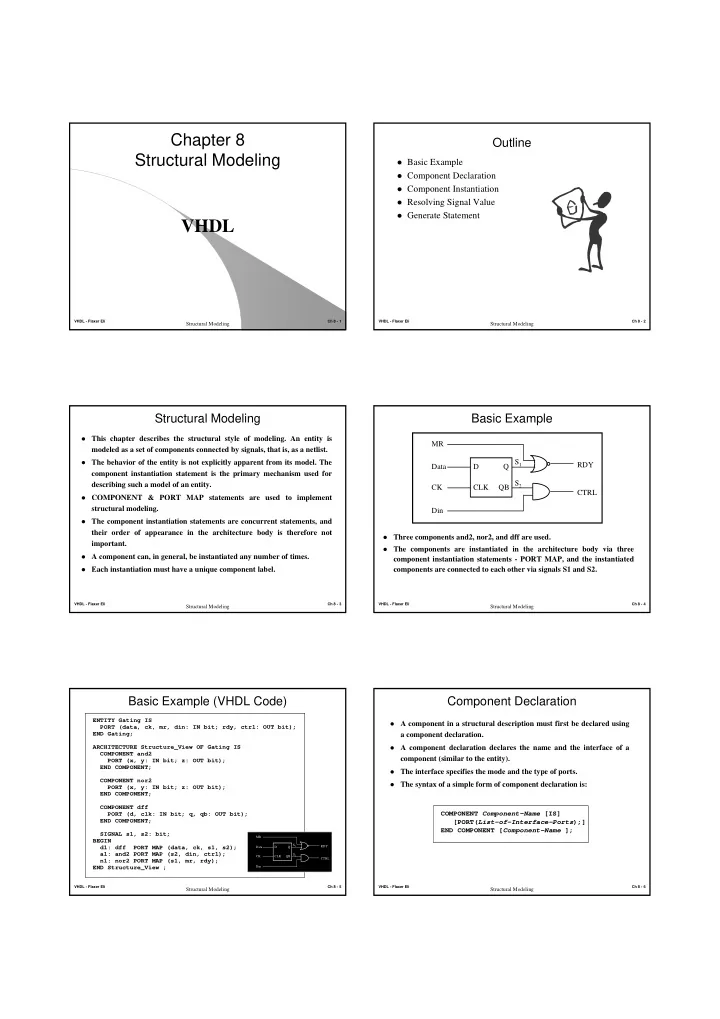
Three components and2, nor2, and dff are used. The components are instantiated in the architecture body via three

component instantiation statements - PORT MAP, and the instantiated components are connected to each other via signals S1 and S2. D CLK Q QB Data CK MR Din RDY CTRL S2 S1

VHDL - Flaxer Eli Ch 8 - 5

Structural Modeling

Basic Example (VHDL Code)

ENTITY Gating IS PORT (data, ck, mr, din: IN bit; rdy, ctrl: OUT bit); END Gating; ARCHITECTURE Structure_View OF Gating IS COMPONENT and2 PORT (x, y: IN bit; z: OUT bit); END COMPONENT; COMPONENT nor2 PORT (x, y: IN bit; z: OUT bit); END COMPONENT; COMPONENT dff PORT (d, clk: IN bit; q, qb: OUT bit); END COMPONENT; SIGNAL s1, s2: bit; BEGIN d1: dff PORT MAP (data, ck, s1, s2); a1: and2 PORT MAP (s2, din, ctrl); n1: nor2 PORT MAP (s1, mr, rdy); END Structure_View ;

D CLK Q QB Data CK MR Din RDY CTRL S2 S1 VHDL - Flaxer Eli Ch 8 - 6

Structural Modeling

Component Declaration

A component in a structural description must first be declared using

a component declaration.

A component declaration declares the name and the interface of a

component (similar to the entity).

The interface specifies the mode and the type of ports. The syntax of a simple form of component declaration is:

COMPONENT Component-Name [IS] [PORT(List-of-Interface-Ports);] END COMPONENT [Component-Name ];

slide-2
SLIDE 2

VHDL - Flaxer Eli Ch 8 - 7

Structural Modeling

Component Declaration (notes)

The component-name may or may not refer to the name of an entity

already existing in a library. If it does not, it must be explicitly bound to an entity.

The binding information can be specified using a configuration. The List-Of-Interface-Ports specifies the name, mode, and type for each

port of the component in a manner similar to that specified in an entity declaration.

The names of the ports may also be different from the names of the ports

in the entity to which it may be bound (different port names can be mapped in a configuration). For while, we will assume that an entity of the same name as that of the component already exists and that the name, mode, and type of each port matches the corresponding ones in the component.

Configurations are discussed in the next chapter.

VHDL - Flaxer Eli Ch 8 - 8

Structural Modeling

Component & Package

Component declarations appear in the declarations part of an architecture

body.

Alternately, they may also appear in a package declaration. Items declared in

this package can then be made visible within any architecture body by using the library and use clauses.

For example, consider the entity GATING described in the basic example. A

package such as shown may be created to hold the component declarations.

PACKAGE MyCOMP IS COMPONENT and2 PORT (x, y: IN bit; z: OUT bit); END COMPONENT; COMPONENT nor2 PORT (x, y: IN bit; z: OUT bit); END COMPONENT; COMPONENT dff PORT (d, clk: IN bit; q, qb: OUT bit); END COMPONENT; END MyCOMP;

VHDL - Flaxer Eli Ch 8 - 9

Structural Modeling

Component & Package Library

If the package MyPackage has been compiled into library MyLib, the

architecture body can be as:

More on Library and Package in the next chapters.

LIBRARY MyLib; USE MyLib.MyPackage.All; ARCHITECTURE Structure_View OF Gating IS SIGNAL s1, s2: bit; BEGIN d1: dff PORT MAP (data, ck, s1, s2); a1: and2 PORT MAP (s2, din, ctrl); n1: nor2 PORT MAP (s1, mr, rdy); END Structure_View ;

VHDL - Flaxer Eli Ch 8 - 10

Structural Modeling

Component Instantiation

A component instantiation statement defines a sub-component of the entity in

which it appears. It associates the signals in the entity with the ports of that sub-component.

  • A format of a component instantiation statement:

The Component-Label can be any legal identifier and can be considered as

the name of the instance.

The Component-Name must be the name of a component declared earlier

using a component declaration.

The association-list, associates signals in the entity, called actuals, with the

ports of a component, called formals.

Component-Label: Component-Name PORT MAP (association-list);

VHDL - Flaxer Eli Ch 8 - 11

Structural Modeling

Actuals and Formals

An actual may be a signal. An actual for an input port may also be an

expression.

An actual may also be the keyword open to indicate a port that is not

connected.

  • There are two ways to perform the association of formals with actuals:

1. Positional association 2. Named association

In positional association, each actual in the component instantiation is

mapped by position with each port in the component declaration. That is, the first port in the component declaration corresponds to the first actual in the component instantiation, the second with the second, and so on.

COMPONENT dff PORT (d, clk: IN bit; q, qb: OUT bit); END COMPONENT;

  • d1: dff

PORT MAP (data, ck, s1, s2);

VHDL - Flaxer Eli Ch 8 - 12

Structural Modeling

Actuals and Formals

If a port in a component instantiation is not connected to any signal, the

keyword OPEN can be used to signify that the port is not connected.

For example: The second input port of the dff component is not connected to any signal.

An input port may be left open only if its declaration specifies an initial

  • value. For the previous component instantiation statement to be legal, port d
  • f the component declaration for dff must have an initial value expression,

while the output port qb not.

A port of any other mode may be left unconnected as long as it is not an

unconstrained array.

COMPONENT dff PORT (d, clk: IN bit:=‘0’; q, qb: OUT bit); END COMPONENT;

  • d1: dff

PORT MAP (OPEN, ck, s1, OPEN);

slide-3
SLIDE 3

VHDL - Flaxer Eli Ch 8 - 13

Structural Modeling

Actuals and Formals

In named association, an association-list is of the form:

– formal1 => actual1, formal2 => actual2, … formaln => actualn

For example: In named association, the ordering of the associations is not important since

the mapping between the actuals and formals is explicitly specified.

An important point to note is that the scope of the formals is restricted to be

within the port map part of the instantiation for that component.

COMPONENT dff PORT (d, clk: IN bit; q, qb: OUT bit); END COMPONENT;

  • d1: dff

PORT MAP (clk => ck, d => data, qb => s2, q => s1);

VHDL - Flaxer Eli Ch 8 - 14

Structural Modeling

Actuals / Formals Type and Mode

The types of the formal and actual being associated must be the same. The modes of the ports must conform to the rule that if the formal is

readable, so must the actual be; and if the formal is writable, so must the actual be.

Locally declared signal is considered to be both readable and writable, such

a signal may be associated with a formal of any mode.

If an actual is a port of mode in, it may not be associated with a formal of

mode out or inout; if the actual is a port of mode out, it may not be associated with a formal of mode in or inout; if the actual is a port of mode inout, it may be associated with a formal of mode in, out, or inout.

It is important to note that an actual of mode out or inout indicates the

presence of a source for that signal, and therefore, it must be resolved if that signal is multiply driven.

A buffer port can never have more than one source; therefore, the only kind

  • f actual that can be associated with a buffer port is another buffer port or a

signal that has at most one source.

VHDL - Flaxer Eli Ch 8 - 15

Structural Modeling

Component Model

Structural models can be simulated and synthesize only after the entities that

the components represent are modeled and placed in a design library.

The lowest-level entities must be behavioral models (or dataflow). Consider the components instantiation A1, N1, and D1 in the basic example.

Assume that those instance is bound to an entity with the same name and identical port names.

The library must include the model of those components. More on Library and Package in the next chapters.

VHDL - Flaxer Eli Ch 8 - 16

Structural Modeling

Component Example (Package)

VHDL - Flaxer Eli Ch 8 - 17

Structural Modeling

Component Example (Entity & Arc)

VHDL - Flaxer Eli Ch 8 - 18

Structural Modeling

Component Example (Main)

slide-4
SLIDE 4

VHDL - Flaxer Eli Ch 8 - 19

Structural Modeling

Component Example (Simulation)

VHDL - Flaxer Eli Ch 8 - 20

Structural Modeling

Resolving Signal Value

If outputs of two components drive a common signal, the value of the signal

must be resolved using a resolution function. This is similar to the case of a signal being assigned using more than one concurrent signal assignment statement.

For example, consider the circuit shown below, which shows two and gates

driving a common signal RS1, which is drive to produce the result in Z.

The RS1 signal must be of resolved type (std_logic for example).

A B RS1 C D Z

VHDL - Flaxer Eli Ch 8 - 21

Structural Modeling

Generate Statement

Generate statement is concurrent. Concurrent statements can be conditionally selected or replicated

during the elaboration phase using the generate statement.

There are two forms of the generate statement:

  • 1. for-generation - concurrent statements replicated a predetermined

number of times.

  • 2. if-generation - concurrent statements conditionally elaborated.

The generate statement is interpreted during elaboration, and

therefore has no simulation semantics. It resembles a macro expansion.

The generate statement provides for a compact description of

regular structures such as memories, registers, and counters.

VHDL - Flaxer Eli Ch 8 - 22

Structural Modeling

For Generate Scheme

The format of a generate statement using the for-generation scheme is:

Generate-Label: FOR index IN range GENERATE [block-declarations BEGIN] concurrent-statements; END GENERATE [Generate-Label];

The values in the discrete range must be globally static, that is, they

must be computable at elaboration time.

During elaboration, the set of concurrent statements are replicated once

for each value in the discrete range.

The statements can use the generate index in their expressions, and its

value would be substituted during elaboration for each replication.

VHDL - Flaxer Eli Ch 8 - 23

Structural Modeling

For Generate Scheme (notes)

There is an implicit declaration for the generate index within the

generate statement.

The type of the identifier is defined by the discrete range. Declarations, if present, declare items that are visible only within the

generate statement.

The body of the generate statement can also include other concurrent

statement (as we will see later).

For-Generate statements may be nested.

VHDL - Flaxer Eli Ch 8 - 24

Structural Modeling

For Generate (example)

Consider the following representation of a 4 - bit full-adder:

CAR(4) CAR(0)

slide-5
SLIDE 5

VHDL - Flaxer Eli Ch 8 - 25

Structural Modeling

For - Generate (example code)

ENTITY full_add4 IS PORT (a, b: IN bit_vector(3 DOWNTO 0); cin: IN bit; sum: OUT bit_vector(3 DOWNTO 0); cout: OUT bit; END full_add4; ARCHITECTURE for_generate OF full_add4 IS COMPONENT fa PORT (pa, pb, pc: IN bit; pcout, psum: OUT bit); END COMPONENT; SIGNAL car: bit_vector(4 DOWNTO 0); BEGIN car(0) <= cin; gk: FOR k IN 3 DOWNTO 0 GENERATE f1: fa PORT MAP(car(k),a(k),b(k),car(k+1),sum(k)); END GENERATE gk; cout <= car(4); END for_generate;

VHDL - Flaxer Eli Ch 8 - 26

Structural Modeling

For - Generate (without Port-Map)

SIGNAL car: bit_vector(4 DOWNTO 0); BEGIN car(0) <= cin; gk: FOR k IN 3 DOWNTO 0 GENERATE sum(k) <= a(k) XOR b(k) XOR car(k); car(k+1) <= a(k) AND b(k) AND car(k); END GENERATE gk; cout <= car(4); END for_generate;

The body of the generate statement can also have other concurrent

statement.

For example, in the previous architecture, the component instantiation

statement could be replace by concurrent signal assignment:

VHDL - Flaxer Eli Ch 8 - 27

Structural Modeling

If Generate Scheme

The format of a generate statement using the if-generation scheme is:

Generate-Label: IF expression GENERATE [block-declarations BEGIN] concurrent-statements; END GENERATE [Generate-Label];

The if-generate statement allows for conditional selection of concurrent

statements based on the value of an expression.

The expression must be a globally static expression, that is, the value

must be computable at elaboration time.

Any declarations present are local to the generate statement. There is no else or elsif branch.

VHDL - Flaxer Eli Ch 8 - 28

Structural Modeling

If Generate (example)

Consider the following representation of a 4 - bit full-adder: This time we use the port directly.

VHDL - Flaxer Eli Ch 8 - 29

Structural Modeling

If - Generate (example code)

ARCHITECTURE if_generate OF full_add4 IS COMPONENT fa PORT (pa, pb, pc: IN bit; pcout, psum: OUT bit); END COMPONENT; SIGNAL car: bit_vector(3 DOWNTO 1); BEGIN gk: FOR k IN 3 DOWNTO 0 GENERATE ck0: IF k = 0 GENERATE f1: fa PORT MAP(cin,a(k),b(k),car(k+1),sum(k)); END GENERATE ck0; ck1: IF k > 0 AND k < 3 GENERATE f1: fa PORT MAP(car(k),a(k),b(k),car(k+1),sum(k)); END GENERATE ck1; ck3: IF k = 3 GENERATE f1: fa PORT MAP(car(k),a(k),b(k),cout,sum(k)); END GENERATE ck3; END GENERATE gk; END if_generate;