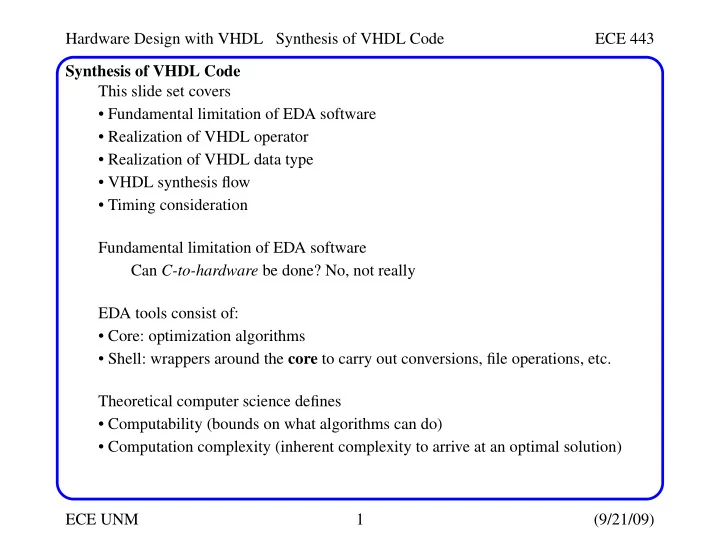
SLIDE 1 Hardware Design with VHDL Synthesis of VHDL Code ECE 443 ECE UNM 1 (9/21/09) Synthesis of VHDL Code This slide set covers
- Fundamental limitation of EDA software
- Realization of VHDL operator
- Realization of VHDL data type
- VHDL synthesis flow
- Timing consideration
Fundamental limitation of EDA software Can C-to-hardware be done? No, not really EDA tools consist of:
- Core: optimization algorithms
- Shell: wrappers around the core to carry out conversions, file operations, etc.
Theoretical computer science defines
- Computability (bounds on what algorithms can do)
- Computation complexity (inherent complexity to arrive at an optimal solution)
SLIDE 2
Hardware Design with VHDL Synthesis of VHDL Code ECE 443 ECE UNM 2 (9/21/09) Computability and Computational Complexity A problem is computable if an algorithm exists Some problems are not computable, e.g., the halting problem Can we develop a program that takes any program and its input, and determines whether the computation of that program will eventually halt? Any attempt to examine the meaning of a program is uncomputable For computable problems, analysis of computation complexity determines how fast an algorithm can run Algorithms are analyzed for both time and space complexity Computation time depends on the size of the input, the type of processor, program- ming language, compiler and even coding style To eliminate the smaller factors, computational analysis focuses only on the order of the algorithm, as a function of the input size
SLIDE 3 Hardware Design with VHDL Synthesis of VHDL Code ECE 443 ECE UNM 3 (9/21/09) Big-O notation f(n) is O(g(n)) if n0 and c can be found to satisfy f(n) < cg(n) for any n, n > n0 g(n) is usually a simple function: 1, n, log2n, n2, n3, 2n For example, the following are O(n2) (0.1n2) <---> (n2 + 5n + 9) <---> (500n2 + 1000000) Interpretation of Big-O
- Filter out constants and other less important terms
- Focus on scaling factor of an algorithm, i.e., what happens if the input size
increases
SLIDE 4 Hardware Design with VHDL Synthesis of VHDL Code ECE 443 ECE UNM 4 (9/21/09) Computation complexity Intractable problems are algorithms with O(2n) -- not computable for large n Frequently tractable heuristic algorithms exist, that run in polynomial time, but gen- erate optimal solutions for only some inputs and/or generate sub-optimal solutions Many problems encountered in synthesis are intractable Synthesis software limitations
- Synthesis software cannot obtain the optimal solution
- Synthesis should be viewed as a transformation carried out using a local search
- Good VHDL code helps a lot by providing a good starting point for the local search
There are other design tasks that are intractable, and no amount of fast hardware or clever heuristics can be used to find the optimal solution Therefore, it is impossible for EDA software to completely automate the design pro- cess This limitation is REAL and is HERE TO STAY!
SLIDE 5
Hardware Design with VHDL Synthesis of VHDL Code ECE 443 ECE UNM 5 (9/21/09) Realization of VHDL Operators Logic operators: simple, direct mapping Relational operators =, /= fast, simple implementation exists >, <, etc: more complex implementation, larger delay Addition operator, and others that can be derived from addition including subtraction, negation and abs, has a multitude of implementations that trade-off speed and area Even more complex than the relation operators Synthesis support for other operators, e.g., shifting, multiplication, division, expo- nentiation, and floating point operations, is sporadic or non-existent Because of their complexity, you must be extremely careful about using them in VHDL code
SLIDE 6 Hardware Design with VHDL Synthesis of VHDL Code ECE 443 ECE UNM 6 (9/21/09) Realization of VHDL Operators Operator with two constant operands: Simplified in preprocessing such that no hardware is inferred -- used because they clarify the code constant OFFSET: integer := 8; signal boundary: unsigned(8 downto 0); signal overflow: std_logic;
- verflow <= ’1’ when boundary > (2**OFFSET-1) else ’0’;
Operator with one constant operand: Can significantly reduce (cut-in-half) the hard- ware complexity, e.g., adder vs. incrementer, later implementable with half-adders y <= rotate_right(x, y);
- - full-fledged barrel shifter
y <= rotate_right(x, 3);
- - rewiring, easy to implement
y <= x(2 downto 0) & x(7 downto 3); -- rewiring Another example, 4-bit comparator: x=y vs. x=0 Much easier, i.e., only a 4-input NOR gate Full logic expression
SLIDE 7
Hardware Design with VHDL Synthesis of VHDL Code ECE 443 ECE UNM 7 (9/21/09) An Example 0.55 um Standard-Cell CMOS Implementation Realization of VHDL data type Use and synthesis of ’Z’ and ’-’ (other values other than ’0’ and ’1’ not used in synthesis) ’Z’ indicates high impedance (or open circuit) Not a Boolean value but is exhibited in a physical circuit, e.g., as the output of a tri-state buffer a: optimized for area d: optimized for delay gate count: in equivalent 2-input NAND gates
SLIDE 8 Hardware Design with VHDL Synthesis of VHDL Code ECE 443 ECE UNM 8 (9/21/09) Tri-State Buffer Tri-state buffer Major applications
- Bi-directional I/O pins
- Tri-state bus
VHDL description y <= ’Z’ when oe=’1’ else a_in; ’Z’ cannot be used as input or manipulated f <= ’Z’ and a; y <= data_a when in_bus=’Z’ else data_b;
SLIDE 9
Hardware Design with VHDL Synthesis of VHDL Code ECE 443 ECE UNM 9 (9/21/09) Tri-State Buffer Because a tri-state buffer is not an ordinary logic value, it is a good idea to separate it from regular code Less clear (cannot be synthesized): Better: with sel select y <= ’Z’ when "00", ’1’ when "01"|"11", ’0’ when others; with sel select tmp <= ’1’ when "01"|"11", ’0’ when others; y <= ’Z’ when sel="00" else tmp;
SLIDE 10
Hardware Design with VHDL Synthesis of VHDL Code ECE 443 ECE UNM 10 (9/21/09) Bi-directional I/O Pins An important application of a tri-state buffer entity bi_demo is port(bi: inout std_logic; ... begin sig_out <= output_expression; ... <= expression_with_sig_in; bi <= sig_out when dir = ’1’ else ’Z’; sig_in <= bi;
SLIDE 11
Hardware Design with VHDL Synthesis of VHDL Code ECE 443 ECE UNM 11 (9/21/09) Bi-directional I/O Pins and Tri-State Bus sig_in <= bi when dir = ’0’ else ’Z’; Tri-state bus Alternative if driving sig_in with sig_out when dir = ’1’ is a problem
SLIDE 12 Hardware Design with VHDL Synthesis of VHDL Code ECE 443 ECE UNM 12 (9/21/09) Tri-State Bus with src_select select
"0010" when "01", "0100" when "10", "1000" when others; y0 <= i0 when oe(0)=’1’ else ’Z’; y1 <= i1 when oe(1)=’1’ else ’Z’; y2 <= i2 when oe(2)=’1’ else ’Z’; y3 <= i3 when oe(3)=’1’ else ’Z’; data_bus <= y0; data_bus <= y1; data_bus <= y2; data_bus <= y3; Problems with the tri-state bus
- Difficult to optimize, verify and test
- Somewhat difficult to design: is technology dependent and can result in ’contention’
SLIDE 13
Hardware Design with VHDL Synthesis of VHDL Code ECE 443 ECE UNM 13 (9/21/09) Alternative to Tri-State Bus Alternative to tri-state bus: mux with src_select select data_bus <= i0 when "00", i1 when "01", i2 when "10", i3 when others; Use of ’-’ In conventional logic design, ’-’ used as input value: shorthand to make table compact
SLIDE 14 Hardware Design with VHDL Synthesis of VHDL Code ECE 443 ECE UNM 14 (9/21/09) Use of ’-’ ’-’ as output value: helps simplification, for example
- If ’-’ assigned to 0: ab + ab
- If ’-’ assigned to 1: a + b (much less hardware than if 0)
As input value: (Syntactically correct but Wrong) y <= "10" when req = "1--" else "01" when req = "01-" else "00" when req = "001" else "00" Fix y <= "10" when req(3) = ’1’ else "01" when req(3 downto 2) = "01" else
SLIDE 15
Hardware Design with VHDL Synthesis of VHDL Code ECE 443 ECE UNM 15 (9/21/09) Use of ’-’ "00" when req(3 downto 1) = "001" else "00" Another fix (must include ’use ieee.numeric_std.all): y <= "10" when std_match(req, "1--") else "01" when std_match(req, "01-") else "00" when std_match(req, "001") else "00" Wrong (but syntactically correct): with req select y <= "10" when "1--", "01" when "01-", "00" when "001", "00" when others; Fix: with req select y <= "10" when "100" | "101" | "110" | "111", "01" when "010" | "011", "00" when others;
SLIDE 16 Hardware Design with VHDL Synthesis of VHDL Code ECE 443 ECE UNM 16 (9/21/09) Use of ’-’ ’-’ as an output value in VHDL may work with some software sel <= a & b; with sel select y <= ’0’ when "00", ’1’ when "01", ’1’ when "10", ’-’ when others; VHDL Synthesis Flow Synthesis: realize VHDL code using logic cells from the target device’s library Main steps:
- High-level synthesis (translates an algorithm into an architecture consisting of a
data path and control path -- done by specialized hardware tools)
- RT level synthesis (the rest generate structural netlists)
- Logic synthesis
- Technology mapping
SLIDE 17
Hardware Design with VHDL Synthesis of VHDL Code ECE 443 ECE UNM 17 (9/21/09) VHDL Synthesis Flow For complex operators, e.g., adder, comparator Level-by-level transformation and optimization
SLIDE 18 Hardware Design with VHDL Synthesis of VHDL Code ECE 443 ECE UNM 18 (9/21/09) RT Level Synthesis Realize VHDL code using generic RT-level components Generic implies that the components are technology independent Components classified into
- function units: those use to implement logic, relational and arith ops
- routing units: various MUXs to construct routing structure
- storage units: registers and latches
During RT-level synthesis, VHDL statements are converted to structural implementa- tions (similar to derivation of the conceptual diagrams given earlier) Some optimizations such as operator sharing, common code elimination and con- stant propagation can be applied to reduce hardware and improve performance Unlike gate- and cell-level synthesis, optimizations are performed in an ad hoc way and scope is very limited Good design can drastically alter the RT-level structure
SLIDE 19
Hardware Design with VHDL Synthesis of VHDL Code ECE 443 ECE UNM 19 (9/21/09) Module Generator The generic RT-level components (from RT-level synthesis) need to be transformed into lower-level components for further processing Some components, such as logical operators and MUXs are simple and can be mapped directly into gate-level components These are called random logic (low regularity) -- can be optimized later in logic syn- thesis Other components such as an adder, subtracter, incrementer, comparator, shifter and multiplier are more complex and need a module generator They usually show some kind of repetitive structure, and are called regular logic Regular logic is usually designed in advance, as presynthesized gate- or cell-level netlists Manual design can be more efficient than logic synthesis so these components are not flattened or optimized with other components during logic synthesis
SLIDE 20 Hardware Design with VHDL Synthesis of VHDL Code ECE 443 ECE UNM 20 (9/21/09) Logic Synthesis Implement the circuit with the optimal number of generic gate level components, such as NAND and NORs The result is a structural view, expressed as Boolean functions Logic synthesis can be divided into categories:
- Two-level synthesis: sum-of-product format
- Multi-level synthesis (deals with large fan-ins, can trade-off area and speed)
Multi-level synthesis is more efficient and flexible, but more difficult to carry out
SLIDE 21 Hardware Design with VHDL Synthesis of VHDL Code ECE 443 ECE UNM 21 (9/21/09) Technology Mapping Map generic gates to device-dependent logic cells The technology library is provided by the vendors who manufactured, as in FPGAs,
- r will manufacture, as in ASICs, the device
Mapping in standard-cell ASIC Technology mapping is a difficult process (intractable) and involves the use of heuristics and rule-based algorithms to find sub-optimal solutions Std cell libraries usually contain several hundred cells, such as simple gates, 1-bit full adders, MUXs The nand-not representation is used to facilitate the mapping process
SLIDE 22
Hardware Design with VHDL Synthesis of VHDL Code ECE 443 ECE UNM 22 (9/21/09) Technology Mapping Std cells are ’tuned’ to a particular technology They are manually designed at the transistor level Multiple versions of the same function are common, each trading-off area and delay Top design is a one-to-one, gate-to-cell mapping -- area is 31 Bottom design is optimized for area by selecting specific std cells from library -- result is 17
SLIDE 23
Hardware Design with VHDL Synthesis of VHDL Code ECE 443 ECE UNM 23 (9/21/09) Technology Mapping Mapping into an FPGA (with 5-input LUT (Look-Up-Table) cells) Effective Use of synthesis software Logic operators: software can do a good job Relational/Arith operators: manual intervention needed Direct mapping -- requires 4 LUTs Optimized mapping -- requires 2 LUTs
SLIDE 24 Hardware Design with VHDL Synthesis of VHDL Code ECE 443 ECE UNM 24 (9/21/09) Effective Use of Synthesis Software "layout" and "routing structure":
- Silicon chip is 2-dimensional square
- rectangular or tree-shaped circuit is easier to optimize
SLIDE 25
Hardware Design with VHDL Synthesis of VHDL Code ECE 443 ECE UNM 25 (9/21/09) Timing Considerations Propagation delay Synthesis with timing constraint Hazards Delay-sensitive design Propagation Delay Delay: time required to propagate a signal from an input port to a output port Cell level delay (vs. RT-level) is the most accurate b/c netlist is final Simplified model: The dintrinsic term is the self-loading component, while the r*Cload term is the driver’s resistance and downstream capacitance components Remember from basic circuit theory that resistance*capacitance = time (delay) delay dintrinsic rCload + =
SLIDE 26
Hardware Design with VHDL Synthesis of VHDL Code ECE 443 ECE UNM 26 (9/21/09) Propagation Delay The routing parasitics are not known at synthesis time, only after place and route In advanced technologies, the impact of wire becomes more significant and must be considered to obtain an accurate delay estimation System Delay There are many paths between the inputs and outputs of a typical circuit Each of them have different delays -- for overall system timing, we are inter- ested in the critical path delay Lumped model of capacitance (Cload) adds together all wire loads (Cwx) and input loads (Cgx)
SLIDE 27
Hardware Design with VHDL Synthesis of VHDL Code ECE 443 ECE UNM 27 (9/21/09) System Delay The worst input-to-output delay This method has the drawback that the critical path obtained may be a false path That is, a path along which it is impossible to propagate a signal Can be obtained from the netlist by treating it as a graph and extracting the longest path Called the topologically critical path This critical path is a false path because MUXs don’t allow it
SLIDE 28 Hardware Design with VHDL Synthesis of VHDL Code ECE 443 ECE UNM 28 (9/21/09) System Delay When estimating RT level delay:
- It is difficult if the design is mainly random logic because the simple logic will go
through many transformations and optimizations
- However, if the design consists of many complex operators (such as addition) and
function blocks, the critical path can be identified This is true because these components are typically pre-designed and optimized Synthesis with Timing Constraints It is possible to reduce by delay at the expense of area, i.e., by adding extra logic There are multiple implementations that trade-off area and delay
SLIDE 29 Hardware Design with VHDL Synthesis of VHDL Code ECE 443 ECE UNM 29 (9/21/09) Synthesis with Timing Constraints Multilevel logic is flexible, making it possible to add additional gates to achieve shorter delay Timing constraints are sometimes needed to guarantee a specific performance metric The synthesis process that considers timing constraints is carried out as follows
- Obtain the minimal-area implementation
- Identify the critical path
- Reduce the delay by adding extra logic
- Repeat 2 & 3 until meeting the constraint
SLIDE 30 Hardware Design with VHDL Synthesis of VHDL Code ECE 443 ECE UNM 30 (9/21/09) Synthesis with Timing Constraints It is also possible to perform this process at the RT level When the design consists of complex operators (blocks), global optimization can be explored (which is more efficient than synthesis optimization at the cell level) Improvements can be made at the "architectural" level, which can have a huge impact
- n critical path delay and size
SLIDE 31 Hardware Design with VHDL Synthesis of VHDL Code ECE 443 ECE UNM 31 (9/21/09) Timing Hazards Propagation delay: time to obtain a stable output Hazards: the fluctuation in the output occurring during the transient period
- Static hazard: glitch in output when the signal should be stable
- Dynamic hazard: a glitch in output during the transition
Hazards are caused by multiple converging paths of an output port Static ’0’ hazard because
a_b_not on transition
Assume a and c are 1 sh = ab + bc (2-to-1 MUX)
SLIDE 32
Hardware Design with VHDL Synthesis of VHDL Code ECE 443 ECE UNM 32 (9/21/09) Timing Hazards Dynamic hazard Dealing with hazards Some hazards can be eliminated in theory Assume a = c = d = 1 Transition of b from 1 to 0 Add an AND gate
SLIDE 33
Hardware Design with VHDL Synthesis of VHDL Code ECE 443 ECE UNM 33 (9/21/09) Timing Hazards Eliminating glitches is very difficult in reality, and almost impossible for synthesis Multiple inputs can change simultaneously (e.g., cycling from 1111 -> 0000 in a counter) How do we deal with them? Ignore glitches in the transient period, e.g., sample after the signal is stabilized Delay Sensitive Design and its Danger Boolean algebra is the theoretical model for digital design and most algorithms used in the synthesis process This model handles only stabilized signals (no transient behavior) Delay-sensitive design, on the other hand, depends on the transient behavior (delay characteristics) of the circuit Consider the addition of the ac (AND gate) to eliminate the static hazard -- the ac term is redundant UNTIL you consider the transient behavior
SLIDE 34 Hardware Design with VHDL Synthesis of VHDL Code ECE 443 ECE UNM 34 (9/21/09) Delay Sensitive Design and its Danger Another circuit that depends on transient behavior is the edge detection circuit, with function pulse = a . a Unfortunately, synthesis software does NOT consider transient behavior and will
- ptimize and eliminate statements such as:
pulse <= a and (not a) Other problems include
- During technology mapping, the gates specified may be re-mapped to other gates
- During placement & routing, wire delays may change creating unexpected results
- Difficult to test and verify (redundant logic is difficult to test for defects)
If delay-sensitive design is really needed, it should be done manually, not by synthe- sis