EE 457 Unit 2a Unsigned 2s Complement Sign and Zero Extension - - PowerPoint PPT Presentation

ee 457 unit 2a
SMART_READER_LITE
LIVE PREVIEW

EE 457 Unit 2a Unsigned 2s Complement Sign and Zero Extension - - PowerPoint PPT Presentation

2a.1 2a.2 EE 457 Unit 2a Unsigned 2s Complement Sign and Zero Extension Fixed Point Systems and Arithmetic Hexadecimal Representation SIGNED AND UNSIGNED SYSTEMS 2a.3 2a.4 Signed Systems Unsigned and Signed Variables Several


slide-1
SLIDE 1

2a.1

EE 457 Unit 2a

Fixed Point Systems and Arithmetic

2a.2

SIGNED AND UNSIGNED SYSTEMS

Unsigned 2’s Complement Sign and Zero Extension Hexadecimal Representation

2a.3

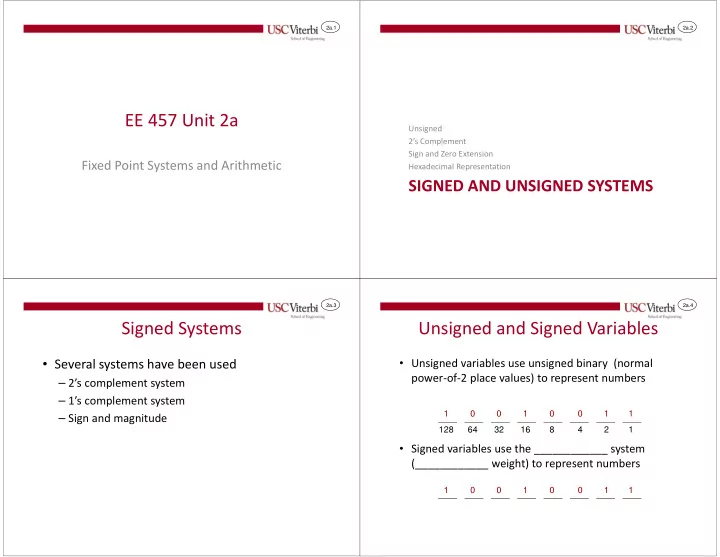
Signed Systems

  • Several systems have been used

– 2’s complement system – 1’s complement system – Sign and magnitude

2a.4

Unsigned and Signed Variables

  • Unsigned variables use unsigned binary (normal

power-of-2 place values) to represent numbers

  • Signed variables use the ____________ system

(____________ weight) to represent numbers

128 64 32 16 8 4 2 1 1 1 1 1 1 1 1 1

slide-2
SLIDE 2

2a.5

2’s Complement System

  • MSB has negative weight
  • MSB determines sign of the number

– 1 = negative – 0 = positive

  • To take the negative of a number

(e.g. -7 => +7 or +2 => -2), requires __________ ____________________

– This is accomplished by ______________________

1001 0110 + 1

0111

x = -7 Bit flip (1’s comp.) Add 1

  • x = -(-7) = +7

2a.6

Zero and Sign Extension

2’s complement = Sign Extension (Replicate sign bit): Unsigned = Zero Extension (Always add leading 0’s): 111011 = 00111011 011010 = 00011010 110011 = 11110011 pos. neg.

Increase a 6-bit number to 8-bit number by zero extending Sign bit is just repeated as many times as necessary

  • Extension is the process of increasing the number of bits used

to represent a number without changing its value

2a.7

Zero and Sign Truncation

  • Truncation is the process of decreasing the number of bits used

to represent a number without changing its value 2’s complement = Sign Truncation (Remove copies of sign bit): Unsigned = Zero Truncation (Remove leading 0’s): 00111011 = 111011 00011010 = 011010 11110011 = 10011 pos. neg.

Decrease an 8-bit number to 6-bit number by truncating 0’s. Can’t remove a ‘1’ because value is changed Any copies of the MSB can be removed without changing the numbers value. Be careful not to change the sign by cutting off ALL the sign bits.

2a.8

Arithmetic & Sign

  • You learned the addition (carry-method) and

subtraction (borrow-method) algorithms in grade school

  • Consider A + B…do you definitely use the addition

algorithm?

– What if A=(2), B=(-5)?

  • Human add/sub algorithm depends on ________!!
slide-3
SLIDE 3

2a.9

Unsigned and Signed Arithmetic

  • Addition/subtraction process is the same for

both unsigned and signed numbers

– Add columns right to left – Drop any final carry out

  • This is the KEY reason we use 2’s complement

system to represent signed numbers

  • Examples:

1001 + 0011 1100

1 1

If unsigned If signed

2a.10

Unsigned and Signed Subtraction

  • Subtraction process is the same for both

unsigned and signed numbers

– Convert A – B to A + Comp. of B – Drop any final carry out

  • Examples:

(12) (2) (-4) (2)

If unsigned If signed

1100

  • 0010

If unsigned If signed

2a.11

Overflow

  • Overflow occurs when the result of an

arithmetic operation is too ____________ __________ with the given number of bits

– Unsigned overflow (___) occurs when adding or subtracting unsigned numbers – Signed (2’s complement overflow) overflow (___)

  • ccurs when adding or subtracting 2’s

complement numbers

2a.12

Unsigned Overflow

0000 0001 0010 0011 0100 0101 0110 0111 1000 1111 1110 1101 1100 1011 1010 1001 +1 +2 +3 +4 +5 +6 +7 +8 +9 +10 +11 +12 +13 +14 +15

Overflow occurs when you cross this discontinuity

10 Plus 7

10 + 7 = 17

With 4-bit unsigned numbers we can only represent 0 – 15. Thus, we say overflow has occurred.

4 - 6 = 14

slide-4
SLIDE 4

2a.13

2’s Complement Overflow

0000 0001 0010 0011 0100 0101 0110 0111 1000 1111 1110 1101 1100 1011 1010 1001 +1 +2 +3 +4 +5 +6 +7

  • 8
  • 7
  • 6
  • 5
  • 4
  • 3
  • 2
  • 1

Overflow occurs when you cross this discontinuity

  • 6 + -4 = -10

With 4-bit 2’s complement numbers we can only represent

  • 8 to +7. Thus, we say overflow

has occurred.

5 + 7 = +12

2a.14

Testing for Overflow

  • Most fundamental test

– Check if answer is wrong (i.e. Positive + Positive yields a negative)

  • Unsigned overflow (C) test

– If _____________________________

  • Signed (2’s complement) overflow (V) test

– Only occurs if

  • ____________________________ … or…
  • ____________________________

– Alternate test: See following slides

2a.15

Alternate Signed Overflow Test

  • Check if _______________________________

A & B A3 B3 S3 C3 C4 V Both Positive 1 One Positive & One Negative 1 1 1 1 Both Negative 1 1 1

2a.16

Overflow in Addition

  • Overflow occurs when the result of the

addition cannot be represented with the given number of bits.

  • Tests for overflow:

– Unsigned: if Cout = 1 – Signed: if p + p = n or n + n = p

1101 + 0100

If unsigned If signed

0110 + 0101

If unsigned If signed

slide-5
SLIDE 5

2a.17

Overflow in Subtraction

  • Overflow occurs when the result of the subtraction

cannot be represented with the given number of bits.

  • Tests for overflow:

– Unsigned: if Cout = 0 – Signed: if addition is p + p = n or n + n = p

If unsigned If signed

0111

  • 1000

If unsigned If signed

2a.18

Addition – Full Adders

  • Show the following addition operation

0110 + 0111 = X = Y

Full Adder X Y Cin S Cout Full Adder X Y Cin S Cout Full Adder X Y Cin S Cout Full Adder X Y Cin S Cout

2a.19

Performing Subtraction w/ Adders

  • To subtract

– Flip bits of Y – Add 1

0101

  • 0011

1101 = X = Y

Full Adder X Y Cin S Cout Full Adder X Y Cin S Cout Full Adder X Y Cin S Cout Full Adder X Y Cin S Cout

0101 + 1100 1 0010

2a.20

XOR Gate Review

XOR Z X Y X Y Z 0 0 0 0 1 1 1 0 1 1 1 0 Y X Z ⊕ = True if an odd # of inputs are true 2 input case: True if inputs are different

slide-6
SLIDE 6

2a.21

XOR Conditional Inverter

  • If one input (say, X) to an XOR gate is 0,

then Z=_____

  • If one input (say, X) to an XOR gate is 1,

then Z=_____

  • Use one input as a control input which

can conditionally pass or invert the

  • ther input

X Y Z 0 0 0 0 1 1 1 0 1 1 1 0

2a.22

Adder/Subtractor

  • Using XOR gates

before one set of adder inputs we can

– Selectively pass or invert Y – Add an extra ‘1’ via the Carry-in

  • If SUB/~ADD=0,

– Z = X+Y

  • If SUB/~ADD=1,

– Z = X-Y

2a.23

Adder/Subtractor

  • Exercise: Add

appropriate logic to produce

– C (unsigned overflow) – V (signed overflow) flags

2a.24

ALU Design

Complete the ALU design given the function table below

OP[2:0] Z 000 X+Y 001 X-Y 011 SLT: Z=1, if X<Y Z=0, other 100 AND 110 OR Others Z = und.

slide-7
SLIDE 7

2a.25

NON-REQUIRED MATERIAL

2a.26

Hexadecimal Representation

  • Since values in modern computers are many

bits, we use hexadecimal as a shorthand notation (4 bits = 1 hex digit)

– 11010010 = D2 hex – 0111011011001011 = 76CB hex

  • To interpret the value of a hex number, you

must know what underlying binary system is assumed (unsigned, 2’s comp. etc.)

2a.27

Translating Hexadecimal

  • Hex place values (162, 161, 160) can ONLY be used if

the number is positive.

  • If hex represents unsigned binary simply apply hex

place values

– B2 hex = 11*161 + 2*160 = 17810

  • If hex represents signed value (2’s comp.)

– First determine the sign to be pos. or neg.

  • Convert the MS-hex digit to binary to determine the MSB (e.g. for

B2 hex, B=1011 so since the MSB=1, B2 is neg.)

  • In general, hex values starting 0-7 = pos. / 8-F = neg.

– If pos., apply hex place values (as if it were unsigned) – If neg., take the 16’s complement and apply hex place values to find the neg. number’s magnitude

2a.28

Taking the 16’s Complement

  • Taking the 2’s complement of a binary number yields

its negative and is accomplished by finding the 1’s complement (bit flip) and adding 1

  • Taking the 16’s complement of a hex number yields

its negative and is accomplished by finding the 15’s complement and adding 1

– 15’s complement is found by subtracting each digit of the hex number from F16

FF

  • B2

4D + 1

4E

Subtract each digit from F 15’s comp. of B2 Add 1 16’s comp. of B2 Original value B2: 16’s comp. of B2:

slide-8
SLIDE 8

2a.29

Translating Hexadecimal

  • Given 6C hex

– If it is unsigned, apply hex place values

  • 6C hex = 6*161 + 12*160 = 10810

–If it is signed…

  • Determine the sign by looking at MSD

– 0-7 hex has a 0 in the MSB [i.e. positive] – 8-F hex has a 1 in the MSB [i.e. negative] – Thus, 6C (start with 6 which has a 0 in the MSB is positive)

  • Since it is positive, apply hex place values

– 6C hex = 6*161 + 12*160 = 10810

2a.30

Translating Hexadecimal

  • Given FE hex

– If it is unsigned, apply hex place values

  • FE hex = 15*161 + 14*160 = 25410

–If it is signed…

  • Determine sign => Negative
  • Since it is negative, take 16’s complement and then

apply place values – 16’s complement of FE = 01 + 1 = 02 and apply place values = 2 – Add in sign => -2 = FE hex

2a.31

Finding the Value of Hex Numbers

  • B2 hex representing a signed (2’s comp.) value

– Step 1: Determine the sign: Neg. – Step 2: Take the 16’s comp. to find magnitude FF - B2 + 1 = 4E hex – Step 3: Apply hex place values (4E16 = +7810) – Step 4: Final value: B2 hex = -7810

  • 7C hex representing a signed (2’s comp.) value

– Step 1: Determine the sign: Pos. – Step 2: Apply hex place values (7C16 = +12410)

  • 82 hex representing an unsigned value

– Step 1: Apply hex place values (8216 = +13010)

2a.32

Hex Addition and Overflow

  • Same rules as in binary

– Add left to right – Drop any carry (carry occurs when sum > F16)

  • Same addition overflow rules

– Unsigned: Check if final Cout = 1 – Signed: Check signs of inputs and result 7AC5 + C18A 3C4F

1 1

If unsigned If signed Overflow Cout = 1 No Overflow p + n

6C12 + 549F C0B1

1

If unsigned If signed No Overflow Cout = 0 Overflow p + p = n

1

slide-9
SLIDE 9

2a.33

Hex Subtraction and Overflow

  • Same rules as in binary

– Convert A – B to A + Comp. of B – Drop any final carry out

  • Same subtraction overflow rules

– Unsigned: Check if final Cout = 0 – Signed: Check signs of addition inputs and result B1ED

  • 76FE

B1ED 8901 + 1 3AEF

If unsigned No Overflow Cout = 1 If signed Overflow n + n = p

1

0001

  • 0002

0001 FFFD + 1 FFFF

If unsigned Overflow Cout = 0 If signed No Overflow p + n

2a.34

Credits

  • These slides were derived from Gandhi

Puvvada’s EE 457 Class Notes