ISAs and Y86-64 Z80 TI calculators lab Wednesday in-lab quiz C - - PowerPoint PPT Presentation

isas and y86 64
SMART_READER_LITE
LIVE PREVIEW

ISAs and Y86-64 Z80 TI calculators lab Wednesday in-lab quiz C - - PowerPoint PPT Presentation

ISAs and Y86-64 Z80 TI calculators lab Wednesday in-lab quiz C loops to assembly loops condition codes ISAs versus microarchitectures last time 2 RISC V some embedded Itanium some HP servers SHARC some digital


slide-1
SLIDE 1

ISAs and Y86-64

1

Changelog

Corrections made in this version not in fjrst posting:

7 Feb 2017: slide 55: fjrst byte of jge is 75, not 70 or 7F

1

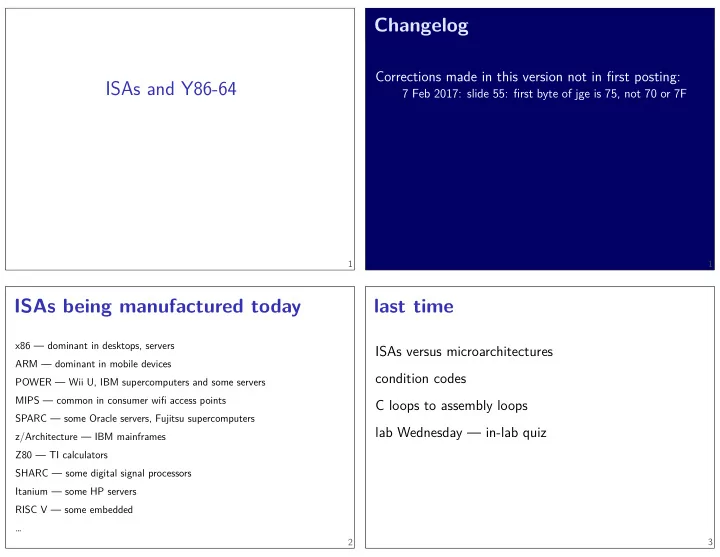
ISAs being manufactured today

x86 — dominant in desktops, servers ARM — dominant in mobile devices POWER — Wii U, IBM supercomputers and some servers MIPS — common in consumer wifj access points SPARC — some Oracle servers, Fujitsu supercomputers z/Architecture — IBM mainframes Z80 — TI calculators SHARC — some digital signal processors Itanium — some HP servers RISC V — some embedded …

2

last time

ISAs versus microarchitectures condition codes C loops to assembly loops lab Wednesday — in-lab quiz

3

slide-2
SLIDE 2

strlen/strsep lab

two functions that operate on C strings

terminated by ‘sentinel’ \0

lab writeup has example implementations you: code both under test conditions

4

anonymous feedback (1)

bunch of comments (some not quite as polite) like: “According to the Schedule, only section 4.1 was required reading before class on Tuesday, however, at the top of the pre-quiz it stated to read sections 4.1–4.3. If you could be consistent, that would be

  • nice. This way, we actually know what to study

before taking the quiz. Thanks.”

pre-week — readings for entire week’s lectures post-week — material from entire week’s lectures

5

anonymous feedback (2)

“why is Professor Khan lecturing instead of Reiss when he is in the lecture?”

should be less work for both of us — better quality? need to stay in sync — labs/homeworks yes, some will like one more than the other yes, one has more experience teaching this course

6

anonymous feedback (3)

“bring back the .webm recordings of the lectures” “Could we go over the quizzes in class the next day, so students who got it wrong can know how the problem is supposed to be solved? If that’s not possible, could we receive solutions to the quizzes?”

7

slide-3
SLIDE 3

anonymous feedback (4)

“I think it is unfair that when asked about the fmags in lecture last week, Khan fumbled her answer and could not explain when each fmag would be set yet that was still a quiz question. If Khan cannot explain to us in lecture which assembly command would set which fmag…”

question on quiz was comparing cmpq and subq cmpq is subtraction without storing result shouldn’t have needed to exactly how fmags were set

8

anonymous feedback (5)

“I am looking over the lab writeup and I cannot understand what the strsep() method is supposed to be doing. I have looked all over the Internet and can’t fjnd anything that would be helpful. If we could spend maybe 5-10 minutes in class Tuesday just going over what the method is supposed to do then maybe I’ll have a better idea of how to approach the problem.”

9

strsep (1)

char *strsep(char **ptrToString, char delimiter); char buffer[] = "this ␣ is ␣ a ␣ test"; char *ptr = buffer; char *token; while ((token = strsep(&ptr, ' ␣ ')) { printf("[%s]", token); } /* output: [this][is][a][test] */ /* final value of buffer: "this\0is\0a\0test" */

10

strsep (2)

char *strsep(char **ptrToString, char delimiter); char str[] = "this ␣ is ␣ a ␣ test"; char *ptr = str; char *token; token = strsep(&ptr, ' ␣ '); /* token points to &buffer[0], string "this" */ /* ' ' after "this" replaced by '\0' */ /* ptr points to &buffer[5]: "is a test" */

11

slide-4
SLIDE 4

anonymous feedback (6)

“I believe that the question ”What does the output f tell us about the input v?” has the incorrect answer. Consider the case in which v=6. Six is not a power

  • f 2, yet it return s true (0010).”

! is logical; ~ is bitwise && is logical; & is bitwise !4 == 0; ~4 == 0xFFF...B f = v && !(v & (v − 1)); f = 6 && !(6 & 5); f = 6 && !(4); f = 6 && 0; f = 0;

12

lists homework

short sentinel = −9999; short *x = malloc(sizeof(short) * 4); x[0] = 1; x[1] = 2; x[2] = 3; x[3] = sentinel; typedef struct range_t { unsigned int length; short *ptr; } range; range x; x.length = 3; x.ptr = malloc(sizeof(short) * 3); x.ptr[0] = 1; ... typedef struct node_t { short payload; list *next; } node; node *x = malloc(sizeof(node_t)); x−>payload = 1; x−>next = ...

13

lists homework

short sentinel = −9999; short *x; x = malloc(sizeof(short)*4); x[3] = sentinel; ...

x

x[0] x[1] x[2] x[3]

1 2 3 −9999

typedef struct range_t { unsigned int length; short *ptr; } range; range x; x.length = 3; x.ptr = malloc(sizeof(short)*3); ...

x len: 3 ptr: 1 2 3

typedef struct node_t { short payload; list *next; } node; node *x; x = malloc(sizeof(node_t)); ...

x payload: 1 ptr: *x

  • n stack
  • r regs
  • n heap

14

lists homework

short sentinel = −9999; short *x; x = malloc(sizeof(short)*4); x[3] = sentinel; ...

x

x[0] x[1] x[2] x[3]

1 2 3 −9999

typedef struct range_t { unsigned int length; short *ptr; } range; range x; x.length = 3; x.ptr = malloc(sizeof(short)*3); ...

x len: 3 ptr: 1 2 3

typedef struct node_t { short payload; list *next; } node; node *x; x = malloc(sizeof(node_t)); ...

x payload: 1 ptr: *x

← on stack

  • r regs
  • n heap →

14

slide-5
SLIDE 5

about our fjnal

9 May, 7PM–10PM location will be announced form for confmicts will be announced

15

non-anonymous feedback

16

ISA variation

instruction set instr. length # normal registers approx. # instrs. x86-64 1–15 byte 16 1500 Y86-64 1–10 byte 15 18 ARMv7 4 byte* 16 400 POWER8 4 byte 32 1400 MIPS32 4 byte 31 200 Itanium 41 bits* 128 300 Z80 1–4 byte 7 40 VAX 1–14 byte 8 150 z/Architecture 2–6 byte 16 1000 RISC V 4 byte* 31 500*

17

Other choices: condition codes?

instead of: testq %r11, %r12 je somewhere could do: /* _B_ranch if _EQ_ual */ beq %r11, %r12, somewhere

18

slide-6
SLIDE 6

Other choices: addressing modes

ways of specifying operands. examples: x86-64: 10(%r11,%r12,4) ARM: %r11 << 3 (shift register value by constant) VAX: ((%r11)) (register value is pointer to pointer)

19

Other choices: number of operands

add dest, src1, src2

ARM, POWER, MIPS, SPARC, …

add src2, src1=dest (or swapped)

x86, AVR, Z80, …

VAX: both

20

CISC and RISC

RISC — Reduced Instruction Set Computer Reduced from what?

21

Other choices: instruction complexity

instructions that write multiple values?

x86-64: push, pop, movsb, …

more?

22

slide-7
SLIDE 7

Some VAX instructions

MATCHC haystackPtr, haystackLen, needlePtr, needleLen Find the position of the string in needle within haystack. POLY x, coeffjcientsLen, coeffjcientsPtr Evaluate the polynomial whose coefficients are pointed to by coeffjcientPtr at the value x. EDITPC sourceLen, sourcePtr, patternLen, patternPtr Edit the string pointed to by sourcePtr using the pattern string specifjed by patternPtr.

23

microcode

MATCHC haystackPtr, haystackLen, needlePtr, needleLen Find the position of the string in needle within haystack.

loop in hardware??? typically: lookup sequence of microinstructions secret simpler instruction set

24

Why RISC?

complex instructions were usually not faster complex instructions were harder to implement compilers, not hand-written assembly

25

typical RISC ISA properties

fewer, simpler instructions seperate instructions to access memory fjxed-length instructions more registers no “loops” within single instructions no instructions with two memory operands few addressing modes

26

slide-8
SLIDE 8

Y86-64 instruction set

based on x86

  • mits most of the 1000+ instructions

leaves addq jmp pushq subq jCC popq andq cmovCC movq (renamed) xorq call hlt (renamed) nop ret much, much simpler encoding

27

Y86-64 instruction set

based on x86

  • mits most of the 1000+ instructions

leaves addq jmp pushq subq jCC popq andq cmovCC movq (renamed) xorq call hlt (renamed) nop ret much, much simpler encoding

27

Y86-64: movq

SDmovq

source destination

i — immediate r — register m — memory irmovq

✘✘✘✘✘ ✘ ❳❳❳❳❳ ❳

immovq

✘✘✘✘✘ ✘ ❳❳❳❳❳ ❳

iimovq rrmovq rmmovq

✘✘✘✘✘ ✘ ❳❳❳❳❳ ❳

rimovq mrmovq

✭✭✭✭✭ ✭ ❤❤❤❤❤ ❤

mmmovq

✘✘✘✘✘ ✘ ❳❳❳❳❳ ❳

mimovq

28

Y86-64: movq

SDmovq

source destination

i — immediate r — register m — memory irmovq

✘✘✘✘✘ ✘ ❳❳❳❳❳ ❳

immovq

✘✘✘✘✘ ✘ ❳❳❳❳❳ ❳

iimovq rrmovq rmmovq

✘✘✘✘✘ ✘ ❳❳❳❳❳ ❳

rimovq mrmovq

✭✭✭✭✭ ✭ ❤❤❤❤❤ ❤

mmmovq

✘✘✘✘✘ ✘ ❳❳❳❳❳ ❳

mimovq

28

slide-9
SLIDE 9

Y86-64: movq

SDmovq

source destination

i — immediate r — register m — memory irmovq

✘✘✘✘✘ ✘ ❳❳❳❳❳ ❳

immovq

✘✘✘✘✘ ✘ ❳❳❳❳❳ ❳

iimovq rrmovq rmmovq

✘✘✘✘✘ ✘ ❳❳❳❳❳ ❳

rimovq mrmovq

✭✭✭✭✭ ✭ ❤❤❤❤❤ ❤

mmmovq

✘✘✘✘✘ ✘ ❳❳❳❳❳ ❳

mimovq

28

Y86-64 instruction set

based on x86

  • mits most of the 1000+ instructions

leaves addq jmp pushq subq jCC popq andq cmovCC movq (renamed) xorq call hlt (renamed) nop ret much, much simpler encoding

29

cmovCC

conditional move exist on x86-64 (but you probably didn’t see them) Y86-64: register-to-register only instead of: jle skip_move rrmovq %rax, %rbx skip_move: // ... can do: cmovg %rax, %rbx

30

Y86-64 instruction set

based on x86

  • mits most of the 1000+ instructions

leaves addq jmp pushq subq jCC popq andq cmovCC movq (renamed) xorq call hlt (renamed) nop ret much, much simpler encoding

31

slide-10
SLIDE 10

halt

(x86-64 instruction called hlt) Y86-64 instruction halt stops the machine

  • therwise — something’s in memory “after” program!

real processors: reserved for OS

32

Y86-64: specifying addresses

Valid: rmmovq %r11, 10(%r12) Invalid: rmmovq %r11, 10(%r12,%r13) Invalid: rmmovq %r11, 10(,%r12,4) Invalid: rmmovq %r11, 10(%r12,%r13,4)

33

Y86-64: specifying addresses

Valid: rmmovq %r11, 10(%r12) Invalid:

✭✭✭✭✭✭✭✭✭✭✭✭✭✭✭✭✭✭✭✭✭✭✭ ✭ ❤❤❤❤❤❤❤❤❤❤❤❤❤❤❤❤❤❤❤❤❤❤❤ ❤

rmmovq %r11, 10(%r12,%r13) Invalid:

✭✭✭✭✭✭✭✭✭✭✭✭✭✭✭✭✭✭✭✭✭ ✭ ❤❤❤❤❤❤❤❤❤❤❤❤❤❤❤❤❤❤❤❤❤ ❤

rmmovq %r11, 10(,%r12,4) Invalid:

✭✭✭✭✭✭✭✭✭✭✭✭✭✭✭✭✭✭✭✭✭✭✭✭✭ ✭ ❤❤❤❤❤❤❤❤❤❤❤❤❤❤❤❤❤❤❤❤❤❤❤❤❤ ❤

rmmovq %r11, 10(%r12,%r13,4)

33

Y86-64: accessing memory (1)

r12 ← memory[10 + r11] + r12 Invalid:

✭✭✭✭✭✭✭✭✭✭✭✭✭✭✭✭✭ ✭ ❤❤❤❤❤❤❤❤❤❤❤❤❤❤❤❤❤ ❤

addq 10(%r11), %r12 Instead: mrmovq 10(%r11), %r11 /* overwrites %r11 */ addq %r11, %r12

34

slide-11
SLIDE 11

Y86-64: accessing memory (1)

r12 ← memory[10 + r11] + r12 Invalid:

✭✭✭✭✭✭✭✭✭✭✭✭✭✭✭✭✭ ✭ ❤❤❤❤❤❤❤❤❤❤❤❤❤❤❤❤❤ ❤

addq 10(%r11), %r12 Instead: mrmovq 10(%r11), %r11 /* overwrites %r11 */ addq %r11, %r12

34

Y86-64: accessing memory (2)

r12 ← memory[10 + 8 * r11] + r12 Invalid:

✭✭✭✭✭✭✭✭✭✭✭✭✭✭✭✭✭✭✭✭ ❤❤❤❤❤❤❤❤❤❤❤❤❤❤❤❤❤❤❤❤

addq 10(,%r11,8), %r12 Instead: /* replace %r11 with 8*%r11 */ addq %r11, %r11 addq %r11, %r11 addq %r11, %r11 mrmovq 10(%r11), %r11 addq %r11, %r12

35

Y86-64: accessing memory (2)

r12 ← memory[10 + 8 * r11] + r12 Invalid:

✭✭✭✭✭✭✭✭✭✭✭✭✭✭✭✭✭✭✭✭ ❤❤❤❤❤❤❤❤❤❤❤❤❤❤❤❤❤❤❤❤

addq 10(,%r11,8), %r12 Instead: /* replace %r11 with 8*%r11 */ addq %r11, %r11 addq %r11, %r11 addq %r11, %r11 mrmovq 10(%r11), %r11 addq %r11, %r12

35

Y86-64 constants (1)

irmovq $100, %r11

  • nly instruction with non-address constant operand

36

slide-12
SLIDE 12

Y86-64 constants (2)

r12 ← r12 + 1 Invalid: ✭✭✭✭✭✭✭✭✭✭✭✭

❤❤❤❤❤❤❤❤❤❤❤❤

addq $1, %r12 Instead, need an extra register: irmovq $1, %r11 addq %r11, %r12

37

Y86-64 constants (2)

r12 ← r12 + 1 Invalid: ✭✭✭✭✭✭✭✭✭✭✭✭

❤❤❤❤❤❤❤❤❤❤❤❤

addq $1, %r12 Instead, need an extra register: irmovq $1, %r11 addq %r11, %r12

37

Y86-64: operand uniqueness

  • nly one kind of value for each operand

instruction name tells you the kind (why movq was ‘split’ into four names)

38

Y86-64: Condition codes

ZF — value was zero? SF — sign bit was set? i.e. value was negative? set by all arithmetic/logic

addq, subq, andq, xorq

not set by anything else

39

slide-13
SLIDE 13

Y86-64: Simple condition codes (1)

If %r9 is -1 and %r10 is 1:

subq %r10, %r9 r9 becomes −1 − (1) = −2.

SF = 1 (negative) ZF = 0 (not zero)

andq %r10, %r10 r10 becomes 1

SF = 0 (non-negative) ZF = 0 (not zero)

40

Y86-64: Using condition codes

subq SECOND, FIRST (value = FIRST - SECOND)

j__

  • r

cmov__ condition code bit test value test le SF = 1 or ZF = 1 value ≤ 0 l SF = 1 value < 0 e ZF = 1 value = 0 ne ZF = 0 value = 0 ge SF = 0 value ≥ 0 g SF = 0 and ZF = 0 value > 0

missing OF (overfmow fmag); CF (carry fmag)

41

Y86-64: Conditionals (1)

✘✘✘ ❳❳❳

cmp, ✘✘✘

✘ ❳❳❳ ❳

test instead: use side efgect of normal arithmetic instead of cmpq %r11, %r12 jle somewhere maybe: subq %r11, %r12 jle (but changes %r12)

42

Y86-64: Conditionals (1)

✘✘✘ ❳❳❳

cmp, ✘✘✘

✘ ❳❳❳ ❳

test instead: use side efgect of normal arithmetic instead of cmpq %r11, %r12 jle somewhere maybe: subq %r11, %r12 jle (but changes %r12)

42

slide-14
SLIDE 14

Y86-64: Conditionals (1)

✘✘✘ ❳❳❳

cmp, ✘✘✘

✘ ❳❳❳ ❳

test instead: use side efgect of normal arithmetic instead of cmpq %r11, %r12 jle somewhere maybe: subq %r11, %r12 jle (but changes %r12)

42

Y86-64: Conditionals (2)

✘✘✘ ❳❳❳

cmp, ✘✘✘

✘ ❳❳❳ ❳

test instead: use side efgect of normal arithmetic instead of test %r11, %r11 je somewhere use: andq %r11, %r11 je somewhere (doesn’t change %r11)

43

push/pop

pushq %rbx

%rsp ← %rsp − 8 memory[%rsp] ← %rbx

popq %rbx

%rbx ← memory[%rsp] %rsp ← %rsp + 8

. . . memory[%rsp + 16] memory[%rsp + 8] memory[%rsp] memory[%rsp - 8] memory[%rsp - 16]

value to pop where to push

stack growth

44

call/ret

call LABEL

push PC (next instruction address) on stack jmp to LABEL address

ret

pop address from stack jmp to that address

. . . memory[%rsp + 16] memory[%rsp + 8] memory[%rsp] memory[%rsp - 8] memory[%rsp - 16]

address ret jumps to where call stores return address

stack growth

45

slide-15
SLIDE 15

Y86-64 state

%rXX — 15 registers

%r15 missing smaller parts of registers missing

ZF (zero), SF (sign), OF (overfmow)

book has OF, we’ll not use it CF (carry) missing

Stat — processor status — halted? PC — program counter (AKA instruction pointer) main memory

46

typical RISC ISA properties

fewer, simpler instructions seperate instructions to access memory fjxed-length instructions more registers no “loops” within single instructions no instructions with two memory operands few addressing modes

47

Y86-64 instruction formats

byte: 1 2 3 4 5 6 7 8 9 halt nop 1 rrmovq/cmovCC rA, rB 2 cc rA rB irmovq V, rB 3 F rB rmmovq rA, D(rB) 4 0 rA rB mrmovq D(rB), rA 5 0 rA rB OPq rA, rB 6 fn rA rB jCC Dest 7 cc call Dest 8 ret 9 pushq rA A 0 rA F popq rA B 0 rA F V D D Dest Dest

48

Secondary opcodes: cmovcc/jcc

byte: 1 2 3 4 5 6 7 8 9 halt nop 1 rrmovq/cmovCC rA, rB 2 cc rA rB irmovq V, rB 3 F rB rmmovq rA, D(rB) 4 0 rA rB mrmovq D(rB), rA 5 0 rA rB OPq rA, rB 6 fn rA rB jCC Dest 7 cc call Dest 8 ret 9 pushq rA A 0 rA F popq rA B 0 rA F V D D Dest Dest 0 always (jmp/rrmovq) 1 le 2 l 3 e 4 ne 5 ge 6 g

49

slide-16
SLIDE 16

Secondary opcodes: OPq

byte: 1 2 3 4 5 6 7 8 9 halt nop 1 rrmovq/cmovCC rA, rB 2 cc rA rB irmovq V, rB 3 F rB rmmovq rA, D(rB) 4 0 rA rB mrmovq D(rB), rA 5 0 rA rB OPq rA, rB 6 fn rA rB jCC Dest 7 cc call Dest 8 ret 9 pushq rA A 0 rA F popq rA B 0 rA F V D D Dest Dest

add

1

sub

2

and

3

xor

50

Registers: rA, rB

byte: 1 2 3 4 5 6 7 8 9 halt nop 1 rrmovq/cmovCC rA, rB 2 cc rA rB irmovq V, rB 3 F rB rmmovq rA, D(rB) 4 0 rA rB mrmovq D(rB), rA 5 0 rA rB OPq rA, rB 6 fn rA rB jCC Dest 7 cc call Dest 8 ret 9 pushq rA A 0 rA F popq rA B 0 rA F V D D Dest Dest

%rax

8

%r8

1

%rcx

9

%r9

2

%rdx

A

%r10

3

%rbx

B

%r11

4

%rsp

C

%r12

5

%rbp

D

%r13

6

%rsi

E

%r14

7

%rdi

F

none

51

Immediates: V, D, Dest

byte: 1 2 3 4 5 6 7 8 9 halt nop 1 rrmovq/cmovCC rA, rB 2 cc rA rB irmovq V, rB 3 F rB rmmovq rA, D(rB) 4 0 rA rB mrmovq D(rB), rA 5 0 rA rB OPq rA, rB 6 fn rA rB jCC Dest 7 cc call Dest 8 ret 9 pushq rA A 0 rA F popq rA B 0 rA F V D D Dest Dest

52

Immediates: V, D, Dest

byte: 1 2 3 4 5 6 7 8 9 halt nop 1 rrmovq/cmovCC rA, rB 2 cc rA rB irmovq V, rB 3 F rB rmmovq rA, D(rB) 4 0 rA rB mrmovq D(rB), rA 5 0 rA rB OPq rA, rB 6 fn rA rB jCC Dest 7 cc call Dest 8 ret 9 pushq rA A 0 rA F popq rA B 0 rA F V D D Dest Dest

52

slide-17
SLIDE 17

Y86-64 encoding (1)

long addOne(long x) { return x + 1; } x86-64: movq %rdi, %rax addq $1, %rax ret Y86-64: irmovq $1, %rax addq %rdi, %rax ret

53

Y86-64 encoding (1)

long addOne(long x) { return x + 1; } x86-64: movq %rdi, %rax addq $1, %rax ret Y86-64: irmovq $1, %rax addq %rdi, %rax ret

53

Y86-64 encoding (2)

addOne: irmovq $1, %rax addq %rdi, %rax ret ⋆

3 F %rax 01 00 00 00 00 00 00 00

30 F0 01 00 00 00 00 00 00 00 60 70 90

54

Y86-64 encoding (2)

addOne: irmovq $1, %rax addq %rdi, %rax ret ⋆

3 F 01 00 00 00 00 00 00 00

30 F0 01 00 00 00 00 00 00 00 60 70 90

54

slide-18
SLIDE 18

Y86-64 encoding (2)

addOne: irmovq $1, %rax addq %rdi, %rax ret

3 F 01 00 00 00 00 00 00 00

6 add %rdi %rax

30 F0 01 00 00 00 00 00 00 00 60 70 90

54

Y86-64 encoding (2)

addOne: irmovq $1, %rax addq %rdi, %rax ret

3 F 01 00 00 00 00 00 00 00

6 7

30 F0 01 00 00 00 00 00 00 00 60 70 90

54

Y86-64 encoding (2)

addOne: irmovq $1, %rax addq %rdi, %rax ret

3 F 01 00 00 00 00 00 00 00 6 7

9

30 F0 01 00 00 00 00 00 00 00 60 70 90

54

Y86-64 encoding (2)

addOne: irmovq $1, %rax addq %rdi, %rax ret

3 F 01 00 00 00 00 00 00 00 6 7 9

30 F0 01 00 00 00 00 00 00 00 60 70 90

54

slide-19
SLIDE 19

Y86-64 encoding (3)

doubleTillNegative: /* suppose at address 0x123 */ addq %rax, %rax jge doubleTillNegative

6 add %rax %rax

55

Y86-64 encoding (3)

doubleTillNegative: /* suppose at address 0x123 */ addq %rax, %rax jge doubleTillNegative ⋆

6 add %rax %rax

55

Y86-64 encoding (3)

doubleTillNegative: /* suppose at address 0x123 */ addq %rax, %rax jge doubleTillNegative ⋆

6

55

Y86-64 encoding (3)

doubleTillNegative: /* suppose at address 0x123 */ addq %rax, %rax jge doubleTillNegative

6 7 5 23 01 00 00 00 00 00 00

55

slide-20
SLIDE 20

Y86-64 encoding (3)

doubleTillNegative: /* suppose at address 0x123 */ addq %rax, %rax jge doubleTillNegative

6

7 5 23 01 00 00 00 00 00 00

55

Y86-64 encoding (3)

doubleTillNegative: /* suppose at address 0x123 */ addq %rax, %rax jge doubleTillNegative

6 7 5 23 01 00 00 00 00 00 00

55

Y86-64 decoding

20 10 60 20 61 37 72 84 00 00 00 00 00 00 00 20 12 20 01 70 68 00 00 00 00 00 00 00 rrmovq %rcx, %rax addq %rdx, %rax subq %rbx, %rdi jl 0x84 rrmovq %rax, %rcx jmp 0x68

byte: 1 2 3 4 5 6 7 8 9 halt nop 1 rrmovq/cmovCC rA, rB 2 cc rA rB irmovq V, rB 3 F rB rmmovq rA, D(rB) 4 0 rA rB mrmovq D(rB), rA 5 0 rA rB OPq rA, rB 6 fn rA rB jCC Dest 7 cc call Dest 8 ret 9 pushq rA A 0 rA F popq rA B 0 rA F V D D Dest Dest

56
Y86-64 decoding

20 10 60 20 61 37 72 84 00 00 00 00 00 00 00 20 12 20 01 70 68 00 00 00 00 00 00 00 rrmovq %rcx, %rax addq %rdx, %rax subq %rbx, %rdi jl 0x84 rrmovq %rax, %rcx jmp 0x68

byte: 1 2 3 4 5 6 7 8 9 halt nop 1 rrmovq/cmovCC rA, rB 2 cc rA rB irmovq V, rB 3 F rB rmmovq rA, D(rB) 4 0 rA rB mrmovq D(rB), rA 5 0 rA rB OPq rA, rB 6 fn rA rB jCC Dest 7 cc call Dest 8 ret 9 pushq rA A 0 rA F popq rA B 0 rA F V D D Dest Dest

56

slide-21
SLIDE 21

Y86-64 decoding

20 10 60 20 61 37 72 84 00 00 00 00 00 00 00 20 12 20 01 70 68 00 00 00 00 00 00 00 rrmovq %rcx, %rax

◮ 0 as cc: always ◮ 1 as reg: %rcx ◮ 0 as reg: %rax

addq %rdx, %rax subq %rbx, %rdi jl 0x84 rrmovq %rax, %rcx jmp 0x68

byte: 1 2 3 4 5 6 7 8 9 halt nop 1 rrmovq/cmovCC rA, rB 2 cc rA rB irmovq V, rB 3 F rB rmmovq rA, D(rB) 4 0 rA rB mrmovq D(rB), rA 5 0 rA rB OPq rA, rB 6 fn rA rB jCC Dest 7 cc call Dest 8 ret 9 pushq rA A 0 rA F popq rA B 0 rA F V D D Dest Dest

56

Y86-64 decoding

20 10 60 20 61 37 72 84 00 00 00 00 00 00 00 20 12 20 01 70 68 00 00 00 00 00 00 00 rrmovq %rcx, %rax addq %rdx, %rax subq %rbx, %rdi

◮ 0 as fn: add ◮ 1 as fn: sub

jl 0x84 rrmovq %rax, %rcx jmp 0x68

byte: 1 2 3 4 5 6 7 8 9 halt nop 1 rrmovq/cmovCC rA, rB 2 cc rA rB irmovq V, rB 3 F rB rmmovq rA, D(rB) 4 0 rA rB mrmovq D(rB), rA 5 0 rA rB OPq rA, rB 6 fn rA rB jCC Dest 7 cc call Dest 8 ret 9 pushq rA A 0 rA F popq rA B 0 rA F V D D Dest Dest

56

Y86-64 decoding

20 10 60 20 61 37 72 84 00 00 00 00 00 00 00 20 12 20 01 70 68 00 00 00 00 00 00 00 rrmovq %rcx, %rax addq %rdx, %rax subq %rbx, %rdi jl 0x84

◮ 2 as cc: l (less than) ◮ hex 84 00… as little endian

Dest: 0x84

rrmovq %rax, %rcx jmp 0x68

byte: 1 2 3 4 5 6 7 8 9 halt nop 1 rrmovq/cmovCC rA, rB 2 cc rA rB irmovq V, rB 3 F rB rmmovq rA, D(rB) 4 0 rA rB mrmovq D(rB), rA 5 0 rA rB OPq rA, rB 6 fn rA rB jCC Dest 7 cc call Dest 8 ret 9 pushq rA A 0 rA F popq rA B 0 rA F V D D Dest Dest

56

Y86-64 decoding

20 10 60 20 61 37 72 84 00 00 00 00 00 00 00 20 12 20 01 70 68 00 00 00 00 00 00 00 rrmovq %rcx, %rax addq %rdx, %rax subq %rbx, %rdi jl 0x84 rrmovq %rax, %rcx jmp 0x68

byte: 1 2 3 4 5 6 7 8 9 halt nop 1 rrmovq/cmovCC rA, rB 2 cc rA rB irmovq V, rB 3 F rB rmmovq rA, D(rB) 4 0 rA rB mrmovq D(rB), rA 5 0 rA rB OPq rA, rB 6 fn rA rB jCC Dest 7 cc call Dest 8 ret 9 pushq rA A 0 rA F popq rA B 0 rA F V D D Dest Dest

56

slide-22
SLIDE 22

Y86-64: Convenience for hardware

4 bits to decode instruction size/layout (mostly) uniform placement of operands jumping to zeroes (uninitialized?) by accident halts no attempt to fjt (parts

  • f) multiple instructions in

a byte

byte: 1 2 3 4 5 6 7 8 9 halt nop 1 rrmovq/cmovCC rA, rB 2 cc rA rB irmovq V, rB 3 F rB rmmovq rA, D(rB) 4 0 rA rB mrmovq D(rB), rA 5 0 rA rB OPq rA, rB 6 fn rA rB jCC Dest 7 cc call Dest 8 ret 9 pushq rA A 0 rA F popq rA B 0 rA F V D D Dest Dest

57

Y86-64

Y86-64: simplifjed, more RISC-y version of X86-64 minimal set of arithmetic

  • nly movs touch memory
  • nly jumps, calls, and movs take immediates

simple variable-length encoding next time: implementing with circuits

58