X TTC / PET / DRAC / CPI Some research applications have been done - - PDF document

x
SMART_READER_LITE
LIVE PREVIEW

X TTC / PET / DRAC / CPI Some research applications have been done - - PDF document

32nd ICTCT Conference in Warsaw, Poland October 24 & 25, 2019 The simulation of potential crashes Purpose as a new safety performance conflict-based indicator The aim of this study is to improve the current session: SURROGATE MEASURES


slide-1
SLIDE 1
  • Prof. Ing. Astarita Vittorio
  • Prof. Ing. Guido Giuseppe

Ph.D. Ing. Giofrè Vincenzo Pasquale Ph.D. Ing. Vitale Alessandro

The simulation of potential crashes as a new safety performance conflict-based indicator

session: SURROGATE MEASURES 32nd ICTCT Conference in Warsaw, Poland October 24 & 25, 2019 University of Calabria (Italy)

Purpose

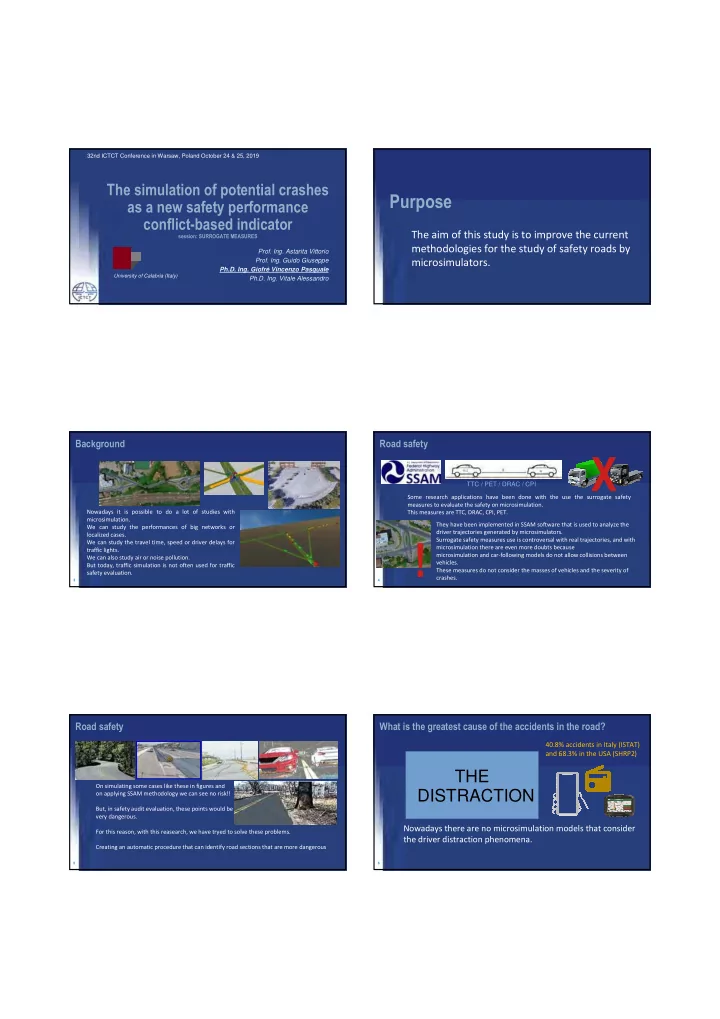
The aim of this study is to improve the current methodologies for the study of safety roads by microsimulators.

Background

3

Nowadays it is possible to do a lot of studies with microsimulation. We can study the performances of big networks or localized cases. We can study the travel time, speed or driver delays for traffic lights. We can also study air or noise pollution. But today, traffic simulation is not often used for traffic safety evaluation.

Road safety

4

TTC / PET / DRAC / CPI

X

Some research applications have been done with the use the surrogate safety measures to evaluate the safety on microsimulation. This measures are TTC, DRAC, CPI, PET.

!

They have been implemented in SSAM software that is used to analyze the driver trajectories generated by microsimulators. Surrogate safety measures use is controversal with real trajectories, and with microsimulation there are even more doubts because microsimulation and car-following models do not allow collisions between vehicles. These measures do not consider the masses of vehicles and the severity of crashes.

Road safety

5

On simulating some cases like these in figures and

  • n applying SSAM methodology we can see no risk!!

But, in safety audit evaluation, these points would be very dangerous. For this reason, with this reasearch, we have tryed to solve these problems. Creating an automatic procedure that can identify road sections that are more dangerous

What is the greatest cause of the accidents in the road?

6

THE DISTRACTION

Nowadays there are no microsimulation models that consider the driver distraction phenomena.

40.8% accidents in Italy (ISTAT) and 68.3% in the USA (SHRP2)

slide-2
SLIDE 2

What is ZombieDriver?

7

Algorithm Software

Algorithm

8

It is an algorithm that can simulate accidents caused by driving distractions. It is an algorithm that works both on real trajectories or on the trajectories generated by a microsimulation model. It is an algorithm that can calculate the energy produced by a crash between vehicle and vehicle or between vehicle and an object. Crash severity is taken into consideration!

What are the differences between SSAM and ZombieDriver?

9

Software for safety analysis Vehicles trajectories Microsimulation Real data observed Roadside objects

UniCAL

ZombieDriver Outputs SSAM

  • Number of conflicts
  • Numerical safety indicators (i.e. TTC)

ZombieDriver

  • Number of conflicts (potential crashes)
  • Numerical safety indicators (i.e. total

crash energy)

  • Potential crash severity (dead, injured)
  • Risk maps
  • Frequency analysis

With SSAM we have trajectories input and conflicts output. With ZombieDriver we have trajectories/objects input and conflicts/Crash severity/Map output.

Story

10

Hyden, 1987 Hayward, 1972 Hyden, 1987 FHWA, 2008 Gettman, 2008 Shelby, 2011 Laureshyn, 2017 Astarita & Giofrè, 2019

Extended Delta-V Severity

How does it work? Vehicle to vehicle

In each step of simulation process, the algorithm selects one vehicle. It changes the trajectory of the car with three new trajectories with different angles +15°,

  • 15°, 0°.

The speed is costant. The vehicle, drives on these trajectories for a distraction time. We have supposed a value of 3 seconds, but we can also generate this value form a normal distribution. If, in one trajectory there is a collision, the algorithm calculates (on the base of the average weight and the vector speed difference) the collision energy.

11

How does it work? Vehicle to object

This methodology evaluates also the energy in collisions between vehicles and roadside rigid objects.

fonte www.ravenna24ore.it è concesso in licenza Creative Commons

12

slide-3
SLIDE 3

How does it work? Vehicle to object

The energy can always be calculated in any case.

fonte www.lastampa.it è concesso in licenza Creative Commons fontecorrieredellasera è concesso in licenza Creative Commons

13

The only two parameters of the model are:

  • Distraction angle (example +15°, 0°, -15°)
  • Distraction time (example 3, 5, 7 seconds)

How does it work? Parameters

14

Software

This algorithm has been implemented in a software. It is a software that automatically allows to detect the critical points of a road network. It is capable of interface with all simulators such as: Aimsun, Vissim and Tritone. It is a software that works on Windows, MacOS and Linux.

15

How does the software work?

Example: Network with two inputs and one output. The flows are equal.

16

How does the software work?

The algorithm selects one vehicle.

17

How does the software work?

The algorithm creates three new trajectories at costant speed.

  • 15°

+15° 0°

18

slide-4
SLIDE 4

How does the software work?

In this case, after 3 seconds: the trajectories are pertubated, but we have no collisions.

  • 15°

+15° 0°

19

How does the software work?

In this case, after 4 seconds: we have one collision for +15°.

20

How does the software work?

In a trajectory of +15°, if the driver was distracted, he would have collided with the vehicle on the other road.

21

How does the software work?

ZombieDriver builds a map of critical areas in relation to the sum

  • f the collision energy.

We can see that the red area coincides with the intersection.

22

Software – Professional target

Unsignalized intersection Deviated road Trees Trees Trees Road signs Service exit Hairpin and barrier Corner start barrier

A B D C O/D A B D A 200 300 B 50 50 C 300 200 Example: Network with A, B, C inputs and A, B, D output. A real safety audit process has shown these critical points in this scenario.

23

Software – Professional target

24

slide-5
SLIDE 5

Software – Professional target

Unsignalized intersection Deviated road Trees Trees Trees Road signs Service exit Hairpin and barrier Corner start barrier By using ZombiDriver algorithm after a microsimulation process, we can see the critical points. They are real crital points that professionals would have found. This is the first software in the world that can identify dangerous road sections by using vehicle trajectories!!!

25

Software – ZombieDriver output

Statistical reports Dangerous areas Total energy Average energy Max energy Number collisions Total speed vector Average speed vector Number dead Number injured Collision animation Frequency analysis

26

A real study

?

Example: A real case study. 40 km of road on SS106 in Italy. We want to study the most dangerous

  • f the two scenarios.

Case A 2010 - Case B 2019 The two scenarios were simulated with the Tritone microsimulator with four car-following models: Gazis-Herman, Gipps, IDM 2000, Wiedemann 99. All models were calibrated with traffic data and GEH

27

A real study

Example, in detail, in 12km: Case A no motorway junction Case B there is the motorway junction Case A Case B

?

28

A real study

Safety audit example

29

Background

By changing the car-following model, we can see that the TTC (extracted from SSAM) fails to identify the most dangerous scenario. ZombieDriver always identifies in B (2019) the most critical scenario, according to the sum

  • f the collision energies.

In this example ZombieDriver is independent of chosen car-following model!

30

slide-6
SLIDE 6

Work in progress

64 KJ 57 KJ 51 KJ 50 KJ 15 KJ 19 KJ 13 KJ 14 KJ 39 KJ 10 KJ 25 KJ 25 KJ 32 KJ 28 KJ 0.39 d 0.25 d 0.20 d 0.40 d 0.45 d 0,18 d 25 KJ 0.10 d 0,15 d

This is a work in progress example. Cosenza network. In the left map we can see the real accident in the last 5 years. In the middle we can see the average collision energy, and on the right the driver dead (based on difference speed vector).

31

Work in progress

In the left map we can see the frequency of collision energy (applyed 10 KJ threshold), and

  • n the right the collision point.

32

Conclusions

This methodology allows to find the critical points of a network through microsimulation. This methodology allows to consider the flow and the detail geometry of the network for safety analysis. This model can consider road-side objects. Without perturbation of trajectories road side objects cannot be considered!! It is fast and effective.

You can download and use for free ZombieDriver software

33

Thank you / Contact

Ph.D. ing. Giofrè Vincenzo Pasquale University of Calabria - Dipartimento di Ingegneria Civile Via P. Bucci, cubo 46b, ultimo piano - 87036 - Rende (CS)

  • Tel. +39-366-53.23.701

vincenzo.giofre@unical.it - http://tis.unical.it

Zombiedriver parameters are just a few!

In our first evaluations we followed a simple deterministic approach with the following values: 1.The time duration of the distraction ( we used 3,5 and 7 seconds) 2.The angle of the deviated trajectory ( we used -15°, 0°and 15°) 3.The choice of vehicle and time for a deviated trajectory (we did take all vehicles

  • n the network every second of simulation!)

35

FUTURE POSSIBLE DIRECTION OF RESEARCH

  • The use of a more general stochastic approach with parameter choice

performed according to some probabilistic distribution law. In this case Montecarlo method could be easily applied. We believe that additional research could prove that the Montecarlo method would converge to the same results we obtained, given that the average values of the probabilistic distributions are the same as the deterministic values.

  • A sensitivity analysis.

36