
SLIDE 1
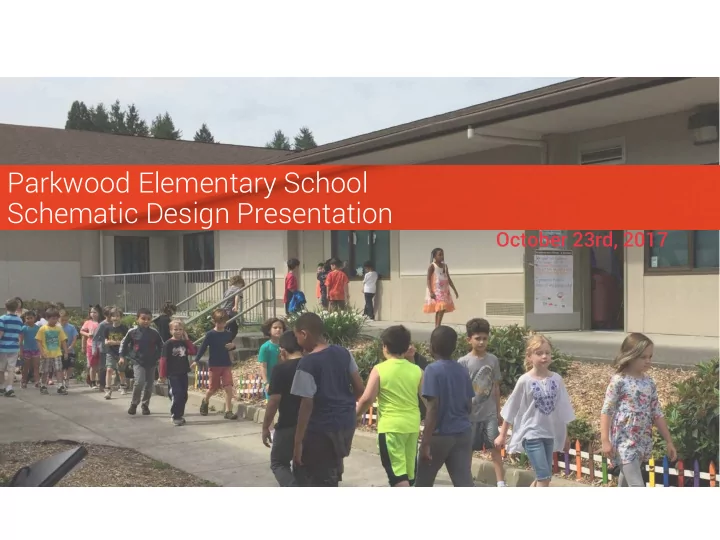
Parkwood Elementary School Schematic Design Presentation October - - PowerPoint PPT Presentation
Parkwood Elementary School Schematic Design Presentation October 23rd, 2017 Agenda Project Review Final Architectural Schematic Design Building Systems Project Review Schedule Guiding Principles Pa Parkwoods Mission: Through our core
Pa Parkwood’s Mission: Through our core values of Academic Excellence, Community, Collaboration, and Respect for Human Differences, Parkwood Elementary School inspires and prepares students to reach their highest potential and live empowered, successful, and compassionate lives. Our new building meets or exceeds industry standards for geographic, environmental, and physical health and safety as well as provides welcoming, flexible, easily accessible spaces for public use. It will incorporate natural light, have designated spaces for the arts, be fully ADA accessible, and well-prepared for technological advancements. Additionally, the newly constructed Parkwood will strengthen our core values in the following ways: Academi mic Excellence: Students and staff learn in spaces that are flexible and intentionally designed to support diverse learning experiences, styles, and needs. The school’s overall layout maximizes instructional time by facilitating efficient movement, streamlined access to instructional resources, and a shared, school-wide responsibility for the success of each student. Commu munity: Parkwood’s design prioritizes an inclusive, welcoming, and multi-cultural spirit that fosters teaming, work, and social relationships between and amongst staff, students, communities, and stakeholders. School spaces enable large and small scale performances, celebrations, and community events. The building has centralized access to shared staff spaces while it simultaneously provides quiet spaces for private activities and work. Co Collaboration: Structured and informal interactions amongst Parkwood stakeholders foster authentic and supportive relationships. Recognizing that collaboration across grade levels, programs, and job types is important for staff and student growth, the building facilitates easy movement as well as chance encounters for staff and students. Respect for Huma man Differences: Parkwood’s design makes students and staff feel empowered and comfortable. Positive behaviors are seamlessly supported through deliberate movement and gathering patterns in hallway design, lunchroom configuration, and arrival/dismissal zones. Inclusive principles are overtly emphasized in learning and community spaces. Furnishings are adaptable and flexible, blending is easy and effortless, and diverse families/cultures/experiences are represented and supported. .
School Capacity: 500 Target Building Size: 57,500 sf – 65,000 sf Core Classroom Capacity: ±25 Students SPED Classroom Capacity: 10 Students # of Core Classrooms: 19 # of SPED Classrooms: 3
N.
th St
St Wa Wallingford Ave N I-5 5 Au Aurora Av Ave N
NO NORTH
WA WALL LLINGFORD AVE N N.
TH ST
ST
Pa Parking Bu Bus Dr Drop Of Off Pare rent nt Dr Drop-Of Off Covere red d Pl Play Bu Bus Route Waiting ng Qu Queue Pare rent nt Drive Lo Loop
CL CLASSROOM PO POD
LEV LEVEL EL 02 LEV LEVEL EL 01
OT/ OT/PT LI LIBRARY BA BAND & OR ORCHESTRA AD ADMIN GY GYM CO COMMONS CHI CHILDCARE MU MUSIC
utilized by vents and radiators
equipment to maintain
disturbance of classrooms
for duct work
windows
WA WALL LLINGFORD AVE N N.
TH ST
ST
Pa Parking Sp Spaces Bu Bus Dr Drop Of Off Pare rent nt Dr Drop-Of Off Covere red d Pl Play Bu Bus Route Waiting ng Qu Queue Pare rent nt Drive Lo Loop
CL CLASSROOM PO POD
LEV LEVEL EL 02 LEV LEVEL EL 01
OT/ OT/PT LI LIBRARY BA BAND & OR ORCHESTRA AD ADMIN GY GYM CO COMMONS CHI CHILDCARE MU MUSIC