Why the 2018 Water Reliability Study WACO Presentation 2018 OC - - PDF document

why the 2018 water reliability study
SMART_READER_LITE
LIVE PREVIEW

Why the 2018 Water Reliability Study WACO Presentation 2018 OC - - PDF document

10/5/2018 20 2018 OC R OC Reliability Study liability Study Draf raft R Repor port Water Advisory Committee of Orange County (WACO) October 5, 2018 Why the 2018 Water Reliability Study WACO Presentation 2018 OC Reliability Study


slide-1
SLIDE 1

10/5/2018 1

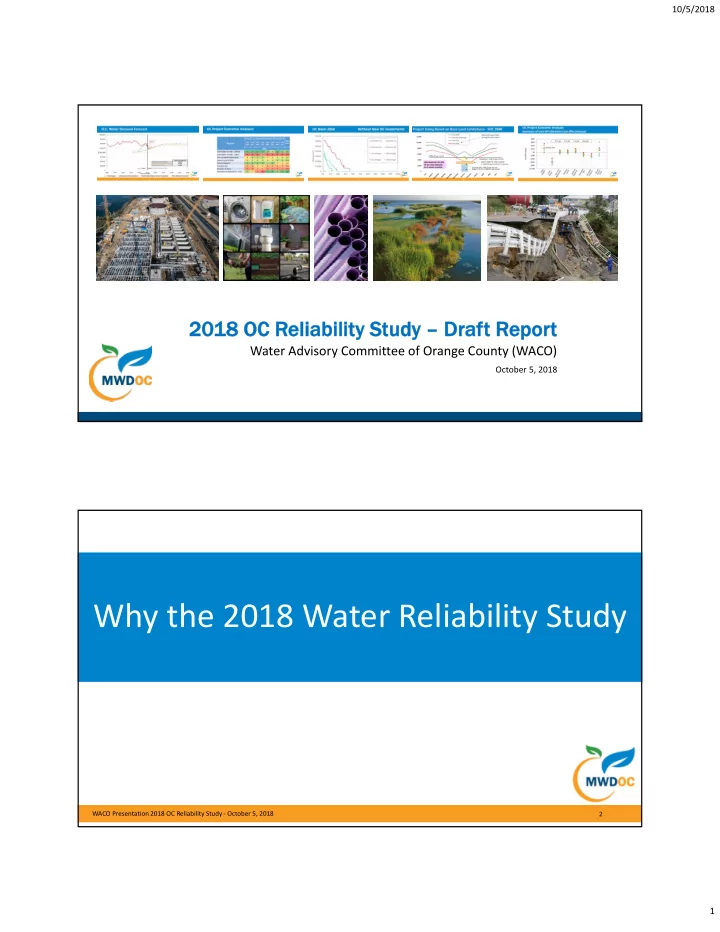
20 2018 OC R OC Reliability Study – liability Study – Draf raft R Repor port

Water Advisory Committee of Orange County (WACO)

October 5, 2018

Why the 2018 Water Reliability Study

2 WACO Presentation 2018 OC Reliability Study ‐ October 5, 2018

slide-2
SLIDE 2

10/5/2018 2

Changed Conditions and Need for 2018 Study

MET financially committed to WaterFix, assumed operational date 2035 MET completed detailed feasibility report on Carson IPR project Newer set of global climate models (GCMs) indicate:

Future temperatures will be significantly greater than GCMs used in 2016 Study Future precipitation will have significantly more variability & average values greater than those used in 2016 Study

Implementation of Bureau of Reclamation’s Draft Drought Contingency Plan for Colorado River results in greater MET shortages Several local Orange County projects have advanced Additional work completed on evaluating emergency needs in South Orange County (SOC)

WACO Presentation 2018 OC Reliability Study ‐ October 5, 2018 3

Objectives for 2018 OC Study

1) Provide unbiased, factual analysis of projects and the benefits they provide for decision‐making purposes 2) Develop new planning scenarios, reflecting changed conditions for MET reliability (assumes WaterFix and newer climate models) 3) Determine new water supply gaps (reliability curves) for OC Basin and SOC areas under new planning scenarios 4) Determine new water system (emergency) gap for SOC based on newer assumptions on emergency water demand needs 5) Estimate cost‐effectiveness of OC local projects in meeting supply reliability needs (Basin and SOC) and system reliability needs (SOC)

WACO Presentation 2018 OC Reliability Study ‐ October 5, 2018 4

NOT DICTATING MEMBER AGENCY DECISIONS

slide-3
SLIDE 3

10/5/2018 3

Three Study Areas in OC

Reliability evaluations are conducted for three regions within OC because the dependence on local groundwater sources varies considerably

75% Local Water 90% Local Water 5‐10% Local Water

WACO Presentation 2018 OC Reliability Study ‐ October 5, 2018 5

What it takes to evaluate our existing water supply reliability

6

What supply investments will MET make? What will they cost? How will MET supplies from the State Water Project and Colorado River Aqueduct perform over time? MET’s member agencies supply options What will demands do over time? MET’s Water Supply Allocation Plan (WSAP) & “Extraordinary Supplies” Potential Climate Change impacts MET’s Rate’s over time Need for local supplies in Orange County

WACO Presentation 2018 OC Reliability Study ‐ October 5, 2018

slide-4
SLIDE 4

10/5/2018 4

MET’s Integrated Resources Plan (IRP)

7

MUNICIPAL WATER DISTRICT OF ORANGE COUNTY (MWDOC) We are part of Metropolitan Water District

  • f Southern California

(MET) - we appoint 4 of 37 directors to the MET Board

WACO Presentation 2018 OC Reliability Study ‐ October 5, 2018

Supply Reliability Analysis Process

WACO Presentation 2018 OC Reliability Study ‐ October 5, 2018 8

DEMAND, SUPPLY & SCENARIOS RELIABILITY MODELLING & GAPs NEW OC WATER PROJECTS PROJECT FINANCIAL EVALUATIONS SYSTEM INTEGRATION

SUPPLY SCENARIOS DEMAND

94 Hydrologies Probability & Volume of Supply Shortages

slide-5
SLIDE 5

10/5/2018 5

Potential New OC Local Projects

9 WACO Presentation 2018 OC Reliability Study ‐ October 5, 2018

OC Project Summary for Water Supply

10

Project Online Date Yield (AFY) Supply Project System Emergency Extraordinary Supply

Cadiz Water Bank – SMWD 2020 5,000 Yes Cadiz Water Bank – Retail 2020 5,000 Yes San Juan Watershed Project 2022 9,480 Yes Yes Doheny Local (SCWD) 2021 5,321 Yes Yes Doheny Regional 2026 10,642 Yes Yes Poseidon SOC 2023 15,964 Yes Yes Poseidon OC Basin 2023 36,164 Yes Yes Groundwater Emergency 2022

Scalable

Yes IRWD SOC Regional Interconnection

Existing/ Expansion Under Study

Yes Strand Ranch Water Bank ‐ Pilot 2019 5,000 Some Yes Santa Ana River Conservation & Conjunctive Use Program (SARCCUP) 2019

36,000 AF of Storage, 12,000 AFY

Yes

WACO Presentation 2018 OC Reliability Study ‐ October 5, 2018

slide-6
SLIDE 6

10/5/2018 6

Cadiz Water Bank (SMWD and Retail)

11

Cadiz Inc., and SMWD long‐term groundwater management program in Cadiz and Fenner Valleys Benefits: An additional water supply source for Southern California. Risks:

  • MET has not agreed to commit to any

permanent or semi‐permanent capacity for Cadiz water in the Colorado River Aqueduct

  • The whole project needs to go for SMWD to

get supply from the project

WACO Presentation 2018 OC Reliability Study ‐ October 5, 2018

Cadiz Water Bank Terms for SMWD

12

Assumptions:

  • 1. Water Supply Cost at $190/AF escalates at

3% for future

  • 2. Water O&M Cost at $118/AF escalates at

2.72% for future

  • 3. Capital Recovery Charge not escalated
  • 4. Treatment for SMWD’s 5,000 AFY uses

incremental Baker WTP cost of $200, escalated at 3% for future

For SMWD as Co‐Developer: $2020

Base Allotment (+10,000 AF Option at Retail Rate)

5,000 AFY

Base (Water Supply) & Operating Costs

$308 /AF

MET Wheeling Rate

$547 /AF

Capital Recovery Charge ‐ Cadiz

$220 /AF

Delivered Cost of Untreated Cadiz Water to Baker

$1,075 /AF

Baker Incremental Treatment Charge

$200 /AF

Cost of Treated Cadiz Water (SMWD Rate)

$1,275 /AF

WACO Presentation 2018 OC Reliability Study ‐ October 5, 2018

slide-7
SLIDE 7

10/5/2018 7

Cadiz Water Bank Terms – for others (Retail)

13

Cadiz Retail: $2020

Additional Retail Amount

5,000 AFY

Base (Water Supply) & Operating Costs

$561 /AF

MET Wheeling Rate

$547 /AF

Capital Recovery Charge ‐ Cadiz

$220 /AF

Delivered Cost of Untreated Cadiz Water to Baker

$1,328 /AF

MET Water Treatment Charge

$323 /AF

Cost of Treated Cadiz Water (SMWD Rate)

$1,651 /AF

Assumptions:

  • 1. Water Supply Cost at $443/AF escalates at

3% for future

  • 2. Water O&M Cost at $118/AF escalates at

2.72% for future

  • 3. Capital Recovery Charge not escalated
  • 4. Treatment for Retail of 5,000 AFY uses

MET treated water rate

WACO Presentation 2018 OC Reliability Study ‐ October 5, 2018

Strand Ranch Pilot Program

14

Term: 7 years fixed (no “opt out”) provision Amount: 5,000 AF Charges: $25 per AF annually ($125,000 per year) $5,000 One‐time Set Up Fee Cost to Call Water: Actual Cost of Water Actual Recovery Cost Charges Fixed Capital Facility Use Fee MET Exchange Fee

Drought protection (insurance) program for extraordinary supply water from IRWD Water Bank.

WACO Presentation 2018 OC Reliability Study ‐ October 5, 2018

slide-8
SLIDE 8

10/5/2018 8

15

Benefits: Extraordinary supply priced below MET water with allocation surcharge 28% less than the MET surcharge (Savings  $3.85 million on 5,000 AF) Cost savings Pilot program vs. MET allocation surcharge  $771/AF. Risks: If option is not exercised then Reservation Charges are forgone ($125,000/Yr. x 7yrs = $880,000)

Strand Ranch Pilot Program

* Recovery Cost estimate based upon 3% escalation rate

Example:

WACO Presentation 2018 OC Reliability Study ‐ October 5, 2018 16

Strand Ranch Pilot Program Over 7 Years

Big question in the original evaluation of the Pilot Program was “will it be needed over 7 years”? Used 2030 reliability results for SOC as a proxy for “need” over next 7 years:

Even though the “need” is relatively low, if limited to one 5,000 AF call over the 7 years, the project costs look high compared to benefits. The project improves with up to two calls over the 7‐year period. This was used in the project evaluation.

Additional analysis needed for evaluation of the project out to 2035 or 2040

WACO Presentation 2018 OC Reliability Study ‐ October 5, 2018

slide-9
SLIDE 9

10/5/2018 9

San Juan Watershed Project

17

Project proposes to increase capture and storage of urban runoff & stormwater, optimize use of recycled water for reuse, and augment San Juan Basin groundwater supplies Phase I: Capture stormwater & urban runoff ‐ 700 AFY (Avg) potable water

Benefits: Provides an additional local water resource and greater utilization of existing assets (CSJC GWRP). Risks: Production uncertainty due to annual rainfall amounts and future climate hydrology.

Phase Startup Year Capital Cost Yield (AFY) Cost/AF in Startup Yr. $ Phase I 2019 $23.3 M 700 $2,198* Phase II 2022 $92.6 M 6,120 $1,581 Phase III 2022 $32.3 M 2,660 $1,200 Total Project 2022 $148.5 M 9,480 $1,521

* Phase I Cost/AF can be considered interim or startup costs

WACO Presentation 2018 OC Reliability Study ‐ October 5, 2018

San Juan Watershed Project

18

Phase III: Live stream recharge of recycled water ‐ 2,660 AFY Benefits: Same as Phase II Risks: Same as Phase II Phase II: Introduce recycled water to the creek ‐ 6,120 AFY Benefits: Recycled water is a sustainable & reliable local supply source. Risks:

Regulations for IPR and/or DPR are not complete. Project costs assume recycled water can be recharged without treatment in excess of tertiary treatment levels. Sufficient basin detention time may not be available. Rubber dam permits may be difficult. Additional recycled water required above current levels may be limited.

WACO Presentation 2018 OC Reliability Study ‐ October 5, 2018

slide-10
SLIDE 10

10/5/2018 10

Doheny Seawater Desalination – Local by South Coast

19

SCWD proposed ocean water desalination facility at Doheny Beach (Phase 1) Initial capacity up to 5 MGD. Potential for future expansions up to 15 MGD. Sizing used in analysis: 5 mgd at 95% load factor = 4.75 mgd (5,321 AFY) for comparison purposes with Poseidon HB Project Benefits: A reliable, locally controlled and drought‐proof water supply source. Risks: Slant well technology is a new technology that has been only been tested at a pilot scale at Doheny Beach and Cal Am.

Doheny Local Startup Year Capital Cost Yield (AFY) Cost/AF in Startup Yr. $ Phase 1 ‐ 5 MGD 2021 $107.2 M 5,321 $1,623

WACO Presentation 2018 OC Reliability Study ‐ October 5, 2018

Doheny Seawater Desalination – Local by South Coast

20

Assumptions:

  • 1. Capital Finance Rate: SCWD 5 MGD Project (2021)

Analyzed at 3% Capital Finance rate, over 30 years. $10 M DWR grant, MET LRP Funding ($475/Yr. for 15 Yrs.) included. Note: Lower Cost SRF funding & other grants (BOR) may be available, but were not included in analysis.

  • 2. Energy costs escalated annually at 2.6%
  • 3. Cost/AF includes annual O&M costs calculated (in 2021)

to be $491/AF. O&M costs for SCWD 5 MGD Project (2021) were escalated annually at a rate of 2%.

  • 4. Costs include oversizing of some components for future

expansions.

WACO Presentation 2018 OC Reliability Study ‐ October 5, 2018

slide-11
SLIDE 11

10/5/2018 11

Doheny Seawater Desalination – Regional

21

Potential expansion(s) of Local Desalination facility up to 15 MGD (at 95% load factor) Phase 2 expansion to 9.5 MGD (10,642 AFY) Phase 3 expansion to 14.25 MGD (15,963 AFY)

Doheny Regional Startup Year Capital Cost Yield (AFY) Cost/AF in Startup Yr. $ Phase 2 ‐ 5 MGD Expansion 2026 $74.5 M 5,321 $1,712 Phase 3 ‐ 5 MGD Expansion 2030 $73.7 M 5,321 $1,648

Benefits: A reliable, locally controlled and drought‐proof water supply source. Risks: Integration issues need to be resolved

WACO Presentation 2018 OC Reliability Study ‐ October 5, 2018

Doheny Seawater Desalination – Regional

22

Assumptions:

  • 1. Capital Finance Rate: SCWD 5 MGD Project (2021)

Phases 2 & 3 ‐ Expansions (2026 and 2030) analyzed at 4%, amortized over 30 years. MET LRP Funding ($475/Yr. for 15 Yrs.) included.

  • 2. Energy costs escalated annually at 2.6%
  • 3. Cost/AF includes annual O&M costs for Phases 2 & 3

Expansions (2026 & 2030) escalated annually at a rate of 3% after startup.

  • 4. Phase 2 includes regional interconnections with JTM &

WIP pipelines.

WACO Presentation 2018 OC Reliability Study ‐ October 5, 2018

slide-12
SLIDE 12

10/5/2018 12

Poseidon Seawater Desalination

23

Proposed ocean water desalination facility in Huntington Beach Capacity 50 MGD (56,000 AFY)

Benefits: A reliable, drought‐proof water supply source. Risks: Ability to secure MET LRP Program funding. Currently the project is delayed due to required environmental permit renewals and the new State Ocean Plan Amendments.

Startup Year Capital Cost (1) Yield (AFY) Cost/AF in Startup Yr. $ North OC 2023 $1,041.1 M 36,163 $2,183 South OC 2023 $433.4 M 15,963 $2,119 City of HB 2023 $0 3,360 95% of MET Rate

(1) Capital costs were estimated based on July 2018 OCWD Board Presentation

WACO Presentation 2018 OC Reliability Study ‐ October 5, 2018

Poseidon Seawater Desalination

24

Assumptions:

  • 1. MET LRP funding ($475/Yr. for 15 Yrs.) is included.
  • 2. Cost per AF includes annual Plant and Pipeline O&M costs.

Costs & Escalation Rates Plant North OC Pipelines South OC Pipeline Capital Finance Rate (over 30 yrs) 4.86% 4.0% 4.0% Energy Costs/AF (in Startup Year 2023) $376 Plant Energy Cost Escalation Rate 2.5% O&M Costs/AF (in Startup Year 2023) Includes energy lift $545 $31 $62 O&M Cost Annual Escalation Rate 2.0% 2.6% 2.6%

WACO Presentation 2018 OC Reliability Study ‐ October 5, 2018

slide-13
SLIDE 13

10/5/2018 13

Poseidon Seawater Desalination Integration Schematic

25

A E D C B G F

WACO Presentation 2018 OC Reliability Study ‐ October 5, 2018

Costs Estimated for Integration of Poseidon Water

26

Key to Poseidon Integration Schematic

22.05 cfs to SOC & 49.95 cfs to OCWD Segment Description Capital Cost in Millions 2023 Dollars Total Basin Cost SOC Cost A & B Hamilton & Brookhurst Pipelines 4,000‘ of 48” and 14,200’ of 48” $31.8 $19.7 $12.1 C SOC Connector to OC‐44 2,300’ of 30” or 36” $2.9 $1.0 $1.9 D Parallel to OC‐44 16,000 ‘ of 14” or 20” $11.4 $3.8 $7.5 D Buy‐In to existing OC‐44 Line $4.1 $1.3 $2.7 E Pipeline to WOCWB Feeders 32,000’ of 27” $49.0 $49.0 $0.0 F Pipeline to Barrier 8,000’ of 30” $122.0 $122.0 $0.0 G EOCF#2 Connector 19,500’ of 24” or 30” includes booster pump, flow control facility, chloramination & connection to EOCF#2 $36.5 $0.0 $36.5 Total $257.6 $196.9 $60.7 Numbers may be affected by rounding; assumes 5.0 cfs goes directly to Huntington Beach

WACO Presentation 2018 OC Reliability Study ‐ October 5, 2018

slide-14
SLIDE 14

10/5/2018 14

Emergency Groundwater

27 WACO Presentation 2018 OC Reliability Study ‐ October 5, 2018

Conceptual at this time; similar to MET’s Conjunctive Use Program Wells can be used by Producer’s until needed by SOC during emergency Cost sharing & other terms to be determined Max SOC need = 27 MGD (42 cfs); depends on IRWD System evaluation As an example, assumes SOC Pays: 1/3 cost of wells Full cost of booster pump station & connection to pipeline Full cost of replacement water + 5% losses $100 per AF fee to OCWD

Still evaluating ability of IRWD system to provide supplies

System (emergency) NEEDS

28 WACO Presentation 2018 OC Reliability Study ‐ October 5, 2018

slide-15
SLIDE 15

10/5/2018 15

What is Water Reliability?

WACO Presentation 2018 OC Reliability Study ‐ October 5, 2018 29

System Reliability

How reliable is your system (can demands be met) under different emergency situations?

Supply Reliability

How often are you short water supplies and how much are you short (Mandatory Reductions)

MET Seismic Performance Expectations Estimated Outage Durations

Facility Maximum Considered Earthquake

Metropolitan – CRA (Colorado River Aqueduct) 2‐6 months

  • Dept. of Water Resources – SWP

(State Water Project East & West Branches) 6‐24+ months Metropolitan ‐ Conveyance & Distribution Pipelines 1 week to 3 months Metropolitan ‐ Treatment Plants 1‐2 months (Partial flow) Up to 6 months (Full capacity)

WACO Presentation 2018 OC Reliability Study ‐ October 5, 2018 30

slide-16
SLIDE 16

10/5/2018 16

31

SOC needs between 20.0 & 27.5 mgd assuming NO capacity is available through the SOC Interconnection A study is underway to examine the ability

  • f the SOC Interconnection to extend or

expand deliveries to SOC

Summary of Emergency Reliability Needs in MGD for SOC for 60 days Assumes NO Emergency Capacity from the SOC Interconnection

Recovery Needs MGD(1) Recovery Needs MGD(2) El Toro WD 0.3 1.7 Laguna Beach CWD ‐‐‐ ‐‐‐ Moulton Niguel WD 6.7 9.7 San Clemente 3.5 4.5 San Juan Capistrano 2.7 2.0 Santa Margarita WD 4.1 6.2 South Coast WD 2.6 3.3 Trabuco Canyon WD ‐‐‐ ‐‐‐ Total 20.0 27.5 (1) 75% of annual average “normalized” 2017‐18 demand (2) 2040 indoor usage at 55 gpcd + 2040 CII demands

WACO Presentation 2018 OC Reliability Study ‐ October 5, 2018

System Reliability Projects Being Discussed

Poseidon Water Groundwater Doheny Water SOC Interconnection Baker WTP San Juan Watershed

WACO Presentation 2018 OC Reliability Study ‐ October 5, 2018 32

slide-17
SLIDE 17

10/5/2018 17

Evaluating the System Reliability of New Local Projects

33

Evaluation Metric (EM) – uses Present Value Analysis for the following:

System Reliability EM = Benefit = Avoided annual MET water purchases MINUS Cost = local project capital and O&M costs over life of project, DIVIDED by project capacity (MGD). Positive numbers are better than negative numbers.

WACO Presentation 2018 OC Reliability Study ‐ October 5, 2018

Ranking of SOC Local Projects for System Reliability

34

Project Max Capacity (MGD) EM (2) 1A EM 1B EM 2A EM 2B Average EM

Project Ranking

(3)

Doheny Local (SCWD) 4.75 ‐$5.9 ‐$2.8 ‐$5.6 ‐$1.0 ‐$3.8

4

Doheny Regional 9.50 ‐$3.0 $0.3 ‐$2.7 $2.3 ‐$0.8

1

San Juan Watershed Project 8.50 ‐$5.1 ‐$2.3 ‐$4.9 ‐$0.6 ‐$3.2

3

Poseidon SOC 14.25 ‐$10.3 ‐$7.0 ‐$10.0 ‐$5.0 ‐$8.1

5

Emergency Groundwater (1) 9.70 ‐$2.3 ‐$2.3 ‐$2.3 ‐$2.4 ‐$2.3

2

1) This project is scalable to fill remaining system reliability need. 2) Represents avoided discounted MET water purchases for different water rate scenarios LESS discounted project costs, DIVIDED by emergency capacity (MGD) = $/MGD. Positive numbers indicate that project is cheaper than purchasing MET water over the life of project. Negative numbers indicate that project is more expensive than purchasing MET water. 3) Ranking is based on average EM between four scenarios, converted to a rank score from 1 (best) to 5 (worst).

WACO Presentation 2018 OC Reliability Study ‐ October 5, 2018

slide-18
SLIDE 18

10/5/2018 18

SOC Portfolio for System Reliability

35

5 10 15 20 25 30 35 40 45 50

Doheny Local (SCWD) San Juan Watershed Project Doheny Regional Emergency Groundwater Cadiz SMWD Extraordinary Supplies

50,000 45,000 40,000 35,000 30,000 25,000 20,000 15,000 10,000 5,000

Range

  • f

need Average need Average need

System Reliability Portfolio (MGD)

Supply Reliability Portfolio (AFY) MGD AFY

Contingency capacity

Range

  • f

need

  • Three most cost effective base loaded

local projects form the base

  • Doheny Local
  • San Juan Watershed
  • Doheny Regional
  • Additional capacity added with

Emergency Groundwater Projects

  • Opportunity to build contingency

capacity with emergency groundwater

WACO Presentation 2018 OC Reliability Study ‐ October 5, 2018 35

Supply NEEDS

36 WACO Presentation 2018 OC Reliability Study ‐ October 5, 2018

slide-19
SLIDE 19

10/5/2018 19

Evaluating Supply Reliability of New Local Projects

37

  • Evaluation Metric (EM) – uses Present Value Analysis for the following
  • Uses reliability curves to determine years and amounts of shortages

Supply Reliability EM = When there are no expected water shortages, EM is avoided annual MET water purchases DIVIDED by local project costs (capital and O&M) over life of project; BUT during water shortages, EM is avoided annual MET water purchases PLUS avoided drought allocation surcharge, DIVIDED by local project costs. A ratio near or greater than 1.0 is better than a ratio less than 1.0.

WACO Presentation 2018 OC Reliability Study ‐ October 5, 2018

Supply Reliability

NOTE: Many Local Water Projects in SOC Provide Both System and Supply Reliability

Supply Reliability during dry years is needed for long‐ term economic vitality and quality of life

For SOC and OC Basin: Annual total water demand

less

Existing water supplies and expected MET water supplies during wet, normal and dry hydrologic periods

equals

Need for New Local Projects, Extraordinary Supplies, Basin Management, and/or Demand Curtailment

38 WACO Presentation 2018 OC Reliability Study ‐ October 5, 2018

slide-20
SLIDE 20

10/5/2018 20

Supply Reliability Analysis Process

WACO Presentation 2018 OC Reliability Study ‐ October 5, 2018 39

DEMAND, SUPPLY & SCENARIOS RELIABILITY MODELLING & GAPs NEW OC WATER PROJECTS PROJECT FINANCIAL EVALUATIONS SYSTEM INTEGRATION

SUPPLY SCENARIOS DEMAND

94 Hydrologies Probability & Volume of Supply Shortages

O.C. Water Demand Forecast

100,000 200,000 300,000 400,000 500,000 600,000 700,000 800,000 1990 1995 2000 2005 2010 2015 2020 2025 2030 2035 2040

AFY Fiscal Year Ending

Actual Usage Existing Levels of Conservation Baseline New Passive/ Active Conservation 20% Landscape Conversion

Projected (Average Weather) Actual Existing Levels of Conservation Baseline New Passive/ Active Conservatio 20% Landscape Conversion 2040 Annual Usage (AF) 617,395 579,189 549,006

24% 21%

WACO Presentation 2018 OC Reliability Study ‐ October 5, 2018 40

slide-21
SLIDE 21

10/5/2018 21

CMIP5 RCP8.5 Climate Models and Impacts on Supplies

Greater Impact on supplies Less Impact on supplies

GCMs with significant impacts

  • n both CRA & SWP

supplies GCMs with moderate impacts

  • n either CRA or

SWP supplies (but not both)

Used for 2018 OC Study Scenarios

MINIMAL Climate Change SIGNIFICANT Climate Change

GCMs with minimal impacts on SWP and no impacts on CRA

WACO Presentation 2018 OC Reliability Study ‐ October 5, 2018 41

NEW Supplies Included Under the Various Scenarios

(1,000’s of AF per Year)

New Supplies Above MET’s Current Scenario 1A 1B 2A 2B WaterFix (approved by MET Board) 440 440 440 440 CRA Transfers (base loaded) 100 100 100 100 LRP (base loaded) 88 88 88 88 Carson IPR (base loaded) 168 168 More LRP (base loaded) 74 74 More CRA Transfers (dry year) 80 80 SWP Transfers (dry year) 150 150 150 More SWP Transfers (dry year) 150 Regional Surface Reservoir (dry year) 400 Total Base Loaded and Dry Year 628 946 932 1,650

WACO Presentation 2018 OC Reliability Study ‐ October 5, 2018 42

Scenario 1: Minimal Climate Change Scenario 2: Significant Climate Change Level A Investments: Low Cost Level B Investments: High Cost

slide-22
SLIDE 22

10/5/2018 22

43

Minimum Climate Change, Low MWD Investment Minimum Climate Change, High MWD Investment Significant Climate Change, Low MWD Investment Significant Climate Change, High MWD Investment

200,000 400,000 600,000 800,000 1,000,000 1,200,000 1,400,000 1,600,000 1,800,000 2020 2021 2022 2023 2024 2025 2026 2027 2028 2029 2030 2031 2032 2033 2034 2035 2036 2037 2038 2039 2040 2041 2042 2043 2044 2045 2046 2047 2048 2049 2050

NEW MET Supplies ‐ Combination of Transfers, Local Projects, Carson IPR, WaterFix, & Additional Surface Reservoir (for Sc 2B) in AF per Year 2030 2040 2050

WACO Presentation 2018 OC Reliability Study ‐ October 5, 2018

MET Rate Projections by Planning Scenario

(MET Tier 1 Treated Rate + MWDOC RTS/Capacity charge)

$500 $1,000 $1,500 $2,000 $2,500 $3,000 $3,500 $4,000 2020 2025 2030 2035 2040 2045 2050

Avoided MET Cost ($/AF) 188,000 AFY of new LRP and transfers + 312,000 AFY of additional LRP and transfers + 168,000 AFY Carson and 50,000 additional transfers + 400,000 AFY new reservoir

  • Sc. 1A = 3.0%
  • Sc. 2A = 3.2%
  • Sc. 1B = 3.6%
  • Sc. 2B = 4.2%

WACO Presentation 2018 OC Reliability Study ‐ October 5, 2018 44

Escalation from 2028 to 2050

slide-23
SLIDE 23

10/5/2018 23

MET Supply Gaps

With Significant Climate Change Impacts in 2050

200,000 400,000 600,000 800,000 1,000,000 1,200,000 1,400,000 1,600,000 1,800,000 2,000,000 2,200,000 0% 10% 20% 30% 40% 50% 60% 70% 80% 90% 100% Shortage (AF) With Low‐Cost Investments With High‐Cost Investments No New Projects 2016 Study ‐ Scenario 2 MET Port B (Sc 2A) (Sc 2B)

Benefit of Carson IPR, Transfers and New Reservoir Projects

WACO Presentation 2018 OC Reliability Study ‐ October 5, 2018 45

Benefit of WaterFix, LRP projects & Transfers

Comparison of MET Supply Gaps in 2050 Under Different Levels of Climate Change

MINIMAL Climate Change Probability

  • f Shortage

SIGNIFICANT Climate Change Magnitude

  • f Shortage

WACO Presentation 2018 OC Reliability Study ‐ October 5, 2018 46

Magnitude

  • f Shortage

Probability

  • f Shortage
slide-24
SLIDE 24

10/5/2018 24

South OC 2050 Reliability Curves Without New OC Investments

10,000 20,000 30,000 40,000 50,000 60,000 70,000 0% 10% 20% 30% 40% 50% 60% 70% 80% 90% 100% Shortage (AF) Scenario 1A Scenario 1B Scenario 2A Scenario 2B 1A average 1B average 2A average 2B average

WACO Presentation 2018 OC Reliability Study ‐ October 5, 2018 47

Total Demand = 120,000 AF (Max Shortage = 53,000 AF = 48%of Total Demand)

OC Basin 2050 Reliability Curves Without New OC Investments

10,000 20,000 30,000 40,000 50,000 60,000 70,000 0% 10% 20% 30% 40% 50% 60% 70% 80% 90% 100% Shortage (AF) Scenario 1A Scenario 1B Scenario 2A Scenario 2B 1A average 1B average 2A average 2B average

WACO Presentation 2018 OC Reliability Study ‐ October 5, 2018 48

Total Demand = 400,000 AF (Max Shortage = 62,000 AF = 16% of Total Demand)

slide-25
SLIDE 25

10/5/2018 25

Agencies Can Take Different Paths to be Reliable

Decide on the role of Demand Curtailment, at what level and frequency Account for integration of base loaded supplies, to minimize shutting down projects in low demand months Optional Paths:

1) Base load supplies for the peak shortages (max gap); concern is over‐investing 2) Base load supplies for the average shortages; concern is under‐investing 3) Demand curtailment and use of extraordinary supplies; concern is not as reliable 4) Middle ground: combinations of demand curtailment for rare events, extraordinary supplies for less rare but significant shortage events, and base loaded supplies for more dependability

WACO Presentation 2018 OC Reliability Study ‐ October 5, 2018 49

SOC Supply – Range of Remaining Gaps after Conservation

Scenario 2030 Max GAP AFY 2040 Max GAP AFY 2050 Max GAP AFY Max Gap Conservation at 10% Remaining GAP 1 A) Minimal Climate Impacts with Low‐Cost MET Investments 27,000 24,000 28,000 28,000 12,000 16,000 1 B) Minimal Climate Impacts with High‐Cost MET Investments 22,000 5,000 22,000 12,000 10,000 2 A) Significant Climate Impacts with Low‐Cost MET Investments 57,000 53,000 53,000 57,000 12,000 45,000 2 B) Significant Climate Impacts with High‐Cost MET Investments 56,000 26,000 37,000 56,000 12,000 44,000

Range after conservation 10,000 – 45,000

WACO Presentation 2018 OC Reliability Study ‐ October 5, 2018 50

slide-26
SLIDE 26

10/5/2018 26

OC Basin ‐ Range of Remaining Gaps after Conservation

Scenario 2030 Max GAP AFY 2040 Max GAP AFY 2050 Max GAP AFY Max Gap Conservation at 10% Remaining GAP 1 A) Minimal Climate Impacts with Low‐Cost MET Investments 56,000 35,000 41,000 56,000 40,000 16,000 1 B) Minimal Climate Impacts with High‐Cost MET Investments 22,000 5,000 22,000 40,000 2 A) Significant Climate Impacts with Low‐Cost MET Investments 62,000 62,000 62,000 62,000 40,000 22,000 2 B) Significant Climate Impacts with High‐Cost MET Investments 56,000 28,000 39,000 56,000 40,000 16,000

Range after conservation 0 – 22,000

WACO Presentation 2018 OC Reliability Study ‐ October 5, 2018 51

Potential Local Projects by OCWD NOT included in the modeling

Project Amount (afy)

CADIZ for OCWD supplies 5,000 to 10,000 West Orange County Well Field 3,000 to 6,000 Prado Dam Operations to 505’ year round 7,000 Purchasing Upper SAR Watershed Supplies ? Silting up of Prado Dam (loss of storage) ? GWRS RO Brine Recovery 5,000 to 10,000 Purchase Land for Additional Replenishment Basins ? SARCCUP – dry year yield 12,000 Chino Basin Water Bank ? Capture Urban Runoff/Shallow GW for Recycling ?

WACO Presentation 2018 OC Reliability Study ‐ October 5, 2018 52

? = Amount not available at this time

slide-27
SLIDE 27

10/5/2018 27

OC Project Summary for Water Supply (all projects except Cadiz and Strand Ranch assumed to get LRP funding for 15 years at $475)

53

Project Online Date Yield (AFY) Startup Year Cost/AF Year 2030 Cost/AF Year 2040 Cost/AF Year 2050 Cost/AF

Cadiz Water Bank – SMWD 2020 5,000 1,275 1,768 2,391 3,236 Cadiz Water Bank – Retail 2020 5,000 1,651 2,165 2,822 3,710 San Juan Watershed Project1 2022 9,480 1,521 1,812 2,762 3,258 Doheny Local (SCWD)1 2021 5,321 1,623 1,894 2,746 3,224 Doheny Regional1 2026 10,642 1,712 1,856 2,281 3,296 Poseidon SOC1 2023 15,964 2,119 2,283 3,042 3,398 Poseidon OC Basin1 2023 36,164 2,183 2,341 3,177 3,430 Strand Ranch Water Bank ‐ Pilot 2019 5,000 MET Water – 1A 1,679 2,261 3,029 MET Water – 1B 1,925 2,551 3,373 MET Water – 2A 1,715 2,276 3,045 MET Water – 2B 1,967 2,787 3,649

1 – Year LRP funding ends for each project: San Juan Watershed ‐ 2035; Doheny Local ‐ 2036; Doheny Regional ‐ 2041; Poseidon SOC ‐ 2038; Poseidon OC Basin ‐ 2038

WACO Presentation 2018 OC Reliability Study ‐ October 5, 2018

MET Rate Projections under Scenarios – does not include allocation surcharge

OC Projects Supply Economic Ranking:

WACO Presentation 2018 OC Reliability Study ‐ October 5, 2018 54

Project Scenario 1A Scenario 1B Scenario 2A Scenario 2B

Average

NPV EM NPV EM NPV EM NPV EM

Rank

Cadiz Water Transfer – SMWD 1 1 2 1 2 3 2 3

1.9

Cadiz Water Transfer – Additional 6 6 6 5 6 6 6 6

5.9

San Juan Watershed Project 5 3 5 3 3 5 3 5

4.0

Doheny Local (SCWD) 4 4 4 4 4 4 4 4

4.0

Doheny Regional 3 2 1 2 1 2 1 2

1.8

Poseidon SOC 7 7 7 6 7 7 7 7

6.9

Poseidon OC Basin 8 8 8 7 8 8 8 8

7.9

Strand Ranch Water Bank – Pilot 2 5 3 8 5 1 5 1

3.8 NPV = Net Present Value EM = Evaluation Metric
slide-28
SLIDE 28

10/5/2018 28

Potential Downside Financial Risk for Supplies

Local investment is made, but supply reliability turns out to be good (Scenario 1B)

$‐ $25 $50 $75 $100 $125 $150 $175 $200 $225 $250 Cadiz Water Bank ‐ SMWD Cadiz Water Bank ‐ Retail San Juan Watershed Project Doheny Local (SCWD) Doheny Regional Poseidon SOC Poseidon Basin Strand Ranch Water Bank ‐ Pilot Present Value Project Cost Exceeds Present Value Avoided MET Purchase ($M)

WACO Presentation 2018 OC Reliability Study ‐ October 5, 2018 55

Project Sizing Based on Base Load Limitations ‐ SOC 2040

56

Import water for water quality for 3 months and headroom for 9 months @ 1,300 AF per month Baker = 33 cfs = 2,000 AF per month Existing GW = 500 AF per month

Max Baseload =22,500 AF per year (reduced for 3 winter months)

Headroom @ 900 AF per month 4,700 AF per month

WACO Presentation 2018 OC Reliability Study ‐ October 5, 2018

slide-29
SLIDE 29

10/5/2018 29

SOC Supply – Range of Remaining Gaps after Conservation

Scenario 2030 Max GAP AFY 2040 Max GAP AFY 2050 Max GAP AFY Max Gap Conservation at 10% Remaining GAP 1 A) Minimal Climate Impacts with Low‐Cost MET Investments 27,000 24,000 28,000 28,000 12,000 16,000 1 B) Minimal Climate Impacts with High‐Cost MET Investments 22,000 5,000 22,000 12,000 10,000 2 A) Significant Climate Impacts with Low‐Cost MET Investments 57,000 53,000 53,000 57,000 12,000 45,000 2 B) Significant Climate Impacts with High‐Cost MET Investments 56,000 26,000 37,000 56,000 12,000 44,000

Range after conservation 10,000 – 45,000

WACO Presentation 2018 OC Reliability Study ‐ October 5, 2018 57

SOC Building Blocks of Reliability Generalized for 2030

10,000 20,000 30,000 40,000 50,000 60,000 70,000 0% 10% 20% 30% 40% 50% 60% 70% 80% 90% 100% Shortage (AF) Scenario 1A Scenario 1B 1A average 1B average

Base Load Supplies of 22,500 AFY Demand Curtailment of 4,000 AFY (3% of demand), occurs less than 1 in 20 years

WACO Presentation 2018 OC Reliability Study ‐ October 5, 2018 58

slide-30
SLIDE 30

10/5/2018 30

SOC Building Blocks of Reliability Generalized for 2030

10,000 20,000 30,000 40,000 50,000 60,000 70,000 0% 10% 20% 30% 40% 50% 60% 70% 80% 90% 100% Shortage (AF) Scenario 2A Scenario 2B 2A average 2B average

Base Load Supplies of 22,500 AFY Storage or Extraordinary Supplies of 22,000 AFY,

  • ccurs 1 in 7 years

Demand Curtailment of 12,000 AFY (10% of demand),

  • ccurs less than 1 in 20 years

WACO Presentation 2018 OC Reliability Study ‐ October 5, 2018 59

SOC Portfolio for Supply Reliability

60

5 10 15 20 25 30 35 40 45 50

Doheny Local (SCWD) San Juan Watershed Project Doheny Regional Emergency Groundwater Cadiz SMWD Extraordinary Supplies

50,000 45,000 40,000 35,000 30,000 25,000 20,000 15,000 10,000 5,000

Range

  • f

need Average need Average need System Reliability Portfolio (MGD)

Supply Reliability Portfolio (AFY)

MGD AFY

Contingency capacity

Range

  • f

need

  • Four most cost effective local

projects build the base

  • Doheny Local
  • San Juan Watershed
  • Doheny Regional
  • Cadiz SMWD
  • Additional capacity added with

Storage or Extraordinary Supply Projects

WACO Presentation 2018 OC Reliability Study ‐ October 5, 2018 60

slide-31
SLIDE 31

10/5/2018 31

OC Basin Supply Gaps with No New OC Projects

Scenario 2030 Max GAP AFY 2040 Max GAP AFY 2050 Max GAP AFY Max Gap Conservation at 10% Remaining GAP 1 A) Minimal Climate Impacts with Low‐Cost MET Investments 56,000 35,000 41,000 56,000 40,000 16,000 1 B) Minimal Climate Impacts with High‐Cost MET Investments 22,000 5,000 22,000 40,000 2 A) Significant Climate Impacts with Low‐Cost MET Investments 62,000 62,000 62,000 62,000 40,000 22,000 2 B) Significant Climate Impacts with High‐Cost MET Investments 56,000 28,000 39,000 56,000 40,000 16,000

Range after conservation 0 – 22,000

WACO Presentation 2018 OC Reliability Study ‐ October 5, 2018 61

OC Basin Building Blocks of Reliability Generalized for 2030

10,000 20,000 30,000 40,000 50,000 60,000 70,000 0% 10% 20% 30% 40% 50% 60% 70% 80% 90% 100% Shortage (AF) Scenario 1A Scenario 1B 1A average 1B average

Demand Curtailment of 30,000 AFY (8% of demand), occurs less than 1 in 20 years

WACO Presentation 2018 OC Reliability Study ‐ October 5, 2018 62

slide-32
SLIDE 32

10/5/2018 32

OC Basin Building Blocks of Reliability Generalized for 2030

10,000 20,000 30,000 40,000 50,000 60,000 70,000 0% 10% 20% 30% 40% 50% 60% 70% 80% 90% 100% Shortage (AF) Scenario 2A Scenario 2B 2A average 2B average

Base Loaded Supplies of 22,000 AFY Demand Curtailment of 40,000 AFY (10% of demand), occurs less than 1 in 20 years Other Projects or Extraordinary Supplies of 18,000 AFY,

  • ccurs less than 1 in 10 years

WACO Presentation 2018 OC Reliability Study ‐ October 5, 2018 63

Primary Findings – 2018 OC Reliability Study

1) Reliability in the OC Basin area, with 10% demand curtailment once every 20 years, is acceptable and there are a number of projects that can improve basin reliability. 2) Emergency supply needs in the event of a MET system outage exist today in the South Orange County (SOC) area and is the major driver for new local projects in SOC. 3) SOC needs additional supply projects, beyond the emergency supply needs, even with the demand curtailment of 10% every 20 years. 4) There are number of projects that can meet both the emergency and supply reliability needs of SOC but they differ significantly in cost, cost‐ efficiency, yield and ability to integrate into the existing system.

WACO Presentation 2018 OC Reliability Study ‐ October 5, 2018 64

slide-33
SLIDE 33

10/5/2018 33

Primary Findings – 2018 OC Reliability Study

5) The San Juan Watershed Project and the Doheny Project both provide cost‐effective annual and emergency supplies. Therefore, they should make up the core reliability improvement strategy in SOC. Collectively, these projects can provide the following supply volumes:

WACO Presentation 2018 OC Reliability Study ‐ October 5, 2018 65

Maximum Supply (AFY) Peak Supply (MGD)

Doheny 15,963 14.25 San Juan Watershed 9,480 8.50 Total 25,443 22.75 Maximum Need 45,000 27.50

Remaining Need 19,557 4.75 Supply System Remaining Needs Recommend 10 to 20 mgd for flexibility

Primary Findings – 2018 OC Reliability Study

6) There are several issues with developing base loaded local supplies:

Operational constraints include those ensuring full project delivery during winter month demands and maintaining minimum imported water deliveries to maintain adequate water quality in the distribution system Local projects can result in the stranding of MET assets MET’s Water Supply Allocation Plan (WSAP) does not provide a 1:1 supply benefit for local projects during allocations These base load supply issues could be addressed by changes to MET WSAP policies, changes in operations of existing and new supplies during winter months, or by seeking drought protection by way of water storage or extraordinary supplies.

WACO Presentation 2018 OC Reliability Study ‐ October 5, 2018 66

slide-34
SLIDE 34

10/5/2018 34

Primary Findings – 2018 OC Reliability Study

7) Additional study is recommended to determine the appropriate sizing of Doheny and Phases 2 and 3 of the San Juan Watershed projects, reflecting system integration and operational issues during winter months. 8) The Strand Ranch drought protection program was evaluated as a seven year pilot program. MWDOC should use the methods and results available from the 2018 study to further structure the pilot program and to develop terms and conditions for a potentially expanded program with Strand Ranch or other extraordinary supply programs (e.g., SARCCUP). The potential term would extend beyond the start‐up of the WaterFix.

WACO Presentation 2018 OC Reliability Study ‐ October 5, 2018 67

Additional Findings – 2018 OC Reliability Study

  • A. The Carson IPR Project may be the next least cost supply available to the

OC Basin, pending final terms and conditions. MWDOC and OCWD should work together to fully evaluate the opportunity.

  • B. OCWD is pursuing the SARRCUP Project which could provide significant

benefits in the form of extraordinary supply. If not needed by the OC Basin, the utilization by others in OC should be evaluated. MWDOC and OCWD should work together on this effort.

  • C. Given that the Poseidon SOC Project was not cost‐effective relative to
  • ther SOC options, a full 56,000 AFY Poseidon project for the OC Basin

would incur greater system integration costs than included in this study, thereby resulting in lower cost‐effectiveness than presented.

WACO Presentation 2018 OC Reliability Study ‐ October 5, 2018 68

slide-35
SLIDE 35

10/5/2018 35

Additional Findings – 2018 OC Reliability Study

  • D. Given the scenarios examined, the Poseidon Project is not cost effective to

augment the OC Basin when compared to MET water (including purchases with the allocation surcharge). However Poseidon would be beneficial to OC under the following circumstances:

MET implements Poseidon as a regional project Climate change is even more extreme than the Significant Climate Change Scenarios (low probability) resulting in low reliability from MET, and OC decides to implement the project OC decides that we want a higher degree of independence from MET and that the Poseidon Project should be implemented in spite of cost impacts.

WACO Presentation 2018 OC Reliability Study ‐ October 5, 2018 69

Additional Findings – 2018 OC Reliability Study

  • E. A new 400,000 AF storage reservoir in Southern California will only be

beneficial under specific future conditions when there are sufficient supplies available to put into storage and when the additional storage is needed to meet demands. The specific conditions are rare occurrences and it is unlikely that a large reservoir investment would be cost efficient.

  • F. MWDOC should use the information developed herein to support efforts

at MET regarding:

The clarity of MET’s development and presentation of their IRP for 2020, especially with respect to future investments needed for full reliability under a range of alternatives including adverse climate change. Need for changes in MET’s LRP program and MET’s WSAP to provide

  • pportunities for improved drought protection by the Member Agencies.

WACO Presentation 2018 OC Reliability Study ‐ October 5, 2018 70

slide-36
SLIDE 36

10/5/2018 36

Additional Findings – 2018 OC Reliability Study

  • G. While the 2016 and 2018 study results indicated minimal emergency

supply needs for the OC Basin and Brea/La Habra areas, there remains a critical need for backup generators throughout Orange County.

WACO Presentation 2018 OC Reliability Study ‐ October 5, 2018 71

Next Steps

WACO Presentation 2018 OC Reliability Study ‐ October 5, 2018 72

Continue discussions with agencies Comments to November MWDOC P&O Committee; need to submit by October 26 Work on spin‐off efforts from study