PRESENTATION TITLE Beyond! Karl W. Seckel, P.E. Assistant General - - PowerPoint PPT Presentation

presentation title
SMART_READER_LITE
LIVE PREVIEW

PRESENTATION TITLE Beyond! Karl W. Seckel, P.E. Assistant General - - PowerPoint PPT Presentation

Orange County Water and PRESENTATION TITLE Beyond! Karl W. Seckel, P.E. Assistant General Manager Municipal Water District of Orange County April 3, 2018 Topics for Presentation Water Basics Water Conservation Climate Change


slide-1
SLIDE 1

PRESENTATION TITLE

Karl W. Seckel, P.E. Assistant General Manager Municipal Water District of Orange County April 3, 2018
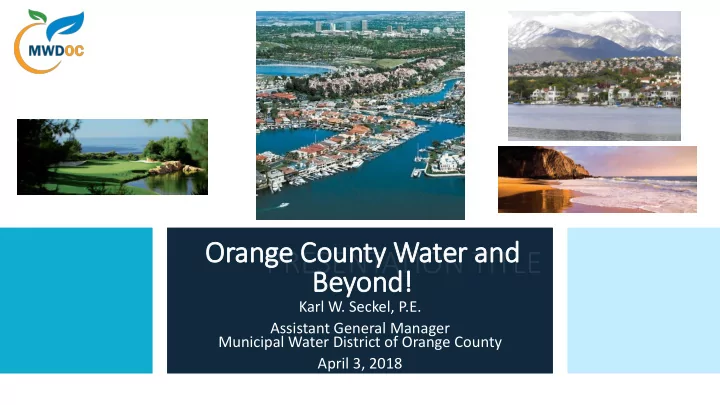
Orange County Water and Beyond!

slide-2
SLIDE 2

2

Topics for Presentation

  • Water Basics
  • Water Conservation
  • Climate Change
  • Colorado River Over Allocation
  • The Drought and how we survived
  • Bay-Delta, California WaterFix – History Being Made!
  • Carson Regional Indirect Potable Supply (Carson IPR)
  • OC Water Reliability Study
  • Parting Thoughts
slide-3
SLIDE 3

3

Drinking Water Cognition

24/7 + 365

slide-4
SLIDE 4

Who we are and where our supplies originate

4

slide-5
SLIDE 5

OC has 30 Retail and 2 Wholesale Water Agencies serving 3.1 million residents

5

slide-6
SLIDE 6

Local Supplies Groundwater & Recycling Ocean Desalination (future) Conservation (Water Use Efficiency) Colorado River Aqueduct (1941) State Water Project Entitlement (1972) Transfers & Storage

Bay Delta Area

25% 25% 50%

Where OC Gets Its Water ~50% Import ~50% Local

6

slide-7
SLIDE 7

How Much Water Do We Use?

  • Southern California = 3.6 Million Acre Feet (MAF)
  • Southern California Imported = 1.8 MAF
  • Orange County Total = 0.5 MAF
  • Indoor usage = 50 gallons per person per day
  • Outdoor usage = depends on size of yard, type of

planting, type of irrigation, # of residents, but somewhere around 100 gallons per person per day average

1 Acre-Foot = 1 Football Field 1 foot deep (also 326,000 Gallons)

7

slide-8
SLIDE 8

Wholesale Water Club

8

Metropolitan Water District Of Southern California (MET) (MWD) (Metropolitan) (Imported – Regional) (MWDOC) Municipal Water District of Orange County (Imported – Orange County) Orange County Water District (OCWD) (Groundwater – Orange County) Orange County Sanitation District (OCSD) (Wastewater – North Orange County) South Orange County Wastewater Authority (SOCWA) – South Orange County 8

slide-9
SLIDE 9

1. Brea/La Habra 2. OCWD 3. Non-OCWD South County 1+2+3 =Total OC

75% Local Water 90% Local Water 5-10% Local Water

OC Study Areas based on Local Resources

9

slide-10
SLIDE 10

10

MWDOC has 7 Directors elected by divisions

10

slide-11
SLIDE 11

11

MWDOC – what we do

MUNICIPAL WATER DISTRICT OF ORANGE COUNTY (MWDOC) We are part of Metropolitan Water District

  • f Southern California

(MET) - we appoint 4 of 37 directors to the MET Board

19 million residents within 26 MET Member Agencies

slide-12
SLIDE 12

12

MWDOC – what we do

Imported Water Supply Water Supply Development Water Reliability Emergency Response Water Use Efficiency School Program Public Information and Water Education Legislative Advocacy PRIMARY RESPONSIBILITIES

slide-13
SLIDE 13

Water Conservation

13

slide-14
SLIDE 14

Subject Introduction

14

O.C. . Water Conservation Mandates – how have we done?

slide-15
SLIDE 15

25.12% 28.45% 23.47% 15.58% 17.67% 18.00% 9.11% 22.56% 22.55% 22.31% 22.90% 18.59%

Orange County Voluntary Savings Goal 10%

0% 5% 10% 15% 20% 25% 30%

Aug-15 Sep-15 Oct-15 Nov-15 Dec-15 Jan-16 Feb-16 Mar-16 Apr-16 May-16 Jun-16 Jul-16

Percent of AF Savings Average Monthly Water Savings for Orange County Compared to CY 2013 Cumulative Savings for O.C. 22.05%

O.C. Water Savings Reported to SWRCB

15

slide-16
SLIDE 16

Too much water applied! System inefficiencies! Too much runoff! Lack of maintenance! Lack of management! Lack of communication!

Water Conservation – Reduce Over-Watering

16

slide-17
SLIDE 17

Water Conservation – The Solution

17

slide-18
SLIDE 18

Comparison of Plant Water Needs

10 20 30 40 50 60

Cool Season Turf Warm Season Turf High Water Use Plants Medimum Water Use Plants Low Water Use Plants - California Friendly California Native Plants Average Orange County Rainfall

Inches of Water / Year *

60% Water Savings

18

slide-19
SLIDE 19
  • 1. Understand how much water is being applied and

adjust appropriately (typically, we over-water)

  • 2. Modify the irrigation system to use MP rotator nozzles
  • r drip irrigation & separate out plant hydrozones
  • 3. Reduce turf areas and add California Friendly plantings.

Provide the appropriate type of irrigation system for the California Friendly plants

  • 4. You may need to hire an irrigation/landscape specialist

Conservation Tips

19

slide-20
SLIDE 20

WWW.ocfriendlylandscapes.com/ WWW.OCWATERSMART.COM WWW.MWDOC.COM

Key Websites for WUE

20

slide-21
SLIDE 21
slide-22
SLIDE 22

Climate Change

22

slide-23
SLIDE 23

23

  • Climate change occurs when the factors that influence it changes.
  • Changing climate on a global scale can only occur when the amount of heat in

the Earth’s system changes by either being added or released.

  • Climate change is happening and has always happened. Currently, our Earth is
  • warming. Earth's average temperature has risen by 1.5°F over the past century,

and is projected to rise another 0.5 to 8.6°F over the next hundred years.

  • Small changes in the average temperature of the planet can translate to large

shifts in climate and weather.

  • To some extent, global warming is a natural event. On the scale of thousands,

hundreds of thousands of years, or millions of years the climate has gone through many changes.

  • What makes this so complex is that everything is connected in some way.

Climate Change Basics

slide-24
SLIDE 24

24

  • Following are a series of graphics indicating the variation of temperature over

many periods of time:

Earth’s Temperature Changes

slide-25
SLIDE 25

25

1o C

slide-26
SLIDE 26

26

1o C

slide-27
SLIDE 27

27

1o C

slide-28
SLIDE 28

28

1o C

slide-29
SLIDE 29

29

1o C

slide-30
SLIDE 30

Sea Level Rise

30

slide-31
SLIDE 31

Global Temperature Increases

31

slide-32
SLIDE 32

32

  • Weather = state of the atmosphere at a given time and place
  • Climate = patterns of weather over a decade or more

Climate vs Weather

Which is more difficult to predict? Typically, climate change is not an absolute prediction of the future, but a plausible implication or trend of what might occur.

slide-33
SLIDE 33
  • Sun & radiative output
  • Earth’s orbit, tilt & wobble
  • Surface reflectivity (albedo)
  • Human induced changes in

greenhouse gases

  • Atmospheric aerosols (volcanic

sulfates, industrial output)

  • Oceans, sea level & currents
  • Ice caps growing and melting
  • Various Cycles – 100k, 41k, 23k, 11k,

etc.

  • Which influences come first and

which follow?

Climate Influences vs Range of Outcomes

33

slide-34
SLIDE 34

34

  • We face risks we can’t easily analyze
  • We have to decide what to believe
  • We have built in naïve beliefs, personal experience

and anecdotes

  • Confirmation bias – look for what we believe
  • Never left High School; we belong to a tribe and our

beliefs come from the tribe, made up of the believers we trust

  • Some believe because they fear the outcome –

government interference, taxes, fees

  • Science is rational but our beliefs are emotional
  • Science (and truth) will prevail in the end

Why Do So Many Reasonable People Doubt Science

  • Genetically

modified

  • rganisms
  • Fluoridation
  • Vaccines
  • Evolution
  • Diet claims
  • Fake News
  • ETC
slide-35
SLIDE 35

Gallup Polling – Is it happening and is it important?

slide-36
SLIDE 36

36

Cape Town Reservoir 1 in 400 year drought

slide-37
SLIDE 37

37

Climate or Weather or Both?

Atmospheric Rivers Hit California

  • Mega storms about every 200

years

  • Smaller storms can bring 30 to

50% of California’s water supply in 8 to 10 storms

  • >8” over 3 days = Cat 1
  • >12” over 3 days = Cat 2
  • Etc.
  • Prediction capabilities are

improving

slide-38
SLIDE 38

38

  • 1. Where will the water be?
  • 2. When are we going to get it?
  • 3. How much are we going to get?
  • 4. How much do we need?
  • 5. Where do we need it?
  • 6. What is the quality?
  • 7. What will it cost?

Fundamental Questions:

Water Planning & Climate Change

  • Key is estimating the inputs &
  • utputs
  • Rainfall/runoff
  • Water demand
  • Desired water quality
slide-39
SLIDE 39

39

Water Demands

  • Utilities faced w/ large range of future climate

projections & how to address uncertainties in planning.

  • Traditional water planning methods fail to treat

uncertainties, emerging methods being developed

slide-40
SLIDE 40

Source: USEPA, http://www.epa.gov/climatechange/science/futureslc_fig1.html

Basis of Projections into the Future

Units Intentionally Eliminated

40

slide-41
SLIDE 41

Climate Implications for Water in California

  • Warmer – more evaporation, sublimation and higher

demands

  • Runoff occurs earlier – California loses the effective

storage of “snow in the mountains” of somewhere between 10 and 20 million acre-feet (maf)

  • California now has approximately 1,400 regulated

reservoirs, with a total storage capacity of about 42 maf

  • The largest 10% of these reservoirs have 95% of this

capacity; Oroville has a capacity of about 3.5 maf

  • Depending on the watershed, precipitation may be about

the same, a little bit less or a little bit more

41

slide-42
SLIDE 42

42

Water Demands

  • Plan for “contingency” demand (difficult for the

environmental community & SWRCB)

  • Demand management strategies
  • Implement indoor and outdoor conservation

measures

  • Reduce unaccounted for water
  • Reduce urban heat retaining surfaces
  • Modify/test modeling assumptions
  • Conduct Scenario Planning
  • Minimize impacts of uncertainties

Climate models do not provide absolute predictions –

  • ur take-away is

what trends could occur and to what degree!

slide-43
SLIDE 43

43

Water Supplies

  • Diversify supply mix = recycling, water transfers, underground

storage, desalination, storm water capture, groundwater cleanup

  • Build in supply buffers
  • Build storage to manage lean years
  • Educate/communicate w/ the public – they are the ones funding

the investments!

  • Synergize efforts w/ others (wastewater is our new supply)
  • Consider & mitigate effects on rates (rates will continue increasing)
  • Monitor trends
  • Expand groundwater spreading capability to capture higher flows
  • Minimize impacts of uncertainties
slide-44
SLIDE 44

The Colorado River as an Example

44

slide-45
SLIDE 45

Colorado River Supplies

45

slide-46
SLIDE 46

Colorado River Supplies

The period 1905-1922, which was used to estimate water production allocated under the Colorado River Compact, had the highest long-term annual flow volume in the 20th century, averaging 16.1 MAF at Lee’s Ferry. The time series of flow indicates the average annual volume was 12.4 million acre-feet (MAF) from 1895 through 2003

46

slide-47
SLIDE 47

Colorado River Supplies for 1255 Years

  • 9 droughts lasting 15-20 years
  • 4 droughts lasting >20 years

Year 762 Today

47

slide-48
SLIDE 48

48

Colorado River Supplies

  • Over allocated basic apportionment system - 20th Century

was very wet

  • Tree Ring studies show long periods of droughts
  • Temperature studies indicate that Colorado River

snowpack will be heavily influenced as temperatures increase – water flow yield will be reduced!

  • 7 States depend on the water from the Colorado
  • Heavy Duty Negotiations!
slide-49
SLIDE 49

Colorado River Apportionments (Million acre-feet)

Apportionments

Mexico

Upper Basin States Lower Basin States

1.71 2.8 .3 1.04 3.86 4.4 .84 1.5 ..05

49

slide-50
SLIDE 50

1922 Colorado River Compact and 1944 Treaty Allocations

Upper Basin Lower Basin Mexico 7.5 mafy 7.5 mafy + 1.0 mafy 1.5 mafy Total 17.5 mafy

50

slide-51
SLIDE 51

Lake Mead Normal Water Budget

Lake Mead Imbalance Upper Basin Compact Release 8.25 MAF Tributary Flows 2.75 MAF Total Inflow 11.0 MAF Lower Basin Water Use

  • 9.5 MAF

Mexico Delivery

  • 1.5 MAF

Lake Mead Evap/River Losses

  • 1.2 MAF

Total Outflow

  • 12.2 MAF

Imbalance

  • 1.2 MAF

51

slide-52
SLIDE 52

8,000 9,000 10,000 11,000 12,000 13,000 14,000 15,000 16,000 17,000 18,000 19,000 20,000 21,000 22,000 23,000 x 1000 acre-feet

Lake Mead Storage 2000 – 2016, Actual and Projected

Surplus Shortage

Elevation 1075 Elevation 1145

52

slide-53
SLIDE 53

Proposed Total State Reductions Under Discussion

200 400 600 800 1,000 1,200 1,090 1,075 1,050 1,045 1,040 1,035 1,030 <1,025 Thousand Acre-feet Lake Mead Elevation (feet) California Reduction Nevada Reduction Arizona Reduction Nevada Shortage Arizona Shortage 53

slide-54
SLIDE 54

Colorado River – Look for Multi- State Settlement for a Drought Contingency Plan An era of hope - communication, cooperation, and collaboration

54

slide-55
SLIDE 55

The Great Drought and How We Survived 2012 - 2016

55

slide-56
SLIDE 56

56

  • 5 years?
  • 11 years?
  • 17 years?
  • The New Normal?

The Great (?) Drought

Lake Mead has dropped over 120 feet

slide-57
SLIDE 57

Santa Ana Precipitation Santa Ana Precipitation

8.06 14.87 3.82 14.57 8.41 29.06 8.51 2.19 9.46 9.88 16.82 21.39 8.27 6.36 4.37 8.83 8.15 20.66 3.62

Average Rainfall

5 10 15 20 25 30 Rainfall (Inches)

5 years, 28” of deficit - largest deficit in Local precipitation since records began in 1908 13 of last 19 years below average

slide-58
SLIDE 58

Santa Ana Precipitation Upper Colorado River Runoff

6.77 6.69 2.80 6.21 6.42 12.79 9.53 7.61 11.90 10.08 8.77 16.17 4.15 5.80 10.61 9.85 9.62 11.90 6.36

10.71 MAF 2 4 6 8 10 12 14 16 18

2000 2001 2002 2003 2004 2005 2006 2007 2008 2009 2010 2011 2012 2013 2014 2015 2016 2017 2018

Runoff (MAF)

Lake Powell Unregulated Historical Inflow

Runoff MAF Average

14 of last 19 years below average

slide-59
SLIDE 59

Santa Ana Precipitation Northern California Runoff

18.9 9.81 14.6 19.31 16.04 18.55 32.09 10.28 10.28 13.02 15.94 25.13 11.8 12.2 7.5 9.3 17.4 38 9.5

18.3 MAF 5 10 15 20 25 30 35 40

2000 2001 2002 2003 2004 2005 2006 2007 2008 2009 2010 2011 2012 2013 2014 2015 2016 2017 2018

Runoff (MAF)

4 River Index Historical Runoff

Runoff MAF Average

13 of last 19 years below average

slide-60
SLIDE 60

MWD 2018 Estimated Water Storage

1.1 1.4 1.5 1.4 1.8 2.2 1.8 1.1 1.0 1.7 2.4 2.7 2.3 1.2 0.9 1.3 2.5 2.2

0.0 0.5 1.0 1.5 2.0 2.5 3.0

2001 2002 2003 2004 2005 2006 2007 2008 2009 2010 2011 2012 2013 2014 2015 2016 2017 2018

Million Acre Feet

MWD Historical Demand VS Supplies

Total MWD EOY Storage Total MWD Supplies Total MWD Sales

Preliminary Estimate

Almost 2 million acre- feet of storage used in recent drought

slide-61
SLIDE 61

61

How did Southern California withstand the Drought?

  • 1. Prior Investments
  • 2. Demand Management

(Conservation)

  • 3. Supply Management

(Projects)

The Great California Drought

slide-62
SLIDE 62

62

Supplies & Demands in OC

Recycled Non-OCWD GW

Surface Water

MET Purchases MET or Future Projects Population Growth 1990 to 2015 2015 to 2040 750,000 317,000 31% 10%

GWRS Groundwater

slide-63
SLIDE 63

63

Past Water Supply was an Essential Component

slide-64
SLIDE 64

64

  • 1.0

2.0 3.0 4.0 5.0 6.0 7.0 8.0 9.0 10.0 11.0 12.0 13.0

1860 1890 1920 1950 1980 2010

Population (Millions)

LA-City LA-County

Past Water Supply was an Essential Component

LA AQUEDUCT 1908-1913 $24.5 Million

slide-65
SLIDE 65

65

  • 1.0

2.0 3.0 4.0 5.0 6.0 7.0 8.0 9.0 10.0 11.0 12.0 13.0

1860 1890 1920 1950 1980 2010

Population (Millions)

LA-City LA-County

Past Water Supply was an Essential Component

COLORADO RIVER AQUEDUCT

1928-1941 $220 Million

slide-66
SLIDE 66

66

  • 1.0

2.0 3.0 4.0 5.0 6.0 7.0 8.0 9.0 10.0 11.0 12.0 13.0

1860 1890 1920 1950 1980 2010

Population (Millions)

LA-City LA-County

Past Water Supply was an Essential Component

STATE WATER PROJECT 1960-1972 $1.75 Billion

slide-67
SLIDE 67

67

  • 1.0

2.0 3.0 4.0 5.0 6.0 7.0 8.0 9.0 10.0 11.0 12.0 13.0

1860 1890 1920 1950 1980 2010

Population (Millions)

LA-City LA-County

Past Water Supply was an Essential Component

DIAMOND VALLEY LAKE 1995-2003 $1.9 Billion

slide-68
SLIDE 68
  • 1.0

2.0 3.0 4.0 5.0 6.0 7.0 8.0 9.0 10.0 11.0 12.0 13.0

1860 1890 1920 1950 1980 2010

Population (Millions)

LA-City LA-County

Continuous Proactive Investment $15 Billion over 20 Years

  • Water Use Efficiency
  • Local Projects
  • Treatment Upgrades
  • Colorado River

Supplies

68

slide-69
SLIDE 69

69

MET Storage Investments

Increased Capacity for WET year Storage to be used during DRY Years:

  • Diamond Valley Reservoir
  • State Water Project Storage

in Southern California

  • Central Valley Groundwater

Storage

  • Lake Mead Storage of

Colorado River Water

1991 = Major Drought DVL Completed = 800,000 AF

slide-70
SLIDE 70

70

Local Storage Diamond Valley Lake Mathews Lake Skinner Conjunctive Use Programs DWR State Project Reservoirs Central Valley/SWP Storage San Luis Carryover Semitropic Arvin-Edison Kern Delta Mojave CRA Storage DWCV Advance Delivery Lake Mead ICS

MET’s Storage Programs

slide-71
SLIDE 71

Use of MET Storage (Living Off Past Investments)

More storage than we had 20 years ago

Use of MET Storage (Living Off Past Investments)

Almost 2 million acre- feet of storage used in recent drought

71

slide-72
SLIDE 72

California WaterFix – History Being Made!

72

slide-73
SLIDE 73

Local Supplies Groundwater & Recycling Ocean Desalination (future) Conservation (Water Use Efficiency) Colorado River Aqueduct (1941) State Water Project Entitlement (1972) Transfers & Storage

Bay Delta Area

25% 25% 50% Many Related Names

  • Peripheral Canal
  • Calfed
  • BDCP
  • Bay Delta Conservation

Plan

  • WaterFix
  • Twin Tunnels
  • EcoRestore
  • Habitat Conservation Plan
  • Natural Communities

Conservation Plan

  • Co-Equal Goals

73

slide-74
SLIDE 74

74

Supports long-term health of native fish and wildlife

Habitat restoration

~ 30,000 acres in 5 years Includes broader public funding

  • Protects State’s water

supplies through Delta system upgrades

  • Mitigation
  • Includes ~15,600 acres of

habitat

  • Water contractor funded
  • Twin tunnel

facilities and mitigation

State’s New Proposal Announced April 2015

slide-75
SLIDE 75

75

Tunnels SWP Pumps CVP Pumps Additional Intakes

Bay Delta RELIABILITY - $17 Billion

Sacramento River San Joaquin River

San Francisco Bay Habitat Restoration

slide-76
SLIDE 76

76

slide-77
SLIDE 77

77

77

Sustainable Delta (P (PPIC)

48” of Sea Level Rise

EcoRestore

slide-78
SLIDE 78

1 2 3 4 5 6

Existing Regulations (No Action) BDCP Regulations without Tunnels Earthquake Scenario NEW BDCP/CA Water Fix SWP-CVP Exports (million AF)

California WaterFix Impact

SoCal Loss of 440,000 Acre Feet without the project

1.5 4.7- 5.3 1.2 MAF Less 3.5 4.7

78

slide-79
SLIDE 79

Water History – How many Tunnels? How much MET participation?

Options under Discussion 1 = MET share in Two Tunnels 2 = MET larger share in 1 Tunnel 3 = MET larger share in 2 Tunnel

1 2 3 Capital Cost (billions) $4.3 $5.3 $10.8 NEW Supply (thousands of AF) 337 410 840 Cost of NEW Supply (per AF treated in So. Calif.) $840 $840 $840 Household Cost per month $1.90 $2.40 $4.80

4,500 to 6,000 cfs each

79

40’ diameter

slide-80
SLIDE 80

Carson Regional Recycling Project by MET

80

Similar to Orange County Water District’s Groundwater Replenishment Project

slide-81
SLIDE 81

15 MGD 0-4 MGD 15 MGD 0-11 MGD 18-58 MGD 62-77 MGD

Carson Regional Recycling Project by MET

81

slide-82
SLIDE 82

82

Carson IPR Project The Next Proactive Investment

  • NEW local supply to groundwater basins in Southern

California – helps stretch other MET supplies

  • Source is treated wastewater from LA County
  • Initial phase = 100 mgd; ultimate up to 150 mgd of NEW

drought proof-supplies

  • On-line 2025 to 2027
  • Estimated Cost ~$2 - 3 billion
  • Costs to be spread across the MET service area

Adds another component to MET’s Water Supply Program

  • 1. Colorado River
  • 2. State Water Project
  • 3. Transfers and Exchanges
  • 4. Support of Local Supplies by Others
  • 5. Local Supplies by MET
slide-83
SLIDE 83

Orange County Water Reliability Study

83

slide-84
SLIDE 84

84

STATE END USERS

  • Homeowner
  • Business
  • Water Bills

ORANGE COUNTY Local Agency SOUTHERN CALIFORNIA MET/

84

slide-85
SLIDE 85

Planning + In Investment = Reliability

85

Iterative Collaboration & Exchange at Many Levels:

  • Information
  • Data
  • Analyses
  • Tools/Modeling
  • Results/Spin-offs
  • Funding opportunities
  • Project Implementation

85

slide-86
SLIDE 86

Ingredients for the OC Water Reliability Study 2016

Demands - including population & job growth to 2040 93 historical hydrologies each for the State Water Project, Colorado River & Local Influence of climate change Local Projects all over Southern California Future Projects by MET Future Projects within OC With and Without the California WaterFix Competition for water Regulatory Actions impacting supplies Water Conservation/Water Use Efficiency Consumer Expectations Earthquakes Adaptive management!

86

slide-87
SLIDE 87

87

MET Projects

California WaterFix MET Carson Recycled Water Transfers & Exchanges Direct Potable Reuse Water Use Efficiency

OC Projects

OCWD basin storage/MET purchases Water transfers and banking Additional Recycling Direct Potable Reuse

Emergency Needs

Supply of Emergency Water following Earthquakes

Potential Projects to Eliminate Shortages

Which of these are part of our NEXT investments and WHEN are they needed? Over versus Under Investment

slide-88
SLIDE 88

OC Water Reliability Study Goal

88

To develop common information regarding existing and future water demands, supplies, costs and potential risks to regional and Orange County water supply reliability under a wide range of possible scenarios and ultimately to improve OC’s reliability

Supply Reliability System Reliability (for emergencies)

88

slide-89
SLIDE 89

Major Earthquake Faults in So. Cal.

San Andreas Fault San Jacinto Fault Santa Susana Fault Whittier Fault Sierra Madre – Cucamonga Fault Elsinore Fault

89

West Branch East Branch SWP

slide-90
SLIDE 90

90

Balancing of Issues

Over Investing Under Performing

90

slide-91
SLIDE 91

91

  • Doheny Desal
  • Led by South Coast Water District
  • Ocean desalination using a

slantwell intake facility at Doheny State Beach

  • Phasing of project between 4 mgd

and 15 mgd being considered.

Two South County Projects

slide-92
SLIDE 92

92

  • Led by Santa

Margarita Water District

  • The initial project

involves rubber dams to capture low flows

  • Expansion projects

will add recycled recharge at the dams to increase groundwater in storage

Two South County Projects

San Juan Watershed Project

slide-93
SLIDE 93

What did id OC le learn?

93

  • 1. Our future reliability is not entirely under our

control; it depends on:

  • Metropolitan’s Integrated Resources Plan
  • MET water supplies & water use efficiency; this includes

the State Water Project & Colorado River Supplies

  • MET Member Agency water supplies & water use

efficiency

  • What we do in OC
  • 2. Without any NEW investments, water shortages

will occur in 8 of 10 years by 2040

  • 3. One single investment, the California WaterFix can

cut shortages down to 3 in 10 years by 2030 Model GAPS Alternatives Evaluations Decisions

93

slide-94
SLIDE 94

What did OC learn?

94

  • 4. South Orange County needs to develop NEW

supplies to improve supply (drought) and system (emergency) reliability

  • NEW local projects will cost more than imported water,

but overall melded costs to agencies remain competitive

  • 5. Remaining water shortages in Brea/La Habra and

OCWD Basin areas were manageable

  • 6. Adaptive Management is key to ensure that OC

maintains acceptable supply reliability without

  • verinvesting at the local level

94

slide-95
SLIDE 95

OC Water Reliability Study Process

95

Highly collaborative process Plausible planning scenarios were analyzed

Growth Climate/hydrologic conditions Demands synthesized to drought decline plus “bounce back”

MET & MET Member Agency IRP projects considered

State Water Project supplies with and without the California WaterFix Colorado River Supplies & use of MET storage accounts

Decision-making left to local agencies

95

slide-96
SLIDE 96

96

300,000 AF 162,000 AF 100,000 AF 168,000 AF Carson IPR Local Projects Remaining Shortages Reliability Supplies

slide-97
SLIDE 97

MET Reliability Under Different Portfolios – 2040

97

  • 200,000

400,000 600,000 800,000 1,000,000 1,200,000 1,400,000 1,600,000 1,800,000 0% 10% 20% 30% 40% 50% 60% 70% 80% 90% 100% Existing Port A Port B Port C Port F Port E Port D Portfolios D, E & F are Fully Reliable & are plotted on the bottom line Probability of Shortage Shortage (AFY) Direction of MORE NEW Projects Portfolio B Selected for OC Modeling Direction of Climate Impacts 97

slide-98
SLIDE 98

2018 Update for Year 2040 for MET Service Area

98

DRAFT Without NEW Investments

slide-99
SLIDE 99
  • 1. California WaterFix & Governor Brown’s Remaining Term
  • 2. MET’s Carson IPR Project, Go/No go
  • 3. MET Member Agency Projects, Go/No go
  • 4. What happens if/when we reach the Lake Mead Trigger

Elevation?

  • 5. Policy issues at MET (water rates, LRP funding, groundwater

replenishment, avoid stranding assets)

  • 6. Revised or updated biological opinions on various specifies of

fish could result in significant supply reductions, primarily on the SWP.

Upcoming High Impact Issues to Reliability

99

High Impact Issues

99

slide-100
SLIDE 100

Adaptive Management is Recommended

100

Next several years are key

Prepare as if WaterFix will NOT happen Monitor the high impact issues May require a change in course or redirection depending on outcome

Adaptive Management is key

100

slide-101
SLIDE 101
  • 1. Currently monitoring “High Impact or Uncertainty

Issues”

  • 2. Key OC projects:
  • a. IRWD & four agencies - $100 M, 30 MGD Baker

Treatment Plant

  • b. OCWD proposed expansion of the Groundwater

Replenishment System from 100 to 130 MGD

  • c. Under Evaluation
  • Doheny Ocean Desal Project
  • Poseidon Ocean Desal Project
  • San Juan Watershed Project
  • Emergency supplies to South Orange County

Outcomes from the Study Effort

101

101

slide-102
SLIDE 102

Parting Water Observations

We survived very tough years due to investments made - but the drought will be back! There are several paths to reliability

California Water Fix & other MET investments Local Investments, including Direct Potable Reuse Demand management – use less water for landscapes All of the above (diversification)

Rates will increase to fund reliability investments Need to understand and educate consumer EXPECTATIONS Need support in the Governor’s office Stay tuned and support the California WaterFix

  • Reliability
  • Resilience
  • Sustainability

102

slide-103
SLIDE 103

Observations for Southern Calif.

Update and strengthen the Integrated Resources Planning process – it provides a path to reliability The need for investments will continue No single silver bullet – diversify supplies and use water efficiently Southern California has always done a good job at making the hard decisions – we expect to continue this track record.

103

103

slide-104
SLIDE 104

Observations for OC

OCWD has a well managed basin Doheny Desal and the San Juan Watershed Projects are key local projects being considered in SOC; these provide both supply and system improvements. Continuing WUE and recycling investments is also key. An increase of the Emergency Services Program, which moves groundwater from the OCWD basin to SOC, is critical for SOC to deal with emergency outages of the MET system for up to 60 days

104

104

slide-105
SLIDE 105

105

Engage in water policy discussions Support the Bay-Delta WaterFix Support water use efficiency measures and new supply development efforts in your community Stress the “value” of water, not the price! Reliable water underpins our economy and way of life for you and future generations

What you can do!

slide-106
SLIDE 106

address

18700 Ward Street, Fountain Valley CA 92708

website

www.mwdoc.com

main office

(714) 963-3058

106

Contact Us or Your Local Water Provider

Karl W. Seckel

Assistant Manager/District Engineer kseckel@mwdoc.com 714-593-5024