Why should I sample feed/forage? How do I use the results? 2018 - - PDF document

why should i sample feed forage how do i use the results
SMART_READER_LITE
LIVE PREVIEW

Why should I sample feed/forage? How do I use the results? 2018 - - PDF document

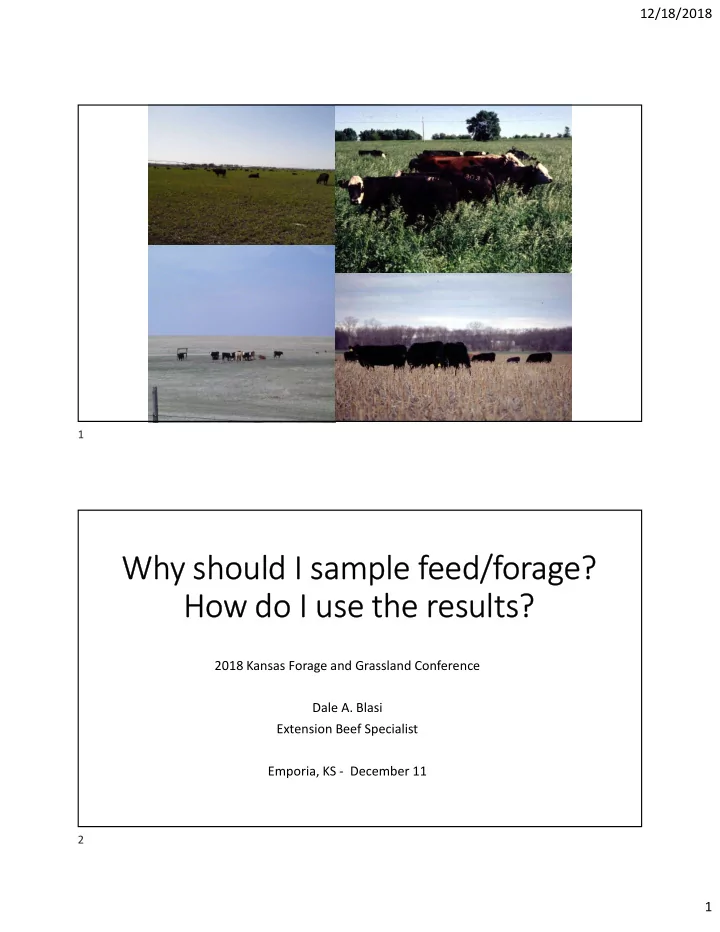
12/18/2018 1 Why should I sample feed/forage? How do I use the results? 2018 Kansas Forage and Grassland Conference Dale A. Blasi Extension Beef Specialist Emporia, KS - December 11 2 1 12/18/2018 Why Test Forages? Feed tests can help


slide-1
SLIDE 1

12/18/2018 1

Why should I sample feed/forage? How do I use the results?

2018 Kansas Forage and Grassland Conference Dale A. Blasi Extension Beef Specialist Emporia, KS - December 11

1 2
slide-2
SLIDE 2

12/18/2018 2

Why Test Forages?

  • Feed tests can help establish the dollar value of a forage
  • Feed tests can establish the feeding value of your forages and help

determine what feeds to feed or sell OR supplements t buy

  • Feed tests are useful in evaluating production practices
  • Fertilization
  • Time of harvest
  • Method of harvest

Forage plants are the product of their environment

  • Soil
  • Weather – growing conditions
  • Animals
  • Disease

3 4

slide-3
SLIDE 3

12/18/2018 3

150 150 160 170 180 190 190 200 200 180

Forage Quality/Utilization

  • Pre-harvest
  • Stage of maturity
  • Harvest
  • Height of cut
  • Baling moisture
  • Post-harvest
  • Storage
  • Method of feeding

5 6

slide-4
SLIDE 4

12/18/2018 4

Growth vs. Quality

Spring Fall Summer

Factors that accelerate the maturation process

  • Temperature
  • Light
  • Water

7 8

slide-5
SLIDE 5

12/18/2018 5

Influence of Water

  • A water deficiency minimizes the development of the plant, thereby

retarding maturity.

  • Therefore:
  • This equals increased digestibility while DM yields are reduced.

Kansas Drought*

  • 1 out of 5 years in eastern Kansas
  • 1 out of 3 years in western Kansas

* Years with less than two-thirds average annual precipitation

9 10

slide-6
SLIDE 6

12/18/2018 6

Drought in Kansas

https://www.drought.gov/drought/states/kansas

The Van Soest Hotel Theory

11 12

slide-7
SLIDE 7

12/18/2018 7

Influence of Environmental Factors Upon Composition and Digestibility of Foragesa

Item Temp. Light Nitrogen Water Predation Yield + + + +

  • Nitrate
  • +

+ + Cell Wall +

  • ±

+

  • Lignin

+

  • +

+

  • Digestibility
  • +

±

  • +

a Van Soest et al., 1978.

% Crude Protein Content of Native Grass Hay by Harvest Date, 1997

2 4 6 8 10 12 14 6/3 6/17 7/1 7/15 7/29 8/12 8/26 9/9 9/23 10/7 Collection Date Crude Protein content, % Butler Cowley Marion

13 14

slide-8
SLIDE 8

12/18/2018 8

Nutrient Availability of Forage Components (Van Soest, 1983)

Forage Fraction Component Nutrient Availability

Cell Contents Soluble sugars Complete Pectin Complete Soluble Protein High Lipids High Cell Wall Elements Hemicellulose Partial Cellulose Partial Lignin Indigestible Silica Indigestible

15 16

slide-9
SLIDE 9

12/18/2018 9

17 18

slide-10
SLIDE 10

12/18/2018 10

Forage Dry Matter Intake

  • Function of:

–Fermentation rate –Rate of particle size reduction –Rate of particle passage rate

Forage Intake of Beef Cows as Affected by Stage of Production, Forage Quality and Supplement Typea

Forage Quality Stage of production & supplementation strategy Low Medium High

Dry, pregnant cow

Intake expressed on % body wt, dry matter basis Unsupplemented 1.5 2.0 2.5 Protein supplementation 1.8 2.2 2.5 Energy supplementation 1.5 2.0 2.5

Lactating cow

Unsupplemented 2.0 2.3 2.7 Protein supplementation 2.2 2.5 2.7 Energy supplementation 2.0 2.3 2.7

aAdapted from Hibberd and Thrift, 1992

19 20

slide-11
SLIDE 11

12/18/2018 11

Harvest Losses

  • Respiration losses
  • Mechanical losses
  • Heat damage

21 22

slide-12
SLIDE 12

12/18/2018 12

Weathering Damage of Large Round Bales

  • Most damage occurs in the outer 12 inches of the bale
  • 50% of the hay in a bale with a radius of 30 inches is in the outer 9 inches of

the bale

  • Proper core-sampling procedures must be adjusted to consider this change

Hay Composition in Different Depths of Unprotected Large Round Bales

% of DM Sampling interval, in DM,% IVDDM NDF ADF 0-3 56.4 43.0 59.5 46.7 3-6 75.5 50.2 58.1 45.1 6-9 81.0 52.1 58.0 45.2 9-12 82.4 53.0 56.2 43.3 12-30 83.9 55.0 53.5 41.5

23 24

slide-13
SLIDE 13

12/18/2018 13

Developing a Sampling Protocol

25 26

slide-14
SLIDE 14

12/18/2018 14

The Sampling Protocol should describe:

  • Method of forage collection
  • Key forage species
  • Key sampling areas
  • During transition periods, sampling should occur every 2

weeks

  • Monthly during forage dormancy

What is a forage lot ?

  • A forage lot consists of forage harvested from one field:
  • at the same cutting and maturity within a 48-hour period
  • Usually contains fewer than 100 tons of hay.
  • A forage lot should be similar for forage type, field (soil type), cutting date,

maturity, variety, weed infestation, type of harvest equipment, weather during growth and harvest and storage conditions.

27 28

slide-15
SLIDE 15

12/18/2018 15

Select Uniform Lots of Hay

Hay field 1st cut Hay field 2nd cut

Grass infested Pure Grass infested Pure Rain Damage Pure No Rain

Lot # 1 2 3 4 5

Segregate Each Lot as It is Harvested and Stored

  • When segregating by quality, a better job can be done nutritionally by

feeding according to specific animal production requirements

  • This will greatly facilitate access so that it may be retrieved as needed
  • This is especially important step in a hay marketing operation.

29 30

slide-16
SLIDE 16

12/18/2018 16

Where Does Variation Arise?

  • Field Variation
  • Weed infestation
  • Soil and fertility differences
  • Harvest Variation
  • Equipment/conditioner differences
  • Management philosophy
  • Sampling Error
  • Location of bale
  • Location/depth of core sample

Variation in Crude Protein Content of Cane Hay - Preliminary Results

Preliminary data represents 25 similar bales at each location

Cowley Pratt Saline 5 6 7 8 9 10 11 12 13 Location of Sampling % Crude Protein Content Maximum Average Minimum

31 32

slide-17
SLIDE 17

12/18/2018 17

Nitrate Variation in Sudan Hay Bales From the Same Field – C. Garten 1989

  • Nitrate content of 23 bales collected from the same field averaged

2,764 ppm but varied from 1,525 to 6,250 ppm on an as-fed basis

  • Thus, the nitrate level in individual bales varied more than TWO –

FOLD from the average.

Recommended Number of Large Round Bales to Sub-sample and Composite

Confidence Interval Forage Type Precision of average CP Estimate, % 99% 95% 80% 1st alfalfa +1 19 11 5 +5 76 44 19 3rd alfalfa +1 12 7 3 +5 47 27 12 Prairie hay +1 4 2 1 +5 15 9 4 Sudan hay +1 7 4 2 +5 28 16 7

Blasi, et al., 1995

33 34

slide-18
SLIDE 18

12/18/2018 18

Bales should be probed from the sides, not the ends

35 36

slide-19
SLIDE 19

12/18/2018 19

Do Not Submit a flake of hay or use the “grab” sample technique When Do You Sample?

Forages should be sampled as close to the time of feeding or sale as possible

37 38

slide-20
SLIDE 20

12/18/2018 20

Sampling Silage

  • Sampling silage at harvest will give one an idea about the

feeding value prior to feeding.

  • Because of fermentation changes, another sample should be

tested when feeding begins.

  • Multiple samples should be collected, combined and then

sub-sampled from the total before submitting to a laboratory.

Collecting a feed sample

  • The entire sample should be placed in a plastic bag and sealed to

retain the moisture level at the time of sampling.

  • The sample(s) should be labeled properly.
  • The sample(s) should then be stored in a cool place until it is shipped

to the laboratory.

  • Send the sample(s) to the laboratory A.S.A.P. via UPS or USPS.

39 40

slide-21
SLIDE 21

12/18/2018 21

Methods of Feed/Forage Testing

  • Physical – Sight, smell and touch are useful, although frequently

misleading indicators of feed value.

  • Chemical – When representative feed samples are tested chemically,

accurate predictions of animal performance usually can be made.

  • NIR Spectroscopy – Rapid, low-cost computerized method with

questionable reliability

Net Energy of Native Range Calculated from ADF

  • %TDN = 88.9 - (0.779 x ADF)
  • ME (Mcal/kg) = (TDN% × 0.044) × 0.82
  • NEm (Mcal/lb) = (1.37 × ME) – (.138 × ME2) + (.0105

× ME3) – 1.12 / 2.204

  • NEg (Mcal/lb) = (1.42 × ME) – (.174 × ME2) + (.0122 ×

ME3) – 1.65 / 2.204

NRC (1996)

41 42

slide-22
SLIDE 22

12/18/2018 22

Relative Feed Value (RFV)

  • RFV has no units but is used only as an index to compare the

potential of two or more like forages for energy intake

  • Forages with NDF = 53% and ADF = 41% represent a RFV of 100.

How Do I Use the Results?

43 44

slide-23
SLIDE 23

12/18/2018 23

45 46

slide-24
SLIDE 24

12/18/2018 24

47 48

slide-25
SLIDE 25

12/18/2018 25

Livestock Feeding Programs

  • Can be improved by relying on forage analyses to plan and balance

rations.

  • However, lab analyses are only useful if the sample represents what

your animal consumes.

49 50

slide-26
SLIDE 26

12/18/2018 26

Dale A. Blasi Kansas State University dblasi@ksu.edu

51