SLIDE 1
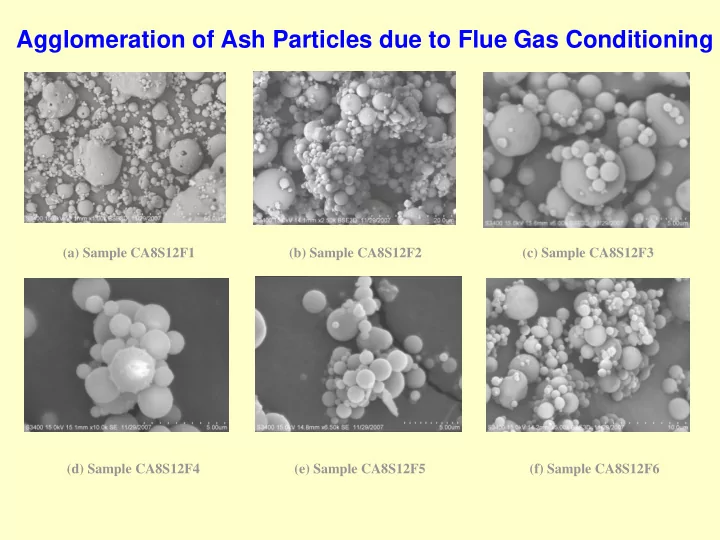
(a) Sample CA8S12F1 (b) Sample CA8S12F2 (c) Sample CA8S12F3 (d) Sample CA8S12F4 (e) Sample CA8S12F5 (f) Sample CA8S12F6
Agglomeration of Ash Particles due to Flue Gas Conditioning
SLIDE 2
SF BFS
SEM micrographs of Silica Fumes & Ground Granulated Blast Furnace Slag (GGBFS/BFS)
SLIDE 3 Compacted sample Cubic specimen
Determination of fabric structure of fine-grained soils Using SEM
Specimen preparation (Challenges):
- Removal of pore fluid from the specimen without disturbing its microstructure.
- Freeze-drying technique (for swelling/shrinking type of soils)
- Air-drying technique (for non swelling/shrinking type of soils)
- Specimen should be able to withstand the vacuum inside the microscope.
- As illumination is with electrons, specimen should be made to conduct electricity.
- Specimen are coated with a very thin layer of Gold or Carbon (a sputter coater).
- Gold coating film can absorb X-ray signal generated into the specimen.
- For obtaining X-ray spectrum of a non-conducting sample a coating material very
transparent to the X-ray (Carbon) must be utilized.
SLIDE 4
Kaolinite plate stacks Face-Face interaction
SLIDE 5
Face-Edge & Edge-Edge interactions
SLIDE 6
- Geomaterials are composed of wide range of particle sizes and
shapes and are porous in nature.
- A knowledge of pore structure of these materials is important as it can
give insight in to both the microstructure and the performance.
- Rather than measuring the porosity, It becomes more informative if the
manner in which volume is distributed With respect to pore size.
Mercury Intrusion Porosimetry (MIP) Dead end Closed Inter-connected Passing
SLIDE 7
Non-porous solids (Extremely low surface area) Porous solids medium high surface area, pore volume and dimension Particulates particle size and surface area Catalysts: activated sites on porous support or powder
Porosity
SLIDE 8
Conical Slits Cylindrical Spherical or Ink Bottle Interstices
Shape of Pores
SLIDE 9
Micropores: 0 < d < 2 nm (zeolites, carbons, silica fumes) Mesopores: 2 < d < 50 nm (alumina, polymers, catalysts) Macropores: 50 < d < ...nm (rocks, cements, soils, ...)
Bulk, apparent and real density [g/cc] Percentage porosity [%] Pore volume/pore size distribution [pore volume vs pore size] Total pore volume [cc/g] Average pore size Specific surface area [m2/g] Particle size distribution [relative percentage vs particle size]
Pore size classification and parameters
SLIDE 10
Pore size distribution
Particle size distribution
Bulk density
Apparent density
Total porosity
Pore area distribution
Low/high specific surface
Micro/mesopores distribution
Micro/mesopores total volume
Real density
Mercury porosimetry Gas adsorption Helium Pycnometry
Characterization schemes
SLIDE 11 Mercury Porosimetry concept
- Hg is a non-wetting liquid for many
solids
- Hg must be forced to penetrate pores
- Penetration pressure is related to pore
size
- Volume of Hg is related to pore
volume
wetting non wetting
SLIDE 12
Hg cannot enter pores under vacuum An increasing pressure forces Hg to penetrate all accessible pores
SLIDE 13 Working principle: P = 2.(T.cosθ)/r ……Washburns Equation
Volume of mercury Pressure
Intrusion curve Extrusion curve
A
Information obtained
- the pore size distribution
- surface area
- equivalent pore size
- critical pore diameter
- distribution of total porosity
- free porosity and trapped porosity
Typical MIP characteristic curve
A: hysterisis
SLIDE 14