SLIDE 1
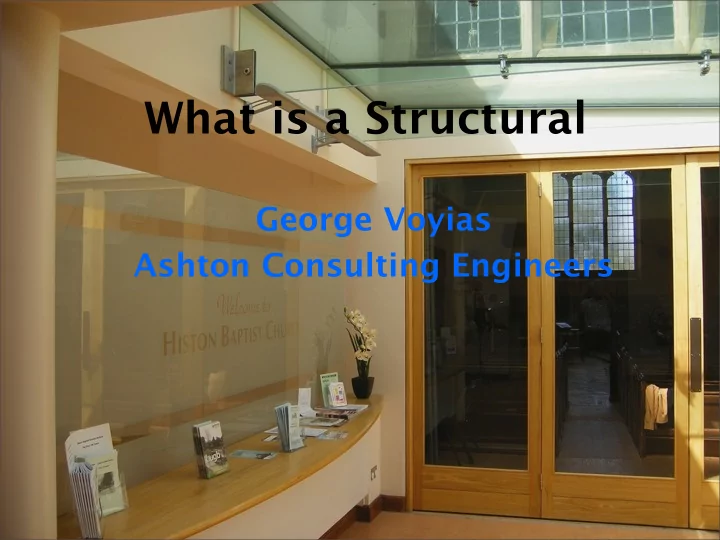
What is a Structural
George Voyias Ashton Consulting Engineers
SLIDE 2 What is a Structural Engineer?
- Simple definition: someone who ensures
that a building or structure stands up.
– self weight of the building elements or 'dead' loads – imposed loadings from the weight of people and furniture – wind loadings
- Knowledge of building materials: steel,
concrete, masonry, timber, etc
- Trained and qualified to a Chartered
Engineer
SLIDE 3 Existing Buildings and
- A load-bearing wall is wall that is
supporting other parts of the building
- External walls and certain internal walls
in buildings are load bearing
- Altering or extending an existing
building:
– removal of a load-bearing wall – making a hole in the floor or roof – building a new glass screen – building a new balcony, etc.
SLIDE 4
Histon Baptist Church
SLIDE 5 New Buildings and Churches
- A structural engineer should be appointed for
all but the simplest of buildings like a standard house, garage or shed
- He should work closely with the architect
designing the building to integrating the structure as part of the design
- He often arranges for a ground investigation
- f the site to assist him in designing the most
appropriate type of foundations
- He typically prepares a set of structural
calculations and drawings that are sent to Building Control for approval before construction work starts.
SLIDE 6 What should clients look for when appointing a structural
- Qualifications - is he/she a Chartered
Engineer?
- Experience in the particular building
sector, e.g. churches
- Does the engineer grasp the vision and
aims of the client?
- Does the engineer carry profession
indemnity insurance to protect the client?
- References - does the architect know the
engineer well? If not take up references from clients or other architects.
SLIDE 7
Introduction to the Construction (Design and Management) Regulations
Ashton Consulting Engineers George Voyias
SLIDE 8
Key aims of the CDM Regulations are to:
– improve the planning and management of projects from the very start – identify hazards early on, so that they can be eliminated or reduced at the design or planning stage and the remaining risks can be properly managed – target efgort where it can do the most good in terms of health and safety – discourage unnecessary bureaucracy
SLIDE 9 Time and thought improves health and safety but also leads
– reductions in the overall cost of
- wnership, because the building is
designed for safe and easy maintenance and cleaning work, and because key information is available in the health and safety file – reduced delays – more reliable costings and completion dates – improved communication between key parties
SLIDE 10 According to a 1998 report of the Royal Academy of Engineering typical
- perating and owning costs of a
building are in the ratio:
- 1 for construction costs
- 5 for maintenance and building
- perating costs
- 200 for business operating costs
SLIDE 11
Except where the project is for a domestic client, the client must appoint a CDM Co-ordinator for a building project where construction work is expected to:
– last more than 30 working days; or – involve more than 500 person days, for example 25 people working over 20 days
SLIDE 12
In this instance the CDM Co-ordinator should:
– notify the Health and Safety Executive of the project – advise and assist the client with their duties – identify, collect and pass on pre- construction information – facilitate good communication between client, designers and contractors – prepare/ update the health and safety file for the building
SLIDE 13
Party Wall Surveyor and Other Consultants
George Voyias Ashton Consulting Engineers
SLIDE 14 The Party Wall Act 1996 provides a framework for preventing and resolving disputes in relation to:
- party walls
- boundary walls
- excavations near neighbouring
buildings
SLIDE 15 Party Wall Surveyor Services
- Issue a party wall notice to the adjoining owners
- Survey the adjoining properties before work
commences and record any defects near the party wall and boundary
- Prepare a draft Party Wall Award for each of the
adjoining properties
- Agree the Party Wall Award with the other
surveyor/s who may be appointed by the adjoining
- wner/s
- Issue the Party Wall Awards to owners and the
- ther surveyor/s
- Be available for visits to the site during the works
- Make a final visit to check for any damage
SLIDE 16 Other Consultants
- Mechanical Engineer - designs the heating
system, ventilation, air conditioning, lifts, etc.
- Electrical Engineer - designs the electrical
system including lighting, data, lightning protection, as well as fire and security alarms, etc
- Quantity Surveyor - prepares cost plans;
tender and contract documents; and keeps control of the costs of a project
- Lighting Consultant - specialist lighting
- Audio Visual Consultant - designs
systems for conference halls and churches