SLIDE 1
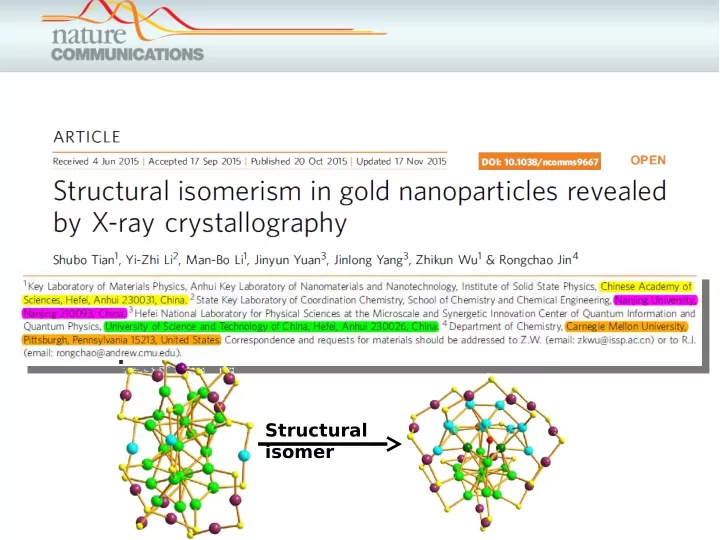
Structural isomer
SLIDE 2
Background….
SLIDE 3 Structural isomerism
- Structural isomerism at nanoscale.
- Resolving structure reveals structure property correlation and
guidance for synthesizing functional material.
- Au24(SCH2Ph-tBu)20 and Au24(SePh)20 have difgerent Au24 core
structures.
Synthesis of Au38PET24 PTLC, ESI-MS, TGA, XPS Single crystal X- Ray crystallography(S CXC) Au38T (new)- Tian Au38Q (old)- Qian 50°C
SLIDE 4
(a) ESI mass spectrum of the Au38T. (b) TGA of Au38T.
SLIDE 5
(c) XPS spectrum of Au38T. (d) Ultraviolet–visible–near-infrared absorption spectra of Au38T (blue) and Au38Q (black) in toluene (measurement temperature: 0° C). Insets are the photo of thin- layer chromatography and enlarged absorption spectra in the range from 800 to 1,200nm of Au38T and Au38Q.
SLIDE 6
Au38Q (old) Au38T (new) 6Au2S R3 3AuSR2 180° rotation
SLIDE 7
Comparison of ultraviolet–visible–near-infrared absorption spectra of Au38T . Blue: experimental; black: calculated by time-dependent density function (TDDFT) method. Inset is the enlarged spectra in the range from 800 to 1,200 nm.
SLIDE 8
(a) Time-dependent ultraviolet–visible–near-infrared absorption spectra of Au38T at -10°C in toluene. (b) Ultraviolet–visible–near- infrared absorption spectral transformation at 50°C in toluene (the isosbestic points are at 360 and 700 nm). Inset: thin-layer chromatography of Au38T before and after the transformation. (c) ESI mass spectrum of the transformed product.
SLIDE 9 Conclusion
- A novel synthesis method is developed, with which a novel gold nanoparticle is
readily synthesized, and the composition of the as-prepared nanoparticleis precisely determined using ESI–MS in conjunction with XPS and TGA.
- The structure of Au38T is resolved using SCXC and the unique structural
features provide important implications for nanocluster structural studies.
- Signifjcantly, structural isomerism is observed in nanoparticles for the fjrst
time.
- The distinctly difgerent properties (in particular the catalytic properties) of
the two structural isomers indicate a structure–property correlation and this will have important implications for future catalytic studies.
SLIDE 10
Future directions. HPLC separation of clusters is a very new fjeld. Finding suitable eluents and column for ligand exchanged products, chiral mixtures and other isomers will lead to effjcient separation.
SLIDE 11
THANK YOU