
SLIDE 1
Innovation & conservation Innovation & conservation - - PowerPoint PPT Presentation
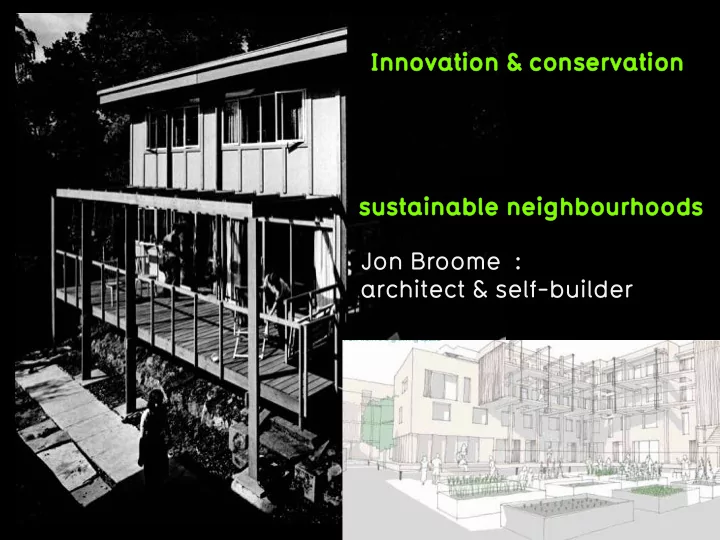
Innovation & conservation Innovation & conservation sustainable sustainable neighbourhoods neighbourhoods Jon Broome : architect & self-builder social sustainability social sustainability Residents have a stake in the
en.wikipedia.org/wiki/Participatory_design
Participatory design (originally co-
design) is an approach to design attempting to actively involve all stakeholders (e.g. employees, partners, customers, citizens, end users) in the design process to help ensure the result meets their needs and is usable. co-design timeline Festival of ideas
The Festival of Ideas was an introduction day, and
Evening session 1
At the fjrst evening session, the residents and facilitators
Evening session 2
At the second evening session, the residents and facilitators
Evening session 3
At the third evening session, the residents and facilitators split
Evening session 4
The fourth evening session consisted of 2 presentations. The
Feedback Session 1
The fjrst feedback session was across a whole day The residents organised a selection of precedents into ‘controversial’, ‘not relevant’ ‘nice to have’ and ‘essential’. The residents organised a selection of precedents into ‘controversial’, ‘not relevant’ ‘nice to have’ and ‘essential’. The residents expressed their preference on a number of questions such as how can we balance the requirements for shared and private space. The residents expressed their preference on a number
be integrated into the character of the building? The residents drew plans of their current homes and talked about what worked well and what they liked/didn’t like. The residents answered a series of questions about their interest and capacity for self-build. The residents reviewed the emerging design strategy, and discussed some
Image 1 - A courtyard around a tree
Image 4
Image 6 - Integrated steps and seats Image 9 - Wildfmowers and grasses Image 2 - A sunken courtyard Image 3 - A courtyard with planting zones Image 8 - Integrated steps and ramps Image 5 - A planted walkway Image 4 - A lightweight walkway through the trees Image 7 - Integrated planting and seating See images 1, 2 and 3 for examples of planted courtyards See images 4 and 5 for examples of walkways See image 9 for an example of a wildlife zone See images 6, 7 and 8 for examples of level changes and seats Viewpoint A
Creating a central community space Current view down Church Grove Proposed view down Church Grove
Growing space Play space Outdoor meeting space 3 Accessible parking spaces and 1 car club space Shared surface for turning waste and fjre vehicles and additional playspace Entrance to the site Outdoor eating space
Other fmoor plans
Precedents Typical section t
Photo credit: James Drew Turner for the Guardian / Taran Wilkhu 25 Green, Turin / Luciano Pia Photo credit: Beppe Giardino Collective Eco-Housing La Canopée / Patrick Arotcharen Architecte Photo credit: Vincent Monthiers , Mathieu Choiselat Accordia, Cambridge /FCB Studios Photo credits: FCB Studios / grant-associates.uk.com
The relationship of the buildings to the gardens is a priority for RUSS and the residents group alike. These are a series of precedents that give an idea of what the Church Grove project might look and feel like.
The building is raised off the ground to protect the properties in case of fmooding. South facing shared gardens set the buildings in context. They will be used for food growing by the residents. The proposal uses the roof for PVs and food growing The balconies and walkways make the most of the South orientation and provide shading to the lower fmats. Buffer zone for EA access and biodiversity. Houses are located on the ground and fjrst fmoors with the fmats above Houses could have additional amenity space to the rear. Ravensbourne river Access decks and walkway provide level access to the building, it also creates a clear threshold between public and private.
Aerial view from the back View from the growing space