Conservation Planning on Cropland Glenn Davis Agronomist-Nutrient - - PowerPoint PPT Presentation

conservation planning on cropland
SMART_READER_LITE
LIVE PREVIEW

Conservation Planning on Cropland Glenn Davis Agronomist-Nutrient - - PowerPoint PPT Presentation

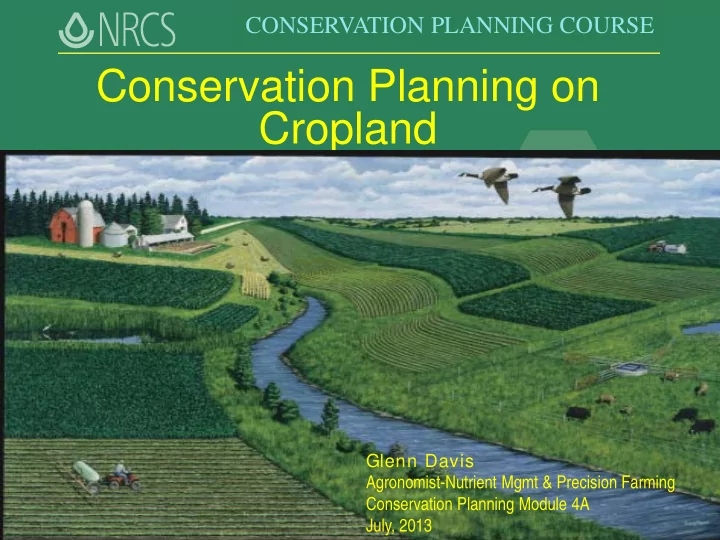
CONSERVATION PLANNING COURSE Conservation Planning on Cropland Glenn Davis Agronomist-Nutrient Mgmt & Precision Farming Conservation Planning Module 4A July, 2013 CONSERVATION PLANNING COURSE Overhead 3-22 Conservation Planning Steps


slide-1
SLIDE 1

CONSERVATION PLANNING COURSE

Conservation Planning on Cropland

Glenn Davis Agronomist-Nutrient Mgmt & Precision Farming Conservation Planning Module 4A July, 2013
slide-2
SLIDE 2

CONSERVATION PLANNING COURSE

  • 1. Identify Problems
  • 2. Determine Objectives
  • 3. Inventory Resources
  • 4. Analyze Resource Data
  • 5. Formulate alternatives
  • 6. Evaluate Alternatives
  • 7. Make Decisions
  • 8. Implement the Plan
  • 9. Evaluate the Plan

Conservation Planning Steps

1 2 3 4 5 6 7 8 9

Overhead 3-22

slide-3
SLIDE 3

CONSERVATION PLANNING COURSE

The conservation planning process on cropland is similar to conservation planning in other land uses. Cropland

  • ffers different options to address

resource concerns.

slide-4
SLIDE 4

CONSERVATION PLANNING COURSE

Definition of Cropland (CRP)

Land that is planted or considered planted to an agricultural commodity 4

  • f the previous 6 crop years
slide-5
SLIDE 5

CONSERVATION PLANNING COURSE

  • Cropland - Altered from natural

state

  • Productive!
  • More Vulnerable!
slide-6
SLIDE 6

CONSERVATION PLANNING COURSE

  • Stewardship challenge
  • Keep the land productive
  • Protect resources
slide-7
SLIDE 7

CONSERVATION PLANNING COURSE

Identify Problems & Opportunities-Resource Concerns

Soil Water Air Plants Animals

Physical

slide-8
SLIDE 8

CONSERVATION PLANNING COURSE

Objective 1: Protect the Soil Resource

  • Erosion by Water
slide-9
SLIDE 9

CONSERVATION PLANNING COURSE

Objective 1: Protect the Soil Resource

  • Erosion by Wind
slide-10
SLIDE 10

CONSERVATION PLANNING COURSE

Objective 1: Protect the Soil Resource Degradation by excessive tillage, excessive salt buildup

slide-11
SLIDE 11

CONSERVATION PLANNING COURSE

Objective 2: Protect Water Resources

slide-12
SLIDE 12

CONSERVATION PLANNING COURSE

Objective 3: Meet Environmental Regulations

slide-13
SLIDE 13

CONSERVATION PLANNING COURSE

Soils

  • Reduce water and

wind erosion

  • Increase fertility
  • Reduce salinity
  • Increase carbon

deposition

slide-14
SLIDE 14

CONSERVATION PLANNING COURSE

Water

  • Increase irrigation

efficiency

  • Minimize nutrient

loading

  • Reduce runoff and

leaching

  • Decrease pollutant

loading

slide-15
SLIDE 15

CONSERVATION PLANNING COURSE

Air

  • Reduce atmospheric

CO2 flux, N2O flux

  • Reduce chemical

drift

  • Reduce ammonia

loss

slide-16
SLIDE 16

CONSERVATION PLANNING COURSE

Plants

  • Plant suitability
  • Crop yield
  • Minimize noxious

and invasive species

  • Increase forage

quality

slide-17
SLIDE 17

CONSERVATION PLANNING COURSE

Animals

  • Enhancing fish and

wildlife habitat

  • Enhance domestic

animal shelter, food and water quality

  • Reduce animal

stress (grazing)

slide-18
SLIDE 18

CONSERVATION PLANNING COURSE

Human Factors

  • Consider the farmers

facility, machinery, and economic situation

  • Consider the farm family

and family farm dynamics

  • Willingness to change?
slide-19
SLIDE 19

CONSERVATION PLANNING COURSE

slide-20
SLIDE 20

CONSERVATION PLANNING COURSE

Quality Criteria

  • What are the “Quality Criteria?”

– Establish performance standards for sustainable resource use

  • Where do you find them?

– FOTG Section III Resource Quality Criteria-RMS

slide-21
SLIDE 21

CONSERVATION PLANNING COURSE

Conservation Practice Effects

  • After Resource Concern(s)

identified:

– What Conservation Practice(s) are best? – Use the Conservation Practice Physical Effects (CPPE) matrix – Found in FOTG Section V

slide-22
SLIDE 22

CONSERVATION PLANNING COURSE

The Natural Resources Conservation Service provides leadership in a partnership effort to help people conserve, maintain, and improve

  • ur natural resources and environment.