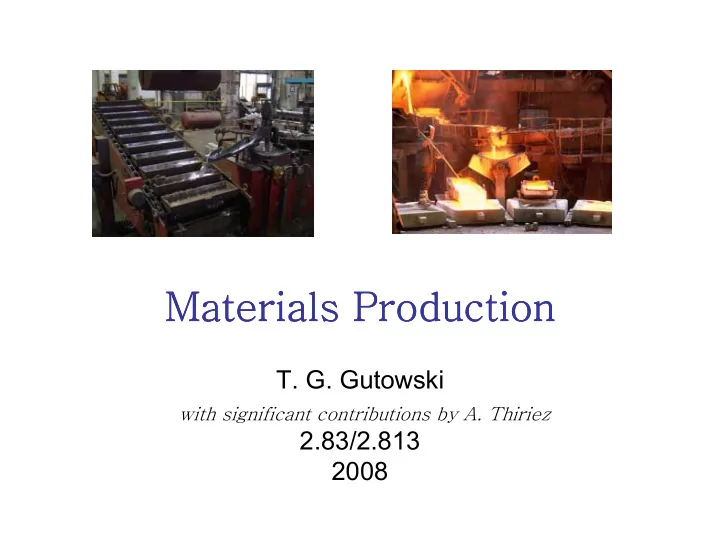
SLIDE 1 Materials Production Materials Production Materials Production Materials Production
with significant contributions by A. Thiriez
2.83/2.813 2008
SLIDE 2 Reading Reading Reading Reading
a) Masini and Ayres, “An Application
- f Exergy Accounting to Five Basic
Metal Industries”, 2001 (click here for PDF).
SLIDE 3 Materials Production Materials Production Materials Production Materials Production
m&
k
m &
m &
8
m &
k
i p m&
k
m &
Recycle, Remanufacture, Reuse Mining Primary Mfg Distribution Use Disposition
m &
8
m &
k
i p m&
k
m &
m &
8
m &
k
i p m&
k
m &
m &
8
m &
k
i p m&
k
m &
Mining Primary Mfg Distribution Use Disposition
m &
8
m &
k
i p m&
k
m &
m &
8
m &
k
i p m&
k
m &
m &
8
m &
k
i p m&
k
m &
m &
8
m &
k
i p m&
k
m &
m &
8
m &
k
i p
m &
8
m &
k
i p m&
k
m &
m &
8
m &
k
i p m&
k
m &
m &
8
m &
k
i p m&
k
m &
Recycle, Remanufacture, Reuse
m &
8
m &
k
i p m&
k
m &
m &
8
m &
k
i p m&
k
m &
m &
8
m &
k
i p m&
k
m &
m &
8
m &
k
i p m&
k
m &
m &
8
m &
k
i p m&
k
m &
m &
8
m &
k
i p m&
k
m &
m &
8
m &
k
i p m&
k
m &
m &
8
m &
k
i p m&
k
m &
m &
8
m &
k
i p m&
k
m &
m &
8
m &
k
i p m&
k
m &
m &
8
m &
k
i p m&
k
m &
m &
8
m &
k
i p m&
k
m &
m &
8
m &
k
i p m&
k
m &
m &
8
m &
k
i p m&
k
m &
m &
8
m &
k
i p m&
k
m &
m &
8
m &
k
i p m&
k
m &
m &
8
m &
k
i p m&
k
m &
m &
8
m &
k
i p m&
k
m &
Recycle, Remanufacture, Reuse
SLIDE 4 Mat Mat Mat Mat’ ’ ’ ’l l l l Production and Mfg Production and Mfg Production and Mfg Production and Mfg
Carbon Dioxide and Toxic Materials per Value of Shipments
0.5 1 1.5 2 2.5 3 3.5 4 4.5 5 Chemicals Petroleum and Coal Plastics and Rubber Primary Metal Fabricated Metal Machinery Electronic Transportation
Manufacturing industries
Weight/Dollars
CO2 (metric ton/$10,000) Toxic Mat'ls (lb/$1000)
SLIDE 5 Outline Outline Outline Outline
- 1. Extraction, Mining
- 2. Refining, Smelting
- 3. Mass and Exergy for US industry
- Copper, Iron, Aluminum, Zinc, Polymers
SLIDE 6
Crustal Abundance
SLIDE 7 Reserves Vs Crustal Abundance
Chapman
SLIDE 8 “ “ “ “McKelvey McKelvey McKelvey McKelvey Box” Box” Box” Box”
Reserves
Decreasing Geologic Assurance of Existence Increased Economic Feasibility
marginally economical
Adapted from C. F. Murphy, and McKelvey, 1972
Resource Base Undiscovered
KNOWN KNOWN KNOWN KNOWN UNKNOWN UNKNOWN UNKNOWN UNKNOWN
SLIDE 9 Known Resources of Uranium Known Resources of Uranium Known Resources of Uranium Known Resources of Uranium
Chapman
SLIDE 10 Definitions Definitions Definitions Definitions
Reserves Reserves Reserves- the amount of a commodity that has been located and which can be economically extracted with current technology and prices
Resources Resources Resources- reserves plus an estimate of the amount the commodity that is as yet undiscovered but would be profitable to extract plus an estimate of located deposits that are expected to be profitable in the near future due to emerging technologies (cost reductions) or moderate price increases
Resource Base Resource Base Resource Base- all of a commodity contained in the earth’s crust
SLIDE 11 Probability of Discovery Probability of Discovery Probability of Discovery Probability of Discovery
- Function of size of target area and number of attempts to
locate a field – Early in discovery process, low number of hits – Late in discovery process, low probability of undetected field
SLIDE 13 Source: http://encarta.msn.com/media_461533479_761561391_-1_1/Open-Pit_Copper_Mine_Utah.html
Open-Pit Copper Mine, Utah
SLIDE 14
Copper Ore Grades in the US Copper Ore Grades in the US Copper Ore Grades in the US Copper Ore Grades in the US
SLIDE 15
Chuquicamata Chuquicamata Chuquicamata Chuquicamata, Chile , Chile , Chile , Chile
SLIDE 16 drilling rig in underground mine in the Głogow area of Poland
Copper concentrations in this area are about 2%
SLIDE 17 energy requirements for mining and milling, possible future trends
Chapman and Roberts p 113 & 116 underground ~ 1000/g (MJ/t metal)
- pen pit ~ 400/g (MJ/t metal)
SLIDE 18 “ “ “ “Sherwood” Plot Sherwood” Plot Sherwood” Plot Sherwood” Plot
Chapman & Roberts 1983 Grubler 1998
SLIDE 19 Main Ore Types for Copper Main Ore Types for Copper Main Ore Types for Copper Main Ore Types for Copper globally 90% sulfides, 10% oxides globally 90% sulfides, 10% oxides globally 90% sulfides, 10% oxides globally 90% sulfides, 10% oxides
Sources: http://en.wikipedia.org/
Cu2S: Chalcocite Cu20: Cuprite Cu2CO3 (OH)2: Malachite CuFeS2: Chalcopyrite (50%
SLIDE 20
Acid mine drainage Acid mine drainage Acid mine drainage Acid mine drainage
4FeS2 + 15O2 +14H2O→ 4Fe(OH)3 + 8H2SO4
SLIDE 21 Outline Outline Outline Outline
- 1. Extraction, Mining
- 2. Refining, Smelting
- 3. Mass and Exergy for US industry
- Copper, Iron, Aluminum, Zinc, Polymers
SLIDE 22 Głogow* Copper Smelter
*pronounced Gwogov
SLIDE 23 Copper Smelting Process
Source: http://encarta.msn.com/media_461533478_761561391_-1_1/Production_of_Copper.html
SLIDE 24 1) Copper Ore (~ 1%) → Concentrate (~20 to 35%)
- milling, flotation, separation
2) Roasting and Smelting
Copper Smelting Process
CuFeS2 Cu2S (matte) 2FeOSiO2 (slag) 0.34
% Cu Cu (blister) ~98% Cu
SLIDE 25
3) Roasting and Smelting 2FeS+3O2! 2FeO+2SO2 xFeO + ySiO2 !(FeO)x·(Si02)y - slag 2Cu2S + 3O2 ! 2Cu2O + 2SO2 Cu2S + 2Cu2O ! 6Cu + SO2 (blister copper ~98%) 4) Electrolytic Refining (99.99%) sulfuric acid electrolyte anode mud (1:100) contains (Cu, Ag, As, Se, Bi, ..Au, Te…)
Copper Smelting Process
SLIDE 26 Source: http://encarta.msn.com/media_461547490_761561391_-1_1/Smelting_Copper.html
SLIDE 27 electro-refining of copper
0.05 0.25 3 1 5 1 5 0.5 5 20 Ni Fe Bi Sb As Te Se Au Ag Cu
Anode slime analysis (%) see Greadel et al (2002)
SLIDE 28
“The Metal Wheel”
SLIDE 29 Outline Outline Outline Outline
- 1. Extraction, Mining
- 2. Refining, Smelting
- 3. Mass and Exergy for US industry
- Copper, Iron, Aluminum, Zinc, Polymers
SLIDE 30
Copper Mass Flows (US)
SLIDE 31
Copper Exergy (US)
SLIDE 32
Copper Summary (US)
SLIDE 33
Tailings pond at Głogow, Poland
SLIDE 34
.02X.9 to smelt, .02X.1 to tailings
these tailings will be mined in the future
SLIDE 35 Summary from Summary from Summary from Summary from Masini Masini Masini Masini & Ayres & Ayres & Ayres & Ayres Exergy Exergy Exergy Exergy Analysis for U.S. Industries Analysis for U.S. Industries Analysis for U.S. Industries Analysis for U.S. Industries
9% 2% 252 5.2 Zinc 0.6% 1% 203.7 2.1 Copper 26% Alu (bauxite) 10% 346.5 32.9 Aluminum Ore 53% + scrap 93% 20% 34.2 6.7(Fe) Steel Ore grade (percent) Bo / Bin Bin(MJ/kg) Bo(MJ/kg) Metal
SLIDE 36 Manufacturing Process (A) Materials Processing (C) Energy Conversion for Materials Processing (D) Energy Conversion for Manufacturing (B)
air fuel
H
+ 1
&
air fuel
S
+ 1
&
air fuel
H
+ *
&
air fuel
S
+ *
&
materials
H1 &
materials
S1 &
materials
H 2 &
materials
S2 &
→ D S
W &
← C S
W &
* * , R C R
T Q
←
&
* * , R D R
T Q
→
&
air fuel
H
+ 1
&
air fuel
S
+ 1
&
air fuel
H
+ *
&
air fuel
S
+ *
&
→ B S
W &
← A S
W &
* * , R A R
T Q ← &
* * , R B R
T Q
→
&
product
H3 &
product
S3 &
SLIDE 37
the fuel requirements of smelting
SLIDE 38
possible future trends in energy use trends reflect lower ore grades
SLIDE 39 bio-toxicity of copper
- Copper in drinking water (USEPA, WHO)
- Copper in fresh water ( 5 pbb)
- bioavailability and the biotic ligand model
“BLM”
- gastrointestinal effects (NOAEL 2mg/L)
- Wilson’s disease and 5% of population
- aggressive water
SLIDE 40
Check out these websites for copper mining and smelting
http://www.na-ag.com/NA_en http://www.mining-technology.com/projects/kghm/
SLIDE 41 Iron: Important oxide ores
Hematite: Fe2O3 Magnetite: Fe3O4
Sources: http://en.wikipedia.org/ & http://resourcescommittee.house.gov/subcommittees/emr/usgsweb/materials/images/imgTaconite.jpg
Taconite
SLIDE 42 Taco – night (not to be confused with Taconite)
This slide brought to you by Tacoo Bell
SLIDE 43 Iron Blast Furnace
Materials required: 1. Iron Ore
2. Carbon (coke is used both as fuel and reducing agent). 3. Hot air (hot enough to ensure combustion of the fuel). 4. Flux (removes earthy matter – turns into slag) 5. Slag (combination of calcium carbonate, silica, alumina and other impurities).
Source: http://www.yourdictionary.com/images/ahd/jpg/A4blfurn.jpg
SLIDE 44 Reactions taking place in the furnace:
- 2 C + O2 ! 2 CO (1300 °C)
- CaO + SiO2 ! CaSiO3
(1200 °C)
(800 °C - 1000 °C)
(800 °C - 1000 °C)
- CO2 + C ! 2 CO (800 °C)
- Fe3O4 + CO ! 3 FeO + CO2 (600 °C)
- 3 Fe2O3 + CO ! 2 Fe3O4 + CO2 (450 °C)
SLIDE 45 Blast Furnace
Source: http://www.ssabox.com/news/Imagebank/blast%20furnace4.jpg
SLIDE 46
Steel Exergy (US)
SLIDE 47
Steel Summary (US)
SLIDE 48 Aluminum
It is the most abundant metal (7% of the earth’s crust) but one of the most difficult metals to refine
Aluminum occurance:
Bauxite : Al2O3·2H20 Cryolite: Na3AlF6 + many silicates such as clay: H2Al2(SiO4)2·H20
Sources: http://en.wikipedia.org/ & http://www.musee.ensmp.fr/mineral//1021x.jpg
SLIDE 49 Aluminum Production: 1. Bayer Process: obtain Alumina (Al2O3) from Bauxite.
- A. Extraction: dissolve oxides with hot
solution of NaOH. Al(OH)3 + Na+ + OH
- ! Al(OH)4
- + Na+
- B. Precipitation: reverse of above, but
controlling crystal formation. Al(OH)4
- + Na+ ! Al(OH)3 + Na+ + OH-
- C. Calcination: water is driven off Al(OH)3
to form alumina (aluminum oxide). Al(OH)3 ---> Al2O3 + 3 H2O
Source: http://www.world-aluminium.org
SLIDE 50
(Electrolytic Reaction).
Source: http://www.world-aluminium.org
Prebake Cell
- A. Al2O3 is dissolved in molten
cryolite (Na3AlF6)
through this mixture, (4-5 volts, 50,000-280,000 amperes) aluminum ions reduce to molten aluminum at the cathode, and oxygen is produce at the anode reacting with carbon to produce CO2. 2 Al2O3 + 3 C ! 4 Al + 3 CO2
Prebake Anode
SLIDE 51
Aluminum Exergy (US)
SLIDE 52
Aluminum Summary (US)
SLIDE 53 Zinc
Main Ore Types:
Smithsonite: ZnCO3 Sphalerite: (Zn, Fe)S Hemimorphite: Zn4Si2O7(OH)2·H2O
Sources: http://en.wikipedia.org/ & http://webmineral.com/specimens/FrankliniteSmall.jpg
Franklinite: (Fe,Mn,Zn)(Fe,Mn)2O4
SLIDE 54 1. Concentrating Zinc
1% as by
roduct of other metal
0% 2. Roasting
Zinc Production
Sulfide to oxide (ZnO) reduce/distillation leaching and electrowinning
SLIDE 55
- Roasting reactions
- 2 ZnS + 3 O2 ! 2 ZnO + 2 SO2
- ZnS + 2 O2 ! 2 ZnSO4
- One can either obtain a mixture of ZnO and
ZnSO4 (for the leaching process) or ZnO (for the distillation process).
- The product of the above reactions is imbedded
in mixtures with other impurities.
Zinc Production
SLIDE 56 Leaching: I. ZnO and ZnSO4 are leached with dilute H2SO4 to produce a zinc sulfide solution . ZnO+ + H2SO4 ! ZnSO4 + H2O II. The solution is purified to precipitate any metal impurities. III. An electrolytic cell is used to deposit the Zinc and sulfuric acid is produced as a by
roduct (can be used in step I.)
“The Electrolytic Plant, which is the size of four football fields, consumes the same amount of power as a city of 250,000 people”. Source: http://www.metsoc.org/virtu altour/processes/zinc- lead/electrolytic.asp
SLIDE 57 Source: http://www.swanseaheritage.net/img/article/100000_00767.jpg
Zinc Distillation Furnaces Old School
Batch Retort Process (Distillation): I. ZnO in the calcine mixture is mixed with anthracite coal and place in a fire
lay retort.
- II. It is heated to 1250 °C.
- III. Zinc vapor distills into an attached condenser.
SLIDE 58
SLIDE 59
SLIDE 60
SLIDE 61
Polymer Production
SLIDE 62
energy requirements for materials production (per cm3)
SLIDE 63 Materials Production, Homework Materials Production, Homework Materials Production, Homework Materials Production, Homework
1. Estimate the efficiency for the Roasting and Smelting of copper sulfide ore in US Industry. 2. Estimate the efficiency for the final refining step for copper in US Industry. 3. Estimate the energy required to process recycled copper if you can skip the roasting and smelting process. 4. Using the CMU I/O model compare primary and secondary production of 1) aluminum and 2) copper in terms of energy use per dollar of output. Can you also do energy use per kg of output? How do these results compare with Masini and Ayres? 5. Please do an exergy analysis for 2Cu2S + 3O2 ! 2Cu2O + 2SO2 (An important reaction in copper smelting) Determine Bin, Bout and Blost How much energy is needed to drive this reaction?