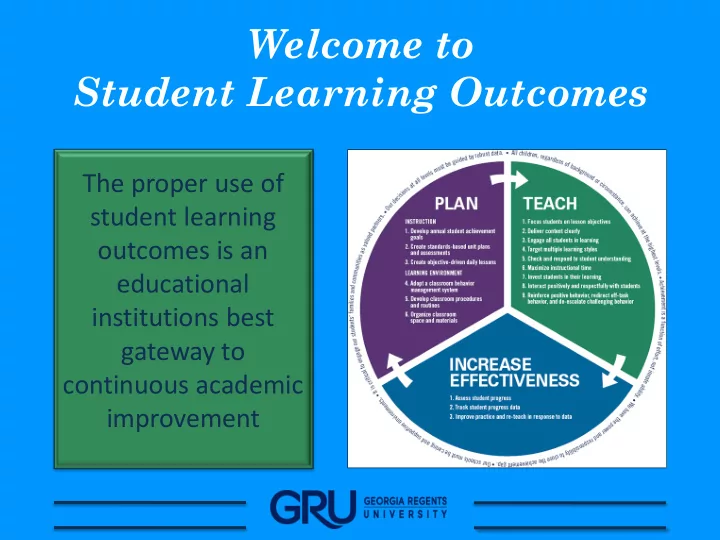
SLIDE 1 Welcome to Student Learning Outcomes
The proper use of student learning
educational institutions best gateway to continuous academic improvement
SLIDE 2
Student Learning Outcomes
What should a GRU student in a particular academic program be able to demonstrate they know and be able to do upon graduation?
The Big questions we need to ask about student learning: – Do they know it? – How do we know they know it? The big question for faculty: – How does this information help improve the quality of my program at GRU?
SLIDE 3 Student Learning Outcomes
The use of Student Learning Outcomes (SLOs):
– Serves as the backbone of a continual improvement process within academic planning. – Provides data to support:
- Curriculum modifications
- Revision of program requirements
- The coordination of teaching efforts, and
- The production of more knowledgeable graduates
SLIDE 4 Student Learning Outcomes
In addition to driving continuous improvement the SACS Principles of Accreditation require that: All institutions identify expected outcomes
- assesses the extent to which it achieves these
- utcomes, and
- provides evidence of improvement based on analysis
- f the results
This activity is required for all educational degree
programs
SLIDE 5
Student Learning Outcomes
Additionally: SACS defines educational programs to include all classes offered:
– on-campus, – off-campus, and – Through distance learning (See SACS/COC 3.4)
The focus of SACS Institutional Effectiveness requirements has changed from: Instructor-focused Teaching To Student-focused Learning
SLIDE 6
Student Learning Outcomes
GRU faculty have a critical role to play when it comes to SLO assessment:
– Identification of desired learning outcomes for academic programs. – Development of appropriate assessments to document student learning. – Review of assessment data to identify areas of possible improvement for student learning. – Implementation of appropriate changes to improve the quality of student learning at GRU.
SLIDE 7 Student Learning Outcomes
So what are Student Learning Outcomes? (SLOs)
- Statements that specify what students will be
able to do, or demonstrate, when they complete an academic program.
- Outcomes are expressed as knowledge, skills,
attitudes or values that students will be able to demonstrate.
SLIDE 8 “Program Level” SLOs
Program level SLOs include:
- Outcomes and overarching concepts that span
several courses. These should not be confused with individual course learning outcomes found inn each syllabus
- Are characterized by measurable behavior
SLIDE 9 Measurable Student Learning Outcomes
Focus on:
- Student behavior and work products
- The behaviors, activities, or products that will be
used to determine that understanding or learning has occurred
- What students will be able to do or produce as a
result of learning that occurs?
SLIDE 10
Measurable Student Learning Outcomes
Use simple, specific action verbs to describe what
the students are expected to demonstrate upon completion of your program. – Action verbs result in overt behavior that can be observed and measured. – Avoid verbs that are unclear and call for behavior that cannot be observed or measured.
SLIDE 11
SLIDE 12
SLIDE 13
Measurable Student Learning Outcomes
Action verbs that are commonly used:
– Analyze, apply, compare, create, estimate, demonstrate, illustrate (see Bloom’s Taxonomy)
Verbs to avoid:
– Appreciate, understand, learn, know, become familiar with
Other Problems:
– Compound outcomes
SLIDE 14
Problematic Language in SLOs
Words that do not produce measureable SLOs:
– Know – Understand – Appreciate These are laudable learning goals, but how would you demonstrate that these have occurred?
Solution: Identify behaviors and activities or describe the quality of products that would provide evidence for these outcomes.
SLIDE 15 Student Learning Outcomes
–Measurable or observable, –Manageable, and –Meaningful
TEACHing
Does Not Equal
LEARNing
SLIDE 16 Student Learning Outcomes
Outcomes focus on observable student behavior that can produce as a work product at the end of your program – How do you know the students have learned what you want them to learn?
- Describe the behaviors, activities, or
products that will be used to determine that understanding or learning has occurred – What does it look like? – How will you identify it?
SLIDE 17
Refining SLOs to Describe Measurable Student Behavior
Original SLO: Explore in depth the literature on an aspect of teaching strategies. Evaluation of this language: Exploration is not a measurable activity but the quality of the product of exploration would be measurable. How do we Improve this SLO: Students will be able to write a paper based on an in-depth exploration of the literature.
SLIDE 18 Write SMART Student Learning Outcomes for Assessment
- S Specific: Designed to produce diagnostic
assessment data
- M Measurable: Assessments track improvements
in student learning
- A Action-oriented: Findings will suggest
strategies to implement improvements
- R Relevant to Discipline
- T Timely: Focus on questions the program is
ready to asses
SLIDE 19 Examples: Measurable and Not Measurable SLOs
Not Measurable Measurable Not Measurable Measurable Demonstrate an historical knowledge of the symphonic, string
chamber ensemble repertoire Recognize Describe the historical development of the symphonic, string orchestra, and chamber ensemble repertoire Recognize a need for lifelong learning and plan for personal and professional growth Describe and adopt a plan for
professional development and lifelong learning.
SLIDE 20 Examples: Measurable and Not Measurable SLOs
Not Measurable Measurable Not Measurable Measurable Students will demonstrate a readiness for advanced level digital multi-media coursework Students will be able to employs digital multi- media and techniques required for progression to advanced level coursework. Students will show a working knowledge of the major theories of American government. Students will be able to write a paper outlining the major theories of American government and their relations to
SLIDE 21 Examples: Measurable and Not Measurable SLOs
Not Measurable Measurable Not Measurable Measurable Students will demonstrate an in-depth understanding of
software engineering process. Students will be able to completes a detailed study of
software engineering process. Students will demonstrate an understanding of key nutritional concepts. Students will be able to identify, define, and explain key nutritional concepts.
SLIDE 22 Examples: Measurable and Not Measurable SLOs
Not Measurable Measurable Not Measurable Measurable Students will
knowledge of linear algebra to solve linear equations using matrix-vector formulation Students will be a able to use matrix- vector formulations to solve a variety of linear equations Programs will demonstrate knowledge of how to write a good student learning
Programs will create student Learning outcomes that are measurable and relevant to the discipline
SLIDE 23 Student Learning Outcomes
Evaluate the learning outcomes with these question:
- Can it be measured?
- Is learning being demonstrated?
SLOs tend to fail when they are:
- Too general and hard to measure
For example:
Students will value exercise as a stress reduction tool. vs. Students will be able to explain how exercise affects stress.
SLIDE 24
Measuring Student Learning Outcomes
Appropriate measures of Learning Outcomes include: Direct Measures (all students)
– Course embedded assessment – Capstone projects/senior projects – Samples of student work – Project-embedded assessment – Observations of student behavior (internships) – Performance on a case study/problem – Pre-and post-tests
SLIDE 25
Measuring Student Learning Outcomes
Indirect Measures (sample)
– Alumni, employer, student surveys – Focus groups – Job placement statistics – Exit interviews with graduates
SLIDE 26 Measuring Student Learning Outcomes
Common problems with assessment reports reviewed by SACS: Using grades, final exam scores, student GPAs or graduation rates as the principle criteria for assessing learning.
- These indicators generally do not
provide sufficient information to guide program improvement.
SLIDE 27
Learning Outcomes: Guidelines
1. Identify at least 3 student learning outcomes for every program, and 2 additional SLO for each track 2. Write outcomes that are Measurable, Manageable, Meaningful 3. Identify 1-2 appropriate assessment strategies for each learning outcome (at least one direct) 4. Develop a scoring guide/rubric, when needed 5. Identify the target Level of success (80% of students 6. Identify the course(s) and other locations where assessment will occur 7. Assess learning and respond to your findings
SLIDE 28 Using Assessment for Improvement
So you have a valid SLO and its been assessed. Now what?
The program faculty must meet and consider all the information gained from assessments of this SLO and:
- Determine if the target performance level has been
met
- Identify areas of weakness
- Identify what changes must be made to improve
student learning
- Identify a new goal based on satisfactory performance
SLIDE 29 Where this Step (closing the loop) Usually Fails
- 1. Programs tend to change the SLO assessment tool
rather teaching activities
- 2. Programs make no change in teaching imputes,
even when SLO assessment indicates that the program goal was not meet
- 3. Programs “Copy and Past” outcomes from one year
to the next, without doing any actual assessment of learning
- 4. After two years of meeting a target goal, programs
fail to increase the targeted level or change the goal
SLIDE 30
Thank you for all you do to improve Student Learning at GRU