Learning outcomes Learning outcomes in UCC in UCC International - - PowerPoint PPT Presentation

learning outcomes learning outcomes in ucc in ucc
SMART_READER_LITE
LIVE PREVIEW

Learning outcomes Learning outcomes in UCC in UCC International - - PowerPoint PPT Presentation

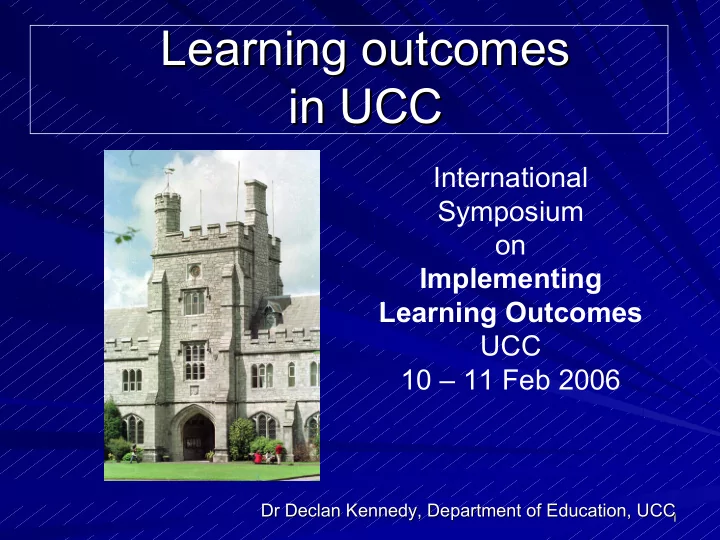
Learning outcomes Learning outcomes in UCC in UCC International Symposium on Implementing Learning Outcomes UCC 10 11 Feb 2006 Dr Declan Kennedy, Department of Education, UCC Dr Declan Kennedy, Department of Education, UCC 1 1


slide-1
SLIDE 1

1 1

Learning outcomes Learning outcomes in UCC in UCC

International Symposium

  • n

Implementing Learning Outcomes UCC 10 – 11 Feb 2006

Dr Declan Kennedy, Department of Education, UCC Dr Declan Kennedy, Department of Education, UCC

slide-2
SLIDE 2

2 2

1. 1.

What are Learning What are Learning Outcomes? Outcomes?

2. 2.

How do I write How do I write Learning Outcomes? Learning Outcomes?

3. 3.

How do I link How do I link Learning Outcomes Learning Outcomes to Teaching and to Teaching and Assessment? Assessment?

4. 4.

What are the benefits What are the benefits and potential and potential problems of Learning problems of Learning Outcomes? Outcomes?

slide-3
SLIDE 3

3 3

  • 1. What are learning outcomes?
  • 1. What are learning outcomes?

Learning outcomes are statements of what is expected that Learning outcomes are statements of what is expected that a student will be able to DO as a result of a learning a student will be able to DO as a result of a learning activity….(Jenkins and activity….(Jenkins and Unwin Unwin). ). Learning outcomes are explicit statements of what we want Learning outcomes are explicit statements of what we want

  • ur students to know, understand or to be able to do as a
  • ur students to know, understand or to be able to do as a

result of completing our courses. (Univ. New South Wales, result of completing our courses. (Univ. New South Wales, Australia) Australia) “Learning outcomes are statements that specify what “Learning outcomes are statements that specify what learners will know or be able to do as a result of a learning learners will know or be able to do as a result of a learning

  • activity. Outcomes are usually expressed as knowledge,
  • activity. Outcomes are usually expressed as knowledge,

skills or attitudes”. (American Association of Law Libraries). skills or attitudes”. (American Association of Law Libraries). Learning outcomes are an explicit description of what a Learning outcomes are an explicit description of what a learner should know, understand and be able to do as a learner should know, understand and be able to do as a result of learning. (Learning and Teaching Institute, result of learning. (Learning and Teaching Institute, Sheffield Hallam University) Sheffield Hallam University)

slide-4
SLIDE 4

4 4

Working Definition Working Definition

Learning outcomes are statements of what a Learning outcomes are statements of what a student should know, understand or be able student should know, understand or be able to do at the end of a learning activity. to do at the end of a learning activity.

The learning activity could be, for example, a lecture, a The learning activity could be, for example, a lecture, a module or an entire programme. module or an entire programme. Learning outcomes must not simply be a “wish list” of Learning outcomes must not simply be a “wish list” of what a student is capable of doing on completion of the what a student is capable of doing on completion of the learning activity. learning activity. Learning outcomes must be simply and clearly Learning outcomes must be simply and clearly described. described. Learning outcomes must be capable of being validly Learning outcomes must be capable of being validly assessed. assessed.

slide-5
SLIDE 5

5 5

From the definitions we see: From the definitions we see: Emphasis on the learner. Emphasis on the learner. Emphasis on the learner’s ability to do something. Emphasis on the learner’s ability to do something.

Focus on teaching Focus on teaching – – aims aims and objectives and use of and objectives and use of terms like terms like know, know, understand, be familiar with. understand, be familiar with. Outcomes: Focus on what we want Outcomes: Focus on what we want the student to be able to do the student to be able to do -

  • use of

use of terms like define, list, name, recall, terms like define, list, name, recall, analyse, calculate, design, etc. analyse, calculate, design, etc.

Aims: Give broad purpose or general intention of the module. Objectives: Information about what the teaching of the module hopes to achieve.

slide-6
SLIDE 6

6 6

  • 2. How do I write Learning
  • 2. How do I write Learning

Outcomes? Outcomes?

slide-7
SLIDE 7

7 7

Benjamin Bloom Benjamin Bloom (1913 (1913 – – 1999) 1999)

He looked on learning as a He looked on learning as a process process – – we build upon our former we build upon our former learning to develop more complex levels of learning to develop more complex levels of understanding understanding Carried out research in the development of Carried out research in the development of classification of levels of thinking behaviours in the classification of levels of thinking behaviours in the process of learning. PhD University of Chicago in process of learning. PhD University of Chicago in 1942. 1942. Worked on drawing up levels of these thinking Worked on drawing up levels of these thinking behaviours from the simple recall of facts at the lowest behaviours from the simple recall of facts at the lowest level up to evaluation at the highest level. level up to evaluation at the highest level.

slide-8
SLIDE 8

8 8

Bloom’s Taxonomy of Bloom’s Taxonomy of Educational Objectives Educational Objectives

Bloom’s taxonomy (1956) is a very useful aid to Bloom’s taxonomy (1956) is a very useful aid to writing learning outcomes. writing learning outcomes. The taxonomy consists of a hierarchy of The taxonomy consists of a hierarchy of increasingly complex processes which we want increasingly complex processes which we want

  • ur students to acquire.
  • ur students to acquire.

Provides the structure for writing learning Provides the structure for writing learning

  • utcomes
  • utcomes

Bloom’s Taxonomy is frequently used by Bloom’s Taxonomy is frequently used by teachers in writing learning outcomes as it teachers in writing learning outcomes as it provides a ready made structure and list of provides a ready made structure and list of verbs. verbs.

slide-9
SLIDE 9

9 9

Bloom (1956) proposed that knowing is composed of six successive levels arranged in a hierarchy.

  • 1. Knowledge
  • 2. Comprehension
  • 3. Application

4.Analysis

  • 5. Synthesis
  • 6. Evaluation
slide-10
SLIDE 10

10 10

This area is commonly called the cognitive (“knowing”) domain (involving thought processes). Bloom suggested certain verbs that characterise the ability to demonstrate these processes. These verbs are the key to writing learning outcomes. The list of verbs has been extended since his

  • riginal publication.

The “toolkit” for writing learning outcomes! The “toolkit” for writing learning outcomes!

slide-11
SLIDE 11

11 11

  • 1. Knowledge
  • 1. Knowledge -
  • ability to recall or

ability to recall or remember facts without necessarily remember facts without necessarily understanding them understanding them

Use action verbs like: Use action verbs like: Arrange, collect, define, Arrange, collect, define, describe, duplicate, describe, duplicate, examine, find, identify, examine, find, identify, label, list, memorise, label, list, memorise, name, order, outline, name, order, outline, present, quote, recall, present, quote, recall, recognise, record, recognise, record, recount, relate, repeat, recount, relate, repeat, reproduce, show, state, reproduce, show, state, tabulate, tell. tabulate, tell.

  • 1. Knowledge
  • 2. Comprehension
  • 3. Application

4.Analysis

  • 5. Synthesis
  • 6. Evaluation
slide-12
SLIDE 12

12 12

Examples: Knowledge Examples: Knowledge

Recall Recall genetics terminology: homozygous, genetics terminology: homozygous, heterozygous, phenotype, genotype, homologous heterozygous, phenotype, genotype, homologous chromosome pair, etc. chromosome pair, etc. Identify Identify and consider ethical implications of and consider ethical implications of scientific investigations. scientific investigations. Describe Describe how and why laws change and the how and why laws change and the consequences of such changes on society. consequences of such changes on society. List List the criteria to be taken into account when the criteria to be taken into account when caring for a patient with tuberculosis. caring for a patient with tuberculosis. Define Define what behaviours constitute unprofessional what behaviours constitute unprofessional practice in the solicitor practice in the solicitor – – client relationship. client relationship. Describe Describe the processes used in engineering when the processes used in engineering when preparing a design brief for a client. preparing a design brief for a client.

slide-13
SLIDE 13

13 13

  • 2. Comprehension
  • 2. Comprehension -
  • ability to

ability to understand and interpret learned understand and interpret learned information information

Use action verbs like: Use action verbs like:

Associate, clarify, Associate, clarify, classify, contrast, classify, contrast, describe, differentiate, describe, differentiate, discuss, distinguish, discuss, distinguish, estimate, explain, estimate, explain, express, extend, identify, express, extend, identify, illustrate, indicate, illustrate, indicate, interpret, locate, predict, interpret, locate, predict, recognise, report, restate, recognise, report, restate, review, select, translate. review, select, translate.

  • 1. Knowledge
  • 2. Comprehension
  • 3. Application

4.Analysis

  • 5. Synthesis
  • 6. Evaluation
slide-14
SLIDE 14

14 14

Examples: Comprehension Examples: Comprehension

Differentiate Differentiate between civil and criminal law between civil and criminal law Identify Identify participants and goals in the development participants and goals in the development

  • f electronic commerce.
  • f electronic commerce.

Predict Predict the genotype of cells that undergo meiosis the genotype of cells that undergo meiosis and mitosis. and mitosis. Explain Explain the social, economic and political effects of the social, economic and political effects of World War I on the post World War I on the post-

  • war world.

war world. Classify Classify reactions as exothermic and endothermic. reactions as exothermic and endothermic. Recognise Recognise the forces discouraging the growth of the forces discouraging the growth of the educational system in Ireland in the 19th the educational system in Ireland in the 19th century. century.

slide-15
SLIDE 15

15 15

  • 3. Application: ability to use learned
  • 3. Application: ability to use learned

material in new situations, e.g. put ideas material in new situations, e.g. put ideas and concepts to work in solving problems and concepts to work in solving problems

Use action verbs like: Use action verbs like: Apply, assess, calculate, Apply, assess, calculate, change, choose, change, choose, complete, compute, complete, compute, construct, demonstrate, construct, demonstrate, discover, dramatise, discover, dramatise, employ, examine, employ, examine, experiment, find, illustrate, experiment, find, illustrate, interpret, modify, operate, interpret, modify, operate, practice, predict, relate, practice, predict, relate, schedule, select, show, schedule, select, show, sketch, solve, use. sketch, solve, use.

  • 1. Knowledge
  • 2. Comprehension
  • 3. Application

4.Analysis

  • 5. Synthesis
  • 6. Evaluation
slide-16
SLIDE 16

16 16

Examples application Examples application

Construct Construct a timeline of significant events in the history of a timeline of significant events in the history of Australia in the 19 Australia in the 19th

th century.

century. Apply Apply knowledge of infection control in the maintenance of knowledge of infection control in the maintenance of patient care facilities. patient care facilities. Select Select and employ sophisticated techniques for analysing the and employ sophisticated techniques for analysing the efficiencies of energy usage in complex industrial processes. efficiencies of energy usage in complex industrial processes. Show Show an understanding of the use of vocabulary and an understanding of the use of vocabulary and grammar, as well as the sounds of the language in different grammar, as well as the sounds of the language in different styles….. styles….. Relate Relate energy changes to bond breaking and formation. energy changes to bond breaking and formation. Modify Modify guidelines in a case study of a small manufacturing guidelines in a case study of a small manufacturing firm to enable tighter quality control of production. firm to enable tighter quality control of production. Show Show how changes in the criminal law affected levels of how changes in the criminal law affected levels of incarceration in Scotland in the 19th century. incarceration in Scotland in the 19th century. Apply Apply principles of evidence principles of evidence-

  • based medicine to determine

based medicine to determine clinical diagnoses. clinical diagnoses.

slide-17
SLIDE 17

17 17

  • 4. Analysis: ability to break down information
  • 4. Analysis: ability to break down information

into its components, e.g. look for inter into its components, e.g. look for inter-

  • relationships and ideas (understanding of

relationships and ideas (understanding of

  • rganisational structure)
  • rganisational structure)

Use action verbs like: Use action verbs like: Analyse, appraise, arrange, Analyse, appraise, arrange, break down, calculate, break down, calculate, categorise, classify, categorise, classify, compare, connect, contrast, compare, connect, contrast, criticise, debate, criticise, debate, differentiate, discriminate, differentiate, discriminate, distinguish, divide, distinguish, divide, examine, experiment, infer, examine, experiment, infer, inspect, investigate, order, inspect, investigate, order, question, separate, test. question, separate, test.

  • 1. Knowledge
  • 2. Comprehension
  • 3. Application

4.Analysis

  • 5. Synthesis
  • 6. Evaluation
slide-18
SLIDE 18

18 18

Examples: Analysis Examples: Analysis

Analyse Analyse why society why society criminalises criminalises certain certain behaviours. behaviours. Compare Compare and contrast the different and contrast the different electronic business models. electronic business models. Debate Debate the economic and environmental the economic and environmental effects of energy conversion processes. effects of energy conversion processes. Calculate Calculate gradient from maps in m, km, % gradient from maps in m, km, % and ratio. and ratio. Compare Compare the classroom practice of a newly the classroom practice of a newly qualified teacher with that of a teacher of 20 qualified teacher with that of a teacher of 20 years teaching experience. years teaching experience.

slide-19
SLIDE 19

19 19

  • 5. Synthesis
  • 5. Synthesis -
  • ability to put

ability to put parts together parts together

Use action verbs like: Use action verbs like:

Argue, arrange, Argue, arrange, assemble, collect, assemble, collect, compose, construct, compose, construct, create, design, create, design, develop, formulate, develop, formulate, generalise, generalise, integrate, manage, integrate, manage,

  • rganise, plan,
  • rganise, plan,

prepare, propose, prepare, propose, relate, rewrite, set relate, rewrite, set up, summarise. up, summarise.

  • 1. Knowledge
  • 2. Comprehension
  • 3. Application

4.Analysis

  • 5. Synthesis
  • 6. Evaluation
slide-20
SLIDE 20

20 20

Examples: Synthesis Examples: Synthesis

Recognise Recognise and formulate problems that are and formulate problems that are amenable to energy management solutions. amenable to energy management solutions. Propose Propose solutions to complex energy solutions to complex energy management problems both verbally and in management problems both verbally and in writing. writing. Summarise Summarise the causes and effects of the 1917 the causes and effects of the 1917 Russian revolutions. Russian revolutions. Relate Relate the sign of enthalpy changes to the sign of enthalpy changes to exothermic and endothermic reactions. exothermic and endothermic reactions. Organise Organise a patient education programme. a patient education programme.

slide-21
SLIDE 21

21 21

  • 6. Evaluation: Ability to judge value
  • 6. Evaluation: Ability to judge value
  • f material for a given purpose
  • f material for a given purpose

Use action verbs like: Use action verbs like: Appraise, argue, Appraise, argue, assess, attach, choose, assess, attach, choose, compare, conclude, compare, conclude, convince, criticise, convince, criticise, defend, evaluate, defend, evaluate, judge, measure, judge, measure, predict, rate, predict, rate, recommend, revise, recommend, revise, score, summarise, score, summarise, support, value. support, value.

  • 1. Knowledge
  • 2. Comprehension
  • 3. Application

4.Analysis

  • 5. Synthesis
  • 6. Evaluation
slide-22
SLIDE 22

22 22

Examples: Evaluation Examples: Evaluation

Assess the importance of key participants Assess the importance of key participants in bringing about change in Irish history in bringing about change in Irish history Evaluate marketing strategies for different Evaluate marketing strategies for different electronic business models. electronic business models. Predict the effect of change in temperature Predict the effect of change in temperature

  • n the position of equilibrium…
  • n the position of equilibrium…

Summarise the main contributions of Summarise the main contributions of Michael Faraday to the field of Michael Faraday to the field of electromagnetic induction. electromagnetic induction.

slide-23
SLIDE 23

23 23

Two other domains in Bloom’s Two other domains in Bloom’s Taxonomy Taxonomy

PSYCHOMOTOR (“Doing”) DOMAIN: PSYCHOMOTOR (“Doing”) DOMAIN: involves co involves co-

  • ordination of brain and
  • rdination of brain and

muscular activity. Active verbs for this muscular activity. Active verbs for this domain: bend, grasp, handle, operate, domain: bend, grasp, handle, operate, perform, reach, relax, shorten, stretch, perform, reach, relax, shorten, stretch, differentiate (by touch), perform (skilfully). differentiate (by touch), perform (skilfully).

slide-24
SLIDE 24

24 24

Laboratory skills Laboratory skills Operate the range of instrumentation specified in Operate the range of instrumentation specified in the module safely and efficiently in the chemistry the module safely and efficiently in the chemistry laboratory. laboratory. Perform titrations accurately and safely in the Perform titrations accurately and safely in the laboratory. laboratory. Clinical Skills Clinical Skills The student is able to perform a comprehensive The student is able to perform a comprehensive history and physical examination of patients in history and physical examination of patients in the outpatient setting and the general medical the outpatient setting and the general medical wards, excluding critical care settings. wards, excluding critical care settings. The student is competent in performing The student is competent in performing venipuncture venipuncture and basic CPR. and basic CPR.

slide-25
SLIDE 25

25 25

AFFECTIVE (“Feeling”) DOMAIN: involves AFFECTIVE (“Feeling”) DOMAIN: involves

  • attitudes. Active verbs for this domain:
  • attitudes. Active verbs for this domain:

appreciate, accept, attempt, challenge, appreciate, accept, attempt, challenge, defend, dispute, join, judge, praise, defend, dispute, join, judge, praise, question, share, support. question, share, support.

slide-26
SLIDE 26

26 26

The challenge of beginning the task The challenge of beginning the task

  • f writing
  • f writing

Learning Outcomes Learning Outcomes

It is vital that learning outcomes are clearly written so that t It is vital that learning outcomes are clearly written so that they hey are understood by students, colleagues and external examiners. are understood by students, colleagues and external examiners. When writing learning outcomes it may be helpful to you if you When writing learning outcomes it may be helpful to you if you focus on what you expect students to be able to demonstrate focus on what you expect students to be able to demonstrate upon completion of the module or programme. upon completion of the module or programme. It is standard practice to list the learning outcomes using a ph It is standard practice to list the learning outcomes using a phrase rase like “On successful completion of this module, students should b like “On successful completion of this module, students should be e able to:” able to:” [list of learning outcomes] [list of learning outcomes] Avoid complicated sentences. If necessary use one than one Avoid complicated sentences. If necessary use one than one sentence to ensure clarity. sentence to ensure clarity. General recommendation: 5 General recommendation: 5 – – 8 learning outcomes per module. 8 learning outcomes per module. Avoid certain words………. Avoid certain words……….

slide-27
SLIDE 27

27 27

Words of advice ….. Words of advice …..

“The key word is DO and the key need in drafting learning “The key word is DO and the key need in drafting learning

  • utcomes is to use active verbs”. (Jenkins and
  • utcomes is to use active verbs”. (Jenkins and Unwin

Unwin, Fry et al.) , Fry et al.) Avoid verbs like “know”, “understand”, “be familiar with”, “be Avoid verbs like “know”, “understand”, “be familiar with”, “be exposed to” ( exposed to” (Osters Osters and and Tiu Tiu) ) “Try to avoid ambiguous verbs such as “understand”, “know”, “be “Try to avoid ambiguous verbs such as “understand”, “know”, “be aware” and “appreciate”. (Sheffield Hallam Guide). aware” and “appreciate”. (Sheffield Hallam Guide). “Care should be taken in using words such as ‘understand’ and “Care should be taken in using words such as ‘understand’ and ‘know’ if you cannot be sure that students will understand what ‘know’ if you cannot be sure that students will understand what it it means to know or understand in a given context” (Univ NSW). means to know or understand in a given context” (Univ NSW). Certain verbs are unclear and subject to different interpretatio Certain verbs are unclear and subject to different interpretations in ns in terms of what action they are specifying…… These types of verbs terms of what action they are specifying…… These types of verbs should be avoided: know, become aware of, appreciate, learn, should be avoided: know, become aware of, appreciate, learn, understand, become familiar with. (American Association of Law understand, become familiar with. (American Association of Law Libraries). Libraries).
slide-28
SLIDE 28

28 28

Checklist for writing Checklist for writing learning outcomes learning outcomes

  • Have I begun each outcome with an active verb?

Have I begun each outcome with an active verb?

  • Have I avoided terms like

Have I avoided terms like know know, , understand understand, , learn learn, , be be familiar with familiar with, , be exposed to be exposed to, , be acquainted with be acquainted with, , be be aware of aware of and and appreciate appreciate? ?

  • Have I included learning outcomes across the range of

Have I included learning outcomes across the range of levels of Bloom’s Taxonomy? levels of Bloom’s Taxonomy?

  • Are my outcomes observable and measurable?

Are my outcomes observable and measurable?

  • Do all the outcomes fit within the aims and content of the

Do all the outcomes fit within the aims and content of the module? module?

  • Have I used only one active verb per learning outcome?

Have I used only one active verb per learning outcome?

slide-29
SLIDE 29

29 29

  • 3. How do I link Learning
  • 3. How do I link Learning

Outcomes to Teaching Outcomes to Teaching and Assessment? and Assessment?

slide-30
SLIDE 30

30 30

Important to ensure that there is alignment between Important to ensure that there is alignment between teaching methods, learning outcomes and assessment teaching methods, learning outcomes and assessment criteria. criteria. This correlation between teaching, learning outcomes and This correlation between teaching, learning outcomes and assessment helps to make the overall learning experience assessment helps to make the overall learning experience more transparent and meaningful for students. more transparent and meaningful for students.

Teaching for understanding Learning outcomes There is a dynamic equilibrium between teaching strategies and Learning Outcomes.

slide-31
SLIDE 31

31 31

It is important that the assessment tasks mirror the Learning Outcomes since, as far as the students are concerned, the assessment is the curriculum: “From out students’ point of view, assessment always defined the actual curriculum” (Ramsden, 1992). Biggs (2003) represents this graphically as follows: Teacher

Learning Teaching

Perspectives: Objectives

Outcomes Activities Assessment

Student Perspectives: Assessment

Learning Activities Outcomes “To the teacher, assessment is at the end of the teaching-learning sequence of events, but to the student it is at the beginning. If the curriculum is reflected in the assessment, as indicated by the downward arrow, the teaching activities of the teacher and the learner activities of the learner are both directed towards the same

  • goal. In preparing for the assessment, students will be learning the curriculum”

(Biggs 2003)

slide-32
SLIDE 32

32 32

The Experience of using Learning The Experience of using Learning Outcomes Outcomes

slide-33
SLIDE 33

33 33

  • 1. Identify aims and objectives of

module

  • 2. Write learning outcomes using

standard guidelines

  • 3. Develop a teaching and learning

strategy to enable students to achieve learning outcomes

  • 4. Design assessment to check if

learning outcomes have been achieved

  • 5. If necessary modify module content and

assessment in light of feedback

slide-34
SLIDE 34

34 34

  • 4. What are the benefits and
  • 4. What are the benefits and

potential problems of Learning potential problems of Learning Outcomes? Outcomes?

slide-35
SLIDE 35

35 35

The benefits of Learning Outcomes The benefits of Learning Outcomes

Help to explain more clearly to students Help to explain more clearly to students what is expected of them and thus help to what is expected of them and thus help to guide them in their studies. guide them in their studies. Help teachers to focus more clearly on Help teachers to focus more clearly on what exactly they want students to achieve what exactly they want students to achieve in terms of knowledge and skills. in terms of knowledge and skills. Help teachers to define the assessment Help teachers to define the assessment criteria more effectively. criteria more effectively. Help to provide guidance to employers Help to provide guidance to employers about the knowledge and understanding about the knowledge and understanding possessed by graduates of programmes. possessed by graduates of programmes. .

.

slide-36
SLIDE 36

36 36

Potential problems with Learning Potential problems with Learning Outcomes Outcomes

Could limit learning if learning outcomes Could limit learning if learning outcomes written within a very narrow framework written within a very narrow framework – – lack of intellectual challenge to learners. lack of intellectual challenge to learners. Danger of assessment Danger of assessment-

  • driven curriculum if

driven curriculum if learning outcomes too confined. learning outcomes too confined. Could give rise to confusion among Could give rise to confusion among students and staff if guidelines not students and staff if guidelines not adhered to when drawing up learning adhered to when drawing up learning

  • utcomes, etc.
  • utcomes, etc.
slide-37
SLIDE 37

37 37

At the end of this talk you should At the end of this talk you should be able to: be able to:

1. 1.

Describe Describe what is meant by the term what is meant by the term learning learning

  • utcome
  • utcome.

.

2. 2.

Discuss Discuss Bloom’s Taxonomy of Educational Bloom’s Taxonomy of Educational Objectives. Objectives.

3. 3.

Apply Apply Bloom’s Taxonomy to help you to write Bloom’s Taxonomy to help you to write some learning outcomes. some learning outcomes.

4. 4.

Design Design a checklist for writing learning outcomes. a checklist for writing learning outcomes.

5. 5.

Recognise Recognise the advantages of learning the advantages of learning

  • utcomes.
  • utcomes.

6. 6.

Assess Assess the problems caused by poorly written the problems caused by poorly written learning outcomes. learning outcomes.

slide-38
SLIDE 38

38 38

That’s all Folks. Hope you learned something about learning outcomes!

slide-39
SLIDE 39

39 39

References References

Baume Baume, D. (1999). , D. (1999). Specifying Aims and Learning Specifying Aims and Learning Outcomes Outcomes Milton Keynes: Open University. Milton Keynes: Open University. Biggs J, (2003) Biggs J, (2003) Teaching and Learning in Higher Teaching and Learning in Higher Education: New Trends and Innovations Education: New Trends and Innovations. . University of Aveiro, 13 University of Aveiro, 13 – – 17 April 2003 17 April 2003 Bingham, J. (1999) Bingham, J. (1999) Guide to Developing Learning Guide to Developing Learning Outcomes Outcomes, The Learning and Teaching Institute , The Learning and Teaching Institute Sheffield Hallam University, Sheffield. Sheffield Hallam University, Sheffield. Fry, H., Fry, H., Ketteridge Ketteridge, S., Marshall (2000) , S., Marshall (2000) A Handbook A Handbook for Teaching and Learning in Higher Education for Teaching and Learning in Higher Education. . London: London: Kogan Kogan Page. Page.

slide-40
SLIDE 40

40 40

Jenkins, A. and Jenkins, A. and Unwin Unwin, D. , D. How to write How to write learning outcomes learning outcomes. See the following url: . See the following url:

http://www. http://www.ncgia ncgia. .ucsb ucsb. .edu edu/education/curricula/ /education/curricula/giscc giscc/units/format/outcomes.html /units/format/outcomes.html

Kendall Phillips L. (1994) The Continuing Kendall Phillips L. (1994) The Continuing Education Guide: the CEU and Other Education Guide: the CEU and Other Professional Development Criteria. Iowa: Professional Development Criteria. Iowa: Hunt Publishing. Hunt Publishing. Ramsden, P (2003) Ramsden, P (2003) Learning to teach in Learning to teach in Higher Education Higher Education, London Routledge , London Routledge. .