We enable businesses, non-profits and communities to achieve higher - - PowerPoint PPT Presentation

we enable businesses non profits and communities to
SMART_READER_LITE
LIVE PREVIEW

We enable businesses, non-profits and communities to achieve higher - - PowerPoint PPT Presentation

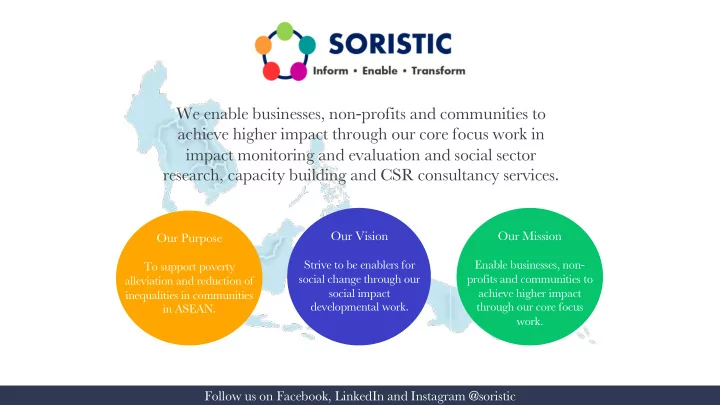
We enable businesses, non-profits and communities to achieve higher impact through our core focus work in impact monitoring and evaluation and social sector research, capacity building and CSR consultancy services. Our Vision Our Mission Our


slide-1
SLIDE 1

We enable businesses, non-profits and communities to achieve higher impact through our core focus work in impact monitoring and evaluation and social sector research, capacity building and CSR consultancy services.

Our Purpose

To support poverty alleviation and reduction of inequalities in communities in ASEAN.

Our Vision

Strive to be enablers for social change through our social impact developmental work.

Our Mission

Enable businesses, non- profits and communities to achieve higher impact through our core focus work.

Follow us on Facebook, LinkedIn and Instagram @soristic

slide-2
SLIDE 2

Ru Rural H Healthcare Pe Peace Building Ze Zero Poverty Ec Economic Opportunities for for Refu fugees Wa Water & Sa Sanit itatio ion Pe Peace Reconciliati tion Hu Hunger in in Sin ingapore Soc Social Imp mpact Bon

  • nd

Mo Movin ing Beyond Good In Intention

  • ns

Social Connex Series

To Toda day: Where Basic Ne Needs Are No Not Met

Follow us on Facebook, LinkedIn and Instagram @soristic

slide-3
SLIDE 3

Where Basic Needs Are Not Met.

slide-4
SLIDE 4

Why are we here today?

slide-5
SLIDE 5
slide-6
SLIDE 6
slide-7
SLIDE 7

“Inequality is often studied as an objective fact, a question of

  • numbers. It is of course that. But the numbers are derivative – they

are drawn from patterns of social realities, but do not fully describe

the realities themselves.

Inequality, as a social phenomenon, is experiential. It is a lived reality, felt in everyone’s everyday lives. These lived experiences tell us important things about how inequality is enacted and everyday reproduced.

slide-8
SLIDE 8

Youngest son stage 4 cancer patient. Sick and wheelchair bound, no income. Unemployed, Husband in prison. Husband sole breadwinner, 4 kids schooling. Eldest daughter has 2 types of cancer. Youngest son stage 4 cancer patient.

slide-9
SLIDE 9

Is there a need complement existing help? Is there a gap in provision of Basic Needs?

slide-10
SLIDE 10

Is there a Basic Needs Gap?

slide-11
SLIDE 11

Is there a Basic Needs Gap?

12 Lives. Hardships and Pains.

slide-12
SLIDE 12
  • 1. Low Income Families With Children
  • 2. People with Health Issues
  • 3. Seniors
slide-13
SLIDE 13

Name Eileen

Age 48 Employment status Part-time worker at a Japanese restaurant Marital Status and Partner Single Mother, Divorced

  • No. of

children 2

Obstacles

  • Inability to fight for child support.
  • Unable to get full-time work.
  • Cannot receive financial assistance

due to living with her mother.

  • Cannot take advantage of Child

Development Account (CDA)

  • Fears that subsidies will be taken

away if she gets a better job.

slide-14
SLIDE 14

Her wish is for her children to be able to eat and live well, not to struggle daily.

slide-15
SLIDE 15
slide-16
SLIDE 16

Name Mdm Ho

Age 73 Employment status Unemployed Marital Status and Partner Married to a 75 yo husband who suffered a stroke.

  • No. of

children 3

Obstacles

  • Hard to get by when both adults are

unable to work.

  • Has just enough to get by, but it

would be hard if there were unforeseen circumstances.

  • Lack of awareness about government

support.

slide-17
SLIDE 17

Her wish is that one day she will no longer have to worry about tomorrow.

slide-18
SLIDE 18

Basic Need Gaps

a) Lack of jobs with sufficient income for basic needs. b) Poor food nutrition. c) Insecure housing. d) Insufficient support for quality education. e) Poor mental well being.

slide-19
SLIDE 19

“A basic standard of living in Singapore is

about, but more than just, housing, food and

  • clothing. It is about having opportunities to

education, employment and work-life balance, as well as access to healthcare.”

Source: https://www.businesstimes.com.sg/government-economy/single-elderly-households-in-singapore-need-s1379-a-month-for-basic-needs-study

slide-20
SLIDE 20

12 Lives. Hardships and Pains.

slide-21
SLIDE 21

Key challenges faced by those who lack basic needs

slide-22
SLIDE 22

Criteria of some program eligibility are inflexible.

Because of unusual and different circumstances, some people might fall through the cracks of program eligibility. Benefits do not seem consistent to the beneficiaries as they are dispensed on a case-by-case basis. Public schemes (e.g. housing) are pro- family, and favour nuclear families than single-parent families.

slide-23
SLIDE 23

Unemployment concerns: difficulty in finding a suitable job.

  • Marginalised individuals may not have a good

education and are often in blue-collar jobs with low pay.

  • Marginalised individuals may have complicated

personal/family issues which hinder them their ability to commit in a full time, permanent job.

  • Better program benefits are only given to

employed individuals (e.g. childcare subsidies)

slide-24
SLIDE 24

“The Poverty Line”: the minimum level

  • f income deemed adequate in a

country.

slide-25
SLIDE 25

Poll time: How much do you need to meet basic needs in Singapore?

$1,250

slide-26
SLIDE 26

Average Household Expenditure on Basic Needs (AHEBN) NUS LKY School of Public Policy’s study in 2019*

*single elderly households, >65 and without illness; single persons aged 55-64

$1,250 – $1,500 per month $1,370 – $1,721 per month

Measures of ‘poverty’ in Singapore: How much is needed to meet basic needs?

slide-27
SLIDE 27

How do they work?

  • People either post items they would like to bless, or

request items to receive.

  • Other members of the Group would then request

for the item in the comments, usually mentioning their circumstances.

Blessing Groups

slide-28
SLIDE 28
slide-29
SLIDE 29
slide-30
SLIDE 30
slide-31
SLIDE 31
slide-32
SLIDE 32
slide-33
SLIDE 33

Priority Items to Bless

  • Home Appliances – Ovens, Fridges, TVs, Washing Machines
  • Infant Care Items – Milk Powder, Diapers, Potty’s, Strollers. Clothing
  • Usable furniture – Tables, Beds, Wardrobes
  • Wet and Dry Food
  • NTUC vouchers
slide-34
SLIDE 34
slide-35
SLIDE 35

Priority Items to Bless

  • Home Appliances – Ovens, Fridges, TVs, Washing Machines
  • Infant Care Items – Milk Powder, Diapers, Potty’s, Strollers. Clothing
  • Usable furniture – Tables, Beds, Wardrobes
  • Wet and Dry Food
  • NTUC vouchers

Focused Blessings can make a direct difference to their lives.

slide-36
SLIDE 36

Key Challenges to Address Basic Needs Gaps

  • 1. Criteria of some program eligibility are rigid.
  • 2. Unemployment concerns: difficulties finding a suitable job.

Now on to the panel

slide-37
SLIDE 37

Panel Session

slide-38
SLIDE 38

Introducing our Speakers

Fi Fion of

  • f Keep

eeping g Hop

  • pe

e Ali live Al Alson of

  • f Soc
  • cial

l Hea ealt lth h Grow

  • wth

Am Amos o

  • f Ope

OpenJio

slide-39
SLIDE 39

What can you do?

slide-40
SLIDE 40

Social Health Growth

www.socialhealthgrowth.org shgsupport@socialhealthgrowth.org @SHGSocialHealthGrowth @SocialHealthGrowth

  • Donate for their various work for underprivileged children and low-income

families

  • Volunteer for their financial literacy class, women empowerment programmes,

enrichment lessons for underprivileged children and computer literacy lessons

https://tinyurl.com/ SHGcampaigns

slide-41
SLIDE 41

Keeping Hope Alive

Keeping Hope Alive

  • Donate for their work with low-income families at rental flats.

Donate preloved items in good condition to their beneficiaries who genuinely need them.

  • Volunteer for their weekly Sunday visits to low-income families at rental flats. Check their

Facebook every Friday for the location and time. Restarting after CB.

slide-42
SLIDE 42

OpenJio

@OpenJioSG @OpenJio @OpenJio

slide-43
SLIDE 43

Soristic’s initiative

Fundraising for the Child Development Accounts (CDA) of underprivileged children

slide-44
SLIDE 44

Low income families have no spare cash to set aside for their children's educational and medical expenses. Contribute $10, $25 or $50 once-off or monthly to asset-build for primary school children from low-income families.

  • Matched 100% by the government.
  • Used only for educational and healthcare

expenses

www.giving.sg/campaigns /cdafundraiser

Soristic x Social Health Growth CDA Fundraiser

slide-45
SLIDE 45

www.soristic.asia connect@soristic.asia @soristic @soristic Keeping Hope Alive www.socialhealthgrowth.org shgsupport@socialhealthgrowth.org @SHGSocialHealthGrowth @SocialHealthGrowth @OpenJioSG @OpenJio @OpenJio

Watch out for our upcoming event on the impact of covid-19 within Singapore!! Soristic x Social Health Growth CDA Fundraiser Social Health Growth General Fundraiser

Thank you u for attending!