Non Profits and Unrelated Business Income: Evaluating Non Core - - PowerPoint PPT Presentation

non profits and unrelated business income evaluating non
SMART_READER_LITE
LIVE PREVIEW

Non Profits and Unrelated Business Income: Evaluating Non Core - - PowerPoint PPT Presentation

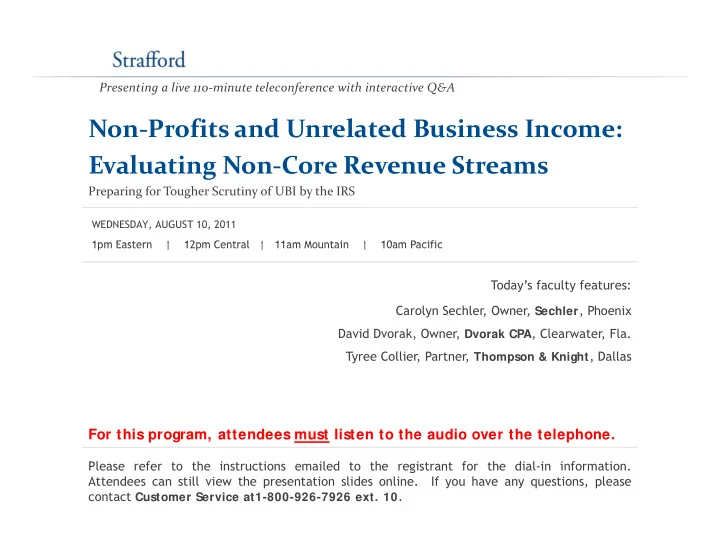
Presenting a live 110 minute teleconference with interactive Q&A Non Profits and Unrelated Business Income: Evaluating Non Core Revenue Streams Evaluating Non Core Revenue Streams Preparing for Tougher Scrutiny of UBI by the IRS


slide-1
SLIDE 1

Presenting a live 110‐minute teleconference with interactive Q&A

Non‐Profits and Unrelated Business Income: Evaluating Non‐Core Revenue Streams Evaluating Non Core Revenue Streams

Preparing for Tougher Scrutiny of UBI by the IRS

1pm Eastern | 12pm Central | 11am Mountain | 10am Pacific WEDNESDAY, AUGUST 10, 2011

Today’s faculty features:

1pm Eastern | 12pm Central | 11am Mountain | 10am Pacific

Carolyn Sechler Owner Sechler Phoenix Carolyn Sechler, Owner, Sechler, Phoenix David Dvorak, Owner, Dvorak CPA, Clearwater, Fla. Tyree Collier, Partner, Thompson & Knight, Dallas

For this program, attendees must listen to the audio over the telephone.

Please refer to the instructions emailed to the registrant for the dial-in information. Attendees can still view the presentation slides online. If you have any questions, please contact Customer Service at1-800-926-7926 ext. 10.

slide-2
SLIDE 2

Conference Materials

If you have not printed the conference materials for this program, please complete the following steps:

  • Click on the + sign next to “Conference Materials” in the middle of the left-

hand column on your screen hand column on your screen.

  • Click on the tab labeled “Handouts” that appears, and there you will see a

PDF of the slides for today's program.

  • Double click on the PDF and a separate page will open.

Double click on the PDF and a separate page will open.

  • Print the slides by clicking on the printer icon.
slide-3
SLIDE 3

Continuing Education Credits

FOR LIVE EVENT ONLY

Attendees must listen to the audio over the telephone. Attendees can still view

the presentation slides online but there is no online audio for this program.

Attendees must stay on the line for at least 100 minutes in order to qualify for

a full 2 credits of CPE. Attendance is monitored as required by NASBA. Please refer to the instructions emailed to the registrant for additional

  • information. If you have any questions, please contact Customer Service

at 1-800-926-7926 ext. 10. at 1 800 926 7926 ext. 10.

slide-4
SLIDE 4

Tips for Optimal Quality

S d Q lit S

  • und Qualit y

For this program, you must listen via the telephone by dialing 1-866-873-1442 and entering your PIN when prompted. There will be no sound over the web connection. co ect o . If you dialed in and have any difficulties during the call, press *0 for assistance. You may also send us a chat or e-mail sound@

straffordpub.com immediately so

we can address the problem.

Viewing Qualit y

To maximize your screen, press the F11 key on your keyboard. To exit full screen, press the F11 key again press the F11 key again.

slide-5
SLIDE 5

Non‐Profits and Unrelated Business I E l ti N C R Income: Evaluating Non‐Core Revenue Streams Seminar

  • Aug. 10, 2011

Tyree Collier, Thompson & Knight

tyree.collier@ tklaw.com

Carolyn Sechler, Sechler CPA PC

carolyn@ azcpa.com

David Dvorak, Dvorak CPA

info@ dvorakcpa.com

slide-6
SLIDE 6

Today’s Program

Reasons For Renewed IRS Interest In UBI

[Carolyn S echler]

Slide 7 – Slide 12 What Constitutes UBI Under Current Law

[Tyree Collier]

Slide 13 – Slide 20 Latest UBI Triggers

[David Dvorak]

Slide 21 – Slide 35 Planning Issues For Non-Profits To Consider

[Carolyn S echler]

Slide 36 – Slide 38, plus see "Background Materials"

slide-7
SLIDE 7

REASONS FOR RENEWED IRS

Carolyn Sechler, Sechler CPA PC

REASONS FOR RENEWED IRS INTEREST IN UBI

slide-8
SLIDE 8

B k d Background

Background Former IRS Tax Exempt Organization Director Marcus Owens (currently principal at Caplin & Drysdale) predicted at the Georgetown Tax Exempt Conference that the IRS’ next compliance check questionnaires would likely address unrelated business income taxes (UBIT) … (and possibly political activity). Reasons alluded to at this presentation were:

  • Possibility of underreporting of taxable income activities
  • Over reporting of allocations of expense to taxable activities

p g p

  • A similar effort has been effective in the for-profit arena
  • The IRS simply had not looked at this area in a while (1986)

8

slide-9
SLIDE 9

Wh IRS D l A F When IRS Develops A Focus

I. Procedure

  • A. As in other areas of focus, it is anticipated that

questionnaires will be issued to exempt organizations quest o a es w ll be ssued to e e pt o ga at o s requesting they voluntarily respond to questions about a particular area of activity. B Th ti i d ( f d ith

  • B. The questionnaire procedure (as performed with

hospitals and universities) allows for an area to be targeted for audit.

9

slide-10
SLIDE 10

E l F Y C id i Example For Your Consideration

  • I. Distinguishing sponsorship vs. advertising

A. A carefully and thoughtfully designed sponsorship program with guidance from your tax professional may result in a w t gu da ce o you ta p o ess o al ay esult a program free of UBI. B. To be considered a related activity, these components t t ib t t th li h t f th must contribute to the accomplishment of the

  • rganization’s exempt purpose.

C. The recent IRS concern over the number of times the logo/brand is shown at an event and whether it is tipping toward advertising (taxable)

10

slide-11
SLIDE 11

M hi M h d l i Matching Methodologies

Expense allocations

  • Carefully match expenditures which occurred as a result
  • f this activity
  • t

s act v ty

  • Would not have expended funds in this area if not for this

activity

  • Consistent methodology for computing allocated costs,

documented

11

slide-12
SLIDE 12

O Th H i On The Horizon

I Fundraising activity I.Fundraising activity A. Appears to have the elements of unrelated activity B. Fundraisers paid internally or externally might be construed as i d b i hi h i l l i d d

  • perating a trade or business which is regularly carried on and

for which funds are raised in a manner which does not further the mission of the organization. C. For now, the IRS is taking the position that this is more of a management activity than a business enterprise activity. In addition there does not seem to be any “unfair competition” i ith f fit titi l ti t thi ti it issue with for-profit entities relative to this activity. D. Scrutinize affinity card programs, “Groupon” type activities, and other forms of cause marketing for potential exposure to UBIT .

12

slide-13
SLIDE 13

WHAT CONSTITUTES UBI

Tyree Collier, Thompson & Knight

WHAT CONSTITUTES UBI UNDER CURRENT LAW

slide-14
SLIDE 14

Hi A d P History And Purpose

I Eff ti i 1951 I. Effective in 1951 II. Response to commercial business operations of charities A. New York University case y 1. Corporation operated macaroni factory 2. Earnings supported NYU Law School 3. IRS attempted to tax earnings but lost the case.

a.

  • C. F

. Mueller Co. v. Commissioner, 190 F

.2d 120 (3 d Ci 1951) (3rd Cir. 1951). b. Congress responded with the first UBIT rules. B Proposed to level playing field reduce non exempt B. Proposed to level playing field, reduce non-exempt activities

14

slide-15
SLIDE 15

O i i S bj T UBI T Organizations Subject To UBI Tax

I. Tax Imposed by IRC §511 A. Applies to all organizations tax exempt under I.R.C. § 501(a) 501(a) 1. 501(c)(3) organizations 2. All other 501(c) organizations ( ) g 3. All 401(a) organizations a. Pension plans b. IRAs c. Etc. B. Applies to state colleges and universities

15

slide-16
SLIDE 16

UBI T R UBI Tax Rates

I T t d d t f tit I. Tax rate depends on type of entity II. Corporations and associations A Taxed at regular corporate rates A. Taxed at regular corporate rates 1. 15% for first $50,000 of net taxable income 2. 34% to 39% over $75,000 of net taxable income 2. 34% to 39% over $75,000 of net taxable income

  • III. Trusts

A. Taxed at complex trust rates 1. 15% for first $2,300 of net taxable income 2. 25% to 33% for $2,301 to $11,500 3. 35% for net taxable income above $11,500

16

slide-17
SLIDE 17

What Is Taxed?

I. Unrelated business taxable income (UBTI) A. Gross income, less deductions, with modifications. IRC §512(a) B. Only from certain activities B. Only from certain activities 1. Trade or business 2. Regularly carried on a. Frequency and continuity comparable to similar commercial

  • perations

b. Annual events usually not regularly carried on i. Advertising in programs for sports, concerts (Treas. Reg. §1.513-1(c)(2)(ii)) ii. Income from annual fundraisers (Treas. Reg. § 1.513- 1( )(2)(iii)) 1(c)(2)(iii)) 3. Unrelated to exempt purpose i. Not substantially related to exempt purpose or function ii. Irrelevant that funds generated will support exempt function

17

slide-18
SLIDE 18

S E i T UBTI Statutory Exceptions To UBTI

I.

  • Sect. 513(a) exceptions

I.

  • Sect. 513(a) exceptions

A. Substantially all work performed by volunteers B. Activities conducted for the convenience of members, employees or the persons being served by the organization 1. Examples: Hospital cafeteria and college student housing housing C. Selling merchandise, substantially all of which was contributed to the organization II. Other specific situations A. Trade shows (§513(d)), sponsorship payments (§513(i)), etc.

18

slide-19
SLIDE 19

“M difi i ” Of IRC § (b) “Modifications” Of IRC §512(b)

I Primarily exclude additional types of income from UBTI I. Primarily exclude additional types of income from UBTI II. Passive income generally excluded from UBTI* A. Dividends (IRC §512(b)(1)) B. Interest (IRC §512(b)(1)) C. Annuities (IRC §512(b)(1)) D R l i (IRC §512(b)(2)) D. Royalties (IRC §512(b)(2)) E. Rents from real property (IRC §512(b)(3)) F. Capital gains (IRC §512(b)(5)) F. Capital gains (IRC §512(b)(5)) III. Various special modifications A. Income from controlled entities (IRC §512(b)(13)) * But subject to debt-financed income rules

19

slide-20
SLIDE 20

Debt‐Financed Income Rules Debt Financed Income Rules

I. Exception to passive income exception A. Applies UBI tax to passive income that is debt-financed II. Requires “acquisition indebtedness” A. Debt incurred to acquire or improve property; or B. Debt incurred earlier, but would not have been incurred

but for acquisition or improvement of property; or but for acquisition or improvement of property; or

C. Debt incurred later, but would not have been incurred but

for acquisition or improvement of property and was reasonably foreseeable

  • III. Calculation: Percentage of income from property to include in

UBTI based on ratio of avg. acquisition indebtedness of UBTI based on ratio of avg. acquisition indebtedness of property to avg. adjusted basis of property during tax year

20

slide-21
SLIDE 21

LATEST UBI TRIGGERS

David Dvorak, Dvorak CPA

slide-22
SLIDE 22

A Q i k C A Quick Caveat

When looking at gray areas involving unrelated business income, we must sometimes look to private letter rulings. Private letter rulings are NOT authoritative and CANNOT be used as precedents, but they do show how the IRS has addressed a specific situation specific situation. We can use private letter rulings to get a glimpse of the IRS’ reasoning process and how the Service is likely to rule on similar issues in the future.

22

slide-23
SLIDE 23
  • 1. Trade or Business (IRC §512)

( § )

  • 2. Regularly Carried On (IRC §512)
  • 3. Not Substantially Related to Exempt Purpose (IRC §513)
  • 1. NOT performed by “substantially all” volunteer labor (IRC §513)
  • 2. NOT carried on for convenience of its members (IRC §513)

(public charities and educational institutions)

  • 3. NOT involving sale of donated merchandise (IRC §513)
  • 4. NOT a “qualified public entertainment” activity (IRC §513)
  • 5. NOT a “qualified convention or trade show” activity (IRC §513)

Gift Sh Associate Member Dues Gift Shops Parking Lots Debt‐Financed Property Advertising Pass‐through Entities 23

slide-24
SLIDE 24

T i N Gif Sh Trigger No 1: Gift Shops

  • I. Gift shops are most likely to fail the ”substantially related” test for certain

items. A. Revenue Ruling 73-105 A folk art museum’s gift shop also sold books of a scientific nature and souvenirs related to the city where the museum was situated. The IRS ruled that the sale of certain items not related to the organization’s exempt purpose constituted UBI. exempt purpose constituted UBI. A. Be careful what you sell! Revenue Ruling 73-105 sets the precedent for the IRS to examine f h d h f d h ll k gift shops according to the types of products they sell. Make sure all your gift shop merchandise is related to your exempt purpose.

24

slide-25
SLIDE 25

T i N P ki L Trigger No. 2: Parking Lots

  • I. Parking lots open to the general public for a fee usually produce UBI,

unless they meet one of several exceptions: A. Substantially related to exempt purpose

  • Ltr. Rul. 200124022

An organization’s exempt purpose was to revitalize a downtown are of a particular city Providing affordable parking to the public are of a particular city. Providing affordable parking to the public was part of the organization’s exempt purpose. B. Not regularly carried on Example: Once a year, an organization opens its parking garage to the general public for a fee in order to accomodate the parking requirements for a local seasonal festival.

25

slide-26
SLIDE 26

T i N P ki L (C ) Trigger No. 2: Parking Lots (Cont.)

C. Convenience of its members Example: A museum with an adjacent parking lot that charges parking fees primarily for its visitors Most parking lots probably meet the ”convenience of its members” test, but beware of the following: A parking lot that charges fees, is open to the general public and is not adjacent to the exempt organization operating it. and is not adjacent to the exempt organization operating it.

26

slide-27
SLIDE 27

Trigger No. 3: Associate Member Dues

I Associate member dues may be UBI if their main purpose is to raise revenue

  • I. Associate member dues may be UBI if their main purpose is to raise revenue.
  • II. Ltr. Rul. 9847001 provides several criteria the IRS considers regarding whether

associate member dues are for the purpose of raising revenue. A. Do associate members have voting rights? g g B. Can associate members hold policy- or decision-making positions? C. Are associate members involved in the organization’s exempt activities? If an organization publishes a periodical for which vendors must be associate members in order to purchase advertising, the vendors’ membership dues may be UBI.

27

slide-28
SLIDE 28

T i N Ad i i Trigger No. 4: Advertising

  • I. Advertising is most often an issue when an organization publishes a periodical.
  • II. Advertising related to the exempt function will not produce UBI, if it is combined

with an approach that focuses on the organization’s exempt purpose. III Th S C t t d i A

i C ll f Ph i i

th t th

h

  • III. The Supreme Court noted in American College of Physicians that the approach

to advertising was the determining factor in whether it created UBI. The IRS can be expected to challenge most advertising revenue from periodicals as UBI, unless an organization proves otherwise.

28

slide-29
SLIDE 29

T i N Ad i i (C ) Trigger No. 4: Advertising (Cont.)

American College of Physicians 57 AFTR 2d 86-1182 (106 S.Ct. 1591) “The evidence is clear that plaintiff did not use the advertising to

provide its readers a comprehensive or systematic presentation of any aspect of the goods or services publicized. Those companies willing to

pay for advertising space got it; others did not. Moreover, some of the advertising was for established drugs or devices and was repeated from

  • ne month to another, undermining the suggestion that the advertising

was principally designed to alert readers of recent developments [citing, l d f V li I li d M l ] S d as examples, ads for Valium, Insulin and Maalox]. Some ads even concerned matters that had no conceivable relationship to the College's tax-exempt purposes.”

29

slide-30
SLIDE 30

Trigger No. 5: Income From Debt‐Financed Property

  • I. Interest and dividends on margin-financed securities are UBI.

Bartels Trust 85 AFTR 2d 2000-1352 (209 F.3d 147)

  • II. Rental income from debt-financed property
  • Definition of debt-financed property

― Property must have “acquisition indebtedness” P b d l h 85% f h i i ’ ― Property must be used less than 85% for the organization’s exempt purpose

  • NOT debt-financed property

― Property leased to a “related” or ”controlled” exempt

  • rganization

― Property subject to the “neighborhood land rule” Property subject to the neighborhood land rule

30

slide-31
SLIDE 31

Trigger No. 5: Income From Debt‐Financed Property (Cont.)

Neighborhood land rule

Real property acquired with debt for future exempt use may be temporarily used to produce income without being subject to the debt-financed rules. Specific rules

  • 1. Property must be in same neighborhood as other organization’s other property.
  • 2. Organization must not abandon its intent to use property for exempt purpose.
  • 3. Structures on land at time of acquisition must be demolished.

Temporarily = 10 years

31

slide-32
SLIDE 32

Trigger No. 5: Income From Debt‐Financed Property (Cont.)

II Rental income from debt-financed property

  • II. Rental income from debt financed property
  • Definition of debt-financed property

― Property must have “acquisition indebtedness.” P t t b d l th 85% f th i ti ’ t ― Property must be used less than 85% for the organization’s exempt purpose.

  • NOT debt-financed property

― Property leased to a “related” or “controlled” exempt organization ― Property subject to the “neighborhood land rule”

  • Debt-financed property rented to similar exempt organizations
  • Ltr. Rul. 200843036

Debt-financed property rented to unrelated organizations whose missions were similar to the landlord’s did not produce UBI, because the p rental was “substantially related” to the landlord’s exempt purpose.

32

slide-33
SLIDE 33

Trigger No. 5: Income From Debt‐Financed Property (Cont.)

If your organization rents out more than 15% of a property to

  • rganizations that do not further your exempt purpose, it

may have UBI. Determined using square footage Example: A free health clinic that rents

  • ut 20% of its facility’s square footage to a

humane society. The two organizations have very different exempt purposes. y p p p

33

slide-34
SLIDE 34

Trigger No. 5: Income From Debt‐Financed Property (Cont.)

If activities not related to your exempt purpose at a property are more than 15% of the total activities (by hours), then you may have UBI. Determined by hours spent on each activity Example: A facility that hosts weddings, social events, company outings, etc. when the owner

  • rganization is not using the facility for an exempt

purpose p p

34

slide-35
SLIDE 35

Trigger No. 6: Pass‐Through Entity Income

  • I. Generally, interests in partnerships and S corporations are

considered to be interests in unrelated trades or businesses. co s de ed to be te ests u elated t ades o bus esses.

  • II. Pass-through income is generally UBI.
  • III. The sale of an interest in a pass-through entity can result in a

gain classified as UBI. g

35

slide-36
SLIDE 36

PLANNING ISSUES FOR NON‐

Carolyn Sechler, Sechler CPA PC

PROFITS TO CONSIDER

slide-37
SLIDE 37

N T A di Note To Audience

Please make sure to reference the “Reference Materials” exhibit Please make sure to reference the Reference Materials exhibit in your materials, which will be important in this section of the program.

37

slide-38
SLIDE 38

Pl i M h i Planning Mechanisms

  • I. Effective UBO oversight

A. Create procedures (see samples) B Review allocation methodologies annually B. Review allocation methodologies annually C. Watch expansion of UBI activity and establish tipping point and options D. Spin-off activity? E. Create for-profit subsidiary F. Evaluate activity once more. What could you change about the activity so it would support mission or otherwise be exempt from tax (e.g., royalty)? be exempt from tax (e.g., royalty)?

38