Virtual Heliodon: Spatially Augmented Reality for Architectural - - PowerPoint PPT Presentation

virtual heliodon spatially augmented reality for
SMART_READER_LITE
LIVE PREVIEW

Virtual Heliodon: Spatially Augmented Reality for Architectural - - PowerPoint PPT Presentation

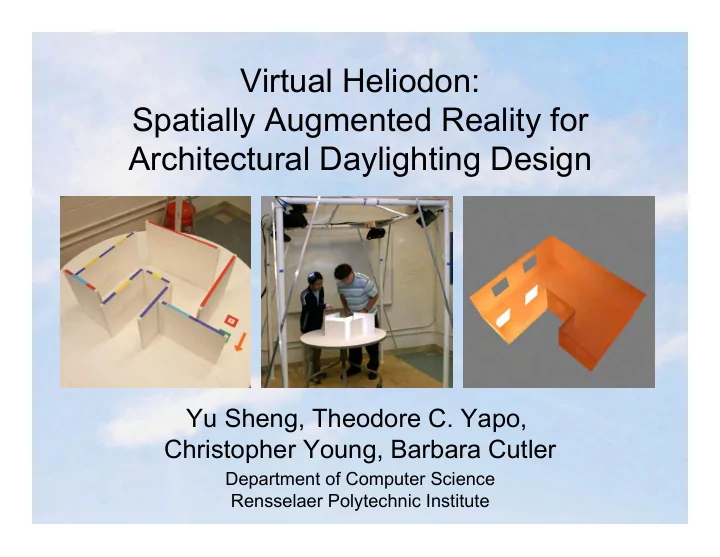
Virtual Heliodon: Spatially Augmented Reality for Architectural Daylighting Design Yu Sheng, Theodore C. Yapo, Christopher Young, Barbara Cutler Department of Computer Science Rensselaer Polytechnic Institute Natural Light vs. Electric Light

slide-1
SLIDE 1

Virtual Heliodon: Spatially Augmented Reality for Architectural Daylighting Design

Yu Sheng, Theodore C. Yapo, Christopher Young, Barbara Cutler

Department of Computer Science Rensselaer Polytechnic Institute

slide-2
SLIDE 2

Natural Light vs. Electric Light

Lighting accounts for 22% of US electricity consumption

slide-3
SLIDE 3

Lights on, blinds closed

  • 620 lux
  • 620 lux

Lights off, blinds closed

  • 110 lux
  • 180 lux

Lights off, blinds open

  • 320 lux
  • 880 lux

Lights off, no blinds

  • 380 lux
  • 1030 lux

500-1000 lux recommended for reading direct sunlight ≈ 100,000 lux

slide-4
SLIDE 4

Architectural Daylighting Design: The use of windows and reflective surfaces to allow natural light from the sun and sky to provide effective and interesting internal illumination.

Jun 21 8 am 10 am 12 pm Mar/Sep 21 2 pm 4 pm Dec 21

Residential design proposal by Mark Cabrinha

slide-5
SLIDE 5

Analysis with Traditional Heliodon

Shadows and light penetration can be

  • bserved on small scale physical model
slide-6
SLIDE 6

Related Work:

  • Daylighting Design

– Radiance, Greg Ward Larson

  • Virtual / Augmented Reality

– CAVE (Cruz-Neira et al., 1992) – Interior Architectural design (Mackie et al., 2004, Dunston et.al, 2007)

  • Spatially Augmented Reality

– Office of the future (Raskar et al., 1998) – Everywhere Display (Underkoffler et al., 1999) – Shader Lamps (Raskar et al., 2001) – Automatically-calibrated cameras and projectors (Raskar et al., 2001) – Multi-planar display (Ashdown et al., 2004) – Shadows and occlusions (Audet & Cooperstock, 2007)

slide-7
SLIDE 7

Table-top Daylighting Design

camera to detect geometry 4 projectors to display solution design sketched with foam-core walls

slide-8
SLIDE 8
slide-9
SLIDE 9

Algorithms and Implementation

  • Hybrid Rendering Algorithm
  • Model Construction
  • Camera & Projector Calibration
  • Primitive Detection
  • Multi-Projector Display
slide-10
SLIDE 10

Algorithms and Implementation

  • Hybrid Rendering Algorithm
  • Model Construction
  • Camera & Projector Calibration
  • Primitive Detection
  • Multi-Projector Display
slide-11
SLIDE 11

Radiosity

  • Global illumination algorithm

– Diffuse surfaces

  • Why not radiosity alone?

– Low resolution mesh → inaccurate shadows

  • Why do we need “hard

shadows”?

– More realistic – More intuition about scene geometry & lighting

Radiosity Radiosity/Shadow Volumes

slide-12
SLIDE 12

Interactive Global Illumination: Hybrid Radiosity/Shadow Volumes

  • 1. Radiosity
  • 3. Indirect=1-2
  • 4. Shadow volumes
  • 5. Final=3+4

Exploit smoothness in indirect illumination Efficiently compute direct illumination

  • 2. First bounce
slide-13
SLIDE 13

Algorithms and Implementation

  • Hybrid Rendering Algorithm
  • Model Construction
  • Camera & Projector Calibration
  • Primitive Detection
  • Multi-Projector Display
slide-14
SLIDE 14

Sketch Interpretation

red: exterior wall w/ window green: exterior wall yellow: interior wall blue north arrow software automatically constructs closed polygonal model for simulation

slide-15
SLIDE 15

Algorithms and Implementation

  • Hybrid Rendering Algorithm
  • Model Construction
  • Camera & Projector Calibration
  • Primitive Detection
  • Multi-Projector Display
slide-16
SLIDE 16

Camera Calibration

  • Using Zhang’s algorithm

[Zhang 1999] to estimate the intrinsic parameters

  • f camera

– Calibration target consisting of 212 black and white corner marks on a white background – 40 pictures taken at different orientations

slide-17
SLIDE 17

Projector Calibration

  • Tsai’s algorithm

[Tsai 1987]

– Uniformly spaced horizontal planes

Projector calibration Common coordinate system

slide-18
SLIDE 18

Algorithms and Implementation

  • Hybrid Rendering Algorithm
  • Model Construction
  • Camera & Projector Calibration
  • Primitive Detection
  • Multi-Projector Display
slide-19
SLIDE 19

Primitive Detection

  • Color classification
  • RANSAC: fit line to edges
  • 2D3D, projection matrix

Projection Geometry

Reconstructed Scene Edge Detection Physical Sketch

slide-20
SLIDE 20

Watertight Mesh for Simulation

“Extra” physical geometry Projection surfaces “Fill-in” geometry Detected geometry

(model interior)

slide-21
SLIDE 21

Algorithms and Implementation

  • Hybrid Rendering Algorithm
  • Model Construction
  • Camera & Projector Calibration
  • Primitive Detection
  • Multi-Projector Display
slide-22
SLIDE 22

Multi-Projector Display

  • Radiange adjustment
  • Intensity blending

– Smooths transitions between projectors – Each vertex in the mesh has a “best projector” for display

slide-23
SLIDE 23

Results

  • For a geometry with 1500 triangles

– 0.6 seconds to relight for changing time / day, north orientation, etc. – 6-7 seconds to generate the projection images for a new geometry

  • Image processing: 0.05 seconds
  • Remeshing: 2.5 seconds
  • Form factor computation: 3 seconds
slide-24
SLIDE 24
slide-25
SLIDE 25

Traditional Heliodon

  • Must peer in the

windows, but avoid blocking the “sun”

  • Close approximations
  • f all materials must be

used in model construction

  • Model construction is

tedious

  • Ceiling has been

removed allowing easy viewing

  • Less precision is

needed in joining walls

  • Materials are specified

digitally and do not require a physical sample of the material

  • Initial construction and

edits are fast and easy

Virtual Heliodon

slide-26
SLIDE 26

Ongoing and Future Work

  • Formal user studies
  • Robust image processing, e.g., ignore

users’ hands

  • Table surfaces, curved walls, sloped

ceilings

  • Consider dynamic range of projectors
  • Complex fenestration (window) materials
  • Compensate for secondary scattering of

projected imagery

slide-27
SLIDE 27

Light-Redirecting Materials

plain glass prismatic

Prismatic panels available in late 1800’s, but lost popularity when electric lighting was introduced

slide-28
SLIDE 28

Secondary Scattering Compensation

Desired illumination Naïve projection Compensated Compensated projection

slide-29
SLIDE 29

Thanks!

  • Collaborators:

Marilyne Andersen Mark Cabrinha Melissa Schroyer

  • RPI Computer

Vision Research Group

  • IBM & NSF