
MOL2NET, 2018, 4, http://sciforum.net/conference/mol2net-04 1
MDPI
MOL2NET, International Conference Series on Multidisciplinary Sciences
Elucidating the role of the intracellular pH sensing mechanism
- f TASK-2 K2P channel
Bustos Daniela, Sepúlveda Franciscob, Concha Guierdyc, Zúñiga Leandroc, González Wendya.
a: Center for Bioinformatics and Molecular Simulations, Universidad de Talca, Chile. b: Centro de Estudios Científicos, Valdivia, Chile. c: Centro de Investigaciones Médicas, Escuela de Medicina, Universidad de Talca, Chile.
Abstract. Two-pore domain potassium (K2P) channels are responsible for maintaining the background conductance essential to the resting membrane
- potential1. K2P channels assemble as dimers
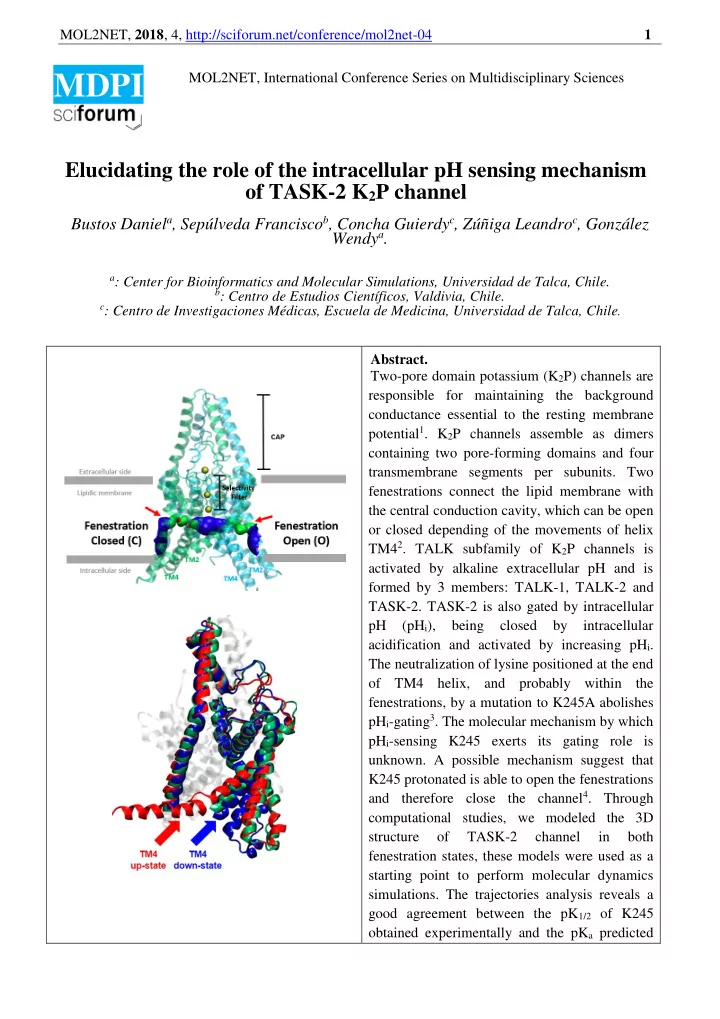
containing two pore-forming domains and four transmembrane segments per subunits. Two fenestrations connect the lipid membrane with the central conduction cavity, which can be open
- r closed depending of the movements of helix
- TM42. TALK subfamily of K2P channels is
activated by alkaline extracellular pH and is formed by 3 members: TALK-1, TALK-2 and TASK-2. TASK-2 is also gated by intracellular pH (pHi), being closed by intracellular acidification and activated by increasing pHi. The neutralization of lysine positioned at the end
- f TM4 helix, and probably within the
fenestrations, by a mutation to K245A abolishes pHi-gating3. The molecular mechanism by which pHi-sensing K245 exerts its gating role is
- unknown. A possible mechanism suggest that
K245 protonated is able to open the fenestrations and therefore close the channel4. Through computational studies, we modeled the 3D structure
- f
TASK-2 channel in both fenestration states, these models were used as a starting point to perform molecular dynamics
- simulations. The trajectories analysis reveals a
good agreement between the pK1/2 of K245
- btained experimentally and the pKa predicted