
MOL2NET, 2018, 4, http://sciforum.net/conference/mol2net-04 1
Cryptosporidium spp. prevalence in sheep from commercial sites in the State of Mexico, Mexico during Summer
María Uxúa Alonso-Fresána*, Maria de Lourdes Ordoñez-Sáncheza, Alberto Barbabosa-Pliegoa, Benjamín Valladares-Carranzaa, Valente Velázquez-Ordoñeza
a Facultad de Medicina Veterinaria y Zootecnia, Universidad Autónoma del Estado de México,
El Cerrillo, Piedras Blancas, CP 50295
* uxua_alonso@hotmail.com
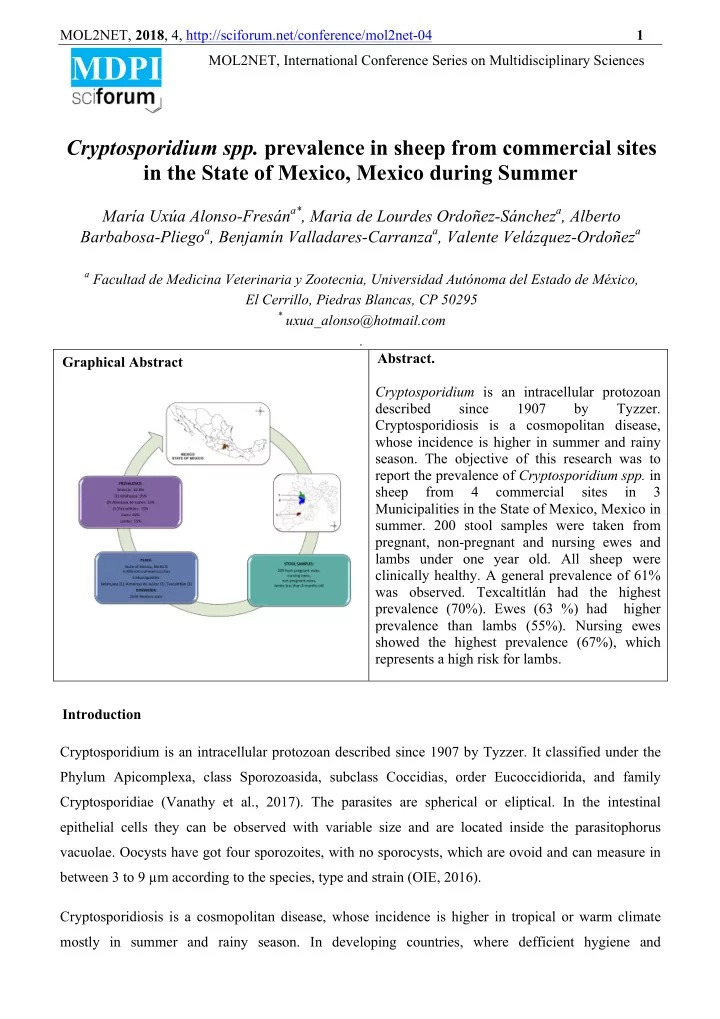
. Graphical Abstract Abstract. Cryptosporidium is an intracellular protozoan described since 1907 by Tyzzer. Cryptosporidiosis is a cosmopolitan disease, whose incidence is higher in summer and rainy
- season. The objective of this research was to
report the prevalence of Cryptosporidium spp. in sheep from 4 commercial sites in 3 Municipalities in the State of Mexico, Mexico in
- summer. 200 stool samples were taken from
pregnant, non-pregnant and nursing ewes and lambs under one year old. All sheep were clinically healthy. A general prevalence of 61% was observed. Texcaltitlán had the highest prevalence (70%). Ewes (63 %) had higher prevalence than lambs (55%). Nursing ewes showed the highest prevalence (67%), which represents a high risk for lambs. Introduction Cryptosporidium is an intracellular protozoan described since 1907 by Tyzzer. It classified under the Phylum Apicomplexa, class Sporozoasida, subclass Coccidias, order Eucoccidiorida, and family Cryptosporidiae (Vanathy et al., 2017). The parasites are spherical or eliptical. In the intestinal epithelial cells they can be observed with variable size and are located inside the parasitophorus
- vacuolae. Oocysts have got four sporozoites, with no sporocysts, which are ovoid and can measure in
between 3 to 9 µm according to the species, type and strain (OIE, 2016). Cryptosporidiosis is a cosmopolitan disease, whose incidence is higher in tropical or warm climate mostly in summer and rainy season. In developing countries, where defficient hygiene and
MDPI
MOL2NET, International Conference Series on Multidisciplinary Sciences