
MOL2NET, 2018, 4, http://sciforum.net/conference/mol2net-04 1
MDPI
MOL2NET, International Conference Series on Multidisciplinary Sciences
Virtual Screening of 1,2-Diazoles Compounds for Chagas Disease: A Prediction Model
SOUSA, N.Fa; BARROS, R.P.Ca; LUÍS, J.A.Sab; SCOTTI, L.a; SCOTTI, M.T.a
aPost-Graduate Program in Natural and Synthetic Bioactive Products, Federal University of Paraíba,
58051-900 João Pessoa, PB, Brazil;
bCenter of Education and Health, Federal University of Campina Grande. 58175-000 Cuité, PB, Brazil.
e-mail: nataliafsousa@ltf.ufpb.br Graphical Abstract Abstract.
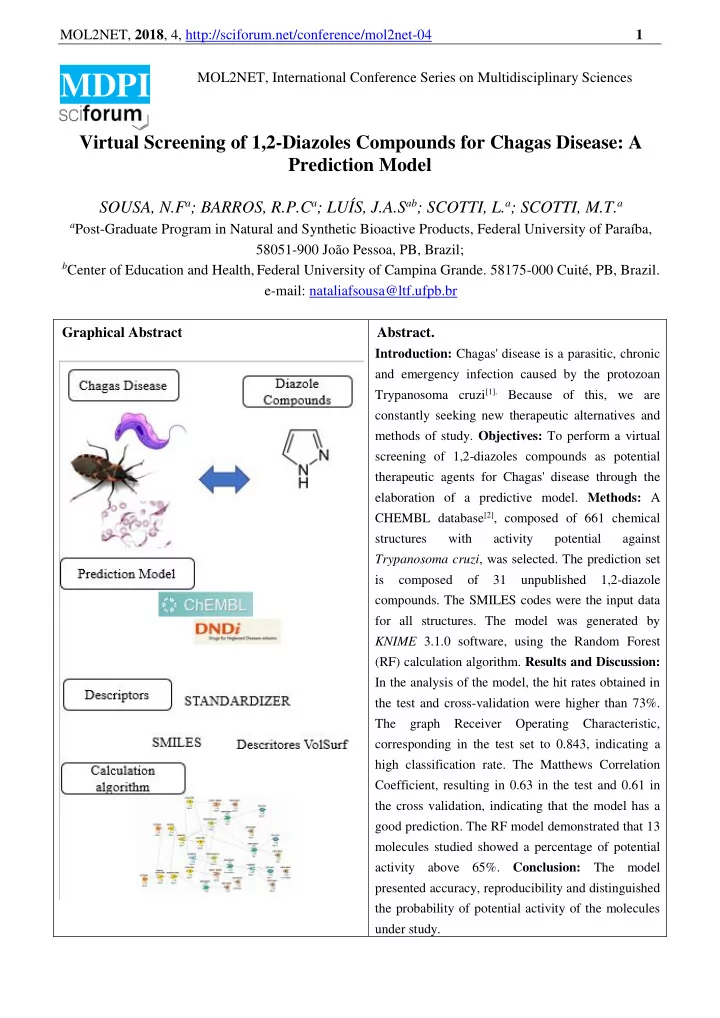
Introduction: Chagas' disease is a parasitic, chronic and emergency infection caused by the protozoan Trypanosoma cruzi[1]. Because of this, we are constantly seeking new therapeutic alternatives and methods of study. Objectives: To perform a virtual screening of 1,2-diazoles compounds as potential therapeutic agents for Chagas' disease through the elaboration of a predictive model. Methods: A CHEMBL database[2], composed of 661 chemical structures with activity potential against Trypanosoma cruzi, was selected. The prediction set is composed
- f
31 unpublished 1,2-diazole
- compounds. The SMILES codes were the input data
for all structures. The model was generated by KNIME 3.1.0 software, using the Random Forest (RF) calculation algorithm. Results and Discussion: In the analysis of the model, the hit rates obtained in the test and cross-validation were higher than 73%. The graph Receiver Operating Characteristic, corresponding in the test set to 0.843, indicating a high classification rate. The Matthews Correlation Coefficient, resulting in 0.63 in the test and 0.61 in the cross validation, indicating that the model has a good prediction. The RF model demonstrated that 13 molecules studied showed a percentage of potential activity above 65%. Conclusion: The model presented accuracy, reproducibility and distinguished the probability of potential activity of the molecules under study.