Hacking Your Own Virtual and Augmented Hacking Your Own Virtual and - - PowerPoint PPT Presentation

hacking your own virtual and augmented hacking your own
SMART_READER_LITE
LIVE PREVIEW

Hacking Your Own Virtual and Augmented Hacking Your Own Virtual and - - PowerPoint PPT Presentation

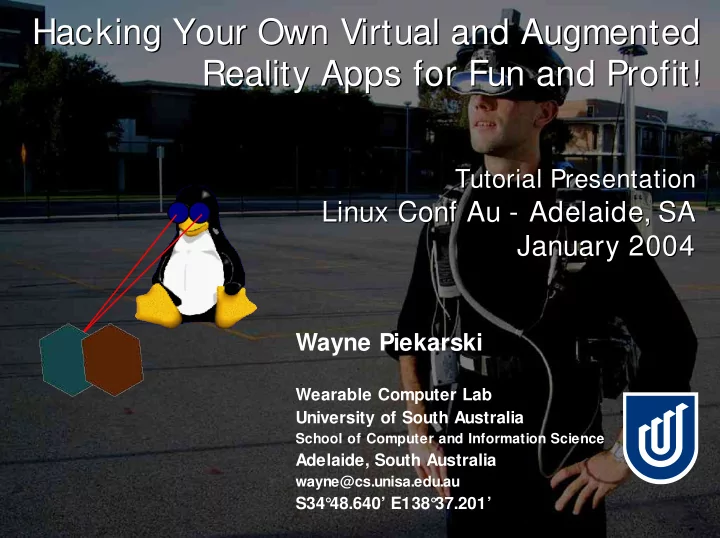
Hacking Your Own Virtual and Augmented Hacking Your Own Virtual and Augmented Reality Apps for Fun and Profit! Reality Apps for Fun and Profit! Tutorial Presentation Tutorial Presentation Linux Conf Au - Adelaide, SA Linux Conf Au - Adelaide,


slide-1
SLIDE 1

lca 2004

1

Wayne Piekarski Wearable Computer Lab CIS @ UniSA http://www.tinmith.net/wayne

Tutorial Presentation Tutorial Presentation

Linux Conf Au - Adelaide, SA Linux Conf Au - Adelaide, SA January 2004 January 2004

Hacking Your Own Virtual and Augmented Hacking Your Own Virtual and Augmented Reality Apps for Fun and Profit! Reality Apps for Fun and Profit!

Wayne Piekarski

Wearable Computer Lab University of South Australia

School of Computer and Information Science

Adelaide, South Australia

wayne@cs.unisa.edu.au

S34°48.640’ E138°37.201’

slide-2
SLIDE 2

lca 2004

2

Wayne Piekarski Wearable Computer Lab CIS @ UniSA http://www.tinmith.net/wayne

What is this tutorial about?

  • Brief introduction to 3D, virtual and augmented reality
  • OpenGL and live video display under X11
  • Video capture using Video4Linux and Firewire
  • 3D vision tracking using ARToolKit
  • Custom hardware input devices
  • Tour of Tinmith-Endeavour backpack
  • Show you the kinds of cool applications you can build

at home without having to spend a lot of money!

slide-3
SLIDE 3

lca 2004

3

Wayne Piekarski Wearable Computer Lab CIS @ UniSA http://www.tinmith.net/wayne

What is this tutorial not about?

  • Will not repeat what you can easily learn elsewhere
  • Linux distro installs, basic OpenGL, simple C programming
  • I will assume you know something about these
  • Mainly focusing on Linux specific problems and

solutions

  • Lots of things which are not documented very well
slide-4
SLIDE 4

lca 2004

4

Wayne Piekarski Wearable Computer Lab CIS @ UniSA http://www.tinmith.net/wayne

Tutorial and supplied materials

  • 3 hour presentation with a break half way
  • 1.5h talking, 0.5h break, 1.5h talking
  • Question times at the end of each section
  • 40 pages of notes with extra material and code

snippets

  • This presentation will be more higher level than the notes
  • Will talk about things at a different angle than the notes
  • CD contains example demos and scripts
  • Also includes open source programs and libraries
  • After the tutorial we will take the backpack outside
  • Inspection of internals, as well as demos
slide-5
SLIDE 5

lca 2004

5

Wayne Piekarski Wearable Computer Lab CIS @ UniSA http://www.tinmith.net/wayne

Lazy like a fox

  • Teach you interesting things you can use at home to

hack around with 3D right now!

  • Lots of projects, not enough time to work on them
  • Focus is on areas that are poorly documented or

difficult to play around with due to complexity

  • Tricks to build things on the cheap
slide-6
SLIDE 6

lca 2004

6

Intro to immersive 3D graphics

slide-7
SLIDE 7

lca 2004

7

Wayne Piekarski Wearable Computer Lab CIS @ UniSA http://www.tinmith.net/wayne

Immersive 3D graphics

  • My research work focuses on immersive 3D

applications

  • Typically use a head mounted display, not a monitor
slide-8
SLIDE 8

lca 2004

8

Wayne Piekarski Wearable Computer Lab CIS @ UniSA http://www.tinmith.net/wayne

Virtual and augmented reality

  • Virtual reality is purely computer generated graphics
  • Augmented reality combines the physical world with

artificial computer graphics

slide-9
SLIDE 9

lca 2004

9

Wayne Piekarski Wearable Computer Lab CIS @ UniSA http://www.tinmith.net/wayne

Optical augmented reality

Optical Combiner Physical World Display Virtual World Generated Graphics Computer Final View

  • Hard to find these displays for a reasonable price now
slide-10
SLIDE 10

lca 2004

10

Wayne Piekarski Wearable Computer Lab CIS @ UniSA http://www.tinmith.net/wayne

Video augmented reality

Display Camera Physical World Virtual World Generated Graphics Final View Computer

  • Displays from VR can be used with no modifications
  • We use these displays almost exclusively now
  • Cheaper and easier to buy, better quality output
slide-11
SLIDE 11

lca 2004

11

Wayne Piekarski Wearable Computer Lab CIS @ UniSA http://www.tinmith.net/wayne

Outdoor augmented reality

  • My research work focuses on performing AR outdoors
  • Especially mobile 3D user interfaces and modelling
slide-12
SLIDE 12

lca 2004

12

Wayne Piekarski Wearable Computer Lab CIS @ UniSA http://www.tinmith.net/wayne

3D compared to 2D

  • 3D is much more challenging than 2D
  • More degrees of freedom and more input devices
  • More realistic and intuitive application possibilities
  • Potential to use the body directly
  • Don’t use 2D input devices

to solve a 3D task!

slide-13
SLIDE 13

lca 2004

13

Wayne Piekarski Wearable Computer Lab CIS @ UniSA http://www.tinmith.net/wayne

Tinmith mobile 3D modelling

  • Gloves are used to control the environment
  • User interface designed specifically for mobile AR
  • Supports outdoor modelling and editing applications
slide-14
SLIDE 14

lca 2004

14

Wayne Piekarski Wearable Computer Lab CIS @ UniSA http://www.tinmith.net/wayne

User interface demonstration

  • Play UI demo video here
slide-15
SLIDE 15

lca 2004

15

Wayne Piekarski Wearable Computer Lab CIS @ UniSA http://www.tinmith.net/wayne

ARQuake demonstration

  • Play video here
slide-16
SLIDE 16

lca 2004

16

Wayne Piekarski Wearable Computer Lab CIS @ UniSA http://www.tinmith.net/wayne

Tracking

  • To generate a view, the computer needs to know the

position and orientation of the user’s head

  • May also require tracking of body parts and tools
  • Restricts the types of user interfaces we can use!
  • Accel/ gyro/ magnetic InertiaCube2
  • A$3500
  • Trimble Ag132 GPS
  • A$8000
  • ARToolKit vision tracking
  • Cost of video camera = $Cheap
  • Magnetic, optical, ultrasonic, mechanical
slide-17
SLIDE 17

lca 2004

17

Wayne Piekarski Wearable Computer Lab CIS @ UniSA http://www.tinmith.net/wayne

Processing

  • We need to carry sufficient computing power with us
  • 3D graphics requires fast video chipset
  • Video processing and capture can be CPU intensive
  • Most small computers have stripped down graphics

hardware because the demand for this is low

  • Laptops used to be pretty poor as well
  • Games market spawned powerful laptops with 3D GPUs
  • Getting laptops with good 3D and small sizes and good

power consumption is still a problem though

slide-18
SLIDE 18

lca 2004

18

Wayne Piekarski Wearable Computer Lab CIS @ UniSA http://www.tinmith.net/wayne

Indoor AR/VR

  • Not everyone has a backpack like me
  • Indoor setups for VR and AR
  • Still require expensive tracking hardware and HMD
  • Slightly easier because hardware can be bulky
  • Limited operating area
slide-19
SLIDE 19

lca 2004

19

Wayne Piekarski Wearable Computer Lab CIS @ UniSA http://www.tinmith.net/wayne

Free beer AR

  • AR and VR are dominated by the cost of the hardware
  • But free beer and free speech are also possible in AR!
  • ARToolKit
  • Hirokazu Kato and Mark Billinghurst
  • University of Washington
  • More on this later
  • Show live demo
slide-20
SLIDE 20

lca 2004

20

Wayne Piekarski Wearable Computer Lab CIS @ UniSA http://www.tinmith.net/wayne

Tutorial discussion

  • Today we will talk about how to use
  • Video cameras
  • ARToolkit
  • 3D renderers
  • Custom hardware
  • Goal is to allow creation of 3D apps to run on a

desktop

  • What else is possible apart from the standard 2D UI?
  • Lets get started!
slide-21
SLIDE 21

lca 2004

21

Distribution installation

slide-22
SLIDE 22

lca 2004

22

Wayne Piekarski Wearable Computer Lab CIS @ UniSA http://www.tinmith.net/wayne

Distribution installation

  • I use Knoppix as my development platform
  • Easy to setup and comes preconfigured for most things
  • I found Debian too hard to do very simple things
  • Has all the advantages of Debian though
  • Based on Debian unstable so it is up to date
  • Problems with Knoppix
  • Unstable and testing have problems
  • Debian stable is not really up to date enough either
  • Still looking for an ideal distribution
  • I can’t afford to spend weeks configuring a machine
  • Simple things should be simple, complex to be possible
slide-23
SLIDE 23

lca 2004

23

Wayne Piekarski Wearable Computer Lab CIS @ UniSA http://www.tinmith.net/wayne

Software requirements

  • Does not matter what distribution you use
  • To be on the safe side, install as much as you can so you

can avoid chasing up missing packages

  • Make sure you include (see notes)
  • Devel, XFree86, DRI, OpenGL, Kernel, Firewire
  • Knoppix has almost everything
  • Use apt-get to install the following
  • coriander, libraw1394-5, libraw1394-dev, libdc1394-dev,

libglut3, libglut3-dev

  • The conference LiveCD will hopefully have these too
slide-24
SLIDE 24

lca 2004

24

3D graphics infrastructure

slide-25
SLIDE 25

lca 2004

25

Wayne Piekarski Wearable Computer Lab CIS @ UniSA http://www.tinmith.net/wayne

Graphics libraries

  • Xlib
  • Existing X11 drawing library used for all X applications
  • GLX
  • Extension to X11 to allow OpenGL over X connection
  • DRI
  • Direct rendering interface for XFree86
  • GL
  • Core drawing functionality, possibly accelerated
  • GLU
  • Utility library, simplifies some GL calls for the programmer
  • GLUT
  • Utility toolkit provides a portable programming interface
  • Allows apps to run on almost any system
slide-26
SLIDE 26

lca 2004

26

Wayne Piekarski Wearable Computer Lab CIS @ UniSA http://www.tinmith.net/wayne

OpenGL advantages

  • Previously, required both X server and client

processes

  • For intensive drawing you waste a lot of CPU time
  • X protocol and memory usage
  • Kernel read() and write() calls
  • Task switching
  • X is not very good at massive primitive numbers
  • This is why SGI implemented direct rendering
  • Now we have GLX and DRI in XFree86 based on this
  • Server sets up video card for security
  • Client can then run without any intervention
  • System calls are evil, we can avoid them now!
slide-27
SLIDE 27

lca 2004

27

Wayne Piekarski Wearable Computer Lab CIS @ UniSA http://www.tinmith.net/wayne

3D hardware is cheap

  • Nowadays 3D hardware is available in almost all PCs
  • Old cards are still excellent, get them for free from

people throwing them away!

  • Older cards have more mature drivers as well
  • 3D drivers are very complicated monsters!
  • Most cards do not use hardware for all features, only

the most commonly used ones

  • SGI used to implement full hardware support though
slide-28
SLIDE 28

lca 2004

28

Wayne Piekarski Wearable Computer Lab CIS @ UniSA http://www.tinmith.net/wayne

Nvidia and ATI

  • Nvidia provide well supported closed source binaries
  • TNT2 is reasonable, GeForce2 is minimum recommended
  • Used this extensively on many boxes with good results
  • Same code base as Windows so has good performance
  • DRI provide open source driver for ATI cards up to

9200

  • Works ok but still has bugs in process of being fixed
  • Use it on my laptop, its ok but the Nvidia is more polished
  • Future for DRI is not certain past 9200?
  • ATI provide binary drivers but not as good as Nvidia
  • Minimum recommended is Radeon 7500
slide-29
SLIDE 29

lca 2004

29

Wayne Piekarski Wearable Computer Lab CIS @ UniSA http://www.tinmith.net/wayne

Nvidia and ATI

  • Avoid other hardware if you can
  • Integrated chipsets are much slower
  • Nvidia and ATI are the two big players
  • Drivers tend to be not as good for less mainstream gear
  • A problem if you use a laptop however!
  • Nvidia versus ATI always starts religious flame wars
  • Nvidia do not release specifications for their cards, but

they do provide good quality drivers that work

  • ATI DRI are getting better, but still have some issues
  • ATI are more power and size efficient for laptops
slide-30
SLIDE 30

lca 2004

30

Wayne Piekarski Wearable Computer Lab CIS @ UniSA http://www.tinmith.net/wayne

Learning OpenGL

  • OpenGL Red Book is what everyone learns from
  • Many free tutorials available on the web
  • OpenGL is beautifully designed and super easy to

learn

  • It is not convoluted and tricky like Xlib
  • Simple things are simple
  • Optimisation and tricky things are still possible
  • Supports primitive rendering, shading, textures, depth

buffering, 2D and 3D projections, linear transformations, and display lists

  • Everything you need to write both 2D and 3D applications
  • X supports 2D primitives and windowing, that’s about it
slide-31
SLIDE 31

lca 2004

31

Wayne Piekarski Wearable Computer Lab CIS @ UniSA http://www.tinmith.net/wayne

Using OpenGL

  • I write most of my apps using pure OpenGL now
  • I use X only as a way of opening a window for OpenGL
  • No way under X to draw lots of primitives without

incurring the overheads described before

  • If you use X then you get hardware acceleration but you

are limited by client/server overheads

  • If you draw locally you can use SHM and DGA to copy

direct to hardware but you have no primitive acceleration

  • I’ve always wanted an Xlib which was compiled directly

into the client or allowed direct access to the hardware

  • We now have it in the form of DRI
slide-32
SLIDE 32

lca 2004

32

Wayne Piekarski Wearable Computer Lab CIS @ UniSA http://www.tinmith.net/wayne

Catches of OpenGL

  • Pipelined in video card to maximise performance
  • May introduce some latency, not sure how much
  • Doesn’t seem to cause a problem for live video though
  • OpenGL is just a renderer, whereas X has toolkits on

top of it like Qt and GTK

  • I guess that some of these have been ported though
slide-33
SLIDE 33

lca 2004

33

Wayne Piekarski Wearable Computer Lab CIS @ UniSA http://www.tinmith.net/wayne

Useful example

  • X has trouble displaying live video
  • MIT SHM, Xvideo, DGA, etc
  • Each driver in XFree86 supports some but not others
  • You have to write your client to support all of them!
  • X doesn’t expose the entire acceleration of the video card
  • OpenGL can display texture maps natively
  • Not just render but perform warping, scaling, etc
  • Can render to flat 2D or any 3D polygon!
  • OpenGL is written to assume acceleration, so it will take

advantage of as much as is available

  • Supports auto format conversions (RGB, YUV, B&W)
  • Show application demo here
slide-34
SLIDE 34

lca 2004

34

Wayne Piekarski Wearable Computer Lab CIS @ UniSA http://www.tinmith.net/wayne

Video display source code

  • Work through example code here
slide-35
SLIDE 35

lca 2004

35

Live video capture

slide-36
SLIDE 36

lca 2004

36

Wayne Piekarski Wearable Computer Lab CIS @ UniSA http://www.tinmith.net/wayne

Capturing video

  • Previous example showed how to display video
  • Now we show how to grab this video
  • Capturing video is supported under Linux
  • Interfaces are non-trivial and tricky to use however
  • Really needs a nice user land API to simplify it
  • Developers have to supply a lot of their own code
  • Not much documentation
  • Not commonly used, so not maintained as much
slide-37
SLIDE 37

lca 2004

37

Wayne Piekarski Wearable Computer Lab CIS @ UniSA http://www.tinmith.net/wayne

Video 4 Linux

  • V4L was the first common kernel API for capture

drivers

  • PCI capture boards, USB cameras
  • Xawtv display program
  • Simple interface calls
  • open() – initialise device
  • read() – read data from camera, can also use mmap()
  • ioctl() – configure capture settings
  • You can specify resolution and pixel format (RGB,

YUV) but the device must support it

  • If not then you must supply your own conversion
slide-38
SLIDE 38

lca 2004

38

Wayne Piekarski Wearable Computer Lab CIS @ UniSA http://www.tinmith.net/wayne

Video 4 Linux

  • If you have trouble using V4L, reload the modules
  • I found the CPIA camera drive was not very reliable
  • New V4L2 API is available in kernel 2.5 and 2.6
  • Not all drivers use this new API
  • Older V4L apps are supported via compatibility layer
  • Designed to fix some flaws in old V4L
  • Still needs a nice user land interface library
  • Go through example V4L code
slide-39
SLIDE 39

lca 2004

39

Wayne Piekarski Wearable Computer Lab CIS @ UniSA http://www.tinmith.net/wayne

Firewire video capture

  • Linux has had Firewire support for about two years
  • Hard drives
  • Digital video cameras (DV)
  • Digital cameras (DC)
  • DV devices are supported using libDV
  • Takes raw DV compressed video from video camera
  • DC devices are supported using libDC
  • Supports YUV and RGB raw video up to 640x480
  • Nice for PCs because no decompression required
  • We will talk about DC devices today
slide-40
SLIDE 40

lca 2004

40

Wayne Piekarski Wearable Computer Lab CIS @ UniSA http://www.tinmith.net/wayne

libDC video capture

  • The libDC library is complicated and has almost no

documentation except for some include files

  • The easiest way to capture from DC devices is to use

the ARToolKit code because they have written an interface

  • ARToolKit is modular so you can use just the capture

code

  • I never wrote my own interface because it is quite tricky
  • The DC specification defines interface for all cameras
  • Very nice because ALL 1394 cameras work with Linux!
  • Contrast to USB cameras where there is no standard and

very poor driver support

  • I have bet the farm on DC cameras, they are a bit more

expensive but they are nice to use

slide-41
SLIDE 41

lca 2004

41

Wayne Piekarski Wearable Computer Lab CIS @ UniSA http://www.tinmith.net/wayne

Using DC devices

  • The RGB24 mode is nice because you can take the

raw image data and work with it straight away

  • Wastes bandwidth but CPU is not used much
  • USB cameras tend to operate in YUV mode
  • Coriander is a nice program for playing with cameras
  • All devices have controllable settings which is nice
  • I found that DC devices are more robust and reliable

than the CPIA USB camera I used

  • I have used the Pyro Webcam and Point Gray Firefly
slide-42
SLIDE 42

lca 2004

42

Wayne Piekarski Wearable Computer Lab CIS @ UniSA http://www.tinmith.net/wayne

Tricks to using DC devices

  • If you have trouble with the cameras, try reloading all

the 1394 modules, this fixes most problems

  • Gscanbus and coriander are nice debugging tools
  • Important you configure your devices properly

depending on the kernel and libDC version

  • Best advice is to use the newest 2.4 kernel
  • Use libDC version 9, and not 8 that you may be using

» mknod /dev/video1394/0 c 171 16

  • See the notes for other configurations
  • Other devices such as /dev/raw1394 are typically ok

» mknod /dev/raw1394 c 171 0

slide-43
SLIDE 43

lca 2004

43

Vision tracking

slide-44
SLIDE 44

lca 2004

44

Wayne Piekarski Wearable Computer Lab CIS @ UniSA http://www.tinmith.net/wayne

Intro to vision tracking

  • We can use video cameras to capture the physical

world

  • Computers can analyse the images to extract

information

  • There has been a lot of talk about vision tracking

coming soon but not really much action

  • The ARToolKit is a nice example of a library we can

use now to begin developing apps, without much knowledge

  • I will show how ARToolKit works and some examples
slide-45
SLIDE 45

lca 2004

45

Wayne Piekarski Wearable Computer Lab CIS @ UniSA http://www.tinmith.net/wayne

ARToolKit processing

  • Capture video frame
  • Extract out edges
  • Calculate rotation and translation
  • Match against pattern database
  • Profit! (well, a matrix)
  • Walk through simpleTest
slide-46
SLIDE 46

lca 2004

46

Wayne Piekarski Wearable Computer Lab CIS @ UniSA http://www.tinmith.net/wayne

Pulling apart 4x4 matrices

  • Computer graphics uses 4x4 matrices to represent

translate, scale, rotate, and other linear operations

  • Can be easily combined and handled in hardware
  • ARToolKit computes its result as a 4x4 matrix
  • Uses [row][col] array notation

| a b c d | | e f g h | | i j k l | | m n o p |

slide-47
SLIDE 47

lca 2004

47

Wayne Piekarski Wearable Computer Lab CIS @ UniSA http://www.tinmith.net/wayne

Example matrix operations

  • Identity

Trans Scale

  • To extract out translation, grab
  • X = matrix [0][3]
  • Y = matrix [1][3]
  • Z = matrix [2][3]
  • Rotation and scale are beyond the scope of this

tutorial!

| 1 0 0 Tx | | 0 1 0 Ty | | 0 0 1 Tz | | 0 0 0 1 | | 1 0 0 0 | | 0 1 0 0 | | 0 0 1 0 | | 0 0 0 1 | | Sx 0 0 0 | | 0 Sy 0 0 | | 0 0 Sz 0 | | 0 0 0 1 |

slide-48
SLIDE 48

lca 2004

48

Wayne Piekarski Wearable Computer Lab CIS @ UniSA http://www.tinmith.net/wayne

Using ARToolKit as a tracker

  • I use ARToolKit as a tracker for my hands
  • Markers placed on each thumb
  • Extract out XYZ coordinates from the matrix
  • Project 3D coordinates to display to get 2D
  • Use it to track your

hands in front of your monitor? Attach a camera to a baseball cap that you wear?

  • Generate real mouse

events for X11?

  • Control Gnome/ KDE?
slide-49
SLIDE 49

lca 2004

49

Wayne Piekarski Wearable Computer Lab CIS @ UniSA http://www.tinmith.net/wayne

Tracking position in a room

  • Multiple cameras observe markers on the ceiling
  • Inverse the matrix to find camera relative to the marker
  • Must measure each marker relative to the room
  • This one is a lot harder than it looks!
slide-50
SLIDE 50

lca 2004

50

Custom hardware

slide-51
SLIDE 51

lca 2004

51

Wayne Piekarski Wearable Computer Lab CIS @ UniSA http://www.tinmith.net/wayne

Important note

  • Hacking is not just about software!
  • It is about using tools to modify your hardware and

also make new cool devices

  • Drills
  • Power Saws
  • Soldering Irons
  • Sticky Tape
  • Plastic and Metal
  • And you make lots of

mistakes along the way

  • Combine the two for

even more fun!

slide-52
SLIDE 52

lca 2004

52

Wayne Piekarski Wearable Computer Lab CIS @ UniSA http://www.tinmith.net/wayne

WCL Project Oxcart

  • Repair damaged 1394 controller chip in Dell 8100

laptop

  • Texas Instruments TSB41AB1, 64-pin surface mount IC
  • 8 hour surgery
  • Saved $1200
  • Cost $5 plus time
  • Fun!
slide-53
SLIDE 53

lca 2004

53

Wayne Piekarski Wearable Computer Lab CIS @ UniSA http://www.tinmith.net/wayne

Interfacing technology

  • Parallel port
  • Serial port
  • USB port
  • PCs are becoming more complex and faster
  • Interfaces are getting harder for hobbyists to play with
  • PCI, USB, Firewire are all very complicated
  • New PCs are removing legacy ports
  • Some nice interface chips to help out though
  • The notes contains very detailed instructions which are

glossed over here

slide-54
SLIDE 54

lca 2004

54

Wayne Piekarski Wearable Computer Lab CIS @ UniSA http://www.tinmith.net/wayne

Parallel port

  • 25-pin D shell connector
  • 8 data lines capable of +5V with low current
  • Old ports are only single direction
  • Other flow control lines also capable of data transfer
  • Write directly to address using ioperm() and outb()
  • LED CPU Meter
  • CPU must bang out each byte manually
  • Interrupt for each incoming byte or intensive polling
  • Linux isn’t really designed for any of these
  • DOS is actually ideal for using these
slide-55
SLIDE 55

lca 2004

55

Wayne Piekarski Wearable Computer Lab CIS @ UniSA http://www.tinmith.net/wayne

Serial RS-232

  • 9-pin D shell connector
  • Baud rates up to 115,200 bps (slower than parallel)
  • Much more friendly on the CPU with large UART

buffers

  • Simple cables with only 3 wires needed
  • Requires a port for each device, limited on laptops
  • Open up device and use standard I/ O calls on an FD
slide-56
SLIDE 56

lca 2004

56

Wayne Piekarski Wearable Computer Lab CIS @ UniSA http://www.tinmith.net/wayne

Serial RS-232

  • Needs extra hardware at the remote end
  • Basic Stamp II or other microcontroller
  • Performs intensive I/O tasks without affecting CPU
  • There are only a small number of serial ports
  • Use USB interfaces - kernel maps to standard /dev
  • FTDI FT8U232AM chip
  • Keyspan series converters
  • Don’t bother with PCMCIA, not enough slots
slide-57
SLIDE 57

lca 2004

57

Wayne Piekarski Wearable Computer Lab CIS @ UniSA http://www.tinmith.net/wayne

Dumb controller boxes

  • You can buy boxes that have a number of input and
  • utput pins connected via USB, serial, parallel
  • These devices have no smarts and must be controlled

continuously and will use up a lot of CPU time

  • Try to use a microcontroller if you can
  • MCU provides real time functionality and only makes

the CPU deal with it when something interesting happens

  • I used this in my glove controller very successfully
slide-58
SLIDE 58

lca 2004

58

Wayne Piekarski Wearable Computer Lab CIS @ UniSA http://www.tinmith.net/wayne

Cheap hacks

  • USB mice have three or more buttons
  • Interfaces are already built
  • Simply cut open and solder custom switches
  • Applications that use a mouse need no modifications
  • Use an old mouse or get a cheap one
  • Why work when you

don’t have to?

  • Hacking existing gear is

much easier and saves time and money

slide-59
SLIDE 59

lca 2004

59

Conclusion

slide-60
SLIDE 60

lca 2004

60

Wayne Piekarski Wearable Computer Lab CIS @ UniSA http://www.tinmith.net/wayne

Conclusion

  • We have talked about a lot of material today
  • We had to gloss over a lot because of time restrictions
  • The notes contain lots of detail about everything I have

talked about today

  • Code examples are on the conference CD
  • Talked about video capture and display, 3D vision

tracking libraries, and building custom hardware

  • I look forward to seeing what people have built by the

next Linux Conf!

slide-61
SLIDE 61

lca 2004

61

Wayne Piekarski Wearable Computer Lab CIS @ UniSA http://www.tinmith.net/wayne

Questions?

  • Good luck, and don't fry your hardware!
  • Wayne Piekarski
  • University of South Australia
  • Wearable Computer Lab
  • http:/ / www.tinmith.net
  • http:/ / wearables.unisa.edu.au
  • wayne@cs.unisa.edu.au