Value Stream Mapping # 2 Report Discharge Process (July 2017) - - PowerPoint PPT Presentation

value stream mapping 2 report discharge process july 2017
SMART_READER_LITE
LIVE PREVIEW

Value Stream Mapping # 2 Report Discharge Process (July 2017) - - PowerPoint PPT Presentation

Value Stream Mapping # 2 Report Discharge Process (July 2017) Presented at the JCC Meeting, November 14, 2017 by Regina Gomez, Director of Quality and Jennifer Carton-Wade, Assistant Hospital Administrator The Team Gemba Sub-Teams We broke


slide-1
SLIDE 1

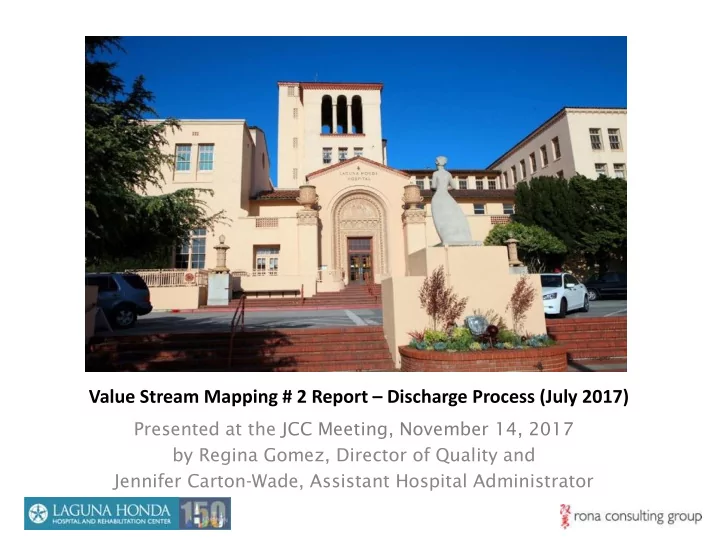
Value Stream Mapping # 2 Report – Discharge Process (July 2017)

Presented at the JCC Meeting, November 14, 2017 by Regina Gomez, Director of Quality and Jennifer Carton-Wade, Assistant Hospital Administrator
slide-2
SLIDE 2

The Team

slide-3
SLIDE 3

Gemba Sub-Teams

We broke into teams in

  • rder to observe:
  • Case conferences
  • Discharge huddles
  • Resident care

conferences

  • Interdisciplinary

resident care teams

  • Individual members of

the care team

slide-4
SLIDE 4

Going to the Gemba

slide-5
SLIDE 5

Processes Observation Summary

Processes Observed

Residents RN MD MSW Rehab Case conference (initial) 4 10 12 8 6 Discharge assessment 2 5 Counseling plan 1 5 8 1 Medication pass 2 4 Therapy 1 5 3 Psychosocial support 1 6 1 2 Home evaluation 8 2 Patient education 2 6 5 1 Pack belongings 2 TOTAL: 113 8 26 29 35 15

105 hours of observation, 113 processes observed!

slide-6
SLIDE 6

Education – lean overview and value stream mapping

slide-7
SLIDE 7

Mapping the Current State

Hot pink stickies for waiting Yellow stickies for observations and wastes Pink stickies for process steps Blue stickies for ideas

slide-8
SLIDE 8

Current State Data Summary

Unit:

PMS S2

Time

Care Planning DC Process Care Planning DC Process

LT

1,490 46,750 2,925 75,460

LT in days

1 day 32 days 2 days 52 days

CT

50 490 45 500

WAIT

1,440 46,260 2,880 74,960

VA

50 465 22 380

NVA

1,1440 46,285 2,903 75,080

VA %

3.4% 1% 1% .5%

slide-9
SLIDE 9

Summary of current state issues

  • No clear signal/notification of discharge date
  • Home not ready (home eval not scheduled soon

enough)

  • Durable medical equipment (DME) delays
  • Resident participation in discharge meeting
  • Lack of a comprehensive discharge plan of care
  • Non-standard discharge care plan meeting
  • Multiple forms of discharge documentation
  • No standard work for linkage/continued care

referrals

slide-10
SLIDE 10

Idea Generation

slide-11
SLIDE 11

Idea Generation Reporting

slide-12
SLIDE 12

Future State Map

mutual goals care coordination care transitions resident empowerment fostering confidence health and wellness

slide-13
SLIDE 13

Lean Concepts to Reflect in the Future State

slide-14
SLIDE 14

Future State Data Summary

Current PMS Current S2 Future “Short Stay”

Care Planning DC Process Care Planning DC Process DC Process Only

LT

1,490 46,750 2,925 75,460 17,550

LT in days

1 day 32 days 2 days 52 days 12.2

CT

50 490 45 500 270

WAIT

1,440 46,260 2,880 74,960 17,280

VA

50 465 22 380 265

NVA

1,1440 46,285 2,903 75,080 17,305

VA %

3.4% 1% 1% .5% 1.4%

Total time for discharge post identification of DC date: 12.2 days in the future vs 32-52 days currently

slide-15
SLIDE 15

Our Vision of the Future

  • Length of stay for short stay residents will drop from 84

to 54 days (a reduction of 36%)

  • Lead time from identification of discharge to actual

discharge will drop from a range of 32-52 to 12.2 days while maintaining time for treatment and care and maintaining a safe and supportive environment

  • Characteristics of the future state include:
  • Resident developing self-confidence for self-care
  • Enabling health and wellness of the resident post-

discharge

  • Fully integrating linkages to community resources

for the betterment of resident outcomes post- discharge

slide-16
SLIDE 16

Problem Statement

The number of residents discharged from Laguna Honda has been declining over the past 3 fiscal years. Availability of housing for the population served is increasingly more limited in San Francisco. There is a need to focus on discharge planning processes of residents who are able to return to their prior living situation where housing is not a barrier to discharge.

slide-17
SLIDE 17

Targets and Goals

By the end of FY 17-18,

  • 1. Increase by 25% the number of residents (who

are short stay and have a home) discharged back to the community within 60 days of admission.

  • 2. Reduce average LOS by 30% by improving

internal and external discharge planning care coordination processes and reducing wait times between processes. (Average LOS for S2 from 263 to 184 days, PM from 77 to 54 days)

slide-18
SLIDE 18

Implementation Plan

Next Steps: Just Do Its - 4 Kaizens - 3

slide-19
SLIDE 19

Questions & Answers

Thank you.