
SLIDE 1
- Workshop SLAC - March 6-8, 2013
Veronica Bindi
Physics and Astronomy Department University of Hawaii at Manoa
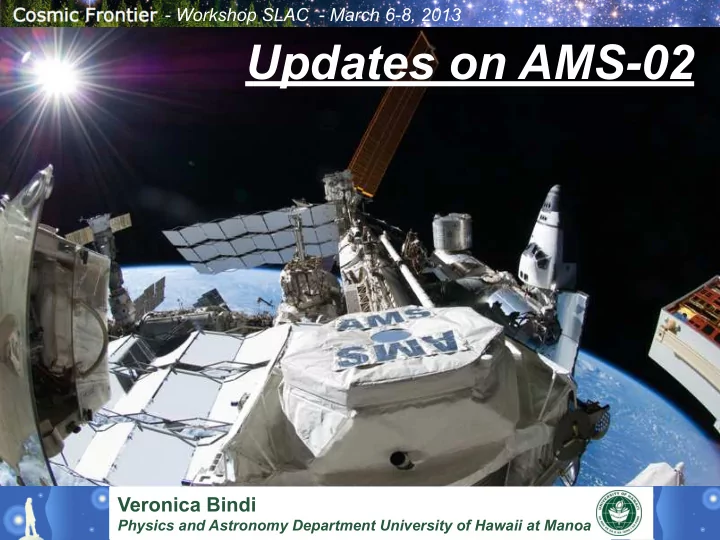
Updates on AMS-02 Veronica Bindi Physics and Astronomy Department - - PowerPoint PPT Presentation
- Workshop SLAC - March 6-8, 2013 Updates on AMS-02 Veronica Bindi Physics and Astronomy Department University of Hawaii at Manoa AMS is a US DOE led International Collaboration Spokesperson: Nobel laureate Prof. Dr. S. Ting from MIT AMS-02
Veronica Bindi
Physics and Astronomy Department University of Hawaii at Manoa
Spokesperson: Nobel laureate Prof. Dr. S. Ting from MIT
2
6
3
TRD TOF
4
channels... e+ , antiprotons, Ɣ, antideuterons
5
Time at location [s]
Acquisition rate [Hz] DAQ efficiency Particle rates vary from 200 to 2000 Hz per orbit Average DAQ efficiency 85% Average DAQ rate ~800Hz 28 billion events collected in 18 moths 60 TB raw events (Downlink 10 Mbit/s)
19 May 2011 1 Jan 2013
DATA collected
6
TRD alignment
Cosmic protons are used for alignment to an accuracy of 0.04 mm for each straw module and used to calibrate the detector response to 3% accuracy.
TRD gain calibration
7
Tracker Thermal Control System
Coordinate resolution on each plane is measured with 10 µm in the bending direction. Position of ladders in the external layers are dynamically aligned to an accuracy of 3 µm.
8
TRD Distinguish between electrons and protons SILICON TRACKER and MAGNET measure the sign and the rigidity ECAL measures the energy, Identifies 3D characteristic positron shower and rejects hadronic showers
9
Proton rejection at 90% e+ efficiency Rigidity (GV)
Signals from 20 layers are combined in a likelihood estimator which allows an efficient discrimination of proton background
10
A fit of particle trajectory is used to measure the sign of the particle and its rigidity: 1) Used to suppress e- 2) compared to the energy E measured by ECAL to suppress P.
3 m
11
Positron E=636 GeV
17 radiation length
12
Momentum (GeV/c)
1 10
2
10
3
10
Proton Rejection
1 10
2
10
3
10
4
10
5
10
A Boosted Decision Tree (BDT) is constructed on the basis of the shower shape in the ECAL to distinguish protons and electrons. BDT and E/p matching combined give a Proton Rejection of 104
13
E bin = 82 - 100 GeV
14
e+ / (e+ + e−) Energy (GeV)
HEAT: J.Beatty et al., Phys. Rev. Lett. 93 (2004) AMS-1: M.Aguilar et al., Phys. Lett. B 646 (2007) Pamela: O.Adriani et al., Astropart. Phys. 34 (2010) FERMI: M.Ackermann et al., PRL 108 (2012) 15
Geomagnetic cutoff
East West
ΔΦ (degrees)
Protons Electrons Average AMS-02 inclination
16
Entries
H He Li Be B C N O F NeNaMg Al Si Cl Ar K Ca ScTi V Cr P S Fe Ni
0 5 10 15 20 25 0 5 10 15 20 25
108 107 106 105 104 103 102 10 1
T
C h a r g e Tracker Charge Accurate Study of the composition of the cosmic rays Multiple Independent Measurements of the Charge (|Z|)
17
18
ZTRK_L1=5.2 ZTRD=5.2 ZTOF_UP=5.5 ZTOF_LOW=5.4 ZTRK_L2-L8=5.0 ZRICH=4.8
Boron
Rigidity=680 GV
ZTRK_L9=5. 1 ZTRK_L1=5.8 ZTRD=6.0 ZTOF_UP=6.1 ZTOF_LOW=6.5 ZTRK_L2-L8=6.0 ZRICH=6.1
Rigidity=666 GV
Carbon
front view side view front view side view
ZTRK_L9=6.1
19
ZTOF_LOW=5.2 ZTRK_IN=4.8 ZRICH=5.1 ZTRK_L1=6.1 ZTRD=6.0 Z0=9.9 Z1=5.3
20
(~90%)
21
are properly functioning
advanced
ratio, gamma)
sensitivity and statistic: great physics potential We want to thank NASA and DOE for making AMS possible!
22
Velocity measured to an accuracy of 1/1000 for 400 GeV protons Bending Plane Residual (cm)
N N
Reconstructed Velocity
TRD: 400 GeV protons Energy N
e± Energy Resolution: 2.5-3%
TOF 1 and 2 TOF 3 and 4
Measures Velocity and Charge of particles
Plane 4 3, 4
Z=2 Z=6 σβ=2% σTime=80ps σβ=1.2% σTime=48ps
x103
TOF Charge Events/Bin Events/Bin TOF Charge Z±ΔZ=26.01± 0.38
Z=26 One-Typical-Counter Charge Resolution
Velocity [Rigidity>20GV] Events Velocity [Rigidity>20GV] Events
TRD T O F Tracker TOF RICH ECAL
1
2
7-8 3-4 9 5-6
There are six types of Quarks found in accelerators (u, d, s, c, b, t). All matter on Earth is made out of only two types (u, d) of quarks. “Strangelets” are new types of matter composed of three types of quarks (u, d, s) which should exist in the cosmos.
Carbon Nucleus Z/A ~ 0.5 Strangelet Z/A ~ 0.1 37
u d s s d d s s u d u d u u d d s u s u u d d d d d d u u u u s u s s s
d d u u u d u u d d d u u u d d d u d d u d d u d d u u u d u u d u u d
p n
After many years, the question of the existence of strange quark matter still remains without a definitive answer.
Front view Side view β1 Amplitude => Z, β2 Rigidity = 4.31 ± 0.38 GV Charge Z = 2 β1 = β2 = 0.462 ± 0.005 Mass = 16.45±0.15 GeV/c2 Z/A = 0.114 ± 0.01 Flux (1.5 < EK < 10 GeV) = 5x10⁻⁵ (m2 sr sec)-1
Candidate observed with AMS-01 5 June 1998 11:13:16 UTC
Jack Sandweiss (Yale) is leading the AMS search.
Z/A~0.1
30
Over 1,100 temperature sensors and 298 heaters are monitored to assure components stay within thermal limits and avoid permanent damage.
E q u a t
ISS Orbital Plane
23.4o
Earth’s Orbital Plane
Solar Beta Angle
Solar Vector SUN
β
Orbital Inclination 51.6o
The thermal environment on ISS is constantly changing due to:
STBD Main Radiator moved from -8o to +25o STBD Main Radiator parked at -8o TRD Pump temperature 3 Sep 4 Sep 5 degrees in a few hours
As estimations: 3 g/cm2 in the TRD 2 g/cm2 in the TOF
DATA Per Year Of Operation:
MC Per Year Of Operation: