Signal Types Recall even digital signals are just voltages Analog - - PowerPoint PPT Presentation

signal types
SMART_READER_LITE
LIVE PREVIEW

Signal Types Recall even digital signals are just voltages Analog - - PowerPoint PPT Presentation

14.1 14.2 Signal Types Recall even digital signals are just voltages Analog signal Continuous time signal where each voltage level has a unique meaning Digital signal Unit 14 Continuous signal where voltage levels are


slide-1
SLIDE 1

14.1

Unit 14

Noise Margins, Interfacing, and Tri-States

14.2

Signal Types

  • Recall even digital signals are just voltages…
  • Analog signal

– Continuous time signal where each voltage level has a unique meaning

  • Digital signal

– Continuous signal where voltage levels are mapped into 2 ranges meaning 0 or 1

1 1

volts volts time time

Analog Digital

Threshold 14.3

Signals and Meaning

0.0 V 0.8 V 2.0 V 5.0 V Each voltage value has unique meaning 0.0 V 5.0 V Logic 1 Logic 0 Illegal Analog Digital

Threshold Range

Each voltage maps to ‘0’ or ‘1’ (There is a small illegal range where meaning is undefined since threshold can vary based on temperature, small variations in manufacturing, etc.)

14.4

NOISE MARGINS, LEVEL SHIFTERS, & DRIVE STRENGTH

slide-2
SLIDE 2

14.5

A Motivating Example

Example 1

  • You connect an output port to an LED

(light emitting diode) and connect everything correctly. The light should turn on when you set your output bit to a high voltage (logic '1').

  • When you turn the system on the LED

does not glow. You measure the voltage at the gate output with a voltmeter and find it is not 5V but 1.8V? Why isn't it a logic 1?

  • The ______________ output ability

from the output port is not ____ enough to adequately ______ the LED which then drags the voltage _______.

Example 2

  • You buy two digital chips (say a

microprocessor and GPS reader

  • You correctly wire them together

and write software to turn 'on' a pin on the microprocessor to a '1' to enable the GPS reader

  • When the software runs the GPS

unit does not turn on. Why?

  • Different circuit implementation

techniques use different voltage ______ to indicate _________ and may be _____________ Lesson To Be Learned: Not all 1's or 0's are created equal!

14.6

The Digital Abstraction

  • Digital is a nice abstraction of voltage and current

– Lets us just think 'on' or 'off' but not really worry about the voltages and currents underneath

  • ______________
  • Not all 1's and 0's are created equal

– A '1' can be any 'HIGH' voltage (maybe in the range ___________) – A '0' can be any 'LOW' voltage (maybe in the range ___________) – So 3V and 5V both mean ________ but they aren't equal

  • Similarly certain outputs of a chip may connect to other devices

that require more _________ than the output can _________

– Think of connecting a ______________ to your garden spigot – Or even worse your garden hose to a fire _________... would shred it – In the same way, inputs and outputs of different devices must be matched to the _____________________ of what they connect to

14.7

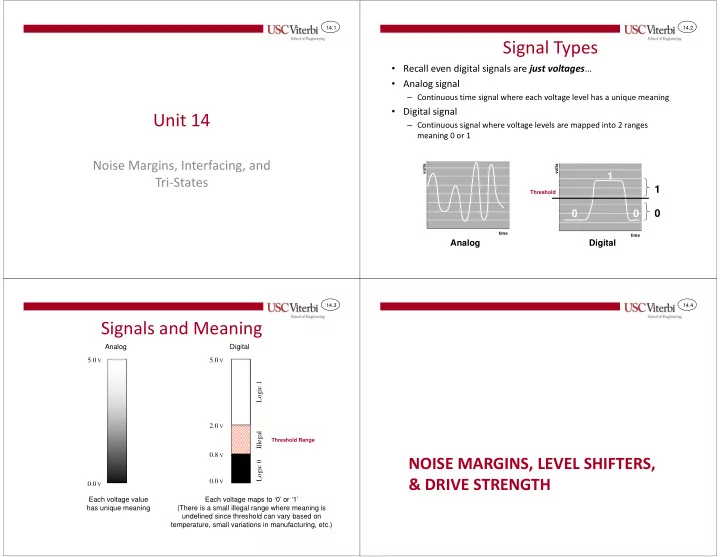
Digital Voltage Noise Margins

  • Consider the output of one digital circuit feeding the input of another

– Assume the devices are from different vendors (families of devices)

  • There may be different ___________ and requirements of the two devices

– Example: The output may produce 3V to mean logic '1' while the next device's input requires 5V to be used as logic '1'

  • Analogy 1: Grades. Suppose the cutoff for an A is 90% (i.e. __________ input)

– If you get a 91% (i.e. output result)…_______! – If you get an 89%…(__________ for this class! But ______ from the cutoff's perspective.)

  • Analogy 2: Tickets. Suppose there are 100 available tickets to an event (i.e.

input limit)

– If you are the 99th person (i.e. output result)…________! – If you are the 101st person…__________!

Output Input

14.8

Digital Voltage Noise Margins

  • Consider one digital gate feeding another

0.0 V 5.0 V Logic 1 Logic 0 Illegal ______ Range Interpretation 0.0 V 5.0 V Logic 1 Logic 0 Illegal ______ Range Interpretation

VOH VOL VIL VIH NMH = ______ NML = _______ OH = Output High OL = Output Low IH = Input High IL = Input Low NM = Noise Margin As long as _________ and _________ we are in good shape… Electromagnetic interference & power spikes can cause this to break down

Required Input Possible Output
slide-3
SLIDE 3

14.9

Class Activity

  • Do an internet search for "74LS00 datasheet"

(this is a chip w/ some 2-input NAND gates) and try to find any PDF and open it

  • Skim the PDF and try to find:

– VOH, VIH, VOL, VIL

14.10

Analogy

  • Consider a sprinkler system…what will happen if you add 100

new sprinklers to your backyard?

  • Pressure (voltage) will go ______________ and ___________

water (current) flow coming out of each

14.11

Current Limitations

  • When a circuit outputs a 'HIGH' ('1') it can only supply (__________) so

much current (think of your garden hose spigot) = IOH

  • When a circuit outputs a 'LOW' ('0') it can only suck up (__________) so

much current = IOL

  • When a circuit receives a 'HIGH' signal on the input side it may need a

certain amount of current to recognize the input as 'HIGH' = IIH

  • When a circuit receives a 'LOW' signal on the input side it may need a

certain amount of current to recognize the input as 'LOW' = IIL

1 IOH IOL IIH IIL

14.12

Example

  • Consider the example where device A's output

connects to device B's input

– Are the voltage requirements compatible? – How many device B inputs can a single device A output drive?

  • Always use worst case of ______________ output drive capability

Dev. VOH VIH VOL VIL IOH IIH IOL IIL A 3.4V 3.3V 0.5V 1.0V

  • 4 mA
  • 1 mA

10 mA 2 mA B 3.2V 3.0V 0.6V 0.7V

  • 2 mA
  • 1 mA

6 mA 2 mA

Voltage requirement are _____________

  • Dev. A VOH ___ Dev. B VIH

AND

  • Dev. A VOL ___ Dev. B. VIL
  • Dev. A's output can drive 4 Dev. B inputs

When outputting '1':

  • (Dev. A IOH / Dev. B IIH) = (________) = ___

When outputting '0':

  • (Dev. A IOL / Dev. B IIL) = (________) = ___

Drive capability = ___________________

slide-4
SLIDE 4

14.13

Consideration

  • If we attach too many gates to one output it

may not be enough to drive those gates

  • Need to make sure the current

requirements and capabilities match

  • Let's say we connect one of the NAND gates
  • n the 74LS00 chip to an input of N other

NAND gates…

  • Can it produce/suck up the required

current…

  • …if N = 6?
  • …if N = 12?

If IOH or IOL is too low we can split the loads by place intermediate buffers

14.14

All In the Family

  • There are many families of circuit devices that talk different

language (Each has a different VOH, VIH, VOL, VIL, IOL, IIL, etc.)

  • Examples:

– _____________ – _____________ – _____________

  • Must make sure if you interface two different devices that they

are ________________ (i.e. VOH of device A is greater than VIH

  • f device B) or use a buffer/amplifier/level shifter circuit to help

them talk to each other

– http://www.ti.com/lit/ds/symlink/cd4504b-ep.pdf

A B

VOH=2.2V VIH=3.5V

14.15

Arduino Limits

  • Arduino outputs can sink (suck up) and source (produce)

around a maximum of 20 mA on a pin

– http://www.atmel.com/Images/Atmel-8271-8-bit-AVR- Microcontroller-ATmega48A-48PA-88A-88PA-168A-168PA-328- 328P_datasheet.pdf

  • Do an internet search for "Standard Servo Motor Datasheet"

and find the maximum current it may need

  • It doesn't seem like the Arduino would be

able to drive the servo motor. How is it working?

– Remember the 3-pin interface: R = Power, B = Ground, W = Signal – The signal is _____________ from the power – The power source is used to amplify the signal

14.16

Another Example

  • Now consider a speaker system where the power and signal

are provide together

– Given our Arduino use 5V = Vcc and its current limitations per pin, how much power can we supply to the speaker? – 5V * _____________ = ____________ – You need an _________________…

Power & Signal together

slide-5
SLIDE 5

14.17

TRI-STATE GATES

14.18

Typical Logic Gate

  • Gates can output two values: 0 & 1

– Logic ‘1’ (Vdd = 3V or 5V), or Logic ‘0’ (Vss = GND) – But they are ALWAYS outputting something!!!

  • Analogy: a sink faucet

– 2 possibilities: Hot (‘1’) or Cold (‘0’)

  • In a real circuit, inputs cause EITHER a pathway from
  • utput to VDD OR VSS

Hot Water = Logic 1 Cold Water = Logic 0

(Strapped together so always one type

  • f water coming out)

+3V PMOS NMOS

Output Inputs

Vdd Vss Inputs

+3V PMOS NMOS

Output Inputs

14.19

Output Connections

  • Can we connect the output of two logic gates together?
  • _______! Possible _______________ (static, low-resistance

pathway from Vdd to GND)

  • We call this situation “_________________”

Src 1 Src 2 Src 3

Vdd Vss Inputs Vdd Vss Inputs

Src 1 Src 2 14.20

Tri-State Buffers

  • Normal digital gates can output two

values: 0 & 1

1. Logic 0 = 0 volts 2. Logic 1 = 5 volts

  • Tristate buffers can output a third

value:

3. ____ = __________________ = "Floating" (no connection to any voltage source…infinite resistance)

  • Analogy: a sink faucet

– 3 possibilities: 1.) Hot water, 2.) Cold water, 3.) _____ water

Hot Water = Logic 1 Cold Water = Logic 0 ___ Water = Z (High-Impedance)

+3V PMOS NMOS

Output Inputs

Z (high impedance)

slide-6
SLIDE 6

14.21

Tri-State Buffers

  • Tri-state buffers have an extra

enable input

  • When disabled, output is said

to be at high impedance (a.k.a. Z)

– High Impedance is equivalent to no connection (i.e. floating

  • utput) or an infinite resistance

– It's like a brick wall between the

  • utput and any connection to

source

  • When enabled, normal buffer

In Out = In Enable=1

Tri-State Buffer En In Out

  • Z

1 1 1 1

E

In Out = ____ Enable=0

E

14.22

Tri-State Buffers

  • We use tri-state buffers to __________ one output

amongst several sources

  • Rule: Only _________________________ at a time

E E E Src 1 Src 2 Src 3 EN1 EN2 EN3

D Q Q CLK D-FF

14.23

Tri-State Buffers

  • We use tri-state buffers to share one output amongst several

sources

  • Rule: Only 1 buffer enabled at a time
  • When 1 buffer enabled, its output overpowers the Z’s (no

connection) from the other gates

1 1 Select source 1 to pass its data Disabled buffers

  • utput ‘Z’

Z Z

  • utput of 0
  • verpowers

the Z

E E E

D Q Q CLK D-FF

14.24

Enable Polarity

  • Side note: Some tri-states are design to pass the input (be enabled)

when the enable is 0 (rather than 1)

– A inversion bubble is shown at the enable input to indicate the "______" polarity needed to enable the tristate

In Out = In Enable=1

En In Out

  • Z

1 1 1 1

E

In Out = Z Enable=0

E

In Out = In Enable=0

En In Out 1

  • Z

1 1

E

In Out = Z Enable=1

E

slide-7
SLIDE 7

14.25

Communication Connections

  • Multiple entities need to communicate
  • We could use

– Point-to-point connections – A ______________________________

Separate point to point connections Shared Bus

14.26

Bidirectional Bus

  • 1 transmitter (otherwise bus contention)
  • N receivers
  • Each device can send (though 1 at a time) or

receive

1

14.27

Tri-State Gates

  • Big advantage: don’t have to know in advance how many devices

will be connected together

– Tri-State gates give us the option of connecting together the outputs of many devices without requiring a circuit to multiplex many signals into one

  • Just have to make sure only one is enabled (output active) at any
  • ne time.

src1 src2 src3 srcn

MUX

Input Select

src1 src2 src3 srcn

Output Enables Single output Source w/ Tri-State Gates

14.28

Tri-State Gates

Problem: How can you use the serial I/O lines of the Arduino, which are also used for programming it?

Arduino µC USB µC

RX

Transmitter Two active devices, both trying to output a signal, collide here.

Arduino Uno

slide-8
SLIDE 8

14.29

Tri-State Gates

Solution: Use a Tri-State gate to isolate the transmitter's data from the µC until programming is over.

Arduino µC USB µC

RX TX

Transmitter Output of gate is floating until µC program makes Pxx a zero.

Arduino Uno

74LS125

Pxx