Signal Types Recall even digital signals are just voltages Analog - - PowerPoint PPT Presentation

signal types
SMART_READER_LITE
LIVE PREVIEW

Signal Types Recall even digital signals are just voltages Analog - - PowerPoint PPT Presentation

19.1 19.2 Signal Types Recall even digital signals are just voltages Analog signal Continuous time signal where each voltage level has a unique meaning Digital signal Unit 19 Continuous signal where voltage levels are


slide-1
SLIDE 1

19.1

Unit 19

Physical Design Constraints & Issues

19.2

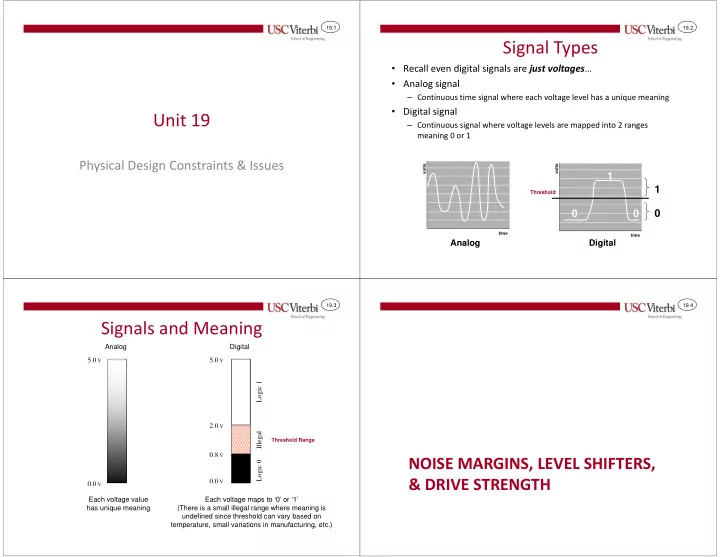
Signal Types

  • Recall even digital signals are just voltages…
  • Analog signal

– Continuous time signal where each voltage level has a unique meaning

  • Digital signal

– Continuous signal where voltage levels are mapped into 2 ranges meaning 0 or 1

1 1

volts volts time time

Analog Digital

Threshold 19.3

Signals and Meaning

0.0 V 0.8 V 2.0 V 5.0 V Each voltage value has unique meaning 0.0 V 5.0 V Logic 1 Logic 0 Illegal Analog Digital

Threshold Range

Each voltage maps to ‘0’ or ‘1’ (There is a small illegal range where meaning is undefined since threshold can vary based on temperature, small variations in manufacturing, etc.)

19.4

NOISE MARGINS, LEVEL SHIFTERS, & DRIVE STRENGTH

slide-2
SLIDE 2

19.5

A Motivating Example

Example 1

  • You connect an output port to an LED

(light emitting diode) and connect everything correctly. The light should turn on when you set your output bit to a high voltage (logic '1').

  • When you turn the system on the LED

does not glow. You measure the voltage at the gate output with a voltmeter and find it is not 5V but 1.8V? Why isn't it a logic 1?

  • The ______________ output ability

from the output port is not ____ enough to adequately ______ the LED which then drags the voltage _______.

Example 2

  • You buy two digital chips (say a

microprocessor and GPS reader

  • You correctly wire them together

and write software to turn 'on' a pin on the microprocessor to a '1' to enable the GPS reader

  • When the software runs the GPS

unit does not turn on. Why?

  • Different circuit implementation

techniques use different voltage ______ to indicate _________ and may be _____________ Lesson To Be Learned: Not all 1's or 0's are created equal!

19.6

The Digital Abstraction

  • Digital is a nice abstraction of voltage and current

– Lets us just think 'on' or 'off' but not really worry about the voltages and currents underneath

  • ______________
  • Not all 1's and 0's are created equal

– A '1' can be any 'HIGH' voltage (maybe in the range ___________) – A '0' can be any 'LOW' voltage (maybe in the range ___________) – So 3V and 5V both mean ________ but they aren't equal

  • Similarly certain outputs of a chip may connect to other devices

that require more _________ than the output can _________

– Think of connecting a ______________ to your garden spigot – Or even worse your garden hose to a fire _________... would shred it – In the same way, inputs and outputs of different devices must be matched to the _____________________ of what they connect to

19.7

Digital Voltage Noise Margins

  • Consider the output of one digital circuit feeding the input of another

– Assume the devices are from different vendors (families of devices)

  • There may be different ___________ and requirements of the two devices

– Example: The output may produce 3V to mean logic '1' while the next device's input requires 5V to be used as logic '1'

  • Analogy 1: Grades. Suppose the cutoff for an A is 90% (i.e. __________ input)

– If you get a 91% (i.e. output result)…_______! – If you get an 89%…(__________ for this class! But ______ from the cutoff's perspective.)

  • Analogy 2: Tickets. Suppose there are 100 available tickets to an event (i.e.

input limit)

– If you are the 99th person (i.e. output result)…________! – If you are the 101st person…__________!

Output Input

19.8

Digital Voltage Noise Margins

  • Consider one digital gate feeding another

0.0 V 5.0 V Logic 1 Logic 0 Illegal ______ Range Interpretation 0.0 V 5.0 V Logic 1 Logic 0 Illegal ______ Range Interpretation

VOH VOL VIL VIH NMH = ______ NML = _______ OH = Output High OL = Output Low IH = Input High IL = Input Low NM = Noise Margin As long as _________ and _________ we are in good shape… Electromagnetic interference & power spikes can cause this to break down

Required Input Possible Output
slide-3
SLIDE 3

19.9

Class Activity

  • Do an internet search for "74LS00 datasheet"

(this is a chip w/ some 2-input NAND gates) and try to find any PDF and open it

  • Skim the PDF and try to find:

– VOH, VIH, VOL, VIL

19.10

Fanout Analogy

  • Can the output of one logic gate be connected to 5 or 10 or

100 gate inputs?

  • Consider a sprinkler system…what will happen if you add 100

new sprinklers to your backyard?

  • Pressure (voltage) will go ______________ and ___________

water (current) flow coming out of each

19.11

Fanout

  • Fanout refers the number of

gates (aka "loads") an output connects to

  • As the fanout increases delay

_______________________

  • In addition, if fanout is too

high the circuit may stop _____________

– Due to current limitations (see next slide)

This inverter has a fanout (# of loads) = 1 This inverter has a fanout (# of loads) = 3

19.12

Fanout & Current Limitations

  • When a circuit outputs a 'HIGH' ('1') it can only supply (__________) so

much current (think of your garden hose spigot) = IOH

  • When a circuit outputs a 'LOW' ('0') it can only suck up (__________) so

much current = IOL

  • When a circuit receives a 'HIGH' signal on the input side it may need a

certain amount of current to recognize the input as 'HIGH' = IIH

  • When a circuit receives a 'LOW' signal on the input side it may need a

certain amount of current to recognize the input as 'LOW' = IIL

1 IOH IOL IIH IIL

slide-4
SLIDE 4

19.13

Example

  • Consider the example where device A's output

connects to device B's input

– Are the voltage requirements compatible? – How many device B inputs can a single device A output drive?

  • Always use worst case of ______________ output drive capability

Dev. VOH VIH VOL VIL IOH IIH IOL IIL A 3.4V 3.3V 0.5V 1.0V

  • 4 mA
  • 1 mA

10 mA 2 mA B 3.2V 3.0V 0.6V 0.7V

  • 2 mA
  • 1 mA

6 mA 2 mA

Voltage requirement are _____________

  • Dev. A VOH ___ Dev. B VIH

AND

  • Dev. A VOL ___ Dev. B. VIL
  • Dev. A's output can drive 4 Dev. B inputs

When outputting '1':

  • (Dev. A IOH / Dev. B IIH) = (________) = ___

When outputting '0':

  • (Dev. A IOL / Dev. B IIL) = (________) = ___

Drive capability = ___________________

19.14

Consideration

  • If we attach too many gates to one output it

may not be enough to drive those gates

  • Need to make sure the current

requirements and capabilities match

  • Let's say we connect one of the NAND gates
  • n the 74LS00 chip to an input of N other

NAND gates…

  • Can it produce/suck up the required

current…

  • …if N = 6?
  • …if N = 12?

If IOH or IOL is too low we can split the loads by place intermediate buffers

19.15

Fan-in

  • Fan-in refers to the number of _______

to a gate

  • Each input adds additional resistance

and ___________ to the circuit and does so in such a way to cause the delay to grow ______________

  • This means delay grows quadratically

with fan-in but linearly with fanout

– Delay ≈ a1FI + a2FI2 + a3FO

  • Important: Rarely want FI > ________

Fanin = 2 Fanin = 5

Transistors to produce logic 1 19.16

All In the Family

  • There are many families of circuit devices that talk different

language (Each has a different VOH, VIH, VOL, VIL, IOL, IIL, etc.)

  • Examples:

– _____________ – _____________ – _____________

  • Must make sure if you interface two different devices that they

are ________________ (i.e. VOH of device A is greater than VIH

  • f device B) or use a buffer/amplifier/level shifter circuit to help

them talk to each other

– http://www.ti.com/lit/ds/symlink/cd4504b-ep.pdf

A B

VOH=2.2V VIH=3.5V

slide-5
SLIDE 5

19.17

Arduino Limits

  • Arduino outputs can sink (suck up) and source (produce)

around a maximum of 20 mA on a pin

– http://www.atmel.com/Images/Atmel-8271-8-bit-AVR- Microcontroller-ATmega48A-48PA-88A-88PA-168A-168PA-328- 328P_datasheet.pdf

  • Do an internet search for "Standard Servo Motor Datasheet"

and find the maximum current it may need

  • It doesn't seem like the Arduino would be

able to drive the servo motor. How is it working?

– Remember the 3-pin interface: R = Power, B = Ground, W = Signal – The signal is _____________ from the power – The power source is used to amplify the signal

19.18

Another Example

  • Now consider a speaker system where the power and signal

are provide together

– Given our Arduino use 5V = Vcc and its current limitations per pin, how much power can we supply to the speaker? – 5V * _____________ = ____________ – You need an _________________…

Power & Signal together