
SLIDE 1
AMS
Status!of!the!AMS!Experiment
Andrei Kounine / MIT
- n behalf of AMS collaboration
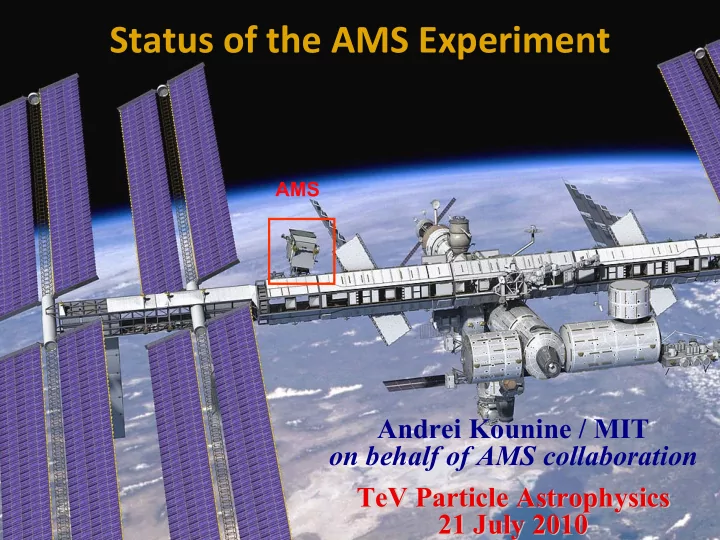
Status ! of ! the ! AMS ! Experiment AMS Andrei Kounine / MIT on - - PowerPoint PPT Presentation
Status ! of ! the ! AMS ! Experiment AMS Andrei Kounine / MIT on behalf of AMS collaboration TeV Particle Astrophysics Particle Astrophysics TeV 21 July 2010 21 July 2010 AMS International Collaboration 16 Countries, 60 Institutes and 600
AMS
USA
FLORIDA A&M UNIV. FLORIDA STATE UNIVERSITY MIT - CAMBRIDGE NASA GODDARD SPACE FLIGHT CENTER NASA JOHNSON SPACE CENTER TEXAS A&M UNIVERSITY
YALE UNIVERSITY - NEW HAVEN
MEXICO
UNAM
DENMARK
FINLAND
HELSINKI UNIV.
FRANCE
GAM MONTPELLIER LAPP ANNECY LPSC GRENOBLE
GERMANY
RWTH-I RWTH-III MAX-PLANK INST.
ITALY
ASI CARSO TRIESTE IROE FLORENCE INFN & UNIV. OF BOLOGNA INFN & UNIV. OF MILANO INFN & UNIV. OF PERUGIA INFN & UNIV. OF PISA INFN & UNIV. OF ROMA INFN & UNIV. OF SIENA
NETHERLANDS
ESA-ESTEC NIKHEF NLR
ROMANIA
ISS
RUSSIA
I.K.I. ITEP KURCHATOV INST. MOSCOW STATE UNIV.
SPAIN
CIEMAT - MADRID I.A.C. CANARIAS.
SWITZERLAND
ETH-ZURICH
CHINA BISEE (Beijing)
IEE (Beijing) IHEP (Beijing) SJTU (Shanghai) SEU (Nanjing) SYSU (Guangzhou) SDU (Jinan)
KOREA
EWHA KYUNGPOOK NAT.UNIV.
PORTUGAL
AIDC (Taiwan) CSIST (Taiwan) NCU (Chung Li) NCKU (Tainan) NCTU (Hsinchu) NSPO (Hsinchu)
TAIWAN
95% of the > $2.0B to build AMS has come from Europe and Asia .
16 Countries, 60 Institutes and 600 Physicists
TRD TOF Tracker T O F RICH ECAL
1
2
7-8 3-4 9 5-6
TRD Identify e+, e-
Silicon Tracker
Z, P ECAL
E of e+, e-, !
RICH
Z, E
TOF
Z, E
Particles!and!nuclei!are!defined!by!their! charge!(Z)!and!energy (E ~ P)
Magnet
"Z Z, P are measured independently from
Tracker, RICH, TOF and ECAL
Identify e+, reject P
BEAM TEST at CERN Design rejection
Leakrate: CO2 # 6 !g/s Storage: 5 kg – 24 years lifetime
Measures the time
to 160 picoseconds
$t/t=160ps
Provides trigger for charged particles Trigger time is synchronized to UTC time to 1µs
4 scintillator planes
pulse height (a.u.)
Events
10 mil pitch; 200,000 channels; alignment 3 !m
Test beam 158 GeV/n
10,880 photosensors
Intensity " Z 2 # " # " V
Radiator detectors Reflector
Particle
Aerogel
Li C O He Ca
Single Event Displays RICH test beam E=158 GeV/n
Nuclear Charge Z
A precision, 17 X0, 3-dimensional measurement of the directions and energies of light rays and electrons 10 000 fibers, $%&%'%mm distributed uniformly Inside 1,200 lb of lead
e(
. (E) 10.6" 0.1 E / E +(1.25" 0.03)% = . (E) 10.6" 0.1 E / E +(1.25" 0.03)% =
Test Beam Results
2009: AFTER 9000 hrs of TVT 2009: AFTER 9000 hrs of TVT… …THE END OF SUB THE END OF SUB-
SYSTEM TESTS
TRD TOF Tracker TOF RICH ECAL
Superconducting Magnet 2500 L SF Helium
4-5 2-3 1 6-7
8
TRD Identify e+, e-
Silicon Tracker
Z , P ECAL
E of e+, e-, !
Magnet
"Z RICH
Z , E
TOF
Z , E
Particles!and!nuclei!are!defined!by!their! charge!(Z)!and!energy (E ~ P)
Z, E are measured independently from
Tracker, RICH, TOF and ECAL
Beam
Tests were performed with the superconducting magnet charged to its design current of 400A and to 80A corresponding to the field of the AMS-01 permanent magnet.
TRD, Tracker, RICH, TOF and ECAL performance was not affected by the change of magnetic field
Bending Plane Residual (cm)
N
Electron Energy Resolution: 2.5-3%
N Energy
Velocity measured to an accuracy of 1/1000 for 400 GeV protons
N TRD:!400!GeV!Protons
Measured combined rejection power at 400 GeV: e+/p = 10-6
AMS in the ESA TVT Chamber
– Model
Chamber walls set to -90oC
Stability criteria: dT/dt < 0.0001K/h
AMS
This upgrade has been supported by agencies from Italy, Germany, Switzerland, Spain, the Netherlands and the U.S.A. The European science community realizes the importance
Michael Braukus Headquarters, Washington 202-358-1979 michael.j.braukus@nasa.gov March 11, 2010 RELEASE : 10-063
Heads of Agency International Space Station Joint Statement TOKYO -- The heads of the International Space Station (ISS) agencies from Canada, Europe, Japan, Russia, and the United States met in Tokyo, Japan, on March 11, 2010, to review ISS cooperation.
With the assembly of the ISS nearing completion and the capability to support a full-time crew of six established, they noted the outstanding opportunities now offered by the ISS for on-orbit research and for discovery including the operation and management of the world's largest international space complex. In particular, they noted the unprecedented opportunities that enhanced use of this unique facility provides to drive advanced science and
activities beyond low-Earth orbit. The ISS will also allow the partnership to experiment with more integrated international operations and research, paving the way for enhanced collaboration on future international missions. The heads of agency reaffirmed the importance of full exploitation of the station's scientific, engineering, utilization, and education potential. They noted that there are no identified technical constraints to continuing ISS operations beyond the current planning horizon of 2015 to at least 2020, and that the partnership is currently working to certify
U.S. fiscal year 2011 budget consistent with the U.S. administration's budget request would allow the United States to support the continuation of ISS operations and utilization activities to at least 2020. They emphasized their common intent to undertake the necessary procedures within their respective governments to reach consensus later this year on the continuation of the ISS to the next decade. In looking ahead, the heads of agency discussed the importance of increasing ISS utilization and operational efficiency by all possible means, including finding and coordinating efficiencies across the ISS Program and assuring the most effective use of essential capabilities, such as space transportation for crew and cargo, for the life
For the latest about the International Space Station, visit the Internet at: http://www.nasa.gov/station
AMS Group Meeting, CERN - 30Jan.-3 Feb. 2006
AMS-02 with a permanent magnet
Permanent Magnet installation, 12 May 2010, RWTH, Aachen, Germany
Hall probes NMR probe Measuring arm
Deviation from 1997 measurement Z=0
which depend on the length L1
B
L
For both magnets, L * 80 cm, but in the permanent magnet B is 5 times smaller
The momentum resolution ($p/p) is the sum of two contributions:
2!3 6!7 4!5 1 8
ECAL
1N 9 2!3 6!7 4!5
ECAL
1 AMS-02 (10 - 18 Yrs) Silicon Tracker Layers AMS-02 SC (3Yrs) Silicon Tracker Layers Layer 9 comes from moving the ladders at the edge of the acceptance from layer 1. The layer 8 is moved on top of the TRD to become 1N.
No new silicon and no new electronics are required.
With 9 tracker planes, the resolution of AMS with the permanent magnet is equal (to 10%) to that of the superconducting magnet. For helium, the MDR for the permanent magnet is 3.75 TV.
AMS-02 (MDRP 2.14 TV) AMS-02 SC (MDRP 2.18 TV)
Rigidity resolution % Proton Rigidity (GV)
PM vs SC Magnet difference
2nd integration of AMS,2009 installation of the Veto system
begins 7 June, with installation of veto system
25
It’s not often that you’re doing something like this with the NASA Associate Administrator for Space Operations looking on…
examining all the engineering details of the integration
Apr 25 AMS AT CERN BACK FROM TVT ESTEC Apr 26 – May 31 AMS DE-INTEGRATION June 1 – June 6 MAGNET CHANGE June 7 – Aug 7 AMS INTEGRATION & Test with cosmic rays Aug 8 – Aug 14 TEST BEAM Aug 15 – Aug 24 AMS READY ON USAF C5 Aug 25 AMS AT KSC
Searches for primordial antimatter:
– – Light anti Light anti-
nuclei: D, He, D, He, … … – – p p / / p p ratio ratio
Dark Matter searches:
– – e e+
+ , e
, e"
" , p ,
, p , … … – – simultaneous observation of several signal channels. simultaneous observation of several signal channels.
Searches for new forms of matter:
– – stranglets stranglets, , … …
Measuring CR spectra – – refining propagation models; refining propagation models;
Identification of local sources of high energy CR (~TeV TeV): ):
– – SNR, Pulsars, PBH, SNR, Pulsars, PBH, … …
Study effects of solar modulation on CR spectra
…
Time (BESS Polar II)
BESS Polar II
GF: 21.5 cm2 sr Magnetic Field: 0.43 T MDR: ~1 TV Mass: 470 kg Size: 130x70x70 cm3 Power Budget: 360W
Spectrometer microstrip silicon tracking system (4µm) + permanent magnet It provides:
Time-Of-Flight (~300ps) plastic scintillators + PMT:
Electromagnetic calorimeter W/Si sampling (16.3 X0, 0.6 2I)
(shower topology)
Neutron detector plastic scintillators + PMT:
(factor ~1000-10000)
+
1 (sr-1 m-2 sr-1 GeV-1) Ekin/n (GeV)
These spectra will provide experimental measurements to refine the assumptions that go into calculating the background in searching for Dark Matter, i.e., p + C 3e+, p, …
We present studies based on three models to highlight AMS sensitivity
(10 Yrs)
I.Cholis et al, arXiv:0810.5344v3
m+ = 100 m+ = 200 m+ = 400 m+ = 800
Energy (GeV)
e+ /(e+ + e-)
m+=400 GeV m+=200 GeV m+=800 GeV
Kaluza-Klein Bosons are also Dark Matter candidates
Eduardo Pontón and Lisa Randall
AMS-02 (18 yrs)
Fig.5 arXiv:0811.1029v2 [hep-ph] 20 Jan 2009 - Fig.5
Sensitivity in Dark Matter Searches – large acceptance, long duration As seen, the permanent magnet upgrade of AMS has a 600-400% improvement in sensitivity in the search for Dark Matter.
AMS-02 (18 Yrs) AMS-02 SC (3 Yrs)
e+
AMS-02 Dark Matter Sensitivity
AMS-02 SC (3 Yrs)
Energy [GeV]
AMS-02 (18 Yrs)
Energy [GeV]
normalized to the sensitivity of AMS with superconducting magnet on ISS for 3 years
+0 +03 e+, e4 for m+0 = 200 GeV
I.Cholis et al, astro-ph 30 Apr 2009 e+/( e+ + e4) e+/( e+ + e4)
5 6 7 8 9 : ; < = > ? @ A
At benchmarks “K” & “M” Supersymmetric particles are not visible at the LHC. Shaded region allowed by WMAP, etc.
AMS is sensitive to SUSY parameter space that is difficult to study at LHC (large m0, m1/2 values)
J.Ellis, private communication
D.N. Spergel et al., astro-ph/0603449
DM signal from p
2007 and private communication
From a Model of Cosmic Ray collisions From Dark Matter (M+ = 840 GeV) Collisions
(10 yrs)
6·102
(corresponding to benchmark M)
Kinetic Energy (GeV)
=6B =6B
In space In space
On the ground On the ground
The Big Bang origin of the Universe requires
matter and antimatter
to be equally abundant at the very beginning S e a r c h f
t h e e x i s t e n c e
a n t i U n i v e r s e Search for the origin of the Universe
Search for Baryogenesis
Super K
(Cp > 6.6 * 1033 years )
Direct search
y06K299a
BELLE BaBar
(sin 2D= 0.672"0.023 consistent with SM)
FNAL KTeV
(Re(E’/ E) = (19.2"2.1)*10-4)
CERN NA-48 CDF, D0 LHC-b ATLAS CMS
Increase in sensitivity: x 103 – 106 Increase in energy to ~TeV
AMS-02 (18 Yrs) BESS Polar II (expected)
=6B 6BFGH FGH Z/A
Front view Side view ,' Amplitude => Z, ,- Rigidity = 4.31 " 0.38 GV Charge Z = 2 ,'%
'% = ,-
= 0.462 " 0.005 Mass = 16.45"0.15 GeV/c2 Z/A = 0.114 " 0.01 Flux (1.5 < EK < 10 GeV) = 5x10⁻⁵ (m2 sr sec)-1
?+IJKJ+(& +IJKJ+(& Candidate observed with AMS-01 5 June 1998 11:13:16 UTC
Jack Sandweiss (Yale) is leading the AMS search.
Z/A~0.1
All the known material on Earth is made out of u and d quarks. Is there material in the universe made up of u, d, & s quarks?
AMS-02 (10 Yrs) Events
1strangelets = 5x10⁻¹⁰(cm2s sr)-1
Strangelets
AMS-02 (10Yrs) Limit AMS-02 SC (3Yrs) Limit
Strangelet Flux (cm2 s sr)-1
A
The diffuse gamma-ray spectrum of the Galactic plane
40o < 1 < 100o, |b| < 5o
upper limits
Space Experiments Ground Experiments
T.ProdanoviLc et al., astro-ph/0603618 v1 22 Mar 2006
EGRET
Identify ! with 8 X0 with magnetic pair spectrometer calorimeter only Energy resolution $E!(10 GeV)=1.5% $E!(10 GeV)=6% Angular resolution $0! < 2 arc-sec $0! ~ 5 arc-sec Energy Range 0.1 Gev – 1 TeV 0.01 GeV – 300 GeV
with 17 X0 calorimeter
FERMI EGRET AMS
Pulsars in the Milky Way:
Pulsar: neutron star sending radiation in a periodic way. Emission in radio, visible, X and gamma
AMS: energy spectrum for pulsars in the 100 MeV – 1 TeV and pulsar periods measured with Msec time precision Similar studies can be made for Blazers and Gamma Ray Bursters (currently measured to millisec precision with energy ~ GeV)