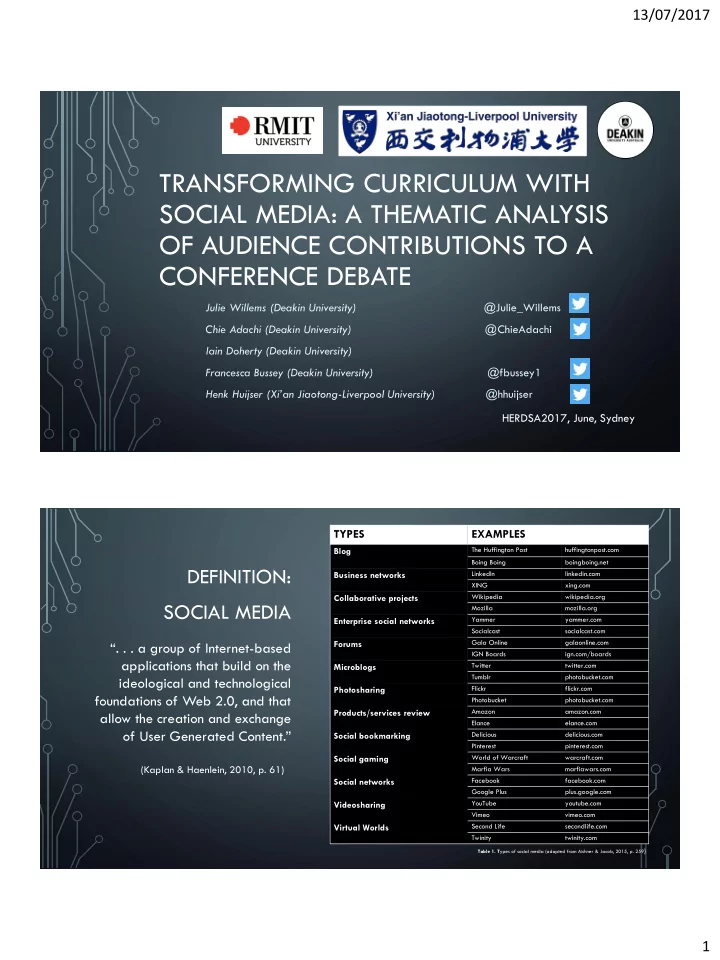
TRANSFORMING CURRICULUM WITH SOCIAL MEDIA: A THEMATIC ANALYSIS OF - - PDF document

transforming curriculum with social media a thematic
SMART_READER_LITE
LIVE PREVIEW

TRANSFORMING CURRICULUM WITH SOCIAL MEDIA: A THEMATIC ANALYSIS OF - - PDF document

13/07/2017 TRANSFORMING CURRICULUM WITH SOCIAL MEDIA: A THEMATIC ANALYSIS OF AUDIENCE CONTRIBUTIONS TO A CONFERENCE DEBATE Julie Willems (Deakin University) @Julie_Willems Chie Adachi (Deakin University) @


slide-1
SLIDE 1

13/07/2017 1

TRANSFORMING CURRICULUM WITH SOCIAL MEDIA: A THEMATIC ANALYSIS OF AUDIENCE CONTRIBUTIONS TO A CONFERENCE DEBATE

Julie Willems (Deakin University) @Julie_Willems Chie Adachi (Deakin University) @ChieAdachi Iain Doherty (Deakin University) Francesca Bussey (Deakin University) @fbussey1 Henk Huijser (Xi’an Jiaotong-Liverpool University) @hhuijser HERDSA2017, June, Sydney

DEFINITION: SOCIAL MEDIA

Table 1. Types of social media (adapted from Aichner & Jacob, 2015, p. 259)

TYPES EXAMPLES

Blog

The Huffington Post huffingtonpost.com Boing Boing boingboing.net

Business networks

LinkedIn linkedin.com XING xing.com

Collaborative projects

Wikipedia wikipedia.org Mozilla mozilla.org

Enterprise social networks

Yammer yammer.com Socialcast socialcast.com

Forums

Gala Online galaonline.com IGN Boards ign.com/boards

Microblogs

Twitter twitter.com Tumblr photobucket.com

Photosharing

Flickr flickr.com Photobucket photobucket.com

Products/services review

Amazon amazon.com Elance elance.com

Social bookmarking

Delicious delicious.com Pinterest pinterest.com

Social gaming

World of Warcraft warcraft.com Marfia Wars marfiawars.com

Social networks

Facebook facebook.com Google Plus plus.google.com

Videosharing

YouTube youtube.com Vimeo vimeo.com

Virtual Worlds

Second Life secondlife.com Twinity twinity.com

“. . . a group of Internet-based applications that build on the ideological and technological foundations of Web 2.0, and that allow the creation and exchange

  • f User Generated Content.”

(Kaplan & Haenlein, 2010, p. 61)

slide-2
SLIDE 2

13/07/2017 2

THE GREAT DEBATE: SOCIAL MEDIA USE IN HE

PROs and CONs

Image attribution: Yana Grevtseva

Twitter: #ASCILITE2016dbt

RESEARCH DATA

  • Participation located and virtual
  • Persicope live streaming
  • Twitter feed (tweets) via Storify
  • Thematic analysis of raw data (Clarke & Braun, 2013):
  • familiarisation with the data,
  • coding,
  • searching for themes,
  • reviewing themes, and
  • defining and naming themes.
slide-3
SLIDE 3

13/07/2017 3

FINDINGS – INSTITUTIONAL LAG

  • Higher education institutions have been, at best, slow and fairly pedestrian in their adoption
  • f digital media:

* Our institutions are not ready...will they ever be? (via Twitter feed)

  • Instead, perhaps :

* [Social Media] is going to be an important part of lifelong learning and if we think about how the university sector is being disrupted more and more, it could be that degrees and qualifications as we know them might not be there in the next ten years. It might be that students get micro-qualifications and then stitch those together , and then in the meantime, go out and do informal learning online. And we've got to prepare our students for that possibility. (via Persicope capture)

(https://www.iconfinder.com/iconsets/colorful-guache-social-media-logos-1)

FINDINGS – SOCIAL MEDIA POLICY

  • A heightened awareness of a lag in the development of social media policies of institutions:

* If the risk of social media use is the main concern, putting your head in the sand and hoping it goes away wont [sic] help. (via Twitter feed) * Where does the ‘institution’ start & where does individual responsibility end?? (via Twitter feed) Perhaps the real issue is instead instituting and managing policy in a way that makes social media use practicable?

(http://www.freeiconspng.com/img/1840)
slide-4
SLIDE 4

13/07/2017 4

FINDINGS - PEDAGOGY

  • Many educators are harnessing social media and adapting their teaching and learning to better connect and

engage their students (despite lack of policy): * Why wait for the institution?? if you are ready and enthusiastic then the students will be too. (via Twitter feed) * Social media…the focus is on what you post and the conversations around that, whereas social networks are around the connections you make and the conversations you have. So I think it's important to make that distinction...And to make sure that it is fit for purpose, because it is not always. (via Periscope capture)

* They [teachers] need to learn about Web 2.0 environments and they need to teach their own students

about becoming curators and creators, rather than being passive consumers. (via Periscope capture)

(http://www.erlen.co.uk/erlens-social-media-icon-set-to-download)

FINDINGS – STAFF PROFESSIONAL DEVELOPMENT

  • The importance of staff professional development in and around the use of social media in HE was

raised during the debate: * Academic staff require more support / training / time in using social media platforms. (via Twitter feed) * The biggest con in using social media for highered [sic] is when it's used badly by academics

  • r is just an 'afterthought'. (via Twitter feed)

* I think as institutions, we need to recognise that our students are going to be using social media anyway…I think we need to recognise that social media is a part of education, whether we like it

  • r not. (via Periscope capture)
  • Social media is here; it is being used for teaching and learning in higher education – whether we like

it or not – and so the real concern is how to best manage this, and how best to leverage their potential?

slide-5
SLIDE 5

13/07/2017 5

FINDINGS – DIGITAL LITERACIES

  • Developing digital literacies is a key graduate outcome for many institutions:

* I feel that I'm empowering my students to be in a community where they can operate

  • utside of me and outside of the university and be empowered to do that. So it's an

'empower and manage' approach, rather than a more guarded approach [to teaching and learning]. (via Periscope capture) * Maybe students making and getting called out on inappropriate tweets is a good thing so they learn & understand why that is. (via Twitter feed) * If we engage with social media we have the opportunity to help our students become digitally literate. (via Twitter feed)

(https://www.vecteezy.com/vector-art/95039-free-social-media-icons)

RECOMMENDATIONS & CONCLUSION

  • Our great debate confirms the high level of interests and importance around

the use of social media for L&T in HE.

  • ‘Inevitable investments’ HE ought to make to meet the demands of the

increasingly digital world we all live in.

  • Areas for consideration for moving forward:
  • Institutional/global policies that guide the best practice of using social media for L&T.
  • Development of PD opportunities for both staff and students.
  • Reimagining ‘digital literacy’ as a notion for Graduate Learning Outcome (GLO), 21st

century skills.

slide-6
SLIDE 6

13/07/2017 6

REFERENCES

  • Bateman, D., & Willems, J. (2012). Facing off: Facebook and higher education. In C. Wankel & L. Wankel (Eds.), Misbehaviour Online (pp. 53–79). Bingley, UK: Emerald

Publishing

  • Clarke, V., & Braun, V. (2013). Successful Qualitative Research: A practical guide for beginners. London: Sage.
  • Dabbagh, N., & Kitsantas, A. (2012). Personal Learning Environments, social media,and self-regulated learning: A natural formula for connecting formal and informal
  • learning. The Internet and higher education, 15(1), 3-8.
  • Johnson, L., Adams Becker, S., Cummins, M., Estrada, V., Freeman, A., & Hall, C. (2016). NMC Horizon Report 2016 Higher Education Edition. Retrieved from

http://cdn.nmc.org/media/2016-nmc-horizon-report-he-EN.pdf

  • Joint Information Systems Committee (JISC) (2008). Effective Practice in a Digital Age: A Guide to Technology-Enhanced Learning and Teaching. Joint Information Systems
  • Committee. Retrieved from http://www.jisc.ac.uk/publications/documents/effectivepracticedigitalage.aspx
  • Pulkit. (2014). The Barriers To Using Social Media In Education (Part 1 of 2). Retrieved from http://www.edudemic.com/social-media-in-education-2/
  • Vaismoradi M., Bondas T., & Turunen H. (2013). Content analysis and thematic analysis: Implications for conducting a qualitative descriptive study. Journal of Nursing &

Health Sciences, 15, 398-405.

  • Willems, J., & Bateman, D. (2013). Facing up to it: blending formal and informal learning opportunities in higher education contexts. In G. Trentin and M. Repetto (Eds.),

Using Network and Mobile Technology to Bridge Formal and Informal Learning (pp.93-117). Cambridge: Woodhead Publishing Limited.

Source: http://patrickcoombe.com/flat-social-media-icons/

THANKYOU QUESTIONS?

Image: http://www.soulfit.com.au/wp-content/uploads/2014/09/sm-questionmark-237x300.png