SLIDE 1
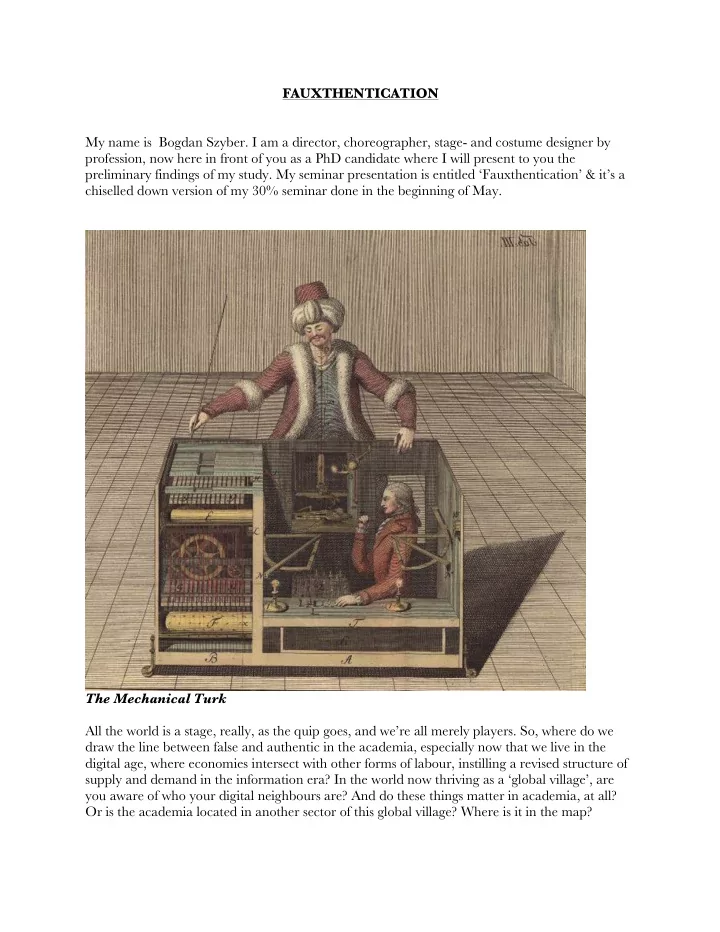
FAUXTHENTICATION My name is Bogdan Szyber. I am a director, choreographer, stage- and costume designer by profession, now here in front of you as a PhD candidate where I will present to you the preliminary findings of my study. My seminar presentation is entitled ‘Fauxthentication’ & it’s a chiselled down version of my 30% seminar done in the beginning of May. The Mechanical Turk All the world is a stage, really, as the quip goes, and we’re all merely players. So, where do we draw the line between false and authentic in the academia, especially now that we live in the digital age, where economies intersect with other forms of labour, instilling a revised structure of supply and demand in the information era? In the world now thriving as a ‘global village’, are you aware of who your digital neighbours are? And do these things matter in academia, at all? Or is the academia located in another sector of this global village? Where is it in the map?
SLIDE 2
This research reframes concepts from Brazilian conceptual artist Cildo Meireles. I reference his concepts of ‘Ideological circuits’ and ‘Monetarised ethics’ of globalised capitalism as a performance that explores the online economies of labour and their structures of power. I interpret the role of the artistic researcher as that of a director/choreographer who choreographs the actresses onstage by commissioning content that brings forth the voices and personalised agendas of these protagonists, simultaneously choreographing text production in the site specifics of academia.
SLIDE 3 In a way, what this means is that I am approaching this whole study as a kind of conceptual art project, where I am creating it and at the same time participating in it, as I will also let others ‘create me,’ as I let them participate as well. My aim is to use conceptual art to unfold hidden layers of mechanisms in the academia, mechanisms that actually make it work, mechanisms that some academics see as necessary tools
- f their survival and that some in academia will readily deny or denounce.
SLIDE 4
The development of internet-based technology has bred a whole new variety of the contingent workforce called the online freelancer, who works in the most unregulated labour marketplace that has ever existed. Online outsourcing has literally exploded during the past decade, aggravating the oppressive practice of contractual work, where workers are deprived of employee benefits like health insurance, unemployment or retirement benefits, or even paid sick leaves. Everything algorithms can’t do yet, are all done by humans. (Examples: tagging batches of photos using speech; reviewing content for positive or negative bias, transcriptions of audio and video, reliable local business information, marketing spam or evaluating content as ‘not safe for work’.).
SLIDE 5
The crowdsourcing site that started it all is called the Amazon Mechanical Turk and the workforce involved within it are colloquially called ‘turkers’. But, as we know, just about anything is available in cyber-space. Scientific, literary, and artistic content can also be outsourced online.
SLIDE 6
There are many other similar sites, virtual marketplaces for outsourced human labour like U.S. sites like oDesk.Com, Upwork.Com, Elance.Com, the Australian Freelancer.Com, the British PeoplePerHour.Com..
SLIDE 7
SLIDE 8
‘Female mechanical turkers meet their parallel in the female computers before them. Before the word “computer” came to describe a machine, it was a job title. David Skinner wrote in The New Atlantis, “computing was thought of as women’s work and computers were assumed to be female.” Female mathematicians embraced computing jobs as an alternative to teaching, and they were often hired in place of men because they commanded a fraction of the wages of a man with a similar education.”’1
1 Shawn Wen, “The Ladies Vanish”, The New Inquiry, 2014
SLIDE 9
There is a hardcore gender issue at hand, because just as in offline contractual employment, women outnumber men, according to studies. A 2012 survey of the top 30 online talent marketplaces revealed that while women constitute less than 50 percent of the traditional workforce, more than 55 percent of online freelancers are women. In Amazon’s Mech Turk it’s 70%.
SLIDE 10 At the centre of my piece is the concept of the Mechanical Turk, the 18th century masterful chess-playing machine that was initially known as the Automaton Chess Player. You can call this an “artificial intelligence,” since its creator, Wolfgang Von Kempelen, attempted to show people that he has made an artificially programmed robotic chess player. In reality, underneath this automaton, there is a real-life human being squished underneath the cabinet that doubles as the chess table. This human is a grandmaster-for-hire, a human who could see the chess playing mechanisms from within. The metaphor of the Mechanical Turk is a central theme of my staged PhD project, being an apt parallel for the role of the artistic researcher and digital proletariat. Much like the hidden grandmaster, the unseen female digital worker behind the scenes is the true driving force behind many products of information technologies. Now why would an academic-artist or artist-academic like me need the help of third world-based female digital freelancers? Here are some justifications. The objective of this section is to lay the groundwork that will enable the audience to appreciate the murky connection between the higher education niche and the exploitation of the digital
- proletariat. Using our offline-online binary, it’s actually easy for anyone in the academia to
- utsource their work. This is another kind of job site specifically addressing academia’s needs:
the essay mill.
SLIDE 11
Whether it’s a term paper, even a Master thesis or PhD dissertation, someone out there can be paid to write these materials for a you. Thanks to websites that offer ready-made essays on just about any topic, you can log on, create an account, post your paper requirements, and receive your freshly cooked up paper, ready for submission. In this manner, plagiarism is no longer detectable, as original work is handed over. But whose originality are we looking at here? This, ladies and gents, is your modern day Academic Mechanical Turk.
SLIDE 12
But – what are the forces behind all of this? It’s pressure from the academia and the economy that is the driving force behind this industry. With college education becoming the norm worldwide, there are two immediate implications relevant to this study: the first is that the consequences of failing to graduate have become more serious in these times than at any other; and second is that institutions of higher education are now being populated by students who are mostly concerned with attaining of a degree, and not so much with “the transformative potential of higher learning.”
SLIDE 13
While mass higher education was a positive development in terms of democratic principles, it had the adverse effect of diminishing the value of the college diploma, a phenomenon economists have dubbed as ‘degree inflation’. It is a matter of time, I would prophesize, before arts education institutions such as ours will become afflicted with this phenomenon: degree inflation… This sets the stage for my artistic exploration of this particular environment as well as my place within it.
SLIDE 14 As a parallel module to my conceptual art slash institutional critique methodology, I also incorporate key thoughts from Anuradha Vikram, a lecturer of arts, history and theory at UC
- Berkeley. She has written:
"As a form, institutional critique exists somewhere between installation art and curatorial
- practice. Its basis in Marxist philosophy and psychoanalytic theory manifests through emphasis of
material as historical trace, audience as subject and object, and labour as performance.
SLIDE 15
SLIDE 16 Labour as performance indeed. Now that I have laid out the theoretical framework and rationale
- f my research, let me outline the methodology where I enter this site-specific project staged here
and now. My artistic research network poses the following questions: Who are the actors? Who is the audience? What is the plot? What is the dramaturgy? Who is my audience in the performing of artistic research? This is what I get when I Google ‘Artistic research’… These are this particular drama’s bodies, expressions, costumes, room’s and set designs… So, if the stage is artistic academia, the plot is no different than ‘out there, in the field’. It’s about getting visibility and recognition from one’s audience, which also are one’s peers – In this drama: What actions must I perform? Obviously creating artistic research ‘art,’ publishing texts, networking, being visible at conferences, generally being 'active' in the discourse of artistic research. In a sense, there is a requirement of being productive and thus being measured and quantified as my productivity is part of a vast bureaucratic apparatus. To navigate this bureaucratic apparatus, I now enact my institutional critique by becoming one with the narrative.
SLIDE 17
My methodology is based on three simple steps I show you here. When I encountered the literature and witness reports behind this online-production based fraud in the academia, I wanted to explore what’s it like to be within this digital space. More importantly, I wanted to know how negotiations happen.
SLIDE 18
In the freelance marketplace websites (and I have an account on all of them), I created a profile in the role of ‘the client.’ I posted this job ad and called for freelancers to submit their papers for a fee. The fees are not fixed, but I put a placeholder amount there, and they were free to bid with the same amount or lower. In their previous experiences, lower bids get the job. I’ll let you read that for a while. Take a look at some samples of the essays they produced for me.
SLIDE 19
SLIDE 20
SLIDE 21
SLIDE 22
By reading their papers, I was able to assess their level of understanding of what I plan to do. Those who seemed to have a good grasp of it I directly handpicked to form a team. True enough, all of these online workers fit the profile outlined earlier in my theoretical investigation: they are based in third world nations, they have bachelors or even masters degrees and they are all professionals within their fields. They’re all women and they comprise the academic think tank for this project. For more or less one and a half years I have been interacting online with these female digital proletariats, or DP:s. I’ve brainstormed with them, conversed with them, processed and reprocessed this artistic research, fine-tuned my theoretical framework, discussed my artistic agenda and asked them to weave their own thoughts into it, outlined my academic purpose and let them have a hand at developing it further. They elevated this discourse on higher planes, explored various dimensions, until we could all exist offline and online, then online and offline.
SLIDE 23
And here they are. All of them will remain unnamed, for the purposes of preserving their online integrity and protecting their privacy. While I present them to you with false titles, I assure you that these stories are authentic. While I am here directing myself onstage with the material I have, let me introduce to you my main playwright: Digital Proletariat 5. She is my playwright as she wrote down my dramaturgy, scripting everything in this presentation. Digital Proletariat #5 wholly wrote this PhD-project presentation of mine in close coordination with me. She is a former university professor from Manila, Philippines. She holds a bachelors degree in filmmaking and a masters degree in creative writing. She wrote the whole dramaturgy for me to follow for this day. These are her words I’m reading to you right now.
SLIDE 24
While Digital Proletariat 5 wrote all of today’s dramaturgy, she was assisted by another, Digital Proletariat 3, also from the Philippines. Digital Proletariat 3 is a single mother who claims to have written PhD dissertations for students like me. She wrote an academic essay that was the basis of the dramaturgical script used here. Originally, I had a Digital Proletariat 4 from Pakistan who was supposed to write this academic essay.
SLIDE 25
DP #4 was more suited to write an academic paper in a short time, since she is a double degree holder, namely a master’s degree in political science in addition to a master of philosophy in public administration. Unfortunately she dropped out from the project quite recently.
SLIDE 26
SLIDE 27 Before I arrived with Digital Proletariat 3 from the Philippines, I first worked w DP:s 1 & 2.
DP 1 is from Bacau, Romania while DP 2 is from Port-of-Spain, Trinidad and Tobago. They started fleshing out the theoretical components with me while DP 3 from the Philippines fleshed out more the theatrical staging components with me. Collectively and through this project, the digital proletariats have proved that online economy levels the playing field, regardless of one’s educational attainment or background. Yet at the same time, in levelling it, their transactions also dishevel it, when the confident student hands over an ‘unoriginal original’ academic paper commissioned from his ‘artificial artificial intelligence’
- freelancer. Now who is being false and who is being true here?
Findings/observations So far, by inserting myself in these worlds, essaying my role and interacting with the female protagonists of this wider globalized drama of online economies of labour, our mutual
- bservations and findings of the false and the authentic embracing each other within academia
and outside of it could be summarised into the following: n how the authentic becomes false (only if discovered) n how authentic thoughts are approved even if they are based on false mechanisms n how false academics get away with being authentic thought-producers n how false intellectual capital can be cheaply bought through legitimate falsifications Now if you think art and academia are strange bedfellows, so are the false and the authentic. But as I have presented to you, it is a reality that happens in this mise-en-scène called online economy
- f digital labour, as globalised capitalism gives the false and the authentic its valid authentication,
both written and directed by the players: the clients and the digital proletariats. There you have it: FAUXTHENTICATION. And these are the last words that Digital Proletariat #5 wrote for me. Thank you.