Transformation Planning is Underway with a Focus on Complex - - PowerPoint PPT Presentation

transformation planning is underway with a focus on
SMART_READER_LITE
LIVE PREVIEW

Transformation Planning is Underway with a Focus on Complex - - PowerPoint PPT Presentation

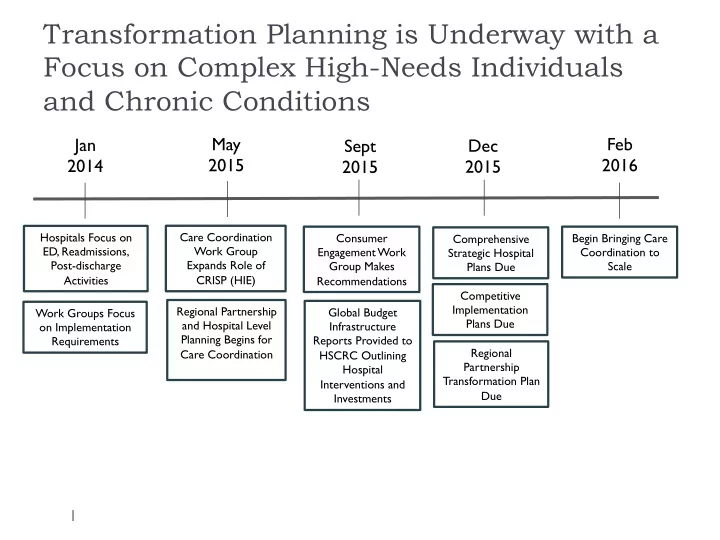
Transformation Planning is Underway with a Focus on Complex High-Needs Individuals and Chronic Conditions May Feb Jan Dec Sept 2015 2016 2014 2015 2015 Hospitals Focus on Care Coordination Consumer Comprehensive Begin Bringing Care


slide-1
SLIDE 1

1

Sept 2015 Feb 2016

Hospitals Focus on ED, Readmissions, Post-discharge Activities Consumer Engagement Work Group Makes Recommendations Global Budget Infrastructure Reports Provided to HSCRC Outlining Hospital Interventions and Investments Comprehensive Strategic Hospital Plans Due Competitive Implementation Plans Due

May 2015

Care Coordination Work Group Expands Role of CRISP (HIE) Regional Partnership Transformation Plan Due

Jan 2014

Regional Partnership and Hospital Level Planning Begins for Care Coordination Work Groups Focus

  • n Implementation

Requirements

Dec 2015

Begin Bringing Care Coordination to Scale

Transformation Planning is Underway with a Focus on Complex High-Needs Individuals and Chronic Conditions

slide-2
SLIDE 2

2

Potential Long-Term Developments

Geographic Hospital + Non- Hospital Model Medical Home or Other Aligned Models ACOs Duals Model

P4O ICS Long-term/ Post-acute Models Align community providers Align providers practicing at hospitals Align/support

  • ther non-

hospital providers

Models Supported By:

  • Data & Financial Incentives for

Providers

(Alignment tools and data for P4O, ICS, , etc.)

  • Common Technology Tools

(Via CRISP: risk stratification, care profiles, etc.)

  • Care Coordination Resources

Common Goals:

  • Reduce Potentially Avoidable Utilization
  • Improve Quality, Outcomes
  • Person-Centered Care
  • Reduce Spending Growth
  • All Payer Hospital Model
  • Aligned Non-hospital Models

Shared savings Additional financial and outcomes responsibility across the system over time Engage and support consumers

Regional Partnerships

slide-3
SLIDE 3

3

Two Potential New Programs: Creating Alignment Across Hospitals & Providers

} 1. Internal Cost Savings (ICS) Program for providers practicing

at hospitals

} Designed to reward improvements in efficiency and cost savings in all

services delivered for an acute care event, including readmissions

} 2. Pay for Outcomes (P4O) Program for non-hospital

providers

} Incentives for high-value activities focused on high needs patients—

Complex and rising needs, such as dual eligible patients

} Hospitals will be able to share resources with hospital and

non-hospital providers through these programs as long as quality targets are met, costs do not shift and the total cost of care does not rise above a benchmark.

slide-4
SLIDE 4

4

Internal Cost Savings (Gainsharing) Program

} Goal: Reward improvements in the quality of hospital

encounters and transitions in care that will create internal hospital cost savings

} Activities that may be included:

} Care coordination and discharge planning } Evidence-based practice support } Patient safety practices } Harm prevention such as self-reporting adverse events } Staff development such as CPOE training } Efficiency and cost reduction such as discharge order by goal

time

slide-5
SLIDE 5

5

Pay for Outcomes (P4O) Program

} Goal: Address the needs of complex patients and those patients

with chronic conditions that would qualify for Medicare’s CCM fee and other available non-visit fees, tying resources from hospitals together with resources from Medicare payments to providers

} By tying such programs together, a chronic medical home is created for

these high needs persons, including beneficiaries in long-term care

} Activities that may be included:

} Care management, such as using HRAs and creating care plans } Care coordination, such as obtaining discharge summary, updating records,

and reconciling medications

} Access to care, such as after-hours care or transportation } Risk stratification } Community activities (e.g. services outside traditional office setting) } Post-acute and long term care redesign, such as deploying health

professionals to settings or using telemedicine