Questions and answers Question 1: Staging dates are based on - - PowerPoint PPT Presentation

questions and answers
SMART_READER_LITE
LIVE PREVIEW

Questions and answers Question 1: Staging dates are based on - - PowerPoint PPT Presentation

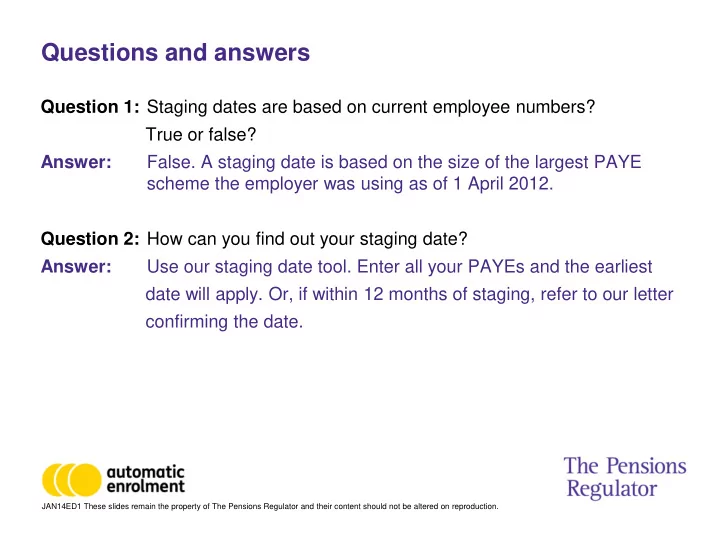
Questions and answers Question 1: Staging dates are based on current employee numbers? True or false? Answer: False. A staging date is based on the size of the largest PAYE scheme the employer was using as of 1 April 2012. Question 2: How can


slide-1
SLIDE 1

JAN14ED1 These slides remain the property of The Pensions Regulator and their content should not be altered on reproduction.

Question 1: Staging dates are based on current employee numbers? True or false? Answer:

  • False. A staging date is based on the size of the largest PAYE

scheme the employer was using as of 1 April 2012. Question 2: How can you find out your staging date? Answer: Use our staging date tool. Enter all your PAYEs and the earliest date will apply. Or, if within 12 months of staging, refer to our letter confirming the date.

Questions and answers

slide-2
SLIDE 2

JAN14ED1 These slides remain the property of The Pensions Regulator and their content should not be altered on reproduction.

Question 3: Nominating a contact is the same as registration? True or false? Answer:

  • False. They are two distinct processes. (See our planning tool)

Question 4: An existing pension can always be used for automatic enrolment? True or false? Answer:

  • False. Although an existing scheme may meet the requirements to

be used for automatic enrolment it will not always be the case. The employer should check with the pension provider.

Questions and answers continued…

slide-3
SLIDE 3

JAN14ED1 These slides remain the property of The Pensions Regulator and their content should not be altered on reproduction.

Question 5: What should an employer do if they receive more than one letter from us with different staging dates? Answer: If an employer has more than one PAYE scheme, use our staging date tool and enter all PAYE references (earliest date applies) - or contact us. Question 6: If, as of 1 April 2012, an employer was paying some of their own employees using another company’s PAYE reference, this will not affect their own staging date, as that PAYE is registered in the other company’s name. True or false? Answer:

  • False. The employer would be considered to be using that PAYE

reference and, if that PAYE was the largest PAYE scheme used as

  • f 1 April 2012, it would determine their staging date.

Questions and answers

slide-4
SLIDE 4

JAN14ED1 These slides remain the property of The Pensions Regulator and their content should not be altered on reproduction.

Question 7 As of 1 April 2012, ACME Industries plc owned two subsidiary companies:

  • ACME Industries had 11,500 workers and was using three PAYE schemes
  • Betamax Components Ltd had 450 workers and was using their own PAYE

scheme, whilst Gamma Ray Ltd had 49 workers and were paying their staff using one of ACME Industries’ PAYE references Question a: Which companies can delay their staging date? Answer: Gamma Ray Ltd was using one of ACME Industries’ PAYE schemes and may have a staging date on or before 1 April 2015. If so, as they had less than 50 workers on 1 April 2012, they may choose to move their staging date to a pre-prescribed alternative date between August 2015 and April 2017. Question b: On 1st January 2014, ACME sold Betamax to another company. How will this affect these companies’ staging dates? Answer: This will not change the staging date of any company, but the workers might be transferred to another employer.

Questions and answers continued…

slide-5
SLIDE 5

JAN14ED1 These slides remain the property of The Pensions Regulator and their content should not be altered on reproduction.

Is Eddie a worker?

Question 8 Eddie is a self employed graphic designer. He works regularly for a company, Acme Workshops Ltd. His role is unique. He designs (and, if necessary, prints on his own equipment) all the flyers and magazine ads. He also designs and updates their website and

  • forum. Eddie is very important to Acme Workshops’ marketing strategy. It is a

nightmare when Eddie is too busy working for other customers, because his contract with Acme does not permit him to send a replacement. Eddie works unsupervised and, generally, he works from home, but sometimes he works in the offices of Acme Workshops. Eddie invoices Acme Workshops at the end of each campaign design and guarantees the quality of his material. Question - Should Acme Workshops consider Eddie to be their worker?

slide-6
SLIDE 6

JAN14ED1 These slides remain the property of The Pensions Regulator and their content should not be altered on reproduction.

Eddie is a self employed graphic designer. He works regularly for a company, Acme Workshops Ltd. His role is unique. He designs (and, if necessary, prints on his own equipment) all the flyers and magazine ads. He also designs and updates their website and

  • forum. Eddie is very important to Acme Workshops’ marketing strategy. It is a

nightmare when Eddie is too busy working for other customers, because his contract with Acme does not permit him to send a replacement. Eddie works unsupervised and, generally, he works from home, but sometimes he works in the offices of Acme Workshops. Eddie invoices Acme Workshops at the end of each campaign design and guarantees the quality of his material. Eddie cannot reasonably be considered a worker, as: i) he is not an employee ii) he sometimes uses his own equipment iii) he works unsupervised & iv) he guarantees the quality of his work

Is Eddie a worker?

slide-7
SLIDE 7

JAN14ED1 These slides remain the property of The Pensions Regulator and their content should not be altered on reproduction.

Is Georgina a worker?

Question 9 Georgina is a self employed IT professional who works full time for Acme Workshops Ltd. Georgina supports Acme Workshops’ in house payroll system and is very important to Acme Workshops and no one else has the expertise to do her work when she’s on holiday. Georgina works in Acme Workshops’ payroll team, alongside Acme Workshops’

  • wn employees in their offices, but sometimes she is allowed to work from home.

Georgina invoices Acme Workshops at the end of each month based on the number of days she has worked. Question: Should Acme Workshops consider Georgina to be their worker?

slide-8
SLIDE 8

JAN14ED1 These slides remain the property of The Pensions Regulator and their content should not be altered on reproduction.

Georgina is a self employed IT professional who works full time for Acme Workshops Ltd. Georgina supports Acme Workshops’ in house payroll system and is very important to Acme Workshops and no one else has the expertise to do her work when she’s on holiday. Georgina works in Acme Workshops’ payroll team, alongside Acme Workshops’

  • wn employees in their offices, but sometimes she is allowed to work from home.

Georgina invoices Acme Workshops at the end of each month based on the number of days she has worked. Georgina can reasonably be considered a worker, because:  she is supervised by Acme (needs permission to work at home)  she works in their offices (uses their office equipment and supplies)  she is paid a daily rate (the completed work is not guaranteed)

Is Georgina a worker?

slide-9
SLIDE 9

JAN14ED1 These slides remain the property of The Pensions Regulator and their content should not be altered on reproduction.

Question 10: A director of a company with two employees does not draw a salary, but only takes dividends. Is the director considered a worker? Answer: If a director is not drawing a salary, but is simply drawing the profits from the business that he or she has an ownership in, then the director would not be a worker (providing the director is not working under an employment contract or personal services contract). However, the two employees would be considered as workers. Question 11: A director of a company is the only employee of the company and she does earn a salary. Would the director be considered a worker? Answer: No, if an individual is a director of a company and the company has no other employees, that individual is not a worker by virtue of any

  • ffice that they hold or contract of employment under which they
  • work. The company is therefore not subject to the employer duties.

Questions and answers

slide-10
SLIDE 10

JAN14ED1 These slides remain the property of The Pensions Regulator and their content should not be altered on reproduction.

Question 12:If someone is a personal services worker, but is not on PAYE, how could an employer deal with this? Answer: It does not matter whether a person is paid through PAYE or not - if they are considered a worker they will need to be assessed and automatically enrolled if eligible. An employer could continue to pay them directly, without deducting tax and national insurance, but make a deduction for their pension contributions as and when

  • appropriate. Alternatively, some employers have chosen to put

these types of people onto their payroll system (marking them as non-tax payers), simply to ensure they are assessed by their payroll software.

Questions and answers

slide-11
SLIDE 11

JAN14ED1 These slides remain the property of The Pensions Regulator and their content should not be altered on reproduction.

Question 13: Could a person, living and working overseas, who has been seconded from a UK employer on a 3 year renewable contract, be subject to the automatic enrolment legislation? Answer: Yes, if the worker has the right of return to work in the UK for the seconding UK employer and is considered ordinarily working in the UK (even though they are currently living abroad). The seconding company retains responsibility for the worker and if they are subject to the automatic enrolment legislation would need to consider their total world-wide earnings to determine their qualifying earnings. Question 14:A person normally resident in Australia, has a 1 year UK work visa and has chosen to work in the UK on a temporary or fixed term employment contract, but intends to return home after a year. Would you consider them to be a worker? Answer:

  • Yes. They are not seconded from an overseas employer and are

wholly working in the UK. It does not matter that they are not a UK national or that they are not a permanent employee.

Questions and answers

slide-12
SLIDE 12

JAN14ED1 These slides remain the property of The Pensions Regulator and their content should not be altered on reproduction.

Question 15: Someone who is self-employed and VAT registered would always be considered to be a business in their own right and therefore not subject to assessment. True or false? Answer:

  • False. VAT registration or an individual's tax status (eg self

employed) does not rule out someone from being considered a

  • worker. The employer needs to consider if the person could be

considered a personal services worker or not and make a reasonable judgement taking all relevant factors into account. Question 16: Would a woman, wholly working in the UK, but on maternity leave, need to be assessed as a worker? Answer: Yes and her maternity pay would be included in the calculation of her qualifying earnings.

Questions and answers

slide-13
SLIDE 13

JAN14ED1 These slides remain the property of The Pensions Regulator and their content should not be altered on reproduction.

Question 17: Who does the law make responsible for carrying out the duties? Answer: The employer (even if some actions are delegated to a third party). Question 18: Who must be enrolled, if they request to opt in? Answer: A non-eligible jobholder (at any time) or an eligible jobholder during postponement. Question 19: Only employees are included in the automatic enrolment legislation. True or false? Answer:

  • False. Duties may apply to other workers, not just employees

(eg personal services workers).

Questions and answers

slide-14
SLIDE 14

JAN14ED1 These slides remain the property of The Pensions Regulator and their content should not be altered on reproduction.

Question 20: If an eligible jobholder is an existing member of a non-qualifying pension scheme, what will the employer need to do? Answer: They could stay in the non-qualifying scheme but this would not meet the employer duties. The employer could see if the existing scheme can be made qualifying, and if it can, make the changes and continue to use it. Alternatively, the employer could enrol them into a new automatic enrolment scheme. Question 21: What happens if a worker sends in an opt-out notice before their opt-out window has started? Answer: It cannot be accepted. The opt-out window will not open until they are an active member of the pension scheme and the employer has issued the enrolment letter.

Questions and answers continued…

slide-15
SLIDE 15

JAN14ED1 These slides remain the property of The Pensions Regulator and their content should not be altered on reproduction.

Question 22: How long can the assessment of workers be postponed? Answer: Between one day and three months. Question 23: If postponement is used, what three duties still apply?

  • 1. Issue postponement notices, within six weeks (or within one

month for assessments before 1 March 2014) - to all postponed staff (including new joiners)

  • 2. Enrol any jobholders who opt in during postponement into an

automatic enrolment pension scheme

  • 3. Enrol any entitled workers who want to join a pension scheme.

Questions and answers continued…

slide-16
SLIDE 16

JAN14ED1 These slides remain the property of The Pensions Regulator and their content should not be altered on reproduction.

Question 24: What is the deadline to complete the declaration of compliance after staging? Answer: Five months after the staging date for those staging from January 2014. Question 25: Who do employers need to write to at staging (eg send a letter or email)?  Workers not in a pension scheme?  Active members of a qualifying pension scheme?  All workers?  Eligible jobholders being automatically enrolled?

Questions and answers continued…