SLIDE 1
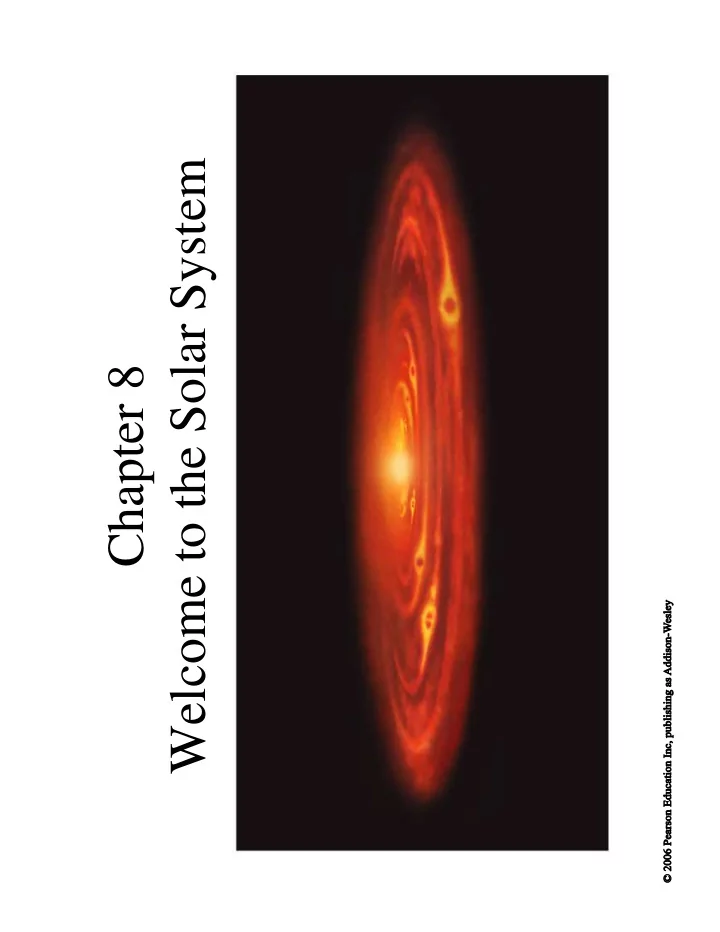
Chapter 8 Welcome to the Solar System
SLIDE 2 8.1 The Search for Origins
- Our goals for learning
- What properties of our solar system must a
formation theory explain?
- What theory best explains the features of
- ur solar system?
SLIDE 3 What properties of our solar system must a formation theory explain?
- 1. Patterns of motion of the large bodies
- Orbit in same direction and plane
- 2. Existence of two types of planets
- Terrestrial and jovian
- 3. Existence of smaller bodies
- Asteroids and comets
- 4. Notable exceptions to usual patterns
- Rotation of Uranus, Earth’s moon, etc.
SLIDE 4 What theory best explains the features of our solar system?
- The nebular theory states that our solar system
formed from the gravitational collapse of a giant interstellar gas cloud—the solar nebula
(Nebula is the Latin word for cloud)
- Kant and Laplace proposed the nebular
hypothesis over two centuries ago
- A large amount of evidence now supports this
idea
SLIDE 5 Close Encounter Hypothesis
- A rival idea proposed that the planets
formed from debris torn off the Sun by a close encounter with another star.
- That hypothesis could not explain
- bserved motions and types of planets.
SLIDE 6 What have we learned?
- What properties of our solar system must a
formation theory explain?
– Motions of large bodies – Two types of planets – Asteroids and comets – Notable exceptions like Earth’s moon
- What theory best explains the features of
- ur solar system?
– Nebular theory states that solar system formed from a large interstellar gas cloud.
SLIDE 7 8.2 The Birth of the Solar System
- Our goals for learning
- Where did the solar system come from?
- What caused the orderly patterns of motion
in our solar system?
SLIDE 8
Where did the solar system come from?
SLIDE 9 Galactic Recycling
formed planets were made in stars and then recycled through interstellar space
SLIDE 10 Evidence from Other Gas Clouds
stars forming in other interstellar gas clouds, lending support to the nebular theory
SLIDE 11 What caused the orderly patterns
- f motion in our solar system?
SLIDE 12
SLIDE 13 Conservation of Angular Momentum
the cloud from which our solar system formed must have increased as the cloud contracted
SLIDE 14
Rotation of a contracting cloud speeds up for the same reason a skater speeds up as she pulls in her arms
SLIDE 15
particles in the cloud caused it to flatten into a disk
Flattening
SLIDE 16
Collisions between gas particles in cloud gradually reduce random motions
SLIDE 17
Collisions between gas particles also reduce up and down motions
SLIDE 18
Spinning cloud flattens as it shrinks
SLIDE 19 Disks around Other Stars
- Observations of disks around other stars
support the nebular hypothesis
SLIDE 20 What have we learned?
- Where did the solar system come from?
– Galactic recycling built the elements from which planets formed. – We can observe stars forming in other gas clouds.
- What caused the orderly patterns of motion in
- ur solar system?
– Solar nebula spun faster as it contracted because of conservation of angular momentum – Collisions between gas particles then caused the nebula to flatten into a disk – We have observed such disks around newly forming stars
SLIDE 21 8.3 The Formation of Planets
- Our goals for learning
- Why are there two types of planets?
- How did terrestrial planets form?
- How did jovian planets form?
- What ended the era of planet formation?
SLIDE 22
Why are there two types of planet?
SLIDE 23 As gravity causes cloud to contract, it heats up
Conservation
SLIDE 24
Inner parts of disk are hotter than outer parts. Rock can be solid at much higher temperatures than ice.
SLIDE 25
Inside the frost line: Too hot for hydrogen compounds to form ices. Outside the frost line: Cold enough for ices to form. Fig 9.5
SLIDE 26 How did terrestrial planets form?
- Small particles of rock and metal were
present inside the frost line
- Planetesimals of rock and metal built up
as these particles collided
- Gravity eventually assembled these
planetesimals into terrestrial planets
SLIDE 27
Tiny solid particles stick to form planetesimals.
SLIDE 28
Gravity draws planetesimals together to form planets This process of assembly is called accretion
SLIDE 29 Accretion of Planetesimals
- Many smaller objects collected into just a
few large ones
SLIDE 30 How did jovian planets form?
- Ice could also form small particles outside
the frost line.
- Larger planetesimals and planets were
able to form.
- Gravity of these larger planets was able to
draw in surrounding H and He gases.
SLIDE 31
Gravity of rock and ice in jovian planets draws in H and He gases
SLIDE 32
Moons of jovian planets form in miniature disks
SLIDE 33
What ended the era of planet formation?
SLIDE 34
Outflowing matter from the Sun -- the solar wind -- blew away the leftover gases
SLIDE 35 Solar Rotation
young Sun was spinning much faster than now
solar magnetic field and solar nebular probably slowed the rotation over time
SLIDE 36 What have we learned?
- Why are there two types of planets?
– Only rock and metals condensed inside the frost line – Rock, metals, and ices condensed outside the frost line
- How did the terrestrial planets form?
– Rock and metals collected into planetsimals – Planetesimals then accreted into planets
- How did the jovian planets form?
– Additional ice particles outside frost line made planets there more massive – Gravity of these massive planets drew in H, He gases
SLIDE 37 What have we learned?
- What ended the era of planet formation?
– Solar wind blew away remaining gases – Magnetic fields in early solar wind helped reduce Sun’s rotation rate
SLIDE 38 8.4 The Aftermath of Planet Formation
- Our goals for learning
- Where did asteroids and comets come
from?
- How do we explain “exceptions to the
rules”?
- How do we explain the existence of Earth’s
moon?
- Was our solar system destined to be?
SLIDE 39
Where did asteroids and comets come from?
SLIDE 40 Asteroids and Comets
- Leftovers from the accretion process
- Rocky asteroids inside frost line
- Icy comets outside frost line
SLIDE 41
How do we explain “exceptions to the rules”?
SLIDE 42 Heavy Bombardment
planetesimals bombarded
in the late stages of solar system formation
SLIDE 43 Origin of Earth’s Water
have come to Earth by way
planetesimals from outer solar system
SLIDE 44 Captured Moons
- Unusual moons of some planets may be
captured planetesimals
SLIDE 45 How do we explain the existence
SLIDE 46
Giant Impact
Giant impact stripped matter from Earth’s crust Giant impact stripped matter from Earth’s crust Stripped matter began to orbit Stripped matter began to orbit Then accreted into Moon Then accreted into Moon
SLIDE 47 Odd Rotation
might also explain the different rotation axes
planets
SLIDE 48 Was our solar system destined to be?
planets in the solar nebula seems inevitable
individual planets could have been different
SLIDE 49 What have we learned?
- Where did asteroids and comets come from?
– They are leftover planetesimals, according to the nebular theory
- How do we explain “exceptions to the rules”?
– Bombardment of newly formed planets by planetesimals may explain the exceptions
- How do we explain the existence of Earth’s
moon?
– Material torn from Earth’s crust by a giant impact formed the Moon
- Was our solar system destined to be?
– Formation of planets seems invevitable. – Detailed characteristics could have been different.
SLIDE 50 8.5 The Age of the Solar System
- Our goals for learning
- How does radioactivity reveal an object’s
age?
- When did the planets form?
SLIDE 51 How does radioactivity reveal an
SLIDE 52 Radioactive Decay
decay into
- ther nuclei
- A half-life is
the time for half the nuclei in a substance to decay
SLIDE 53 When did the planets form?
- Radiometric dating tells us that oldest
moon rocks are 4.4 billion years old
- Oldest meteorites are 4.55 billion years
- ld
- Planets probably formed 4.5 billion years
ago
SLIDE 54 What have we learned?
- How does radioactivity reveal an object’s
age?
– Some isotopes decay with a well-known half- life – Comparing the proportions of those isotopes with their decay products tells us age of object
- When did the planets form?
– Radiometric dating indicates that planets formed 4.5 billion years ago