Overview Focus Projection Focus Projection Focus to Accent Focus - - PowerPoint PPT Presentation

overview
SMART_READER_LITE
LIVE PREVIEW

Overview Focus Projection Focus Projection Focus to Accent Focus - - PowerPoint PPT Presentation

On the Limits of On the Limits of Overview Focus Projection Focus Projection Focus to Accent Focus to Accent Restricted View of Restricted View of Focus Projection Focus Projection Extended Focus Extended Focus On the Limits of Focus


slide-1
SLIDE 1

On the Limits of Focus Projection Focus to Accent Restricted View of Focus Projection Extended Focus Projection Discontinuous Focus Sentence Focus Focus Projection in Complex Sentences

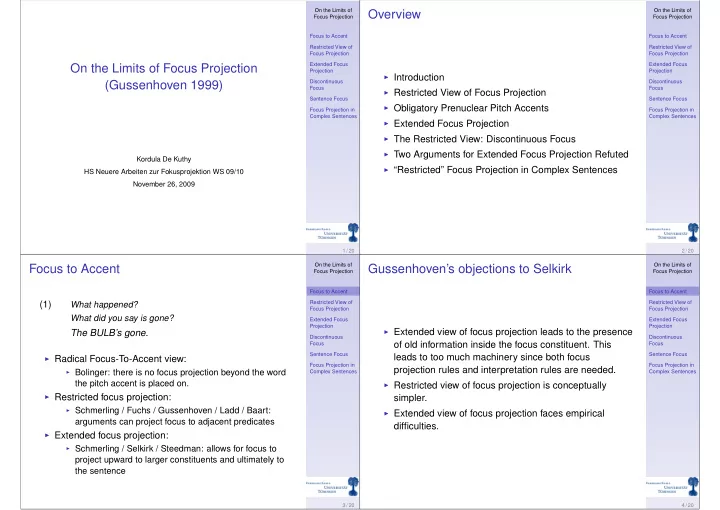
On the Limits of Focus Projection (Gussenhoven 1999)

Kordula De Kuthy HS Neuere Arbeiten zur Fokusprojektion WS 09/10 November 26, 2009

1 / 20 On the Limits of Focus Projection Focus to Accent Restricted View of Focus Projection Extended Focus Projection Discontinuous Focus Sentence Focus Focus Projection in Complex Sentences

Overview

◮ Introduction ◮ Restricted View of Focus Projection ◮ Obligatory Prenuclear Pitch Accents ◮ Extended Focus Projection ◮ The Restricted View: Discontinuous Focus ◮ Two Arguments for Extended Focus Projection Refuted ◮ “Restricted” Focus Projection in Complex Sentences

2 / 20 On the Limits of Focus Projection Focus to Accent Restricted View of Focus Projection Extended Focus Projection Discontinuous Focus Sentence Focus Focus Projection in Complex Sentences

Focus to Accent

(1)

What happened? What did you say is gone?

The BULB’s gone.

◮ Radical Focus-To-Accent view:

◮ Bolinger: there is no focus projection beyond the word

the pitch accent is placed on.

◮ Restricted focus projection:

◮ Schmerling / Fuchs / Gussenhoven / Ladd / Baart:

arguments can project focus to adjacent predicates

◮ Extended focus projection:

◮ Schmerling / Selkirk / Steedman: allows for focus to

project upward to larger constituents and ultimately to the sentence

3 / 20 On the Limits of Focus Projection Focus to Accent Restricted View of Focus Projection Extended Focus Projection Discontinuous Focus Sentence Focus Focus Projection in Complex Sentences

Gussenhoven’s objections to Selkirk

◮ Extended view of focus projection leads to the presence

  • f old information inside the focus constituent. This

leads to too much machinery since both focus projection rules and interpretation rules are needed.

◮ Restricted view of focus projection is conceptually

simpler.

◮ Extended view of focus projection faces empirical

difficulties.

4 / 20

slide-2
SLIDE 2

On the Limits of Focus Projection Focus to Accent Restricted View of Focus Projection Extended Focus Projection Discontinuous Focus Sentence Focus Focus Projection in Complex Sentences

The Restricted View of Focus Projection

Sentence Accent Assignment Rule (SAAR):

◮ Every focused argument (A), modifier (M), and

predicate (P) is accented, with the exception of a predicate that is adjacent to one of its arguments.

◮ Accents are abstract placeholders, marking locations

that will be filled with a pitch accent if they survive the actions of various deletion rules.

5 / 20 On the Limits of Focus Projection Focus to Accent Restricted View of Focus Projection Extended Focus Projection Discontinuous Focus Sentence Focus Focus Projection in Complex Sentences

The Restricted View of Focus Projection

◮ Deletion rules (focus projection rules):

◮ Deaccent every A, P

, and M outside the focus cpnstituent.

◮ Deaccent a focused P that is adjacent – disregarding

any intervening nonfocused A or M – to an accented A.

◮ Prefocal pitch accents:

◮ Assign pitch accents to the constituents before the

nuclear pitch accent. (Optional)

6 / 20 On the Limits of Focus Projection Focus to Accent Restricted View of Focus Projection Extended Focus Projection Discontinuous Focus Sentence Focus Focus Projection in Complex Sentences

Obligatory Prenuclear Pitch Accents

◮ Gussenhoven disagrees with the belief that a full-focus

version of a sentence is always equivalent to a narrow focus version with the focus on the last pitch accented word.

◮ Instead he suggests:

(2) a. What’s John tickling Mary with? John’s tickling Mary with a FEATHER. b. What’s going on? * John’s tickling Mary with a FEATHER. c. What’s John tickling Mary with? JOHN’s tickling MARY with a FEATHER. d. What’s going on? JOHN’s tickling MARY with a FEATHER.

7 / 20 On the Limits of Focus Projection Focus to Accent Restricted View of Focus Projection Extended Focus Projection Discontinuous Focus Sentence Focus Focus Projection in Complex Sentences

Extended Focus Projection

Focus Projection (Selkirk 1995)

◮ An accented word is F-marked ◮ F-marking of the head of a phrase licenses F-marking

  • f the phrase

◮ F-marking of an internal argument of a head licenses

F-marking of the head Focus Interpretation Principles

◮ F-marked, but not A Focus: New ◮ Not F-marked (not a Focus): Given ◮ F-marked, and Focus: Given or New

8 / 20

slide-3
SLIDE 3

On the Limits of Focus Projection Focus to Accent Restricted View of Focus Projection Extended Focus Projection Discontinuous Focus Sentence Focus Focus Projection in Complex Sentences

Extended Focus Projection

Objection to Selkirks’s assumption that FOC should be a constituent: (3) What did she do with the book? [She [[sent]F a book [to [MARY]F]F]F]Foc. Following to Selkirk, we get:

◮ Focus: She sent a book to Mary. ◮ New: sent a book to Mary, sent, to Mary, Mary ◮ Given: She, a book ◮ Given or New: She sent a book to Mary

9 / 20 On the Limits of Focus Projection Focus to Accent Restricted View of Focus Projection Extended Focus Projection Discontinuous Focus Sentence Focus Focus Projection in Complex Sentences

Extended Focus Projection

Other counterexamples: (4) What did she do? [She [[SENT]F a book to Mary]F]Foc.

◮ Gussenhoven claims that Selkirk’s theory suggests that

the VP sent a book to Mary can be interpreted as new. But the context: “What did she do?” is inappropriate.

◮ Note that this is not quite correct: Selkirk’s theory

requires the NPs a book to Mary inside the VP to be given, since they are not F-marked.

10 / 20 On the Limits of Focus Projection Focus to Accent Restricted View of Focus Projection Extended Focus Projection Discontinuous Focus Sentence Focus Focus Projection in Complex Sentences

Extended Focus Projection

Counterexamples (cont.) (5) What happened?

  • a. FOC[[[JOHNSON]F]F [[t]F [died]F]F]FOC.
  • b. MARY bought a book about bats.

◮ Gussenhoven Selkirk’s theory does not explain why (b)

is not a possible reply to “What happened?” Why would (a) have a trace and not (b)?

◮ But Selkirk assumes that only VP-internal subjects

leave a trace in the VP . VP-external subjects, such as subjects of transitive verbs like buy, do not leave a trace in the VP and thus cannot serve as an internal argument from which F-marking can further project.

11 / 20 On the Limits of Focus Projection Focus to Accent Restricted View of Focus Projection Extended Focus Projection Discontinuous Focus Sentence Focus Focus Projection in Complex Sentences

Problems for the Restricted View

(6) What happened?

  • a. JOHNSON died.
  • b. MARY bought a book about bats.

◮ For SAAR, (6a) is no problem, since focus projection

from an argument to a predicate can take place regardless of the argument’s role.

◮ But what prevents the subject in (6b) from passing on

focus to its predicate?

◮ It seems to be case that the subject argument cannot

project focus to its predicate if some other constituent in the VP is realized ba a major-class item. (7) Why is she here? a. Her HUSband beats her.

  • b. * Her HUSband beats the poor soul.

12 / 20

slide-4
SLIDE 4

On the Limits of Focus Projection Focus to Accent Restricted View of Focus Projection Extended Focus Projection Discontinuous Focus Sentence Focus Focus Projection in Complex Sentences

The Restricted View: Discontinuous Focus

Gussenhoven’s account of previous example: (8) What did she do with the book? [She [[sent]F a book [to [MARY]F]F]F]Foc.

◮ By focus projection rules, either (to) Mary or sent to

Mary is [+focus]

◮ Example shows that focus can be discontinuous. ◮ The notion of discontinuous focus should be

distinguished from the notion of multiple foci.

13 / 20 On the Limits of Focus Projection Focus to Accent Restricted View of Focus Projection Extended Focus Projection Discontinuous Focus Sentence Focus Focus Projection in Complex Sentences

The Restricted View: Discontinuous Focus

Minimal pair of discontinuous focus / multiple foci: (9) a. Was hat das Kind erlebt? KARL hat dem Kind einen F ¨ ULLER geschenkt. [Karl. . . einen F¨ uller geschenkt]FOC

  • b. Wer hat was hinsichtlich des Kindes getan?

KARL hat dem Kind einen F ¨ ULLER geschenkt. [Karl]FOC [einen F¨ uller geschenkt]FOC (cf. H¨

  • hle

1982)

14 / 20 On the Limits of Focus Projection Focus to Accent Restricted View of Focus Projection Extended Focus Projection Discontinuous Focus Sentence Focus Focus Projection in Complex Sentences

The Restricted View: Discontinuous Focus

◮ In restricted focus projection theories, the need for a

separate set of focus interpretation rules never arises.

◮ Focus projection principles should in themselves suffice

to identify the focused (new) status of the constituents in a sentence.

◮ Restricted Focus Projection:

Pitch Accent distribution ⇔ Focus distribution

◮ Extended Focus Projection:

Pitch Accent distribution ⇔ Focus distribution ⇔ Focus interpretation

15 / 20 On the Limits of Focus Projection Focus to Accent Restricted View of Focus Projection Extended Focus Projection Discontinuous Focus Sentence Focus Focus Projection in Complex Sentences

Two Arguments for Extended Focus Projection Refuted

Selkirk’s example of sentence focus with accented auxiliary: (10) FOC[[Mary] [[DID]F [buy a book about bats]]F]FOC.

◮ Gussenhoven suggests that there is no need to assume

sentence focus.

◮ This could be a reply to the implied question: Which of

the information contained in NEG,PAST[Mary buy a book about bats] is incorrect?

◮ NEG is taken as the focus (“counterassertive focus”,

which needs to be distinguished from “counterpresuppositional focus”)

16 / 20

slide-5
SLIDE 5

On the Limits of Focus Projection Focus to Accent Restricted View of Focus Projection Extended Focus Projection Discontinuous Focus Sentence Focus Focus Projection in Complex Sentences

Counterasserive vs. Counterpresuppositional Focus

(11) a. He doesn’t read books

  • b. HE DOES read books / Er liest DOCH B¨

ucher (counterassertive, POS) (12) a. He reads books.

  • b. He DOESN’T read books / Er liest KEINE B¨

ucher/ (counterassertive, NEG) (13) a. If he read books, he would know this.

  • b. He READS (DOES READ) books / Er LIEST doch

  • ucher. (counterpresuppositional, POS)

(14) a. Has John read Slaughterhouse Five?

  • b. He doesn’t READ books / Er LIEST keine B¨

ucher. (counterpresuppositional, NEG)

17 / 20 On the Limits of Focus Projection Focus to Accent Restricted View of Focus Projection Extended Focus Projection Discontinuous Focus Sentence Focus Focus Projection in Complex Sentences

Two Arguments for Extended Focus Projection Refuted

◮ Selkirk’s example:

(15) I was only thinking that FOC[MARY bought a BOOK about bats]FOC. (only dominates embedded S, therefore S must be focus)

◮ Counterexamples:

(16) a. Were you thinking that they might catch a cold

  • r what?

I was only thinking FOC[that they wouldn’t fit into the PHONE booth]FOC.

  • b. Were you perhaps thinking that they wouldn’t fit

into the spare bedroom? I was only thinking that they wouldn’t fit

FOC[into the PHONE booth]FOC.

18 / 20 On the Limits of Focus Projection Focus to Accent Restricted View of Focus Projection Extended Focus Projection Discontinuous Focus Sentence Focus Focus Projection in Complex Sentences

“Restricted” Focus Projection in Complex Sentences

What’s going on with him? (to look OUT)Pred (for a MANiac)Arg

  • ut
  • 1. cycle

(was WARNED)Pred (to look out for a MANiac)Arg warned

  • 2. cycle

He [was warned to look out for a MANiac]FOC. Output

19 / 20 On the Limits of Focus Projection Focus to Accent Restricted View of Focus Projection Extended Focus Projection Discontinuous Focus Sentence Focus Focus Projection in Complex Sentences

“Restricted” Focus Projection in Complex Sentences

Why weren’t you admitted to the Poets’ Club? (a BIRD)Arg (SING)Pred sing 1. cycle (to HEAR)Pred (a BIRD sing)Arg hear

  • 2. cycle

(FAILED)Pred (to hear a BIRD sing)Arg failed

  • 3. cycle

I [failed to hear a BIRD sing]FOC.

  • utput

20 / 20