
SLIDE 1
Totech dry cabinet
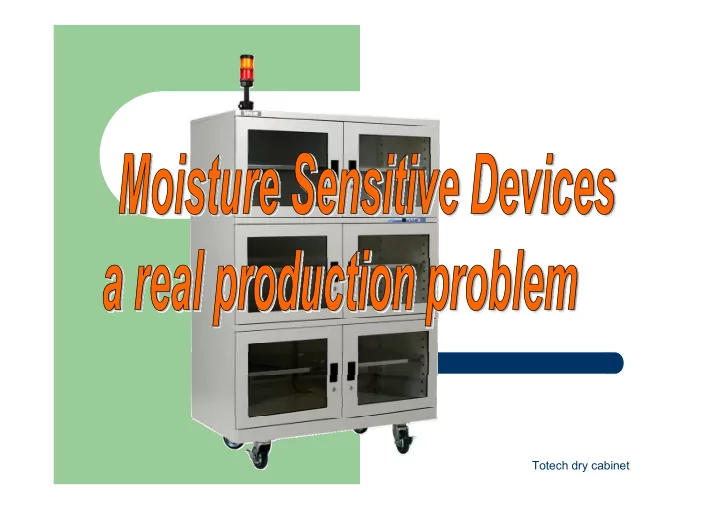
Totech dry cabinet Background Moisture and Surface Mount Components - - PowerPoint PPT Presentation
Totech dry cabinet Background Moisture and Surface Mount Components do not mix Plastic packaging material very often is permeable to moisture If moisture levels become critical, component damage may occur when heated during soldering
Totech dry cabinet
Totech dry cabinet
Moisture and Surface Mount Components do not mix Plastic packaging material very often is permeable to
If moisture levels become critical, component
Moisture induced failures are often undetectable,
Higher processing temperatures of unleaded solder
Totech dry cabinet
Increases up to 3 times
Totech dry cabinet
The epoxy moulding compound used in most plastic
While processing, temperatures reach 260ºC Fast ramps and high temperatures prevent moisture
Totech dry cabinet
This leads to delaminating the encapsulated
This is not always visually apparent
Totech dry cabinet
Exceeding the technical elastic limit results in
The plastic packaging has a „leak“permeating
Totech dry cabinet
Totech dry cabinet
BGA device, showing
Totech dry cabinet
QFP device, showing
Totech dry cabinet
Micro section through
Totech dry cabinet
Thin film
Totech dry cabinet
Table 5-1 Moisture Classification Level and Floor Life
Mandatory bake before use. After bake, must be reflowed witin the limit time specified on the label. 6 24 hours 5a 48 hours 5 72 hours 4 168 hours 3 4 weeks 2a 1year 2 Unlimited at ≤30℃/85%RH 1 Floor life (out of bag) at factory ambient ≤30℃/60%RH or as stated Level
Totech dry cabinet
Table 5-1 Table 5-1 Moisture Classification Level and Floor Life
Mandatory bake before use. After bake, must be reflowed witin the limit time specified on the label. 6 24 hours 5a 48 hours 5 72 hours 4 168 hours 3 4 weeks 2a 1 year 2 Unlimited at ≤30℃/85%RH 1 Floor life (out of bag) at factory ambient ≤30℃/60%RH or as stated Level
Totech dry cabinet
Totech dry cabinet
Time
Totech dry cabinet
Component embedded water molecules Component molecules Water molecules
Totech dry cabinet
Time Absorption %
Totech dry cabinet
Historically, components and printed control boards have
Typically temperatures from 40 to 125°C and times
This adds time and costs to production Backing is still possible, but only according to IPC
Totech dry cabinet
Sample number Time
Wetting Times SOIC 14 Chip, 60/40 Sn/Pballoy, type R flux, 4 hours @ 100 C SOIC 14 Chip, 60/40 Sn/Pballoy, typeR flux, as received
Totech dry cabinet
Inter metallic growth depends on time and temperature
Total inter metallic thickness has shown to increase by approximately 50% when baked at 125°C for 4 days
Concerning copper metallisation, this is mainly the Cu6 Sn5 layer, but all layers are effected
The thicker inter metallic layers can lead to a reduction in solder joint integrity and in extreme cases reduce solder ability
Totech dry cabinet
Surface solder ability is reduced Growth of inter metallic layers is promoted, also at
Baking is only possible one time (according to IPC) Ovens are expensive to operate, mostly needing N²-
They occupy valuable space on the production floor
Totech dry cabinet
Totech dry cabinet
Inexpensive start up, little investment required
Bags can/do remain unsealed for extended periods
Silica Gel packets used ‘’past their prime’’
Silica Gel packets improperly stored
Labor intensive
Pros
Totech dry cabinet
Often poorly maintained Rarely monitored for
Costly to operate Installing is necessary Not available everywhere
Pros Cons
Totech dry cabinet
Pipe and Installing is
Not convenient to move May cause noise by air
May have impurity
Air is easy to get Fast dehumidification
Pros Cons
Totech dry cabinet
Dries without heat Fast de-humidification Zero maintenance Constantly monitored for
Low cost operation Air tight Mobile Higher initial investment
Pros Cans
Totech dry cabinet
Storage of MSD packages in these dry cabinets
If the time limit is exceeded they should be baked
Totech dry cabinet
Storage in these dry cabinets may be considered
the floor life time stops it is not possible to restore the floor life with this
Totech dry cabinet
Totech dry cabinet
Totech dry cabinet
Totech dry cabinet
No reduction of solder ability as no heat is involved Oxidisation is prevented by reducing humidity All moisture is removed by a desiccant drying system
Low operating cost (compared to baking) Unlimited drying and storage time in the cabinet
Totech dry cabinet
CSP, BGA, QFP Printed Circuit Boards Wafers Ceramics Crystal Resonator Optical Fiber, CCD etc (LCG) Liquid Crystal Glass
Totech dry cabinet
An interlocked fan causes the air to circulate through the dry unit While passing through the dry unit moisture in the air is absorbed
During periodic regenerating of the zeolite desiccantby heating,
Totech dry cabinet
Totech dry cabinet
Synthetically produced zeolite A 47% open space High rate of absorption at low
Excellent ability to regenerate
Totech dry cabinet
Moisture
Totech dry cabinet
Totech dry cabinet
Totech dry cabinet
Totech dry cabinet
Convenient Digital Control Panel ON/OFF calliper on front side Infinitely variable humidity setting Automatic resetting temperature display Alarm function when doors are left open Delayed humidity alarm with LED Key Lock Function for the Digital Control prevent unintended
Totech dry cabinet
Totech dry cabinet
Totech dry cabinet
Totech dry cabinet
Single or Dubble
Totech dry cabinet
Multi-point sampling of temperature and humidity, carried out at 24hrs. The monitored data is transmited directly to thenetworked computers. The temperature and humidity is displayed and stored simultaneously. The data can be checked and printed at any time. Automatic alarm in case of overrun. Software also has the function of calculating the floor life. Multiple languages available (Chinese, English, Japanese)
Totech dry cabinet
Comprehensive ESD protection A closed loop feedback from the
Forced air circulation Use of a good dessicant(zeolites
Totech dry cabinet