Determination of Dry Coating Determination of Dry Coating A B C - - PDF document

determination of dry coating
SMART_READER_LITE
LIVE PREVIEW

Determination of Dry Coating Determination of Dry Coating A B C - - PDF document

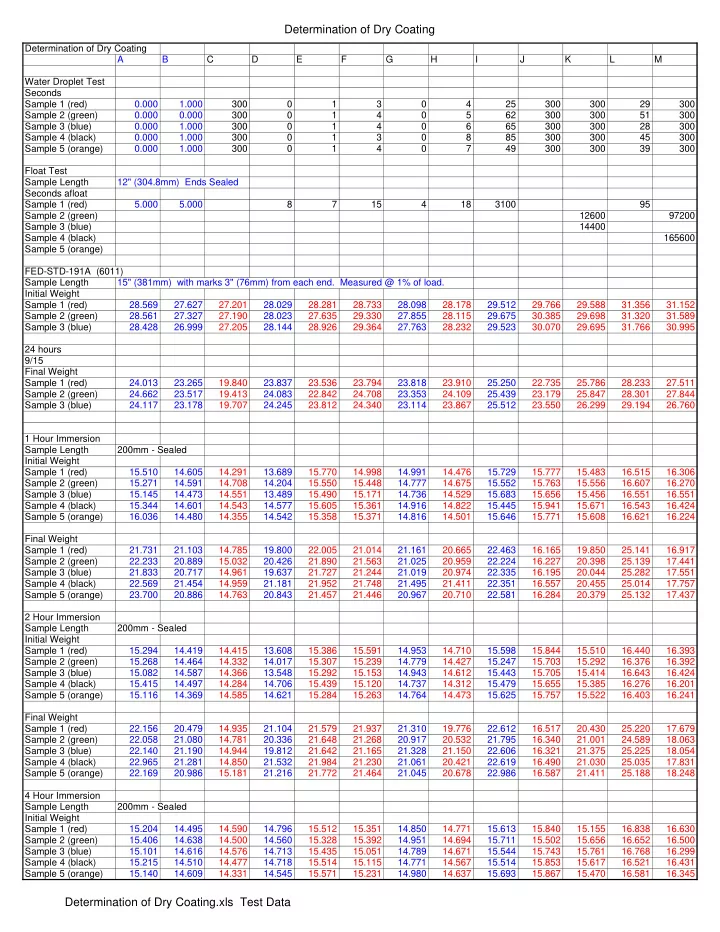
Determination of Dry Coating Determination of Dry Coating A B C D E F G H I J K L M Water Droplet Test Seconds Sample 1 (red) 0.000 1.000 300 0 1 3 0 4 25 300 300 29 300 Sample 2 (green) 0.000 0.000 300 0 1 4 0


slide-1
SLIDE 1

Determination of Dry Coating

Determination of Dry Coating A B C D E F G H I J K L M Water Droplet Test Seconds Sample 1 (red) 0.000 1.000 300 1 3 4 25 300 300 29 300 Sample 2 (green) 0.000 0.000 300 1 4 5 62 300 300 51 300 Sample 3 (blue) 0.000 1.000 300 1 4 6 65 300 300 28 300 Sample 4 (black) 0.000 1.000 300 1 3 8 85 300 300 45 300 Sample 5 (orange) 0.000 1.000 300 1 4 7 49 300 300 39 300 Float Test Sample Length 12" (304.8mm) Ends Sealed Seconds afloat Sample 1 (red) 5.000 5.000 8 7 15 4 18 3100 95 Sample 2 (green) 12600 97200 Sample 3 (blue) 14400 Sample 4 (black) 165600 Sample 5 (orange) FED-STD-191A (6011) Sample Length 15" (381mm) with marks 3" (76mm) from each end. Measured @ 1% of load. Initial Weight Sample 1 (red) 28.569 27.627 27.201 28.029 28.281 28.733 28.098 28.178 29.512 29.766 29.588 31.356 31.152 Sample 2 (green) 28.561 27.327 27.190 28.023 27.635 29.330 27.855 28.115 29.675 30.385 29.698 31.320 31.589 Sample 3 (blue) 28.428 26.999 27.205 28.144 28.926 29.364 27.763 28.232 29.523 30.070 29.695 31.766 30.995 24 hours 9/15 Final Weight Sample 1 (red) 24.013 23.265 19.840 23.837 23.536 23.794 23.818 23.910 25.250 22.735 25.786 28.233 27.511 Sample 2 (green) 24.662 23.517 19.413 24.083 22.842 24.708 23.353 24.109 25.439 23.179 25.847 28.301 27.844 Sample 3 (blue) 24.117 23.178 19.707 24.245 23.812 24.340 23.114 23.867 25.512 23.550 26.299 29.194 26.760 1 Hour Immersion Sample Length 200mm - Sealed Initial Weight Sample 1 (red) 15.510 14.605 14.291 13.689 15.770 14.998 14.991 14.476 15.729 15.777 15.483 16.515 16.306 Sample 2 (green) 15.271 14.591 14.708 14.204 15.550 15.448 14.777 14.675 15.552 15.763 15.556 16.607 16.270 Sample 3 (blue) 15.145 14.473 14.551 13.489 15.490 15.171 14.736 14.529 15.683 15.656 15.456 16.551 16.551 Sample 4 (black) 15.344 14.601 14.543 14.577 15.605 15.361 14.916 14.822 15.445 15.941 15.671 16.543 16.424 Sample 5 (orange) 16.036 14.480 14.355 14.542 15.358 15.371 14.816 14.501 15.646 15.771 15.608 16.621 16.224 Final Weight Sample 1 (red) 21.731 21.103 14.785 19.800 22.005 21.014 21.161 20.665 22.463 16.165 19.850 25.141 16.917 Sample 2 (green) 22.233 20.889 15.032 20.426 21.890 21.563 21.025 20.959 22.224 16.227 20.398 25.139 17.441 Sample 3 (blue) 21.833 20.717 14.961 19.637 21.727 21.244 21.019 20.974 22.335 16.195 20.044 25.282 17.551 Sample 4 (black) 22.569 21.454 14.959 21.181 21.952 21.748 21.495 21.411 22.351 16.557 20.455 25.014 17.757 Sample 5 (orange) 23.700 20.886 14.763 20.843 21.457 21.446 20.967 20.710 22.581 16.284 20.379 25.132 17.437 2 Hour Immersion Sample Length 200mm - Sealed Initial Weight Sample 1 (red) 15.294 14.419 14.415 13.608 15.386 15.591 14.953 14.710 15.598 15.844 15.510 16.440 16.393 Sample 2 (green) 15.268 14.464 14.332 14.017 15.307 15.239 14.779 14.427 15.247 15.703 15.292 16.376 16.392 Sample 3 (blue) 15.082 14.587 14.366 13.548 15.292 15.153 14.943 14.612 15.443 15.705 15.414 16.643 16.424 Sample 4 (black) 15.415 14.497 14.284 14.706 15.439 15.120 14.737 14.312 15.479 15.655 15.385 16.276 16.201 Sample 5 (orange) 15.116 14.369 14.585 14.621 15.284 15.263 14.764 14.473 15.625 15.757 15.522 16.403 16.241 Final Weight Sample 1 (red) 22.156 20.479 14.935 21.104 21.579 21.937 21.310 19.776 22.612 16.517 20.430 25.220 17.679 Sample 2 (green) 22.058 21.080 14.781 20.336 21.648 21.268 20.917 20.532 21.795 16.340 21.001 24.589 18.063 Sample 3 (blue) 22.140 21.190 14.944 19.812 21.642 21.165 21.328 21.150 22.606 16.321 21.375 25.225 18.054 Sample 4 (black) 22.965 21.281 14.850 21.532 21.984 21.230 21.061 20.421 22.619 16.490 21.030 25.035 17.831 Sample 5 (orange) 22.169 20.986 15.181 21.216 21.772 21.464 21.045 20.678 22.986 16.587 21.411 25.188 18.248 4 Hour Immersion Sample Length 200mm - Sealed Initial Weight Sample 1 (red) 15.204 14.495 14.590 14.796 15.512 15.351 14.850 14.771 15.613 15.840 15.155 16.838 16.630 Sample 2 (green) 15.406 14.638 14.500 14.560 15.328 15.392 14.951 14.694 15.711 15.502 15.656 16.652 16.500 Sample 3 (blue) 15.101 14.616 14.576 14.713 15.435 15.051 14.789 14.671 15.544 15.743 15.761 16.768 16.299 Sample 4 (black) 15.215 14.510 14.477 14.718 15.514 15.115 14.771 14.567 15.514 15.853 15.617 16.521 16.431 Sample 5 (orange) 15.140 14.609 14.331 14.545 15.571 15.231 14.980 14.637 15.693 15.867 15.470 16.581 16.345

Determination of Dry Coating.xls Test Data

slide-2
SLIDE 2

Determination of Dry Coating

Determination of Dry Coating A B C D E F G H I J K L M Final Weight Sample 1 (red) 22.056 21.124 15.613 21.415 21.730 21.123 21.201 21.629 22.786 16.832 19.884 25.505 19.667 Sample 2 (green) 22.534 21.404 15.240 20.984 21.738 21.283 21.011 21.655 23.029 16.166 21.340 25.272 19.644 Sample 3 (blue) 22.001 21.285 15.358 21.307 22.001 21.262 20.940 20.802 22.344 16.526 20.261 25.392 19.263 Sample 4 (black) 22.011 20.973 15.076 21.224 21.910 21.071 20.994 21.025 22.438 16.635 20.548 25.164 19.805 Sample 5 (orange) 22.305 21.376 14.975 21.209 22.148 21.816 21.475 21.072 22.793 16.548 21.317 25.200 18.910 24 Hour Immersion Sample Length 200mm - Sealed Initial Weight Sample 1 (red) 15.505 14.358 14.301 13.538 15.189 14.787 14.783 14.494 15.526 15.626 15.478 16.246 16.315 Sample 2 (green) 15.165 14.212 14.627 14.651 15.328 15.411 14.851 14.607 15.463 15.648 15.364 16.464 16.226 Sample 3 (blue) 14.853 14.467 14.324 13.544 15.389 15.454 15.011 14.592 15.405 15.837 15.245 16.307 16.141 Sample 4 (black) 15.048 14.240 14.385 14.712 15.403 15.302 14.877 14.261 15.468 15.758 15.454 16.374 16.368 Sample 5 (orange) 15.080 14.427 14.420 14.189 15.235 15.220 14.908 14.483 15.358 15.748 15.410 16.342 16.162 Final Weight Sample 1 (red) 22.789 21.530 15.289 20.078 21.680 21.013 21.448 20.927 22.769 17.100 22.598 24.541 21.240 Sample 2 (green) 23.209 21.320 16.068 21.409 21.857 22.229 21.575 21.069 22.676 16.787 22.388 25.265 22.876 Sample 3 (blue) 22.270 21.543 15.123 20.009 22.101 22.121 21.864 21.111 22.469 17.304 20.988 24.849 21.747 Sample 4 (black) 22.586 21.344 15.319 21.633 21.959 21.811 21.627 20.726 22.760 17.111 21.230 25.233 22.690 Sample 5 (orange) 22.610 22.061 15.356 20.879 21.997 22.053 21.708 21.186 22.763 17.186 21.273 25.274 22.534 48 Hour Immersion Sample Length 200mm - Sealed Initial Weight Sample 1 (red) 15.374 14.395 14.407 14.478 13.552 13.420 13.042 14.736 15.660 15.650 15.388 16.594 16.457 Sample 2 (green) 15.128 14.407 14.296 14.637 15.810 15.568 14.992 14.739 15.471 15.779 15.733 16.444 16.479 Sample 3 (blue) 15.121 14.615 14.447 14.503 15.640 15.505 14.789 14.954 15.451 15.862 15.356 16.724 16.463 Sample 4 (black) 15.245 14.334 14.389 13.524 15.590 15.397 14.974 14.682 15.435 15.820 15.483 16.505 16.500 Sample 5 (orange) 15.105 14.339 14.318 14.501 15.404 14.919 14.940 14.613 15.475 15.813 15.522 16.507 16.507 Final Weight Sample 1 (red) 23.049 21.501 15.296 21.003 22.082 22.070 21.786 21.400 22.980 17.220 21.522 25.484 22.303 Sample 2 (green) 22.361 21.254 15.251 21.201 22.265 22.140 21.660 21.411 22.860 17.107 21.601 25.215 23.204 Sample 3 (blue) 22.773 22.080 15.476 21.212 22.192 22.338 21.537 21.719 22.984 17.472 22.321 25.739 23.635 Sample 4 (black) 23.294 21.561 15.518 20.078 22.206 22.200 21.724 21.825 23.043 17.884 22.722 25.600 21.512 Sample 5 (orange) 22.454 21.701 15.713 21.392 22.021 21.410 21.670 21.245 23.154 17.725 21.596 25.388 23.412 72 Hour Immersion Sample Length 200mm - Sealed Initial Weight Sample 1 (red) 15.509 14.598 14.654 14.642 15.433 15.365 14.857 14.740 15.830 15.892 15.674 16.542 16.507 Sample 2 (green) 15.375 14.703 14.860 13.630 15.528 15.583 15.033 14.830 15.782 15.958 15.505 16.661 16.348 Sample 3 (blue) 15.279 14.543 14.515 14.822 15.622 15.787 15.025 14.746 15.829 15.970 15.710 16.726 16.555 Sample 4 (black) 15.229 14.522 14.566 14.635 15.549 15.627 15.033 14.496 15.531 16.069 15.462 16.357 16.304 Sample 5 (orange) 15.364 14.693 14.635 14.619 15.526 15.557 15.032 14.719 15.673 16.105 15.372 16.561 16.343 Final Weight Sample 1 (red) 23.896 22.328 16.718 21.826 22.522 22.353 22.083 21.707 24.163 19.294 23.495 25.803 23.506 Sample 2 (green) 23.647 22.479 16.586 20.464 22.184 22.855 21.855 21.879 23.613 18.678 21.956 25.639 23.377 Sample 3 (blue) 22.423 22.005 16.403 21.558 22.478 22.860 21.948 21.556 23.712 20.633 22.918 25.739 23.463 Sample 4 (black) 23.288 21.974 16.568 21.500 22.170 22.535 21.992 21.181 19.019 23.088 21.662 24.985 23.056 Sample 5 (orange) 23.306 22.122 16.816 21.383 22.136 22.339 22.048 21.420 19.798 23.332 21.732 24.913 23.037 German Military Standard Test TL 4020-0015 (BWB) Dynamic Ropes - Method B Sample Length 200mm - Sealed Initial Weight Sample 1 (red) 15.434 14.587 14.510 14.792 15.710 15.581 14.810 14.788 15.592 16.043 15.422 16.521 16.395 Sample 2 (green) 15.276 14.718 14.377 14.584 15.541 15.265 14.930 14.475 15.515 15.834 15.475 16.376 16.372 Sample 3 (blue) 15.367 14.681 14.372 13.598 15.625 15.590 14.859 14.448 15.915 15.998 15.325 16.666 16.531 Sample 4 (black) 15.278 14.562 14.850 13.908 15.547 15.601 15.101 14.716 15.555 15.857 15.668 16.542 16.505 Sample 5 (orange) 15.344 14.554 14.685 14.838 15.430 15.449 14.855 14.872 15.783 15.780 15.508 16.294 16.657 Final Weight Sample 1 (red) 22.660 21.471 16.942 21.285 22.144 22.113 21.335 21.200 23.108 18.689 22.308 24.673 22.942 Sample 2 (green) 22.525 21.639 16.004 20.937 21.155 21.653 21.501 21.244 22.775 18.222 21.580 24.349 22.786 Sample 3 (blue) 22.391 21.509 15.828 19.563 21.880 22.051 21.642 20.645 23.347 18.797 21.616 24.295 22.881 Sample 4 (black) 22.338 21.375 17.025 19.630 21.728 22.149 21.727 21.033 23.001 14.083 22.177 24.244 22.879 Sample 5 (orange) 22.356 20.949 16.389 20.630 21.505 21.494 21.154 21.055 23.094 19.146 21.570 23.866 22.826

Determination of Dry Coating.xls Test Data

slide-3
SLIDE 3

Determination of Dry Coating

Determination of Dry Coating A B C D E F G H I J K L M 1 Hour Immersion After wash Sample Length 200mm - Sealed Initial Weight Sample 1 (red) 15.122 14.393 14.356 13.538 15.206 14.699 14.718 14.508 15.476 15.658 15.500 16.272 16.351 Sample 2 (green) 15.090 14.176 14.630 14.592 15.374 15.307 14.736 14.543 15.462 15.579 15.336 16.456 16.264 Sample 3 (blue) 14.870 14.418 14.344 13.540 15.407 15.380 14.919 14.544 15.433 15.860 15.243 16.288 16.180 Sample 4 (black) 15.013 14.178 14.411 14.780 15.441 15.246 14.780 14.292 15.530 15.929 15.488 16.377 16.413 Sample 5 (orange) 15.029 14.358 14.505 14.182 15.253 15.199 14.853 14.477 15.385 15.755 15.392 16.429 16.275 Final Weight Sample 1 (red) 24.348 22.942 14.965 20.619 19.737 17.009 23.310 15.395 23.731 16.639 17.666 25.046 17.858 Sample 2 (green) 24.465 22.835 15.865 20.891 21.139 18.004 23.052 15.916 22.755 16.661 17.292 24.740 17.609 Sample 3 (blue) 24.069 23.119 15.106 20.575 20.079 17.742 22.989 15.531 23.009 16.828 17.063 25.657 17.220 Sample 4 (black) 24.088 22.867 15.509 20.481 19.006 17.861 23.057 15.743 23.264 16.919 17.239 24.722 17.603 Sample 5 (orange) 24.255 23.267 15.268 20.041 21.739 21.828 23.101 16.260 23.422 16.909 18.162 25.064 17.897 Shower Test Sample Length 200mm - Sealed Initial Weight Sample 1 (red) 15.242 14.918 14.393 14.739 15.932 15.436 15.089 14.803 15.653 15.747 15.288 16.303 16.364 Sample 2 (green) 15.285 14.978 14.385 14.663 15.553 15.499 14.856 14.613 15.468 15.640 15.659 16.405 16.481 Sample 3 (blue) 15.216 15.056 14.347 13.816 15.635 15.182 14.556 14.607 15.595 15.709 15.380 16.333 16.542 Sample 4 (black) 15.286 14.621 14.336 14.798 15.735 15.311 14.921 14.752 15.520 15.024 15.497 16.620 16.479 Final Weight Sample 1 (red) 22.137 22.042 16.024 21.458 22.411 21.668 21.377 20.976 22.770 16.855 18.448 24.580 17.616 Sample 2 (green) 21.928 22.236 15.836 21.314 21.881 21.627 21.042 20.655 22.439 16.816 18.512 24.466 17.778 Sample 3 (blue) 22.175 21.787 16.099 20.189 21.981 21.400 20.703 20.726 22.803 16.654 18.621 24.288 17.911 Sample 4 (black) 22.543 21.369 16.136 21.306 22.097 21.289 21.284 20.814 22.618 16.892 18.570 24.720 17.554

Determination of Dry Coating.xls Test Data

slide-4
SLIDE 4

Determination of Dry Coating

Determination of Dry Coating A B C D E F G H I J K L M Water Droplet Test Seconds Sample 1 (red) 1 300 1 3 4 25 300 300 29 300 Sample 2 (green) 300 1 4 5 62 300 300 51 300 Sample 3 (blue) 1 300 1 4 6 65 300 300 28 300 Sample 4 (black) 1 300 1 3 8 85 300 300 45 300 Sample 5 (orange) 1 300 1 4 7 49 300 300 39 300 Float Test Sample Length 12" (304.8mm) Ends Sealed Seconds afloat Sample 1 (red) 5 5 8 7 15 4 18 3100 95 Sample 2 (green) 12600 97200 Sample 3 (blue) 14400 Sample 4 (black) 165600 Sample 5 (orange) FED-STD-191A (6011) Sample Length 15" (381mm) with marks 3" (76mm) from each end. Measured @ 1% of load. Initial Weight Sample 1 (red) 0.40 0.40 0.22 0.42 0.39 0.38 0.41 0.41 0.43 0.27 0.45 0.50 0.47 Sample 2 (green) 0.44 0.43 0.19 0.43 0.38 0.40 0.40 0.43 0.43 0.27 0.45 0.51 0.47 Sample 3 (blue) 0.41 0.43 0.21 0.44 0.37 0.38 0.39 0.41 0.44 0.31 0.48 0.53 0.44 Average Change 0.42 0.42 0.20 0.43 0.38 0.39 0.40 0.42 0.43 0.28 0.46 0.51 0.46 Std Dev. 0.019 0.017 0.013 0.010 0.008 0.013 0.013 0.010 0.008 0.019 0.014 0.017 0.018 %Std Dev 0.04654 0.03985 0.06413 0.02279 0.02004 0.03448 0.03186 0.02512 0.01751 0.06752 0.03089 0.03237 0.03969 1 Hour Immersion Sample Length 200mm - Sealed Change Sample 1 0.40 0.44 0.03 0.45 0.40 0.40 0.41 0.43 0.43 0.02 0.28 0.52 0.04 Sample 2 0.46 0.43 0.02 0.44 0.41 0.40 0.42 0.43 0.43 0.03 0.31 0.51 0.07 Sample 3 0.44 0.43 0.03 0.46 0.40 0.40 0.43 0.44 0.42 0.03 0.30 0.53 0.06 Sample 4 0.47 0.47 0.03 0.45 0.41 0.42 0.44 0.44 0.45 0.04 0.31 0.51 0.08 Sample 5 0.48 0.44 0.03 0.43 0.40 0.40 0.42 0.43 0.44 0.03 0.31 0.51 0.07 Average Change 0.45 0.44 0.03 0.45 0.40 0.40 0.42 0.43 0.43 0.03 0.30 0.52 0.07 Std Dev. 0.030 0.015 0.004 0.010 0.006 0.008 0.012 0.009 0.010 0.005 0.011 0.007 0.017 %Std Dev 0.06776 0.03484 0.15642 0.02153 0.01381 0.02072 0.02716 0.02032 0.02342 0.16553 0.03793 0.01355 0.26403 2 Hour Immersion Sample Length 200mm - Sealed Change Sample 1 0.45 0.42 0.04 0.55 0.40 0.41 0.43 0.34 0.45 0.04 0.32 0.53 0.08 Sample 2 0.44 0.46 0.03 0.45 0.41 0.40 0.42 0.42 0.43 0.04 0.37 0.50 0.10 Sample 3 0.47 0.45 0.04 0.46 0.42 0.40 0.43 0.45 0.46 0.04 0.39 0.52 0.10 Sample 4 0.49 0.47 0.04 0.46 0.42 0.40 0.43 0.43 0.46 0.05 0.37 0.54 0.10 Sample 5 0.47 0.46 0.04 0.45 0.42 0.41 0.43 0.43 0.47 0.05 0.38 0.54 0.12 Average Change 0.46 0.45 0.04 0.48 0.42 0.40 0.42 0.41 0.46 0.05 0.36 0.52 0.10 Std Dev. 0.018 0.018 0.004 0.042 0.009 0.005 0.005 0.040 0.016 0.007 0.028 0.016 0.016 %Std Dev 0.03878 0.04086 0.10577 0.08907 0.02152 0.0134 0.01262 0.09681 0.03573 0.14923 0.07553 0.0302 0.15864 4 Hour Immersion Sample Length 200mm - Sealed Change Sample 1 0.45 0.46 0.07 0.45 0.40 0.38 0.43 0.46 0.46 0.06 0.31 0.51 0.18 Sample 2 0.46 0.46 0.05 0.44 0.42 0.38 0.41 0.47 0.47 0.04 0.36 0.52 0.19 Sample 3 0.46 0.46 0.05 0.45 0.43 0.41 0.42 0.42 0.44 0.05 0.29 0.51 0.18 Sample 4 0.45 0.45 0.04 0.44 0.41 0.39 0.42 0.44 0.45 0.05 0.32 0.52 0.21 Sample 5 0.47 0.46 0.04 0.46 0.42 0.43 0.43 0.44 0.45 0.04 0.38 0.52 0.16

Determination of Dry Coating.xls Results

slide-5
SLIDE 5

Determination of Dry Coating

Determination of Dry Coating A B C D E F G H I J K L M Average Change 0.46 0.46 0.05 0.45 0.42 0.40 0.42 0.45 0.45 0.05 0.33 0.52 0.18 Std Dev. 0.010 0.007 0.011 0.007 0.010 0.023 0.011 0.022 0.011 0.008 0.038 0.004 0.018 %Std Dev 0.02284 0.0155 0.21288 0.01514 0.02335 0.05755 0.02588 0.04899 0.02444 0.16295 0.11601 0.00711 0.09583 24 Hour Immersion Sample Length 200mm - Sealed Change Sample 1 0.47 0.50 0.07 0.48 0.43 0.42 0.45 0.44 0.47 0.09 0.46 0.51 0.30 Sample 2 0.53 0.50 0.10 0.46 0.43 0.44 0.45 0.44 0.47 0.07 0.46 0.53 0.41 Sample 3 0.50 0.49 0.06 0.48 0.44 0.43 0.46 0.45 0.46 0.09 0.38 0.52 0.35 Sample 4 0.50 0.50 0.06 0.47 0.43 0.43 0.45 0.45 0.47 0.09 0.37 0.54 0.39 Sample 5 0.50 0.53 0.06 0.47 0.44 0.45 0.46 0.46 0.48 0.09 0.38 0.55 0.39 Average Change 0.50 0.50 0.07 0.47 0.43 0.43 0.45 0.45 0.47 0.09 0.41 0.53 0.37 Std Dev. 0.021 0.015 0.016 0.008 0.008 0.012 0.002 0.008 0.009 0.009 0.045 0.014 0.044 %Std Dev 0.04291 0.03002 0.23106 0.01727 0.01853 0.02686 0.00522 0.01866 0.01849 0.10018 0.10931 0.02701 0.11827 48 Hour Immersion Sample Length 200mm - Sealed Change Sample 1 0.50 0.49 0.06 0.45 0.63 0.64 0.67 0.45 0.47 0.10 0.40 0.54 0.36 Sample 2 0.48 0.48 0.07 0.45 0.41 0.42 0.44 0.45 0.48 0.08 0.37 0.53 0.41 Sample 3 0.51 0.51 0.07 0.46 0.42 0.44 0.46 0.45 0.49 0.10 0.45 0.54 0.44 Sample 4 0.53 0.50 0.08 0.48 0.42 0.44 0.45 0.49 0.49 0.13 0.47 0.55 0.30 Sample 5 0.49 0.51 0.10 0.48 0.43 0.44 0.45 0.45 0.50 0.12 0.39 0.54 0.42 Average Change 0.50 0.50 0.08 0.46 0.46 0.48 0.49 0.46 0.48 0.11 0.42 0.54 0.38 Std Dev. 0.019 0.016 0.014 0.016 0.094 0.094 0.098 0.015 0.012 0.018 0.041 0.007 0.054 %Std Dev 0.03849 0.0311 0.18507 0.03356 0.20311 0.19727 0.199 0.03286 0.02434 0.17028 0.09912 0.01268 0.14071 72 Hour Immersion Sample Length 200mm - Sealed Change Sample 1 0.54 0.53 0.14 0.49 0.46 0.45 0.49 0.47 0.53 0.21 0.50 0.56 0.42 Sample 2 0.54 0.53 0.12 0.50 0.43 0.47 0.45 0.48 0.50 0.17 0.42 0.54 0.43 Sample 3 0.47 0.51 0.13 0.45 0.44 0.45 0.46 0.46 0.50 0.29 0.46 0.54 0.42 Sample 4 0.53 0.51 0.14 0.47 0.43 0.44 0.46 0.46 0.22 0.44 0.40 0.53 0.41 Sample 5 0.52 0.51 0.15 0.46 0.43 0.44 0.47 0.46 0.26 0.45 0.41 0.50 0.41 Average Change 0.52 0.52 0.13 0.48 0.44 0.45 0.47 0.47 0.40 0.31 0.44 0.53 0.42 Std Dev. 0.030 0.011 0.012 0.020 0.014 0.012 0.012 0.008 0.145 0.127 0.041 0.020 0.008 %Std Dev 0.05776 0.02052 0.09213 0.04136 0.03278 0.02642 0.0263 0.01813 0.36144 0.40584 0.09274 0.03791 0.01925 German Military Standard Test TL 4020-0015 (BWB) Dynamic Ropes - Method B Sample Length 200mm - Sealed Change Sample 1 0.47 0.47 0.17 0.44 0.41 0.42 0.44 0.43 0.48 0.16 0.45 0.49 0.40 Sample 2 0.47 0.47 0.11 0.44 0.36 0.42 0.44 0.47 0.47 0.15 0.39 0.49 0.39 Sample 3 0.46 0.47 0.10 0.44 0.40 0.41 0.46 0.43 0.47 0.17 0.41 0.46 0.38 Sample 4 0.46 0.47 0.15 0.41 0.40 0.42 0.44 0.43 0.48

  • 0.11

0.42 0.47 0.39 Sample 5 0.46 0.44 0.12 0.39 0.39 0.39 0.42 0.42 0.46 0.21 0.39 0.46 0.37 Average Change 0.46 0.46 0.13 0.42 0.39 0.41 0.44 0.44 0.47 0.12 0.41 0.47 0.39 Std Dev. 0.008 0.013 0.027 0.022 0.02 0.01 0.011 0.019 0.008 0.131 0.022 0.016 0.011 %Std Dev 0.01631 0.02893 0.21176 0.05097 0.05 0.03 0.02613 0.04463 0.01722 1.10459 0.05372 0.03276 0.02771

Determination of Dry Coating.xls Results

slide-6
SLIDE 6

Determination of Dry Coating

Determination of Dry Coating A B C D E F G H I J K L M 1 Hour Immersion After wash Sample Length 200mm - Sealed Change Sample 1 0.61 0.59 0.04 0.52 0.30 0.16 0.58 0.06 0.53 0.06 0.14 0.54 0.09 Sample 2 0.62 0.61 0.08 0.43 0.37 0.18 0.56 0.09 0.47 0.07 0.13 0.50 0.08 Sample 3 0.62 0.60 0.05 0.52 0.30 0.15 0.54 0.07 0.49 0.06 0.12 0.58 0.06 Sample 4 0.60 0.61 0.08 0.39 0.23 0.17 0.56 0.10 0.50 0.06 0.11 0.51 0.07 Sample 5 0.61 0.62 0.05 0.41 0.43 0.44 0.56 0.12 0.52 0.07 0.18 0.53 0.10 Average Change 0.61 0.61 0.06 0.45 0.33 0.22 0.56 0.09 0.50 0.07 0.14 0.53 0.08 Std Dev. 0.007 0.010 0.018 0.063 0.075 0.122 0.016 0.025 0.025 0.005 0.027 0.029 0.014 %Std Dev 0.01091 0.01653 0.28673 0.13866 0.23023 0.55639 0.02771 0.28307 0.04921 0.08149 0.19533 0.0539 0.17402 Shower Test Sample Length 200mm - Sealed Change Sample 1 0.45 0.48 0.11 0.46 0.41 0.40 0.42 0.42 0.45 0.07 0.21 0.51 0.08 Sample 2 0.43 0.48 0.10 0.45 0.41 0.40 0.42 0.41 0.45 0.08 0.18 0.49 0.08 Sample 3 0.46 0.45 0.12 0.46 0.41 0.41 0.42 0.42 0.46 0.06 0.21 0.49 0.08 Sample 4 0.47 0.46 0.13 0.44 0.40 0.39 0.43 0.41 0.46 0.12 0.20 0.49 0.07 Average Change 0.45 0.47 0.12 0.45 0.41 0.40 0.42 0.42 0.46 0.08 0.20 0.49 0.08 Std Dev. 0.017 0.017 0.011 0.009 0.001 0.009 0.005 0.004 0.005 0.029 0.013 0.010 0.008 %Std Dev 0.03631 0.0359 0.09537 0.02021 0.00285 0.02132 0.01146 0.0086 0.0106 0.34635 0.06333 0.01976 0.099

Determination of Dry Coating.xls Results

slide-7
SLIDE 7

Safety of Equipment

25

UIAA 2/ 2001

Wet and Icy Ropes May Be Dangerous!

Gigi Signoretti, C.A.I. – Materials and Techniques Commission Reprinted from: La Rivista del Club Alpino Italiano, Jan-Feb 2001 Translation from the Original Italian text by Anna Maria Torresan

Foreword

I

t is well known that modern moun- taineering ropes are made of very thin continuous filaments

  • f

polyamide-6, known as nylon. This synthetic fibre is characterised by ex- cellent mechanical properties, such as high breaking strength, large elonga- tion at rupture and good elastic recov- ery; it is less known that its breaking strength is greatly decreased by water absorption[4]. The dangers that might

  • ccur when using wet and frozen ropes

in mountaineering can be inferred from the data presented here. The loss in performance of wet/ frozen ropes was first studied at the end

  • f the sixties by a Spanish mountaineer,
  • Prof. José A. Odriozola, and after a cou-

ple of years by Fa. Teufelberger and by Pit Schubert, the Chairman of the DAV Safety Working Group. The results they

  • btained are similar to those presented
  • here. In particular, in Odriozola’s two

studies on the static strength of wet and frozen ropes a reduction of about 30 % in static resistance, as compared to dry ropes, was reported [1] [2]. This prompted the Austrian firm Teufelberger (EDEL- WEISS ropes) as well as Pit Schubert to investigate to what extent such a reduc- tion might occur for wet ropes in dy- namic conditions. Tests on wet ropes were carried out on the Dodero ma-

  • chine. Result: ropes that held 2 falls

when dry (the minimum imposed by the standards at that time) only held up to 1 fall, or none, when wet [3]. It is astonishing that such a problem hasn’t been further studied for thirty years, although the reduction of resis- tance in wet ropes may be equally and even more important than the loss caused by a long rope wear in moun- taineering. In order to know more about it, a set

  • f tests were made by the author for the

Safety Commission (Commissione Materiali e Tecniche, CMT) of the Ital- ian Alpine Club (CAI). They concern new and used ropes, of normal and ‘dry’ type (i.e. treated with waterproof- ing substances). The purpose of the tests was to asses the dynamic perfor- mance – on the Dodero machine – of a wet, frozen, and wet & dried rope compared to the reference rope.

Description of the tests

The tests were executed on samples

  • f rope of three different makes A, B, C

(three specimens per sample), with the following characteristics:

  • A. NEW rope, diameter 10,5 mm,

version normal

  • B. NEW rope, diameter 10,5 mm,

version ever dry

  • C. USED rope, diameter 10,5 mm,

version normal The following samples were sub- jected to the UIAA test on a Dodero machine:

  • non treated (reference)
  • wet (by immersion in water for at

least 48 hours, at normal tempera- ture);

  • frozen (wet as above, then kept for at

least 48 hours in a freezer at –30 °C);

  • wet, then dried normally (wet as

above, then laid out in an airy and shady place, as it is convenient to do with your own rope);

  • wet and dried “extra dry” (wet as

above, then centrifuged, then dried at normal temperature in an ventilated room, and finally vacuum-dried in presence of a chemical dehydrator). A few tests were made on ropes sub- mitted to a shorter soaking, to simulate mountaineering conditions:

  • immersion in water for a couple of

hours

  • brief treatment with splashes of water

under a shower Furthermore, the effect of numerous soaking/drying cycles was studied, dry- ing the ropes under cover (as normally recommended) as well as in direct sun- light. After each treatment the variations in weight and length of each specimen were checked, in order to investigate possible correlations with the dynamic tests.

Results

The results obtained, listed in TABLE 1, are briefly discussed here. Wet ropes The alarming effect of water content

  • n the dynamic performances of a rope

has emerged from the tests: the number

  • f falls held on the Dodero is reduced to

about 1/3 of the initial value. Such a de- crease of performance has been noted

  • n both new and used ropes, and also on

both normal and water-proof treated

  • ropes. (Apparently, the waterproofing

additive seems to prevent water from sticking to the surface of the sheath, but doesn't stop water from entering the kernel of the rope.) It is interesting that the effect of water is remarkable also in case of brief immersion (2 hours) and even in the case of a simple splash. Such a behaviour is in accordance with literature [4]: the presence of water in nylon greatly lowers its Tg [a], the Glass Temperature (glass transition temperature of the material). Water acts like a real plasticizer, since it deeply modifies both the mobility of the amor- phous part of the macromolecule and the characteristic temperature of me-

slide-8
SLIDE 8

Safety of Equipment

26 UIAA 2/ 2001

chanical relaxation of the material. This means that “in many respects, the addi- tion of water to nylon is equivalent to raising its temperature by a substantial amount” (literature). In other words: testing a wet rope on the Dodero at nor- mal temperature is about equivalent to testing the dry rope at 70–80 °C, condi- tions which cause a loss in perfor- mance. It has also been noted that the impact force at the first fall with the wet rope is significantly larger (5–10 %), as if the rope had become more rigid than the dry one. This could be due to increased fibre-fibre friction as well as to the in- creased length of the

  • rope. Arope that is al-

ready stretched is in- deed more resistant to strain, more “rigid”. The stretching – aver- age 3–5% – mea- sured on wet ropes just after removal from water is not negligible compared to the strain that oc- curs in the Dodero test (30–35 %). Another unexpect- ed result: the amount

  • f water retained by

new ropes is 40–45%

  • f the weight of the

dry rope, indepen- dent from the water- proofing treatment (maybe the long soaking time – 48 hours – renders the additive ineffec- tive). In the case of a used rope, the quan- tity of water retained is much greater, about 60 %; this is probably due to ab- sorption of water caused by the great quantity of broken filaments existing

  • n the rope surface.

Frozen ropes A warning must be made here con- cerning the meaning of the tests: it is not possible to keep the rope icy during the whole test. This is due to the time that of a dry rope at normal tempera- ture. Wet ropes, dried normally Here is at least one good news for

  • climbers. After soaking and drying, the

ropes seem to regain their characteris- tics, as quoted in literature for nylon fi-

  • bres. The number of falls on the Dodero

machine reaches its original values, while the impact force decreases a lit- tle, since the rope is slightly (4%) shorter. It is also interesting that the return to the original performance is granted even after various cy- cles of soaking-dry- ing, as long as the ropes are dried in a cool, airy and shady

  • place. If, however,

they are dried in sun- light there is a de- crease

  • f

perfor- mance at the Dodero test, due to the nega- tive effect of the UV radiation [5]. In our case the ropes had been kept in sunlight for 4 weeks, long enough to see these effects. Wet ropes, dried “ex- tra-dry” These tests confirm the results reported

  • above. The complete

drying of the rope reduces its weight of about 3% compared to the reference

  • case. This thorough drying process

leads to an almost complete recovery of the dynamic resistance of the rope – be it new or used, normal or waterproofed – and to a reduction of the impact force at the first fall by about 10–12% (the rope is about 4–8 % shorter).

Conclusions

The presence of water or ice in climb- ing ropes produces important modifica- tions in their performance, such as: necessary to mount the rope on the Do- dero machine and to the long waiting time required by the standard testing procedure (a succession of falls at inter- vals of 5 minutes). In addition, the rope is warmed up by the heat due to the en- ergy developed at each fall and to the higher ambient temperature. As a con- sequence, only during the initial phases

  • f the test were the ropes frozen. There-

fore the results must be read critically, trying to extrapolate the results of the ice-effect from our tests. In spite of these uncertainties, it can be stated that the Dodero tests prove that frozen ropes behave slightly better than wet ropes: there is a smaller reduc- tion (“only” about 50%) of the dy- namic performances, and even a reduc- tion (about –10 %) of the impact force at the first fall. As a conclusion, we may dare to guess that if we were able to maintain the rope frozen during the whole test the performances of frozen ropes could be even better, maybe almost as good as for dry ropes! At low temperature, in fact, the crystalline structure of the wet rope, in particular the mobility of its amorphous part, would be the same as

  • Fig. 1: Correlation betw een rope diameter and residual dynamic strength of w et ropes
slide-9
SLIDE 9

Safety of Equipment

  • 1. The dynamic resistance of the ropes

(i.e. the number of falls held on the Dodero) decreases enormously – down to 30 % of the initial value – when they are soaked with water, be they new or used, normal or water- proofed.

  • 2. After soaking in water a rope be-

comes 4–5 % longer, which can be correlated to the 5–10% increase of the impact force at the first fall on the Dodero machine.

  • 3. The negative effects of water on the

dynamic performance of ropes are remarkable even in case of a brief soaking time, even after being splashed under a shower.

  • 4. This behaviour seems to be due to

the interaction of water with the crystal structure of the nylon macro- molecule (according to literature).

  • 5. Such a behaviour lasts as long as the

rope is wet, but after drying – in a cool, airy and shady place, as recom- mended – the rope recovers almost completely its original dynamic per- formance, even after various soak- ing/drying cycles.

  • 6. Depending on the drying grade (nor-

mal or thorough) the rope can be- come shorter by 4 % to 8 %, which seems to be correlated to the de- crease by 6–12 % of the impact force at the first fall on the Dodero ma- chine.

  • 7. Even in the case of soaked and

frozen ropes the dynamic resistance decreases, but less than in wet ropes.

  • 8. Relationship

between residual strength and rope diameter: see Ap- pendix 1 In conclusion, a used rope in good conditions, say a rope which can still hold 4–5 falls in the UIAA test on the Dodero machine when dry, might only hold 1 or 2 falls when soaked after a sudden rain fall, as often occurs in the mountains. This may not be too much of a serious problem when climbing in a Kletter- garten, where falls are usually less dan- gerous and it takes little time to pull the rope down and go home. But moun- taineers must demand the maximum se- curity from their rope, even when wet, since it might snap on a rough edge dur- ing a fall. This risk is lower when the rope is in good condition. The problem can be less critical when climbing a glacier or an ice-fall, because the ropes are frozen, but even in this case the tem- perature is very important: if it is goes

  • ver 0°C, the rope returns to being wet!

In conclusion, it would be a good idea to change our ropes more often!

Bibliography

[1] Josè A. Odriozola – Estudios previos para

ensayos de cuerdas a baja temperatura – Revista Peñalara n. 377, abril–junio 1968, pages 37–40.

[2] Josè A. Odriozola – Comportamiento de

una cuerda de montaña a baja temperatura – Revista Peñalara n. 380, enero–marzo 1969, pages 14–21.

[3] Pit Schubert – Was halten nasse und

vereiste Seile? – Sicherheitskreis im DAV; Tätigkeitsbericht, pages 197–206.

[4] Nylon Plastics, edited by Melvin I. Kohan –

Plastics Department, E. I. Du Pot De Nemours and Co., Inc.

[5] Gigi Signoretti – Corde e luce solare – La

Rivista del CAI, Luglio-Agosto 1999, pages 76–84.

Notes

[a] The Tg, or Glass Temperature, is the glass

transition temperature of the material. Poly- mers, as nylon, are made of macromole- cules, where crystal parts (i. e. perfectly or- derly chain structures) alternate casually with amorphous parts (i.e. disorderly struc- tures with tangled chains). The temperature at which the mobility of the amorphous part is modified is called glass transition temper- ature (Tg, Glass Temperature), since the be- haviour of the material is similar to that of glass (typical amorphous solid) when it is taken to softening/fusion. The amorphous part of the material goes from a rigid state to a plastic state, with greater mobility; gener- ally all polymers above Tg can be deformed due to their greater plasticity. It has been proved that the presence of water in nylon lowers considerably its glass transition tem- perature: according to literature, the Tg of dry nylon is 60–80 °C, but for wet nylon it goes down to about 0 °C! This lower Tg in presence of water means that the mechani- cal properties of the nylon filaments of the rope are strongly modified.

Addition to the mailing list of “World Mountaineering and Climbing”

Incorrect address? Moved? No longer interested? New subscription? Please fill in the following coupon and send it to the Editor’s address as given in the Imprint on page 43: Tick the box please: New Change Delete

  • 1. Form of address (Mr., Mrs., etc.)
  • 2. First name
  • 3. Surname
  • 4. Position
  • 5. Organisation
  • 6. Street address
  • 7. Post Code
  • 8. City
  • 9. Country

In the case of new subscription, please transfer CHF30.00 for one year (3 issues) to the bank acct of the UIAA (see page 43).

Place, Date Signature

> > > > > > > > > > > > > > > > > > > > > > > > > > > > >

slide-10
SLIDE 10

Safety of Equipment

28 UIAA 2/ 2001

Table 1 UIAA TEST ON DODERO MACHINE: BEHAVIOUR OF WET, WET & DRIED AND FROZEN ROPES

Rope A Rope B Rope C TREATMENT TEST Normal Everdry Normal NEW NEW USED NON TREATED Falls on Dodero No. 8 11 4 (reference) Impact force daN 886 946 950 Falls on Dodero No. 2,3 3 1,5 WET Impact force daN 926 1022 1052 Falls variation –71 % –73 % –62 % In water Impact force variation +5 % +8% +11 % for 48 hours Weight variation +45% +42% +59% Lenght variation +4 % +2% +5 % Falls on Dodero No. 3 WET Impact force daN 984 Soaked Falls variation –73 % for 2 hours Impact force variation +1 % Falls on Dodero No. 5 WET Impact force daN 990 With splashes Falls variation –55 %

  • f water

Impact force variation +2 % Falls on Dodero No. 6 9,4 WET & DRIED Impact force daN 867 812 IN NORMAL Falls variation –25 % –15 % CONDITIONS Impact force variation –2% –4% Weight variation – –1% Lenght variation – –4% Falls on Dodero No. 9 10 3 WET & DRIED Impact force daN 785 826 861 IN “EXTRA-DRY” Falls variation +12% –9% –25 % CONDITIONS Impact force variation –11% –13 % –9 % Weight variation –3% –3% –3% Lenght variation –7% –8% –3,5% 4 CYCLES Falls on Dodero No. 12 OF SOAKING Impact force daN 860 AND DRYING Falls variation +9 % UNDER COVER Impact force variation –7% 4 CYCLES Falls on Dodero No. 8 OF SOAKING Impact force daN 860 AND DRYING Falls variation –27 % IN SUNLIGHT Impact force variation –9% FROZEN Falls on Dodero No. 4 5 3 Wet and kept Impact force daN 805 898 819 at –30°C Falls variation –50 % –64 % –25 % for 48 hours Impact force variation –9% –5% –14 % Note: these data are the average over three specimens.

Acknowledgements

The author gratefully acknowledges the collaboration of the Director of the Laboratory, Department of Construc- tions, University of Padova, where the tests have been carried out. Thanks also to: Professor Lorenzo Contri, co-ordi- nator of the tests; Sandro Bavaresco, who very professionally executed the Dodero tests; Gianni Bavaresco, who reported the temperatures during ice- climbing. Warm thanks are also given by the au- thor to his colleagues of CAI-CMT Vit- torio Bedogni, Giuliano Bressan, Carlo Zanantoni, and in particular to Prof. Luigi Costa, for their precious advice and suggestions related to this article.

Appendix 1

Correlation between rope diameter and residual dynamic strength of wet ropes The correlation between the effects

  • f water absorption and rope diameter

deserves further investigation, as sug- gested by Fig.1. In this Figure the data concerning our ropes A and B are com- pared with information kindly provided by Michel Beal. His data refer to three different types of rope, but suggest that a curve can be drawn to indicate the im- provement in the strength of wet ropes with increasing rope diameter. The agreement between our data and Beal’s can be considered good, particu- larly considering that Beal’s soaking time is much shorter than ours (1 hr in- stead of 48 hrs). This additional information is pro- vided here not only to suggest that thicker ropes may be safer in case of bad weather, but also as a warning to those who may be wishing to extend the evaluations discussed in this paper to other types of rope.

Visit the UIAA webpage: www.uiaa.ch

slide-11
SLIDE 11

METHOD 4500 July 20, 1978 WATER ABSORPTION,

1.

SCOPE DYNAMIC; TUMBLE JAR METHOD 1.1 This method is intended for determining sorbed by thread, yarns, tapes, cords, braids, cloths when subjected to dynamic conditions.

2.

TEST SPECIMEN the amount of water ab- webbings, and narrow 2.1 Unless otherwise specified in the procurement document, the specimen shall be 5 pieces of the material 6 to 36 inches (152 to 915 mm) in length, for cord, braid, tape, webbing, and similar materials as specified in Table I, and 1 cabled skein for thread, yarns, light cords, and light braids, prepared as specified in 5.1. TABLE I Specimen Weight Specimen Length 0 thru 4 g/m 36 inches (915 mm) 5 thru 20 g/m 24 inches (610 mm) 21 thru 50 g/m 18 inches (457 mm) 51 thru 100 g/m 12 inches (305 mm) 101 g/m and over 6 inches (152 mm)

  • 3. NUMBER OF DETERMINATIONS

3.1 Unless otherwise specified In the procurement document, two speci- mens (10 pieces) shall be tested from each sample unit for cords, braids, tapes, webbings, and similar materials, and three specimens shall be tested from each sample unit for thread, light cords, and light braids.

4.

APPARATUS 4.2 Tumble jar. A tumble jar (see figure 4500A), cylindrical in shape, with approximate dimensions of 12 inches (305 mm) in height and 6 inches (152 mm) in diameter or between opposite flat faces, and with a capacity of approximately 6 L. The jar shall be of glass, corrosion-resistant metal,

  • r chemical stoneware.

The jar shall be mounted in a vertical position, in such a manner that it can be rotated around the horizontal axis passing through the center of the jar. Means shall be provided for rotating the jar around the axis at a rate of 55 ± 2 revolutions per minute. The jar shall be clean and thoroughly rinsed so that it is free from soap, detergent, and wetting agents (see 7.1).

  • FED. TEST METHOD STD. NO. 191A
slide-12
SLIDE 12

METHOD 4500 4.2 Wringer. A wringer (see figure 4500B), of the household type, equipped with smooth rubber squeeze rolls 2-1/8 to 2-1/2 inches (54 to 64 mm) in diameter and not less than 11 inches (279 mm) or more than 16 inches (406 mm) in length. The rubber rolls shall have a Shore durometer hardness of 70 to 80 (A scale). The load exerted on the specimen shall be applied uniformly by means of a dead weight attached to the top roller. The total load of the roller, means of attaching the weight, and the weight itself shall be 60 pounds (27 kg). The rolls shall be power driven at such a speed that the specimen shall pass through the rolls at a rate of 1 inch (25 mm) per second. 4.3 4.4 1 inch 4.5 device 4.6

  • Balance. Laboratory balance accurate to 0.01 g.

Blotting paper. The blotting paper dimensions shall be approximately greater than the length and width of the specimens (see 7.3). Yarn reel. A 54-inch (1.37 m) periphery skein reel or other suitable for preparing a skein. Twist tester. A twist tester or other suitable device for twisting skeins. 4.7 Container. Tared glass or plastic containers.

5.

PROCEDURE 5.1 Preparation of thread, yarns, light cord and light braid specimens. The test specimens shall consist of 5.0 + 1.0 g skeins made on a 54-inch

(1.37 m) periphery skein reel. The skein shall be folded flat, then twisted around its long axis for a total of 25 turns using a twist tester (see figure 4500C). The twist must be inserted In the skein in the same direction as the final twist of the specimen. The two ends shall be brought together and the folded skein allowed to back twist on itself. The ends shall be tied off to prevent untwisting (see figure 4500D). 5.2 Time of rotation. Unless otherwise specified in the procurement document, the time of rotation of the jar (test time) shall be a minimum of 10 minutes for threads, yarns, light cords and light braids; and a minimum of 20 minutes for webbings, tapes, heavy cords and braids, and narrow cloths. 5.3 Weight of original specimen. The specimen, 5 pieces of cord, braid, tapes, webbing, or narrow cloths, or 1 cable skein for lighter materials, shall be conditioned and weighed to the nearest 0.1 g. This is the “Weight of the

  • riginal conditioned specimen”, and in the calculation of results is designated

as 0 l Each individual piece of the specimen for cord, braids, tapes, and webbings shall be marked to maintain its identity.

  • FED. TEST METHOD STD. NO. 191A
slide-13
SLIDE 13

METHOD 4500 One L of distilled water for threads, yarns, light cords and light braids, and 2 L of water for webbings, tapes, or narrow cloths-at a temperature of 80° ± 2°F (27°C ± 1°C) shall be placed in the tumble jar (see 4.1) and the specimen added. 5.3.1 Cords, braids, webbings, tapes, or narrow cloths. Two specimens (10 pieces) may be tested at the same time, provided each specimen is taken from a different sample unit. If less than 2 specimens are tested, a clean specimen of comparable weight, finish, size, and type of cloth shall be run as ballast with the specimen undergoing test. Care shall be taken that the material in the jar during any run shall be the equivalent weight of the 2 specimens. 5.3.1.1 The jar and contents shall be rotated at the revolutions per minute for the time specified. 5.3.1.2 At the end of the required running time, one specimen shall be run through the wringer smoothly with rate of 55 ± 2 piece of the the lengthwise direction of the specimen perpendicular to the length of the rollers. 5.3.1.3 The same piece of the specimen shall immediately be placed smoothly between 2 sheets of blotting paper. The specimen and blotters shall be passed through the rollers of the wringer by the procedure described in 5.3.1.2. 5.3.1.4 The piece of material shall be left between the 2 blotters until all 5 pieces (between sheets of blotting paper) have been passed between the rollers as described in 5.3.1.2 and 5.3.1.3. 5.3.1.5 Final weight of specimen. The 5 pieces constituting the specimen shall then be removed from the blotting paper and weighed immediately in a tared closed container to the nearest 0.1 g. This is the “Final weight of the specimen”, and in the calculation of results is designated as “F”. 5.3.2 Thread yarns, light cords and light braids. No more than 1 cabled skein shall be tested In the jar at one time. 5.3.2.1 The jar and contents shall be rotated at the speed of 55 ± 2 revolutions per minute for the time specified. 5.3.2.2 At the end of the required running time, the specimen shall be run through the wringer smoothly with the lengthwise direction of the specimen perpendicular to the length of the rollers.

  • FED. TEST METHOD STD. NO. 191A
slide-14
SLIDE 14

METHOD 4500 5.3.2.3 The same specimen shall immediately be placed smoothly between 2 sheets of blotting paper. The specimen and blotters shall be passed through the rollers of the wringer by the procedure described in 5.3.2.2. 5.3.2.4 Final weight of specimen. The specimen shall then be removed from the blotting paper and weighed immediately in a tared closed container to the nearest 0.1 g. This is the “Final weight of the specimen”, and in the calculation of results shall be designated as “F”. 5.4 Care shall be taken at all times to keep evaporation of moisture from the specimen to a minimum. 5.5 Calculation of results. The dynamic absorption shall be cal- culated as follows: Dynamic absorption, percent = Where: O = Original weight of the specimen. F = Final weight of the specimen.

6.

REPORT 6.1 The dynamic absorption of the sample unit shall be the average

  • f the results obtained from

to the nearest 0.1 percent. 6.2 Each individual value

7.

NOTES 7.1 A tumble jar suitable the specimens tested, and shall be reported used to calculate the average shall also be reported. for conducting this test may be purchased from Atlas Electric Devices Co., 4114 N. Ravenwood Ave., Chicago 13, Illinois, and Illinois and Mico Instrument Co., 80 Trowbridge St., Cambridge, MA 02138. 7.2 If the material for test is subject to excessive raveling, a drop of liquid latex or rubber cement should be spread on the yarns at each corner to prevent raveling. Care should be exercised in the selection of the latex or rubber cement to insure impurities are not present which would affect results. 7.3 The blotting paper is available from: James River Paper Company, P.O. Box 2218, Richmond, VA 23217.

  • FED. TEST METHOD STD. NO. 191A
slide-15
SLIDE 15

METHOD 4500 DYNAMIC ABSORPTION TEST FIGURE 4500A - TUMBLE JAR FIGURE 4500B- WRINGER

  • FED. TEST METHOD STD. NO. 191A
slide-16
SLIDE 16

METHOD 6011 July 20, 1978 WATER ABSORPTION; CORDAGE

1.

SCOPE 1.1 This method is intended for determining the water absorption of cordage.

2.

TEST SPECIMEN 2.1 The test specimen shall be a single length 15 from a sample unit.

3.

3.1 shall 4. 4.1 NUMBER OF DETERMINATIONS Unless otherwise specified in the procurement be tested from each sample unit. APPARATUS

Tension apparatus. Any suitable required load. 4.2 Container. A suitable container immersed as required. inches (381 mm) long cut document, five specimens device may be used for applying the In which the test specimen shall be 4.3 Wire rack for drying the specimen during testing. 4.4 Marking medium. Pen marker containing water-insoluble ink.

5.

PROCEDURE 5.1 Unless otherwise specified in the procurement document, the specimens shall be brought to equilibrium under Standard Atmospheric Conditions in accor- dance with Section 4 of this Standard. 5.2 Tension a suitable length of the cordage with a weight equal to 1 percent

  • f the minimum breaking strength specified for the cordage tested, and mark off

the required 15 inch (381 mm) specimen length. 5.3 The load is released on the sample unit and the specimen cut out at the marks. A mark is placed 3 inches (76 mm) from each end of the specimen using water-insoluble ink or other suitable marking material. 5.4 The specimen shall be weighed to the nearest 0.1 g. 5.5 The specimen shall be looped, and the loop immersed in a container of distilled water at room temperature until the water surface is level with, but not below or over the marks, so that the cut ends are out of the water.

  • FED. TEST METHOD STD. NO. 191A
slide-17
SLIDE 17

METHOD 6011 5.6 The specimen shall be allowed to steep for 24 hours. 5.7 The specimen shall be removed and cut at the mark, thus removing the cut ends that were not immersed in the water. 5.8 The specimen shall be placed in a draft free area of the conditioned room on a wire rack, care being exercised to prevent shaking or squeezing of the specimen to remove the excess water. The specimen shall be laid horizontally and not touched again until the expiration of the required time for draining. The specimen shall be allowed to drain 1-1/2 hours. 5.9 At the end of the 1-1/2 hour period, the sample shall again be weighed and the amount of water absorption recorded. 5.10 Calculations. Water absorbed, percent = (Weight (g)of steeped sample with ends cut)-9/15 of original sample weight (g) 9/15 of original sample weight (g) x 100

6.

REPORT 6.1 The amount of water absorbed shall be the average of the specimens tested, and shall be reported to the nearest 1.0 percent. 6.2 Each individual value used to calculate the average shall also be reported.

  • FED. TEST METHOD STD. NO. 191A
slide-18
SLIDE 18

Mammut AG CH-5703 Seon

Prüfanweisung

Entwicklung Dokumentart: AA

  • Dok. Nr.: 06.05.47

Blatt Nr.: 1 (1) Pfad: 060547 Wasseraufnahme (Beregnungstest).doc 02.04.01 SAm

47 Wasseraufnahme (Beregnungstest)

1 Geltungsbereich

Alle Super-Dry ausgerüsteten Bergseile, Statikseile, Reepschnüre etc.

2 Geräte und Vorrichtungen

01 Holzrahmen mit Netz bespannt, ca. 50 x 50 cm 02 DIN-Brause, 18 l/min, ca. 150 cm über dem Netzmittelpunkt 03 Waage Mettler P-1200 (Prüfmittel Nr. 492)

3 Probe

01 Die Proben werden vor der Prüfung gemäss AA 06.05.40 klimatisiert 02 3 Stk. à ca. 300 mm, Enden abgeschmolzen, einzeln gekennzeichnet.

4 Durchführung

01 Es wird das Trockengewicht bestimmt 02 Die Prüfmuster werden auf das Netz gelegt und 2.5 min beregnet. 03 Nach der Beregnung wird das anhaftende Oberflächenwasser abgeschüttelt. 04 Es wird sofort das Nassgewicht bestimmt

5 Berechnungen

Die Wasseraufnahme wird als Prozentsatz des Trockengewichts berechnet. Es ist der Durchschnitt der drei Messungen gerundet auf eine 0.1 % anzugeben.

6 Sollwerte

Es bestehen keine Vorgaben der Norm. Für Bergseile und Reepschnüre wurde ein Richtwert von <= 15 % festgelegt.

slide-19
SLIDE 19
slide-20
SLIDE 20
slide-21
SLIDE 21