Thermochromic Materials Wash and oven dry: (2020/05/08 revised) - - PowerPoint PPT Presentation

thermochromic materials
SMART_READER_LITE
LIVE PREVIEW

Thermochromic Materials Wash and oven dry: (2020/05/08 revised) - - PowerPoint PPT Presentation

Synthesis of Thermochromic Materials Wash and oven dry: (2020/05/08 revised) Two centrifuge tubes Two test tubes Two droppers Collect: One Styrofoam cup (for ice-water bath) One thermometer Four rubber septa


slide-1
SLIDE 1

Synthesis of Thermochromic Materials

 Wash and oven dry:

- Two centrifuge tubes - Two test tubes - Two droppers

 Collect:

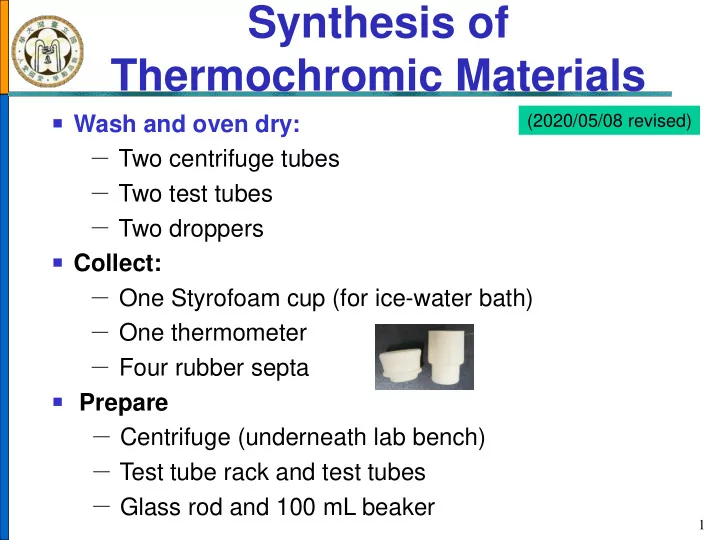
- One Styrofoam cup (for ice-water bath) - One thermometer - Four rubber septa

 Prepare

- Centrifuge (underneath lab bench) - Test tube rack and test tubes - Glass rod and 100 mL beaker

1

(2020/05/08 revised)

slide-2
SLIDE 2

2

Objective

  • Objective

To synthesize a thermochromic solid from diethylamine hydrochloride and copper(II) chloride 2(CH3CH2)2NHHCl + CuCl2  [(CH3CH2)2NH2]2[CuCl4]

  • Thermochromic materials

– Substance that changes color with temperature – Divided into two types: continuous and discontinuous thermochromic – According to the crystal field theory, changes in geometry, ligands, or coordination number in the coordination sphere may cause the color change

slide-3
SLIDE 3

3

Introduction

  • [(CH3CH2)2NH2]2[CuCl4]

– Bright green at room temperature – Yellow color when temperature increases

  • The color change is caused by a change in the geometry
  • f the complex ion, [CuCl4]2-

Low temp. Square planar, green

High temp. Distorted tetrahedron, yellow

[CuCl4]2- Cu2+ Cu2+

slide-4
SLIDE 4
  • Placed chemicals in

a centrifuge tube

  • Add 1 mL isopropyl

alcohol, iPA

  • Stir to dissolve and

produce product

Step 1 Prepare Reactants and React

4

  • 0.001 mol (0.13 g)

CuCl2

  • 0.002 mol (0.22 g)

diethylamine hydrochloride *All glassware must be dried

Wash & oven dry:

  • Centrifuge tubes
  • Glass dropper
  • Test tubes
  • Place in an ice-water bath

to crystallize completely

slide-5
SLIDE 5

 Collect product

 Add 1 mL ether to

rinse the final product in tube thoroughly

 Settle in ice-water bath

for 1 min. and decant the ether layer

 Place the tube in a

warm water bath ca. 40oC to evaporate residual ether

Step 2 Wash and Collect the Product

 Wash the product

 Centrifuge and decant the

supernatant, iPA

 Add 1 mL ice-cooled ether  Stir and mix well to wash

the product

 Centrifuge and decant the

ether layer

5

[(CH3CH2)2NH2]2[CuCl4]

 Rinse with ether

several times until the supernatant is colorless

slide-6
SLIDE 6

Step 3 Examine the Thermochromic Temperature

 Fix the sample tube to the

thermometer as shown

 Place the test tube and

thermometer in a cold water bath in a 100 mL beaker

 Heat the water bath slowly to

  • bserve the color varied with

temperature

 Replace into ice-water bath

to check if the color change is reversible Thermochromic temp.? Reversible? Place the thermometer in the center of water bath

6

slide-7
SLIDE 7

Notice

 Both reactants are hygroscopic; put the cap back

after use

 Cap the tube with rubber septum to reduce the

evaporation of organic solvent

 Cool the product in centrifuge tube after each

rinsing to reduce solubility of product

 During centrifuge, centrifuge tubes should be

placed in opposite sides to keep balanced

 Evaporate the ether solvent in the fume hood  Collect all the organic solvent in one test tube, then

pour into organic waste bottle

 Use small portions of water to dissolve the product

and discard into the heavy metal recycling bin

7

Condensed report

slide-8
SLIDE 8

T8 Video on YouTube (Click)

8

T8 - Centrifugation

  • Check the casing inside the machine is intact. If corrosion causes holes in

casing or there is an unknown object inside, clean or replace the casing.

  • Use centrifuge tubes in centrifugation, do not use test tubes.
  • Centrifuge tubes should be placed in opposite sides to keep balancing.
  • The lid should be closed during use; the centrifuge should be started from

slow rate to check if there is any malfunction, then the speed can be increased.

  • If there are unusual sounds or shaking in the centrifuge, the power should

be turned off first in order to fix up.

  • There must be at least one person look after the centrifuge when in use.
  • Centrifuge for approx. 1~2 min, open lid when the centrifuge has

completely stopped.