four mechanics www.carttalk.com of materials Mechanics of - - PowerPoint PPT Presentation

four
SMART_READER_LITE
LIVE PREVIEW

four mechanics www.carttalk.com of materials Mechanics of - - PowerPoint PPT Presentation

E LEMENTS OF A RCHITECTURAL S TRUCTURES : Mechanics of Materials F ORM, B EHAVIOR, AND D ESIGN ARCH 614 MECHANICS MATERIALS D R. A NNE N ICHOLS S PRING 2019 lecture four mechanics www.carttalk.com of materials Mechanics of Materials


slide-1
SLIDE 1

1

S2009abn Mechanics of Materials 1 Lecture 4 Elements of Architectural Structures ARCH 614

ELEMENTS OF ARCHITECTURAL STRUCTURES: FORM, BEHAVIOR, AND DESIGN

ARCH 614

  • DR. ANNE NICHOLS

SPRING 2019

four

mechanics

  • f materials

lecture

www.carttalk.com Mechanics of Materials 7 Lecture 14 Elements of Architectural Structures ARCH 614 S2004abn

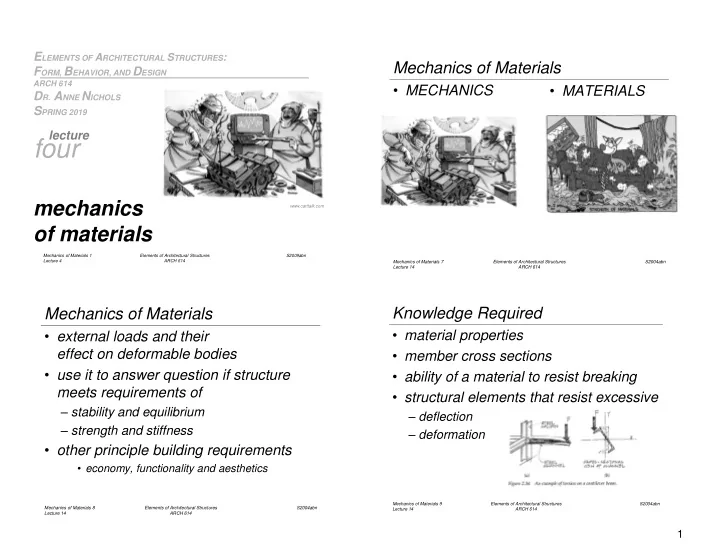
Mechanics of Materials

  • MECHANICS
  • MATERIALS

Mechanics of Materials 8 Lecture 14 Elements of Architectural Structures ARCH 614 S2004abn

Mechanics of Materials

  • external loads and their

effect on deformable bodies

  • use it to answer question if structure

meets requirements of

– stability and equilibrium – strength and stiffness

  • other principle building requirements
  • economy, functionality and aesthetics

Mechanics of Materials 9 Lecture 14 Elements of Architectural Structures ARCH 614 S2004abn

Knowledge Required

  • material properties
  • member cross sections
  • ability of a material to resist breaking
  • structural elements that resist excessive

– deflection – deformation

slide-2
SLIDE 2

2

Mechanics of Materials 10 Lecture 14 Elements of Architectural Structures ARCH 614 S2004abn

Problem Solving

  • 1. STATICS:

equilibrium of external forces, internal forces, stresses

  • 2. GEOMETRY:

cross section properties, deformations and conditions of geometric fit, strains

  • 3. MATERIAL PROPERTIES:

stress-strain relationship for each material

  • btained from testing

Mechanics of Materials 11 Lecture 14 Elements of Architectural Structures ARCH 614 S2004abn

Stress

  • stress is a term for the intensity of a

force, like a pressure

  • internal or applied
  • force per unit area

A P f stress  

Mechanics of Materials 12 Lecture 14 Elements of Architectural Structures ARCH 614 S2004abn

  • materials have a critical stress value

where they could break or yield

– ultimate stress – yield stress – compressive stress – fatigue strength – (creep & temperature)

Design

acceptance

  • vs. failure

Mechanics of Materials 13 Lecture 14 Elements of Architectural Structures ARCH 614 S2004abn

allowable actual

F f 

  • we’d like
  • stress distribution may

vary: average

  • uniform distribution

exists IF the member is loaded axially (concentric)

Design (cont)

slide-3
SLIDE 3

3

Mechanics of Materials 9 Lecture 4 Elements of Architectural Structures ARCH 614 S2009abn

Scale Effect

  • model scale

– material weights by volume, small section areas

  • structural scale

– much more material weight, bigger section areas

  • scale for strength is not

proportional: L L L   

2 3

Mechanics of Materials 16 Lecture 14 Elements of Architectural Structures ARCH 614 S2004abn

Normal Stress

  • normal stress is normal

to the cross section

– stressed area is perpendicular to the load

A P f

c

  • r

t

 

Mechanics of Materials 17 Lecture 14 Elements of Architectural Structures ARCH 614 S2004abn

  • stress parallel to a surface

Shear Stress

td P A P fv  

 

ave

Mechanics of Materials 18 Lecture 14 Elements of Architectural Structures ARCH 614 S2004abn

  • stress on a surface by

contact in compression

Bearing Stress

td P A P f p  

 

slide-4
SLIDE 4

4

Mechanics of Materials 19 Lecture 14 Elements of Architectural Structures ARCH 614 S2004abn

  • normal stress caused by bending

Bending Stress

S M I Mc fb  

 

Mechanics of Materials 20 Lecture 14 Elements of Architectural Structures ARCH 614 S2004abn

  • shear stress caused by twisting

Torsional Stress

J T fv  

 

Mechanics of Materials 21 Lecture 14 Elements of Architectural Structures ARCH 614 S2004abn

  • what structural elements see shear?

– beams – bolts – splices – slabs – footings – walls

  • wind
  • seismic loads

Structures and Shear

connections

V

S2011abn

  • connected members in tension cause

shear stress

  • connected members in

compression cause bearing stress

Bolts

Mechanics of Materials 16 Lecture 4 Elements of Architectural Structures ARCH 614

slide-5
SLIDE 5

5

S2011abn

  • seen when 2 members are connected

Single Shear

Mechanics of Materials 17 Lecture 4 Elements of Architectural Structures ARCH 614

4

2

d v

P A P f   

S2011abn

Double Shear

Mechanics of Materials 18 Lecture 4 Elements of Architectural Structures ARCH 614

F=

  • seen when 3 members are connected
  • two areas

4 d v

2

2 P A 2 P A 2 P f    

S2011abn

td P A P f

projected p

 

  • compression & contact
  • projected area

Bolt Bearing Stress

Mechanics of Materials 19 Lecture 4 Elements of Architectural Structures ARCH 614

F=

Mechanics of Materials 15 Lecture 14 Elements of Architectural Structures ARCH 614 S2004abn

Strain

  • materials deform
  • axially loaded materials change

length

  • bending materials deflect
  • STRAIN:

– change in length

  • ver length

L L strain    

(S)

slide-6
SLIDE 6

6

Stress & Strain 10 Lecture 15 Elements of Architectural Structures ARCH 614 S2004abn

Shearing Strain

  • deformations

with shear

  • parallelogram
  • change in angles
  • stress:
  • strain:

– unitless (radians)

s

 L

        tan L

s

Stress & Strain 11 Lecture 15 Elements of Architectural Structures ARCH 614 S2004abn

Shearing Strain

  • deformations

with torsion

  • twist
  • change in angle of line
  • stress:
  • strain:

– unitless (radians)

  L   

Stress & Strain 12 Lecture 15 Elements of Architectural Structures ARCH 614 S2004abn

Load and Deformation

  • for stress, need P & A
  • for strain, need  & L

– how? – TEST with load and measure – plot P/A vs. 

Stress & Strain 13 Lecture 15 Elements of Architectural Structures ARCH 614 S2005abn

Material Behavior

  • every material has its own response

– 10,000 psi – L = 10 in – Douglas fir vs. steel?

slide-7
SLIDE 7

7

Stress & Strain 14 Lecture 15 Elements of Architectural Structures ARCH 614 S2004abn

Behavior Types

  • ductile - “necking”
  • true stress
  • engineering stress

– (simplified)

A P f 

  • A

P f 

Stress & Strain 15 Lecture 15 Elements of Architectural Structures ARCH 614 S2004abn

Behavior Types

  • brittle
  • semi-brittle

Stress & Strain 16 Lecture 15 Elements of Architectural Structures ARCH 614 S2004abn

Stress to Strain

  • important to us in f- diagrams:

– straight section – LINEAR-ELASTIC – recovers shape (no permanent deformation)

Stress & Strain 17 Lecture 15 Elements of Architectural Structures ARCH 614 S2004abn

Hooke’s Law

  • straight line has constant slope
  • Hooke’s Law
  • E

– Modulus of elasticity – Young’s modulus – units just like stress

f

 E 1

   E f

slide-8
SLIDE 8

8

Stress & Strain 18 Lecture 15 Elements of Architectural Structures ARCH 614 S2004abn

Stiffness

  • ability to resist strain
  • steels

– same E – different yield points – different ultimate strength

u

f

Stress & Strain 19 Lecture 15 Elements of Architectural Structures ARCH 614 S2004abn

Isotropy & Anisotropy

  • ISOTROPIC

– materials with E same at any direction of loading – ex. steel

  • ANISOTROPIC

– materials with different E at any direction of loading – ex. wood is orthotropic

Stress & Strain 20 Lecture 15 Elements of Architectural Structures ARCH 614 S2004abn

Elastic, Plastic, Fatigue

  • elastic springs back
  • plastic has permanent

deformation

  • fatigue caused by

reversed loading cycles

Stress & Strain 21 Lecture 15 Elements of Architectural Structures ARCH 614 S2004abn

Plastic Behavior

  • ductile

at yield stress

slide-9
SLIDE 9

9

Stress & Strain 15 Lecture 15 Elements of Architectural Structures ARCH 614 S2006abn

Lateral Strain

  • or “what happens to the cross section

with axial stress”

  • strain in lateral direction

– negative – equal for isometric materials

z y

   E f x

x 

  

z y

f f

Stress & Strain 23 Lecture 15 Elements of Architectural Structures ARCH 614 S2004abn

Poisson’s Ratio

  • constant relationship between

longitudinal strain and lateral strain

  • sign!

x z x y

strain axial strain lateral            E f x

z y

      5 .   

S2004abn Stress & Strain 24 Lecture 15 Elements of Architectural Structures ARCH 614

Calculating Strain

  • from Hooke’s law
  • substitute
  • get 

   E f L E A P    AE PL  

(L)

Stress & Strain 25 Lecture 15 Elements of Architectural Structures ARCH 614 S2004abn

Orthotropic Materials

  • non-isometric
  • directional values of

E and 

  • ex:

– plywood – laminates – polymer composites

slide-10
SLIDE 10

10

Stress & Strain 26 Lecture 15 Elements of Architectural Structures ARCH 614 S2004abn

  • why we use fave
  • increase in stress at

changes in geometry

– sharp notches – holes – corners –

Stress Concentrations

Stress & Strain 27 Lecture 15 Elements of Architectural Structures ARCH 614 S2004abn

2 2

max

  • max

v

f A P f  

  • if we need to know

where max f and fv happen:

Maximum Stresses

F

  • max

A P f  1       cos 5 45 . sin cos        

Stress & Strain 28 Lecture 15 Elements of Architectural Structures ARCH 614 S2004abn

Maximum Stresses

Torsion & Temp 18 Lecture 16 Elements of Architectural Structures ARCH 614 S2004abn

Deformation Relationships

  • physical movement

– axially (same or zero) – rotations from axial changes

  • relates  to P

steel 20 kN  aluminum

AE PL  

slide-11
SLIDE 11

11

Torsion & Temp 19 Lecture 16 Elements of Architectural Structures ARCH 614 S2004abn

Deformations from Temperature

  • atomic chemistry reacts

to changes in energy

  • solid materials
  • can contract with decrease in temperature
  • can expand with increase in temperature
  • linear change can

be measured per degree

Torsion & Temp 20 Lecture 16 Elements of Architectural Structures ARCH 614 S2004abn

Thermal Deformation

  •  - the rate of strain per degree
  • UNITS : ,
  • length change:
  • thermal strain:

– no stress when movement allowed

 L

T

T

  

 

T

T

   F  C 

Torsion & Temp 21 Lecture 16 Elements of Architectural Structures ARCH 614 S2004abn

Coefficients of Thermal Expansion

12.8 x 10⁻⁶ Aluminum 10.4 x 10⁻⁶ Brass 10.1 x 10⁻⁶ Bronze 9.3 x 10⁻⁶ Copper 6.7 x 10⁻⁶ Wrought Iron 6.5 x 10⁻⁶ Steel 5.9 x 10⁻⁶ Cast Iron 5.5 x 10⁻⁶ Concrete 4.4 x 10⁻⁶ Glass 3.0 x 10⁻⁶ Wood Coefficients () [in./in./F] Material

Torsion & Temp 22 Lecture 16 Elements of Architectural Structures ARCH 614 S2004abn

E L A P f   

Stresses and Thermal Strains

  • if thermal movement is restrained

stresses are induced

  • 1. bar pushes on supports
  • 2. support pushes back
  • 3. reaction causes internal

stress

slide-12
SLIDE 12

12

Torsion & Temp 23 Lecture 16 Elements of Architectural Structures ARCH 614 S2004abn

Superposition Method

– can remove a support to make it look determinant – replace the support with a reaction – enforce the geometry constraint

Torsion & Temp 24 Lecture 16 Elements of Architectural Structures ARCH 614 S2004abn

Superposition Method

– total length change restrained to zero

 

T P

 

 

    L T AE PL 

 E

T A P f      

 L

T

T

    AE PL

p

  

constraint: sub:

Mechanics of Materials 43 Lecture 4 Elements of Architectural Structures ARCH 614 S2007abn

Dynamics

  • kinematics

– time, velocity, acceleration – linear motion – angular rotation

  • kinetics

– forces causing motion W = m·g – work – conservation of energy

2

2 1 ) ( ) ( at t v t s  

Mechanics of Materials 44 Lecture 4 Elements of Architectural Structures ARCH 614 S2007abn

Dynamic Response

slide-13
SLIDE 13

13

Mechanics of Materials 45 Lecture 4 Elements of Architectural Structures ARCH 614 S2007abn

Dynamic Response

  • period of vibration or

frequency

– wave – sway/time period

  • damping

– reduction in sway

  • resonance

– amplification of sway

Mechanics of Materials 46 Lecture 4 Elements of Architectural Structures ARCH 614 S2007abn

Frequency and Period

  • natural period of vibration

– avoid resonance – hard to predict seismic period – affected by soil – short period

  • high stiffness

– long period

  • low stiffness

“To ring the bell, the sexton must pull

  • n the downswing of the bell in time

with the natural frequency of the bell.”

Stress & Strain 29 Lecture 15 Elements of Architectural Structures ARCH 614 S2004abn

Design of Members

  • beyond allowable stress...
  • materials aren’t uniform 100% of the

time

– ultimate strength or capacity to failure may be different and some strengths hard to test for

  • RISK & UNCERTAINTY

A P f

u u 

Stress & Strain 30 Lecture 15 Elements of Architectural Structures ARCH 614 S2004abn

Factor of Safety

  • accommodate uncertainty with a safety

factor:

  • with linear relation between load and

stress:

S F load ultimate load allowable . 

stress allowable stress ultimate load allowable load ultimate S F   .

slide-14
SLIDE 14

14

Stress & Strain 31 Lecture 15 Elements of Architectural Structures ARCH 614 S2005abn

Load and Resistance Factor Design

  • loads on structures are

– not constant – can be more influential on failure – happen more or less often – UNCERTAINTY  - resistance factor  - load factor for (D)ead & (L)ive load

n L L D D u

R R R R      