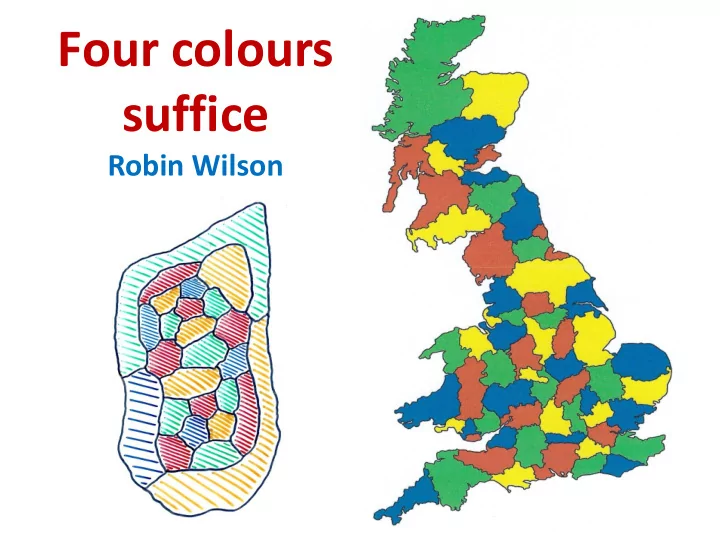
SLIDE 1
Four colours suffice
Robin Wilson
SLIDE 2
Four colours suffice
Robin Wilson
SLIDE 3
This talk is dedicated to Wolfgang Haken and the late Kenneth Appel
SLIDE 4 Guthrie’s map-color problem
Can every map be colored with four colors so that neighboring countries are colored differently?
We certainly need four for some maps . . . but do four colors suffice for all maps?
four neighboring countries . . . but not here
Francis Guthrie
SLIDE 5
A map-coloring problem
Country A must be blue or red
The countries of this map are to be colored red, blue, green, and yellow. What color is country B?
SLIDE 6
Try blue first: if country A is blue . . . then F is red, D is green, E is yellow and we can’t then color C
SLIDE 7
So country A is red, country C is green, . . . , and we can complete the coloring: country B is yellow
SLIDE 8
Coloring the USA
SLIDE 9
Two observations
The map can be on a plane or a sphere It doesn’t matter whether we include the outside region
SLIDE 10 De Morgan’s letter to W. R. Hamilton
23 October 1852
The student was Frederick Guthrie, Francis’s brother, who’d been coloring a map of England
SLIDE 11 The first appearance in print?
- F. G. in The Athenaeum, June 1854
SLIDE 12
Möbius and the five princes (c.1840)
A king on his death-bed: ‘My five sons, divide my land among you, so that each part has a border with each of the others.’
Möbius’s problem has no solution: five neighboring regions cannot exist
SLIDE 13
Some logic . . .
A solution to Möbius’s problem would give us a 5-colored map: ‘5 neighboring regions exist’ implies that ‘the 4-color theorem is false’ and so ‘the 4-color theorem is true’ implies that ‘5 neighboring regions don’t exist’ BUT ‘5 neighboring regions don’t exist’ DOESN’T imply that ‘the 4-color theorem is true’ So Möbius did NOT originate the 4-color problem
SLIDE 14
Arthur Cayley revives the problem
13 June 1878 London Mathematical Society Has the problem been solved? 1879: short note: we need consider only ‘cubic’ maps (3 countries at each point)
SLIDE 15
- A. B. Kempe ‘proves’ the theorem
American Journal of Mathematics, 1879 ‘On the geographical problem
From Euler’s polyhedron formula: Every map contains a digon, triangle, square, or pentagon
SLIDE 16
Kempe’s proof 1: digon or triangle Every map can be 4-colored
Assume not, and let M be a map with the smallest number of countries that cannot be 4-colored. If M contains a digon or triangle T, remove it, 4-colour the resulting map, reinstate T, and color it with any spare color. This gives a 4-coloring for M: contradiction
SLIDE 17
Kempe’s proof 2: square
If the map M contains a square S, try to proceed as before: Are the red and green countries joined? Two cases:
SLIDE 18
Kempe’s proof 3: pentagon
If the map M contains a pentagon P: Carry out TWO ‘Kempe interchanges’ of color:
SLIDE 19 The problem becomes popular . . .
Lewis Carroll turned the problem into a game for two people . . . 1886: J. M. Wilson, Headmaster of Clifton College, set it as a challenge problem for the school 1887: . . . and sent it to the Journal
. . . who in 1889 published a ‘solution’ by Frederick Temple, Bishop of London
SLIDE 20 Percy Heawood’s ‘bombshell’
1890: ‘Map-colour theorem’
- pointed out the error in Kempe’s proof
- salvaged enough from it to prove the 5-color
theorem
- generalized the problem from the sphere to
- ther surfaces
SLIDE 21
Heawood’s example 1
You cannot do two Kempe interchanges at once . . .
SLIDE 22
Heawood’s example 2
SLIDE 23 Maps on other surfaces
The four-color problem concerns maps on a plane
- r sphere . . . but what about other surfaces?
TORUS 7 colors suffice . . . and may be necessary HEAWOOD CONJECTURE
For a surface with h holes (h ≥ 1) [1/2(7 + √(1 + 48h))] colors suffice h = 1: [1/2(7 + √49)] = 7 h = 2: [1/2(7 + √97)] = 8 But do we need this number of colors? YES: G. Ringel & J. W. T. Youngs (1968)
SLIDE 24 Two main ideas
A configuration is a collection
We shall be concerned with
- unavoidable sets of configurations
- reducible configurations
SLIDE 25
Unavoidable sets
is an unavoidable set: every map contains at least one of them and so is the following set of Wernicke (1904):
SLIDE 26 Unavoidable sets
Kempe 1879 Wernicke 1904
so the four-color theorem is true for all maps with up to 25 countries. Later sets found by
SLIDE 27
Reducible configurations
Each of these configurations is ‘reducible’: any coloring of the rest of the map can be extended to include them So is the ‘Birkhoff diamond’ (1913)
SLIDE 28 Testing for reducibility
Color the countries 1–6 in all 31 possible ways:
rgrgrb extends directly: In fact, ALL can be done directly
- r via Kempe interchanges of color
→
SLIDE 29 Enter Heinrich Heesch (1906-95)
To solve the four color problem, find an unavoidable set of reducible configurations
Every map must contain at least one of them, and whichever it is, any coloring of the rest of the map can be extended to it.
- In 1932 he solved Hilbert’s Problem 18 on
tilings of the plane.
- He invented the ‘method of discharging’ for
unavoidable sets, and found thousands of reducible configurations.
- He estimated that 10,000 configurations
might need to be tested, up to ‘ring-size’ 18.
- He gave lectures on the 4-color problem at
the University of Kiel, attended by Haken.
SLIDE 30 Maps versus graphs
Appel & Haken, 1977
SLIDE 31
Three obstacles to reducibility
If any of these appears in a configuration, then it’s likely not to be reducible.
SLIDE 32 Enter Wolfgang Haken
Three problems: The knot problem
(solved completely in 1954)
The Poincaré conjecture
(almost solved)
The four-color problem
(solved with Ken Appel in 1976) “Mathematicians usually know when they have gotten too deep into the forest to proceed any further. That is the time Haken takes out his penknife and cuts down the trees one at a time.”
SLIDE 33 Enter Kenneth Appel
Heesch, Haken, and others were already using computers to test reducibility, with a certain amount of success. But the problem was quickly becoming too big to handle, possibly with thousands of large configurations, each taking many hours of computer time. Haken, in a lecture at the University of Illinois “The computer experts have told me that it is not possible to go on like that. But right now I’m quitting. I consider this to be the point to which and not beyond one can go without a computer.” In the audience was Appel, an experienced computer programmer “I don’t know of anything involving computers that can’t be done: some things just take longer than others. Why don’t we take a shot at it?”
SLIDE 34 1976 Kenneth Appel & Wolfgang Haken
(Univ. of Illinois) They solved the problem by finding an unavoidable set of 1936 (later 1482) reducible configurations. Every planar map is four colorable
(with John Koch)
SLIDE 35 The Appel-Haken approach
They developed a ‘discharging method’ that yields an unavoidable set of ‘likely-to-be-reducible’ configurations. They then used a computer to check whether these configurations are actually reducible: if not, modify the unavoidable set. They had to go up to ‘ring-size’ 14.
(199,291 colorings)
SLIDE 36
The proof is widely acclaimed
SLIDE 37 Aftermath
The ‘computer proof’ was greeted with suspicion, derision and dismay – and raised philosophical issues. Is a ‘proof’ really a proof if you can’t check it by hand? Some minor errors were found in Appel and Haken’s proof, and corrected. Using the same approach, N. Robertson, P. Seymour,
- D. Sanders, and R. Thomas obtained a more systematic
proof in 1994, involving about 600 configurations. In 2004 G. Gonthier produced a fully machine-checked proof of the four-color theorem (a formal machine verification of Robertson et al.’s proof).
SLIDE 38
The story is not finished
Many new lines of research have been stimulated by the four-color theorem, and there are several conjectures of which it is but a special case. In 1978 W. T. Tutte wrote: The Four Colour Theorem is the tip of the iceberg, the thin end of the wedge and the first cuckoo of Spring
SLIDE 39