ON AN ALTERNATIVE TO TRADITIONAL CONCRETE FORMWORK FOR WALLS - - PowerPoint PPT Presentation

on an alternative to
SMART_READER_LITE
LIVE PREVIEW

ON AN ALTERNATIVE TO TRADITIONAL CONCRETE FORMWORK FOR WALLS - - PowerPoint PPT Presentation

OUR OBJECTIVE: TO PROVIDE EDUCATION ON AN ALTERNATIVE TO TRADITIONAL CONCRETE FORMWORK FOR WALLS AUSTRALIAN INVENTED, OWNED AND MANUFACTURED Launched in 2006, and prompted by increasing construction costs with a decreasing availability of


slide-1
SLIDE 1
slide-2
SLIDE 2

OUR OBJECTIVE: TO PROVIDE EDUCATION ON AN ALTERNATIVE TO TRADITIONAL CONCRETE FORMWORK FOR WALLS

slide-3
SLIDE 3

AUSTRALIAN INVENTED, OWNED AND MANUFACTURED

Launched in 2006, and prompted by increasing construction costs with a decreasing availability

  • f skilled labour, an advanced, cost-effective

and innovative construction technology called Dincel Construction System was developed. Locally manufactured and supplied from 22,000sqm quality controlled Dincel plant located at Erskine Park, NSW.

slide-4
SLIDE 4

WHAT ARE DINCEL STRUCTURAL WALLS?

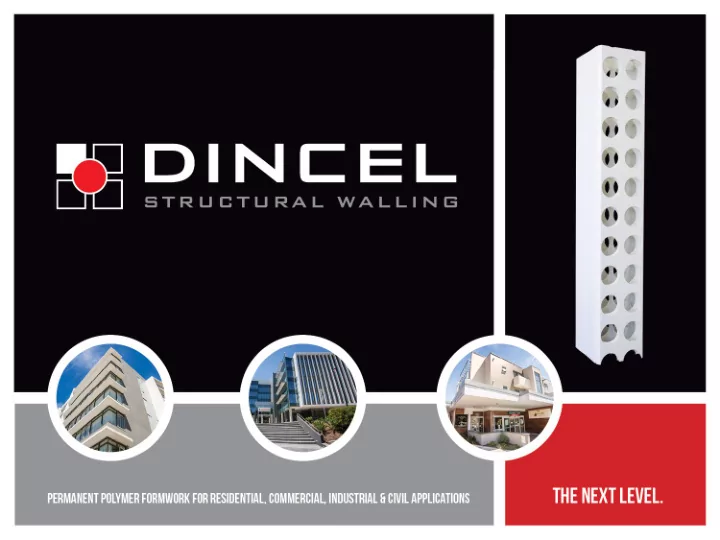
Dincel Structural Walls are a permanent polymer formwork system that uniquely snaps into position to quickly build all types of structural walling. When filled with ready mixed concrete, provides a waterproof, strong and durable protective barrier for residential, commercial and civil applications.

  • Simple to use and fast to install
  • Acoustic tested and certified
  • Fire tested by the CSIRO
  • Waterproof protective barrier
  • Termite, rot and mildew proof
  • Joint and crack free
  • VOC free
  • Available in 110, 155, 200 and 275mm profiles

and in custom lengths between 1.8m & 8m.

slide-5
SLIDE 5

PROFILE RANGE TO SUIT MARKET APPLICATIONS

110mm profile – Up to 12 storeys 155mm profile – Up to 22 storeys 200mm profile – Up to 40 storeys 275mm profile – Up to 60 storeys

slide-6
SLIDE 6
slide-7
SLIDE 7

WHY BUILDERS & DEVELOPERS USE DINCEL

SPEED & EFFICIENCY

  • Lightweight panels provide speed of installation,

require no cranage and improve workplace safety

  • Allows installation without scaffolding by one trade only
  • Not affected by wet weather conditions
  • Faster than column-slab system having infill walls

MATERIAL COST SAVING

  • Less cement/concrete and steel in typical floor slabs

and transfer levels

  • Eliminates conventional footings and waterproofing costs
  • Reduced waste and cleaning costs
  • Reduced maintenance costs
slide-8
SLIDE 8

CONVENTIONAL CONCRETE ISSUES

1. Conventional concrete requires formwork to hold wet concrete until it dries. It’s therefore expensive, requires skilled labour, increased material handling, storage and safety issues. 2. Conventional concrete is brittle and weak in tension Hence the reason for steel reinforcement. 3. Conventional concrete is porous which leads to durability-corrosion/concrete degradation issues. Concrete cracking is unavoidable, inadequate concrete cover, honeycombing, air voids lead to concrete cancer.

slide-9
SLIDE 9

HOW DINCEL WALLS ACT AS A ‘PROTECTIVE SKIN’

slide-10
SLIDE 10

WHY DINCEL FORMWORK IS DIFFERENT

  • Dincel’s polymer is impervious which does not suck water

from wet concrete. Hence no friction between the formwork and concrete infill, thus preventing:

  • No elaborate tying of formwork, i.e. no buoyancy

upward movement during concrete pouring

  • No honeycombing, air voids
  • Web holes smaller than 85mm prevent an easy flow of

concrete which can cause air voids

  • The round web holes of Dincel’s panels act as an

‘Elephant Trunk’ which means:

  • No segregation – free fall of aggregate is prevented
slide-11
SLIDE 11

WALL JOINTS & CRACK CONTROL STEEL IS NOT REQUIRED WITH DINCEL WALLS

EuroCode and American Code allow unreinforced concrete walls provided crack control measures are adopted. Elimination of steel bars, at least in

  • ne direction, is the key for end of life total recycling.

Impervious vapour barrier for both faces Crack control joints at 125mm centres

slide-12
SLIDE 12

WHY DINCEL WALLING IS WATERPROOF

slide-13
SLIDE 13

UNIQUE DURABILITY OF DINCEL MATERIAL

HYGROSCOPIC

  • Porous material sucks the water from the concrete mix

(e.g. Besser Blocks, Fibre Cement Sheets, MgO Boards) which can lead to concrete cancer, mould and mildew. DINCEL IS A NON-HYGROSCOPIC MATERIAL FOR THE FOLLOWING REASONS:

  • POLYMER MATERIAL; CSIRO testing confirms that the

vapour transmission rate of Dincel is 180 times better than the Australian Standard’s threshold for conventional membranes.

  • Dincel Panel Joints are WATERPROOF as confirmed by CSIRO

tests and under 6m of water head pressure at the panel joints.

slide-14
SLIDE 14

WHAT MAKES IT WATERPROOF?

  • Polymer material acts as a “protective skin”
  • Improves concrete flow and compaction
  • No additional waterproof membrane required
  • CSIRO test under 6m head of water pressure

at both joints confirmed waterproofing. Slump invades connection between panels Concrete slurry Patented Dincel barbs and cement slurry ensures that snap joint is waterproof

slide-15
SLIDE 15

HOW DINCEL MEETS COMPLIANCE & SAFETY

slide-16
SLIDE 16

Top-down method

(Requires safety rail)

CONSTRUCTION METHOD = 25M2 / 2 MAN / HOUR

Bottom-up method

(Safest install methodology)

The bottom-up method is the

  • nly way to eliminate

scaffolding and safety rails

slide-17
SLIDE 17

4 HOURS FIRE RESISTANCE

The fire performance of a Dincel Wall has been assessed by the CSIRO for the following:

  • Fire resistance levels
  • Fire hazard properties
  • Non-combustibility
  • Bush fire prone areas
  • Dincel material’s char formation does not

allow the polymer webs to burn In a CSIRO test, a 200mm concrete filled Dincel Wall completed a minimum fire resistance level of 4 hours to meet relevant building code requirements.

slide-18
SLIDE 18

WORKPLACE SAFETY IN CONSTRUCTION

With tighter legislation around OH&S requirements, Dincel Walls provide a safer alternative.

  • Light – Man Handleable – No Cranage
  • Minimise the risk of back injury
  • Reduction in the risk of cuts, trip hazards

and crushing fingers

  • Eliminates the risk of accidents due to wall

formwork stripping Dincel Structural Walling eliminates the need for scaffolding for edge protection.

slide-19
SLIDE 19

ISSUES WITH POROUS PERMANENT FORMWORK

The main reasons for honeycombing and air voids that lead to corrosion are hygroscopic material such as besser block, fibre cement and sheet formwork that sucks the moisture, along with low slump and inadequate compaction. Air voids identified and grouted by installer Fibre cement sheet joint Air voids failed to be identified by the installer who grouted the above voids

Note: Besser block and cement based formworks require in excess of 200mm slump concrete to minimise honeycombing and airvoids.

slide-20
SLIDE 20

CONVENTIONAL CONCRETE WALLS’ CORROSION PATH

If air-water gaps shown are not filled by cement hydration, the gaps are easily linked to each other by concrete cracking which leads to steel corrosion.

slide-21
SLIDE 21

USING DINCEL INCREASES CONCRETE STRENGTH

A Holcim Concrete test concluded the strength of concrete at: 28 days = 18MPa 120 days = 32MPa and increasing in strength.

Dincel Wall encapsulation achieves greater concrete strength by minimising moisture evaporation throughout the curing process.

Note: Design requirement strength = 20MPa achieved using a mix consisting of 50% less cement.

Not actual test image shown.

slide-22
SLIDE 22

BENEFITS FOR BASEMENT WALLS

Dincel Walls eliminate/minimises:

  • Loss of valuable land use
  • Waterproofing need for the wall
  • Stray current corrosion damage
  • Excavation behind the wall
  • Backfilling the excavation
  • Wall joints
  • Agricultural lines
  • Conventional footings
  • Horizontal wall reinforcement
  • Scaffolding
  • Painting of the internal wall face
  • Cleaning costs
  • Wastage
  • Builder’s Liability for wall cracking, water damages
slide-23
SLIDE 23

MINIMUM BASEMENT EXCAVATION WITH NO WATERPROOFING

Dincel Walls allow:

  • Habitable spaces in basements
  • Minimum 100 years wall life
  • Stronger structural walls in comparison to

reinforced masonry walls

  • Fastest wall construction

With a minimum 50mm clearance, and minimal overcut required to site excavations, build times, labour and project costs are significantly reduced and even eliminated.

slide-24
SLIDE 24

RENDERS AND FINISHES FOR DINCEL WALLS

slide-25
SLIDE 25

SMOOTH & TEXTURED FINISHES

15 year Warranty with render manufacturers

slide-26
SLIDE 26

EXTERNAL FAÇADE FINISHES

  • Waterproof
  • No cracks
  • No concrete cancer
  • Insulation for hot

and cold climates

  • Effective solution for

condensation, mould and mildew development

slide-27
SLIDE 27

CLADDING

Dincel can be cladded in a range of options including Stone, Timber, Alucobond & many more.

slide-28
SLIDE 28

INTERNAL FINISHES

slide-29
SLIDE 29

WHERE DINCEL HAS BEEN SUCCESSFULLY USED

slide-30
SLIDE 30
slide-31
SLIDE 31

DINCEL WALLING MARKETS AND APPLICATIONS

slide-32
SLIDE 32

DINCEL PROFILE APPLICATIONS

Being a maintenance-free, waterproof and airtight construction solution, the benefits for residential, commercial, civil and infrastructure applications makes this profile ideal for:

  • Column construction in new builds
  • Blade, party-corridor-façade walls
  • Lift and stairwells up to 60 storeys
  • Waterproof basements
  • Tanks – water, sewer, oil, grain and petrol
  • Retaining walls – sea walls, flood levees, erosion, contamination

control in soils for chemicals

  • Culverts for roads, railways, drainage, service ducts
slide-33
SLIDE 33
slide-34
SLIDE 34

CURVED WALLS OF ANY HEIGHT AND LENGTH WITHOUT JOINTS

slide-35
SLIDE 35

CURVED WALLS

slide-36
SLIDE 36

LIFT & STAIR SHAFTS

slide-37
SLIDE 37

STORAGE TANKS

Dincel panel joints have been tested by CSIRO Australia for waterproofing under 6m head of water pressure.

slide-38
SLIDE 38

RETAINING WALLS

  • Significant cost and speed advantages
slide-39
SLIDE 39

USING DINCEL AS A LOAD-BEARING WALL

slide-40
SLIDE 40

BENEFITS FOR USING DINCEL FOR LOAD BEARING WALLS IN BUILDINGS

  • Construction at lower cost and less time
  • Maximum strength, safety and simplicity
  • Up to 50% faster construction
  • Maximum cost efficiency both in walls and floor slabs
  • Maximum space saving
  • Maximum recyclability and embodied energy saving
  • Less steel and concrete
  • Waterproof
  • Longer building life and better air quality
slide-41
SLIDE 41
slide-42
SLIDE 42
slide-43
SLIDE 43
slide-44
SLIDE 44

JUMP-FORM ALTERNATIVE

Replaces conventional columns and challenges jump-form in lift shafts and fire stairs in up to 60 storey construction by:

  • Eliminates high cost for

jump-form assembly

  • Faster floor construction
  • Allows construction of lift/stair

shafts with or without scaffolding

  • Reducing install costs such as cranes
  • Eliminating operation costs
  • Reducing labour costs
slide-45
SLIDE 45

DESIGNING WITH DINCEL

When you talk to us early in your project, design and technical support is always available with our highly skilled engineers and backed by Australian manufacturing in an ISO 9001 production facility.

  • Now on PlusSpec™
  • NATSPEC Partner
  • Technical support and design

assistance available at Dincel

  • On-site and installation support
slide-46
SLIDE 46