SLIDE 1
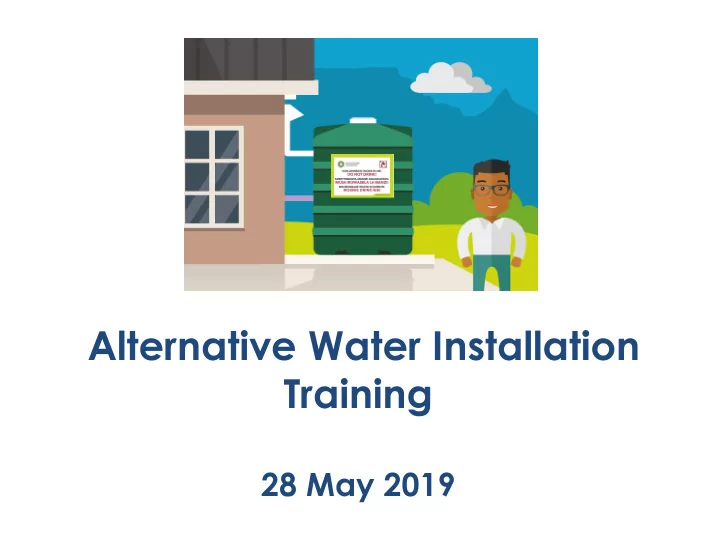
Alternative Water Installation Training
28 May 2019
SLIDE 2
Alternative Water Installation Training
May 2019
SLIDE 3 Alternative Water Installation Training
facilitated by
Ryan Marsh, College of Cape Town Chris Swartz, Chris Swartz Water Utilisation Engineers
SLIDE 4 TRAINING WORKSHOP OVERVIEW
1. INTRODUCTION 2. CITY OF CAPE TOWN BY-LAWS 3. CITY OF CAPE TOWN ALTERNATIVE WATER USE GUIDELINES 4. BACKFLOW PREVENTION 5. PUMPS AND SYSTEM PRESSURES 6. LABELLING, COLOUR-CODING AND SIGNAGE 7. RAINWATER SYSTEMS 8. GREYWATER SYSTEMS 9. GROUNDWATER SYSTEMS
- 10. TREATED WASTEWATER FROM THE CITY’S WASTEWATER
TREATMENT PLANS
- 11. STORAGE OF ALTERNATIVE WATER
- 12. DISCHARGE AND DISPOSAL OF ALTERNATIVE WATER
SLIDE 5
- Cape Town has experienced a multi-year drought
- Significant increase in installation of alternative
water system (potential for business expansion)
- Needs to be managed and regulated
- Potentially serious health and environmental risks
- Possible contamination of drinking water supply
- City of Cape Town requires safe and legal installation
and use of alternative water.
- Plumbers need to be aware of the requirements
contained in the Water By-law and its amendment
WHAT IS IT ALL ABOUT?
SLIDE 6 The objective of the training is twofold:
- To up-skill qualified plumbers with the necessary
knowledge to comply with the City’s guidelines and Water By-law requirements
- To provide information on installation best practice.
The alternative water installation training therefore aims to equip qualified plumbers with the necessary skills and knowledge to safely install alternative water supply to residents in Cape Town.
WHY THIS WORKSHOP?
SLIDE 7
- Rainwater
- Greywater
- Groundwater – boreholes, wellpoints and springs
- Treated Effluent supplied by City
- Basement water – essentially groundwater seepage but
treated as wastewater in some regulations
- Stormwater
- Surface water – streams and rivers
- Sea water
- Swimming pool water
- ‘Water from air’
WHAT ARE THE ALTERNATIVE WATER SOURCES?
SLIDE 8
- Rainwater
- Greywater
- Groundwater – boreholes, wellpoints and springs
- Treated Effluent supplied by City
- Basement water – essentially groundwater seepage but
treated as wastewater in some regulations Not included in this training:
- Stormwater
- Surface water – streams and rivers
- Sea water
- Swimming pool water
- ‘Water from air’
WHAT ARE THE ALTERNATIVE WATER SOURCES?
SLIDE 9
- 1. Imperative to prevent potentially dangerous alternative water from
contaminating drinking water system on premises and surrounding area. Reduced Pressure Zone (RPZ) valve back-flow preventer is mandatory.
- 2. Different quality required for different uses – as per 1996 national
guidelines.
- 3. Discharge to correct place – overflow to stormwater, or to sewer if any
harmful chemicals or substances
- 4. Put up official ‘Do not drink’ warning signage
- 5. Colour code the pipes
- 6. Plumbing Certificate of Approval is compulsory
SUMMARY OF KEY POINTS ON ALTERNATIVE WATER INSTALLATIONS
SLIDE 10 ALTERNATIVE WATER SOURCE AUTHORISATION FROM NATIONAL DEPT OF WATER & SANITATION APPROVAL FROM CITY
Rainwater N/A Approval for installation Groundwater If beyond ‘reasonable’ domestic use as described in Schedule 1, then General Authorisation or Water Use Licence applies Registration of boreholes/well points Approval for installation Basement water If beyond use permitted by Schedule 1 use, then General Authorisation or Water Use Licence applies Approval for installation Surface water If beyond use permitted by Schedule 1 use, then General Authorisation or Water Use Licence applies Permission to abstract stormwater Approval for installation Greywater N/A Approval for installation Treated effluent – from City Registration as a water user Approval for installation
Summary of authorisations
SLIDE 11
CITY OF CAPE TOWN BY-LAWS
SLIDE 12
- All alternative water systems are subject to approval from
the City
- City has a statutory responsibility for the water quality and
the associated potential health risks
- Important that alternative water installations are installed
correctly and according to the requirements of the By-law and other relevant legislation
- Plumbers need to comply with the by-laws or there may be
consequences (de-registration)
CITY OF CAPE TOWN BY-LAWS
SLIDE 13
The City of Cape Town’s Water By-law is a legal document that outlines everything to do with the usage of municipal drinking water and alternative water within the City. The By-law informs residents, property owners, plumbers, builders and built environment professionals about how they can go about using water generally, the use of certified materials and what measures need to be put in place under certain circumstances. What is the Water By-law?
SLIDE 14
If you are qualified and accredited in terms of the National Qualifications Framework Act of 2008, you may register with the City. Only City- registered plumbers may issue Certificates of Compliance / Approval. To register, call 0860 103 089, or email certificateofcompliance@capetown.gov.za Plumbers: Registering with the City
SLIDE 15 Register as a Plumber
Qualified plumbers who wish to register with the City and have their business particulars added to the City’s plumber's register can do so by following the steps on the following slides. Fast fact
- Only registered plumbers can issue a Certificate of
Compliance for existing water installations. This certificate is required before any property in Cape Town can be sold.
- If you are a qualified plumber, getting onto the City’s
register is a simple process.
SLIDE 16 Register as a Plumber
Step 1: Collate all your documents. If you already have a permanent City of Cape Town plumbing license, then you will need to provide a copy of the license. If you do not, then you will need to provide a certified copy of your Plumbing Trade Test Certificate. You will need:
- a certified copy of your ID;
- a copy of your plumbing license or Plumbing Trade Test Certificate
- if you are self-employed, provide the name and details of your
business
- if you are working for an employer, provide details of the company
contact details (number and email). Step 2: Send all the documentation via email to certificateofcompliance@capetown.gov.za.
SLIDE 17 If you are registered with the City, all plumbing work undertaken by you - or anyone under your supervision - must comply with the Water By-law(s). You are also required to submit:
- Certificates of Compliance for the transfer of ownership of a
property.
- Certificates of Approval for new or altered water installations.
- Certificates of Approval for the use and installation of alternative
water systems, or any changes to the installation. Submit these documents to certificateofcompliance@capetown.gov.za
Your responsibilities as a registered plumber
SLIDE 18 If you are not qualified and accredited in terms of the National Qualifications Framework Act of 2008, you are not allowed to do any of the following, unless working under the supervision of a registered plumber:
- replace fixed water heaters (geysers, heat pumps or
solar systems) and their protective devices;
- inspect, disinfect or test fire installations or storage
tanks; or
- service, replace or repair backflow preventers.
Not qualified?
SLIDE 19
You may undertake work on new or altered water installations, or on the installation of (or changes to) alternative water systems which require a Certificate of Approval (CoA), but only under the supervision of a registered plumber who must sign off on that CoA. However, only registered plumbers may undertake the work and sign off on the Certificate of Compliance for the transfer of ownership of a property .
Not qualified?
SLIDE 20
The City can deregister and remove plumbers from the City’s plumber database if you fail to comply with the requirements of the By-law. This will also apply if you falsely or misleadingly issue Certificates of Compliance/Approval or allow your registration details to be used in a fraudulent manner. Did you know?
SLIDE 21
- No unauthorised connection to the City’s
water supply system
- No selling of municipal drinking water.
- No purposeful or negligent wastage of water.
What everyone needs to know: Using water in the City of Cape Town
SLIDE 22
All water installations, hot water cylinders, solar panels (systems), heat pumps and water tanks used must comply with the relevant SANS standards. You also have to ensure that non-return valves are used in all water installations. Reduced Pressure Zone (RPZ) valves installed above ground are used for backflow prevention for alternative water systems. These valves must be positioned immediately after the property’s private isolating valve (stopcock).
Water installations
SLIDE 23 Step 1: Download the application form for the installation and use of alternative water. Attach the following to the form:
- FOR SYSTEMS INTENDED FOR IRRIGATION AND EXTERNAL USE ONLY:
- Compulsory schematic drawing of intended installation
- Permission or license from DWS, where required, such as for
groundwater or surface water
- FOR SYSTEMS PLUMBED INTO THE BUILDING FOR INTERNAL USE:
- Copy of most recent municipal account for the property (rates, water
and sewage bill)
- Compulsory schematic drawing of intended installation, showing
location of RPZ valve back-flow preventer
- Certificate of Approval from qualified plumber if the system is already
installed
- Water quality test analysis, if that has been done
City approval for plumbing installation and use
SLIDE 24 Step 2: E-mail the completed form and supporting documents to water@capetown.gov.za Step 3: The City will review your application and supporting documents, after which a City Water Inspector will conduct an inspection to verify that the installation complies with regulations. Note that if the installation is ever changed in future, further approval for the altered installation will be required. This includes cases where alternative water initially used for irrigation only is plumbed into the building at a later stage.
City approval for plumbing installation and use
SLIDE 25
SLIDE 26
SLIDE 27
SLIDE 28
Inspection Checklist
SLIDE 29
- The City’s Municipal Planning By-law (2015), specifically as it relates to
building regulations which apply to the erection of some structures and the connection of certain systems to water installations. Note that the requirements for building plan approval are regularly amended
- The City’s Treated Effluent By-law (2010)
- The City’s Stormwater Management By-law (2005)
- The City’s Wastewater and Industrial Effluent By-law (2013)
- The National Building Regulations and Building Standards Act 103 of 1977
and its associated regulations and standards, in particular SANS 10400
Other applicable By-Laws
SLIDE 30 The National Water Act outlines government’s entrusts the national Department of Water and Sanitation (DWS) as the custodian of this national resource. The Water Services Act stipulates various institutional arrangements, including Water Services Authorities, Providers and Intermediaries, along with their corresponding responsibilities and regulatory frameworks. The City is both a Water Services Authority and Provider, as it is responsible for not only ensuring access to water services, but also providing water services to consumers, including other water service
- institutions. This means that the City has the statutory responsibility
and is held accountable for providing Cape Town with access to treated water that meets the SANS 241
DWS Legislation
SLIDE 31
CITY OF CAPE TOWN ALTERNATIVE WATER USE GUIDELINES
SLIDE 32
- Developed to show how to safely install and use
alternative water systems
- Needs to be well managed and regulated
- Alternative water systems pose potentially serious
health and environmental risks
- Contamination of the drinking water supply
- The document does not have official legal status, but
does point to the relevant legislation and regulations, as well as best practices. CITY OF CAPE TOWN GUIDELINES DOCUMENT FOR ALTERNATIVE WATER INSTALLATIONS
SLIDE 33
The guidelines provide summary information about the safe installation of alternative water systems for irrigation or where they are plumbed into the water installation of a building, and the subsequent use of the water collected/extracted. For the full Guidelines for the Installation of Alternative Water Systems, visit http://cct.gov.za/AIBNl What are the guidelines about?
SLIDE 34
- Install a Reduced Pressure Zone (RPZ) backflow preventer valve
(or alternatively an ‘air gap’ tank) so that the municipal drinking water supply in your area cannot be contaminated.
- The quality of an alternative water source, and how it is stored
and managed, is key to where/ how it can be used.
- Alternative water can be used to flush toilets and for a few other
uses, with required permission and quality. However, you are not allowed to drink alternative water or use it for ablution (body washing) and cooking (or food preparation) due to the potential health risks it poses.
- Discharge of used alternative water or any effluent generated
must be directed to the correct place.
Safe Use of Alternative Water
SLIDE 35 The City’s current position is that the risks and costs associated with consumers going completely ‘Off Grid’ are too high to allow it on a widespread scale. Consumers may use alternative water for purposes such as flushing toilets, irrigating gardens and washing vehicles, provided that they obtain City permission for plumbing installation compliance as well as DWS approval for the actual taking of the water from the source.
‘Off-grid’ installations
SLIDE 36
SLIDE 37
SLIDE 38
SLIDE 39 CITY WEBSITE - USEFUL LINKS SHORT URL
Apply to sink a borehole or wellpoint http://cct.gov.za/99C1r Register a borehole or wellpoint http://cct.gov.za/juF60 Apply for supply of treated effluent http://cct.gov.za/iNPx2 Apply to install and use an alternative water system http://cct.gov.za/AIBNl Apply to operate as a water services intermediary (WSI) http://cct.gov.za/AIBNl scroll down a bit Water By-law – recently amended. In ‘Know your water regulations’ www.capetown.gov.za/water regulations
SLIDE 40
- Also demand for alternative water use from buildings
larger than residential dwellings, including community halls, schools, high density residential and commercial premises.
- Many similarities, but also important differences:
- greater exposure to larger sensitive populations
(e.g. schools, nursing homes)
- liabilities different
- greater impact of cross-connection
- more complex arrangements.
DOMESTIC AND COMMERCIAL BUILDINGS
SLIDE 41
BACKFLOW PREVENTION
SLIDE 42
BACKFLOW PREVENTION What is backflow? “the movement of a liquid or air back in the direction it was flowing from”
SLIDE 43
- Keep alternative water separate from the
municipal drinking water supply system.
- A RPZ valve back-flow preventer is regarded as the approved level of
back-flow prevention, and an air-gap method is permitted as an alternative.
- Installation of the RPZ valve must be done by a qualified plumber and
conform to SANS 10252- 1:2016 (Edition 3.1) which is the standard which applies .
- The only alternative to an RPZ valve back-flow preventer is an air gap
tank back-flow prevention method.
- Discharge or generated waste from the installed system must be directed
to the correct place.
Backflow prevention
SLIDE 44
- Specifications & functionality outlined in SANS 1808-15. If products approved
according to this standard are not easily available locally, the City will also accept international standards for RPZs from organisations such as the German Institute
- f Standardization (Deutche Institut vur Normung– DIN) or the American Water
Works Association (AWWA). Locally available RPZ models include the products manufactured by ARI and Caleffi.
– Equilibrium Water, importing Caleffi range (www.equilibrium-water.com) – Ultra control valves (www.ultravalves.co.za) – Wholesale plumbing supply in Mpumalanga (www.wholesaleplumbingsupply.co.za)
- City has approached these specialist retailers: Plumblink, Incledon, CP&B, OnTap,
Brights, Buco, Build It and Builders Warehouse. NOTE: City of Cape Town does not endorse any particular product or service provider and cannot be held liable for any non-performance.
Backflow prevention
SLIDE 45 Video: RPZ Installation & Maintenance
Caleffi Backflow preventer functionality https://youtu.be/U9sS7fpTldw Caleffi Backflow preventer Installation & Function Test https://www.youtube.com/watch?v=gGCwJ2sabqE Caleffi Backflow preventer Maintenance. https://www.youtube.com/watch?v=B_fOBiZ68pI&t=3s
Note: videos are included here purely for information and training purposes and do not indicate any endorsement of the product
SLIDE 47 Incorrect installation of the RPZ valve
SLIDE 48 Incorrect installations
SLIDE 51 University of the Western Cape
SLIDE 52 University of the Western Cape
SLIDE 53
PUMPS
SLIDE 54 Pressure and pumps
PUMP SELECTION GUIDANCE To determine the appropriate pump for your alternative system the following should be considered: 1. Is the water tank located above-ground or below-ground level? 2. Is the pump to be installed in the tank or externally near the tank? 3. Number of plumbing fixtures and flow rates to be served by alternative water supply. 4. Number of people living in the house—to determine the probable peak demand flow rate for the building. (toilet flushing & washing machine) 5. Pressure drop and index length of the rainwater system.
SLIDE 55 PUMP SELECTION GUIDANCE To determine the appropriate pump for your alternative water system the following should be considered: 6. Pump should have a safety device to prevent pump running dry. 7. Select a pump that is efficient for intended use, do not over- or under-size the pump, consider energy efficiency and electrical power consumption. 8. Control device (e.g. pressure control)—to start and stop the pump automatically, depending upon water usage demand. 9. The pressure of the water supply in a gravity feed system is 10 kPa for every 1 m of head.
- 10. Proximity to electrical supply.
Pressure and pumps for water storage tanks
SLIDE 56 To maximise the operating life of a rainwater pump, it will need to be protected from water, UV light, dust and extremes of temperature.
External pumps should ideally be installed:
- nto a firm base such as a concrete pad, so that vibrations do not cause pump
movement and increased stress on pipework
- in a free-draining area that is not prone to flooding
- with isolating valves and barrel unions for ease of service
- so water cannot freeze inside the pump or associated pipework not exposed to long
periods of sunlight—consider the southern side of buildings
- under cover to eliminate rainfall on the pump’s electrical components
- in a well-ventilated area so that waste motor heat is circulated away from the motor
- so that flammable materials are not stored near or on the pump
- to ensure primed pumps do not loss prime water.
Pump installation
SLIDE 57 Video: Basic Pump Installation & Maintenance
Pump and tank connection: https://www.youtube.com/watch?v=BZIqdlGCIuQ Pump Maintenance https://www.youtube.com/watch?v=TxGY5tC87s0&t=134s
Note: videos are included here purely for information and training purposes and do not indicate any endorsement of the product
SLIDE 58
LABELLING, COLOUR-CODING AND SIGNAGE
SLIDE 59 ALTERNATIVE WATER LABELLING- SANS 10140-3 2017
Apply the colour so it’s a length & width so that it’s visible from normal working
- levels. Use any of these methods:
- Paint the colour over the entire length of the pipe (see figure 1) or
- Paint the colour in bands (see figure 2).
- Wrap adhesive tape of the colour in bands (see figure 2). Ensure that paint
adhesive bands used to apply identification colours are of compatible materials (which may be retro-reflective) of the appropriate colour.
59
SLIDE 60 DESCRIPTIVE CODE INDICATORS
60
- Descriptive code indicators in the form of a chemical formula, or symbol,
to be used in conjunction with the colour coding system as a further aid in the identification of the specific contents of a pipeline
- If the diameter of a pipeline is too small to provide legibility of a
descriptive code indicator, place the indicator on a plate (or similar supporting surface) and fix the plate firmly to the pipeline(see figure 8). Where a pipeline is above the normal line of vision, ensure the visibility & legibility
SLIDE 61 Treated effluent = orange Rainwater and Greywater = lilac Groundwater = dark green with two grey stripes
COLOUR-CODING
SLIDE 62
SLIDE 63
SLIDE 64 RAINWATER SYSTEMS
- 1. Objectives: Rainwater systems training
- 2. Uses of rainwater
- 3. Guidelines for rainwater systems
- 4. Design
- 5. Installation
- 6. Maintenance
- 7. Checklists
- 8. Guidelines
RAINWATER SYSTEMS
SLIDE 65 To provide practical information for the collection, storage and use of rainwater for domestic residences and commercial/residential buildings To provide plumbers with by-law requirements and guidelines for the practical installation of rainwater systems Objectives: Rainwater systems training
RAINWATER SYSTEMS
SLIDE 66 Uses of Rainwater
Allowed – untreated
- toilet flushing
- cleaning vehicles, bins and outdoor
surfaces
- irrigation – limited depending on
restrictions in place at the time Allowed – with appropriate treatment laundry washing indoor surface cleaning, such as floors and table or countertops water-cooled air-conditioning systems water features topping up of swimming pools Not allowed
- Drinking
- Cooking
- food preparation
- body washing
Important facts Rainwater quality varies throughout the year because it is affected by the quantity
- f rainfall in relation to possible
- contaminants. Stored rainwater is more
likely to be of a better quality during wet months than dry months.
SLIDE 67
SLIDE 68
SLIDE 69
SLIDE 70
- Ensure that the appropriate colour-coding is used
- Ensure that the official signage is displayed on the property
- Select appropriately sized gutters, downpipes and drainage piping
- The gutters must slope to the rainwater tank to maximise efficiency and
minimise water loss
- Overflow must discharge into the stormwater system
- Ensure that tank access openings are properly covered
- Ensure that the tank location allows sufficient space for inspection and
maintenance
City of Cape Town guidelines for rainwater systems (1)
RAINWATER SYSTEMS
SLIDE 71
- Install the storage tank in a shady space to keep out direct sunlight
- Follow the manufacturer’s recommendations for levelling
- Compact the ground on which the tank is to be placed, or provide a
concrete plinth
- Underground tanks save space, but aboveground tanks are cheaper and
more accessible
- Any subsurface tanks must be installed at least 1 m away from the
property boundary line/wall and will require a pump for distribution.
City of Cape Town guidelines for rainwater systems (2)
RAINWATER SYSTEMS
SLIDE 72 Pre-installation:
- Determine the rainwater harvesting potential for the property.
- Choose the right rainwater system for the needs.
- Submit an application to the City for the installation of an alternative
water system.
- Submit a building plan to the City for the authorisation of a water tank,
where applicable.
Pre-installation
RAINWATER SYSTEMS
SLIDE 73 Rainwater System Design
When considering the design of your rainwater harvesting systems there are typically three key installation components:
- Collection: How the water will be collected from your roof
space (What is the approximate collection potential)
- Storage: Where the collected water will be stored
(Above / Below ground tanks)
- Distribution: How the collected water will be used.
SLIDE 74 Rainfall data:
WRC/CSAG water harvesting tool: http://cip.csag.uct.ac.za/webclient2/waterharvest/
Design
RAINWATER SYSTEMS
SLIDE 75
Calculations: Design
SLIDE 76 Main installation:
- The two main uses of rainwater - outdoor use (including garden irrigation,
vehicle and hard-surface cleaning) and toilet flushing – are illustrated on pages 49 and 50.
- All the principles and requirements contained in the illustrations and the
numbered explanatory notes are in line with the City
Installation
RAINWATER SYSTEMS
SLIDE 77
Installation : Outdoor Use
SLIDE 78
SLIDE 79
Installation : Outdoor Use / Toilet Flushing
SLIDE 80
SLIDE 81 Video: Basic RWH System Installation
Jojo Tank Installation https://www.youtube.com/watch?v=2Bq71mPvK0k https://www.youtube.com/watch?v=Hjvsnu0rt8U&t=124s https://www.youtube.com/watch?v=DGCggdHRpMo
Note: videos are included here purely for information and training purposes and do not indicate any endorsement of the product
SLIDE 82 Rainwater feed with colour-coded pipe
SLIDE 83 Borehole water and City water separated and protected by an RPZ valve Rainwater pump with colour-coded pipe
SLIDE 84 Rainwater tanks with colour-coded piping
SLIDE 85 Rainwater tap with the required signage
SLIDE 86 Post-installation:
- Signage indicating use of non-drinking water must be displayed at all times.
- Regular maintenance to ensure optimum functionality and avoid health
risks.
- Filters must be cleaned weekly or according to the manufacturer’s
specifications.
- Irrigation systems must be inspected regularly.
- If a storage tank is installed, it must be visually inspected weekly, and
periodic de-sludging should be conducted.
- Gutters should be cleaned regularly to keep them free of debris, such
as leaf litters and bird faeces.
Maintenance
RAINWATER SYSTEMS
SLIDE 87 Periodic Maintenance Checklist
RAINWATER SYSTEMS
SLIDE 88 GREYWATER SYSTEMS
- 1. What is greywater?
- 2. What are the risks of using greywater?
- 3. Greywater volume estimates
- 4. Uses of greywater
- 5. Installation and maintenance
GREYWATER SYSTEMS
SLIDE 89 Greywater is untreated wastewater that comes from:
- baths
- showers
- hand-washing basins
- washing machines
- kitchen wastewater (not recommended for use as greywater)
Greywater does not include wastewater from toilets, urinals, or bidets. This is referred to as blackwater (water containing human excrement).
What is greywater?
GREYWATER SYSTEMS
SLIDE 90 The risks associated with greywater potentially relates to human health and the environment. Human health: Greywater can contain large numbers of disease-causing
- rganisms (human pathogens such as bacteria, viruses and
protozoa). Environment: Greywater can also include a number of contaminants including fats and oils, food scraps, nutrients, salts, sodium, phosphorus, detergents, cleaning products, sunscreens and personal care products.
What are the risks of using greywater?
GREYWATER SYSTEMS
SLIDE 91 Source: Urban Greywater Design and Installation Handbook, RMIT University
Greywater volume estimates
GREYWATER SYSTEMS
SLIDE 92 Source: Urban Greywater Design and Installation Handbook, RMIT University
Greywater volume estimates
GREYWATER SYSTEMS
SLIDE 93 Uses of greywater
GREYWATER SYSTEMS
SLIDE 94 Uses of greywater
GREYWATER SYSTEMS
Allowed – untreated
- toilet flushing
- cleaning vehicles
- garden irrigation
Allowed – with appropriate treatment
- laundry washing
- cleaning bins and outdoor surfaces
- water-cooled air-conditioning systems
- water features
- topping up of swimming pools
Not allowed
- drinking
- cooking
- food preparation
- body washing
Important facts The key principle is that any greywater should be used within 24 hours wherever
- possible. If it is stored for longer than 24
hours, it has to be treated.
SLIDE 95
SLIDE 96
SLIDE 97
Example of a greywater treatment system
SLIDE 98 Sub-surface irrigation of greywater
GREYWATER SYSTEMS
Source: Urban Greywater Design and Installation Handbook, RMIT University
SLIDE 99
Greywater System: Outdoor
SLIDE 100
SLIDE 101
Greywater System: Outdoor
SLIDE 102
SLIDE 103
- Signage indicating use of non-drinking water must be
displayed at all times.
- Regular (as needed) maintenance to ensure optimum
- peration as well as good health and safety should be
performed.
- Tanks should be regularly disinfected, in compliance
with SANS 10252:1 (as amended).
- Draw up a maintenance plan for the greywater system
and provide to the owner.
INSTALLATION OF GREYWATER SYSTEMS
SLIDE 104 Maintenance checklist for greywater systems
Source: Urban Greywater Design and Installation Handbook, RMIT University
SLIDE 105 City of Cape Town guidelines
GREYWATER SYSTEMS
- Greywater is highly variable in quality and can often be relatively
‘high-risk’.
- Untreated greywater must be collected/stored and used within 24
hours.
- Any greywater stored for more than 24 hours needs to be filtered
and treated in accordance with its intended use.
- Depending on its source, greywater can typically contain bacteria,
- rganic material, oil and grease, soap and detergent residue,
pesticide residue, dirt, lint, sodium, nitrates and phosphates (from detergent), high salt and pH levels, bleach, and hair and skin particles.
SLIDE 106 GROUNDWATER SYSTEMS
- 1. Introduction to groundwater systems
- 2. Latest DWS requirements for boreholes
- 3. Basement water
- 4. City’s guidelines for groundwater use
- 5. Use of groundwater
- 6. Installation
- 7. Maintenance
- 8. Authorisations and registration of groundwater
systems
GROUNDWATER SYSTEMS
SLIDE 107
- To create a wellpoint, a high-pressure jet is used to pump water through a
steel pipe, pushing it down into the ground.
- A perforated pipe is placed inside the steel pipe, and the steel pipe is
removed.
- Wellpoints may consist of multiple holes connected to the common
suction pipe just below ground level.
- A borehole is usually a single, larger-diameter hole (100 mm to 250 mm)
drilled into the ground at a depth ranging between 15 m and 130 m.
- Boreholes cost roughly R1 000 for every metre in depth, depending on the
depth and extent of hard rock conditions. Installation takes approximately three to five days.
- The drilling procedure generates excess material that needs to be used
elsewhere or be disposed of at a landfill site.
Introduction to groundwater systems
GROUNDWATER SYSTEMS
SLIDE 108
- All water sector groups and individuals who abstract
surface or groundwater must install electronic water- recording, monitoring or measuring devices. The volumes of water abstracted must be reported on a weekly basis to metering@dws.gov.za every Monday before 12:00.
- Groundwater abstraction in the Cape Town
catchment area (for domestic and industrial use) must reduce by 10%
- A permit is required to transport borehole water.
Latest DWS borehole requirements
SLIDE 109
- Basement water: found in many building basements in Cape
Town
- Often situated below what used to be the sea level
- Usually groundwater or sub-surface seawater
- Seeps or flows into the basement
- It could also be spring water if the building was constructed
- n or over a spring.
- Traditionally, this water has been pumped out of basements
to the sewer or stormwater system, depending on its quality.
- Depending on the intended use and quantities to be
abstracted, stored or disposed of, a General Authorisation or Water Use Licence may apply.
Basement water
SLIDE 110
- Again, ensure that the appropriate colour-coding for groundwater
pipes is used.
- Also, again ensure that the official signage for the use of
groundwater systems is displayed on the property.
- DWS has gazetted a notice on limitations and related matters
around borehole, wellpoint and surface water (rivers and streams). This took effect on 12 January 2018 and includes the following requirements:
- The owner must install electronic water-recording, monitoring or
measuring devices.
- The volumes of water abstracted must be reported to
metering@dws.gov.za every Monday.
- Owners must use 10% less in comparison to pre-drought usage
- DWS’s permission is required to sell or buy borehole or
wellpoint water.
City’s guidelines for groundwater use
GROUNDWATER SYSTEMS
SLIDE 111 Uses of groundwater
GROUNDWATER SYSTEMS
SLIDE 112 APPROPRIATE USES, QUALITY AND TREATMENT Boreholes, wellpoints and springs
Allowed – untreated
- toilet flushing
- cleaning vehicles, bins and outdoor
surfaces
- irrigation – limited depending on
restrictions in place at the time Allowed – with appropriate treatment
- laundry washing
- indoor surface cleaning, such as floors and
table or countertops
- water-cooled air-conditioning systems
- water features
- topping up of swimming pools
Not allowed
- drinking
- cooking
- food preparation
- body washing
Important facts Untreated groundwater may have a high metal content. This is normally corrosive and would discolour surfaces or laundry and react with the plumbing materials, causing damage to pipes and pumps.
SLIDE 113
SLIDE 114
SLIDE 115
Groundwater: Indoor/ Outdoor
SLIDE 116
SLIDE 117 Borehole water and City water separated and protected by an RPZ valve
SLIDE 118 City’s drinking water and borhole water connceted to either end of the manifold
SLIDE 119
- Cover the pump to protect it from the sun, rain, wind and adverse weather
conditions.
- Ensure that the power supply and components to the borehole or
wellpoint pump are kept dry and are not exposed to rain, water, wet conditions or moisture.
- The non-return valve must be checked frequently to ensure that no solids
- r sand grains are trapped inside, preventing it from closing fully.
- During the winter months, when boreholes and wellpoints are used less
frequently due to winter rains, the pump must be switched on at least
- nce every one to two weeks and left to run for one to two minutes
- Clean nozzles and filters of irrigation sprinklers frequently to prevent
clogging.
Monitoring and maintenance
GROUNDWATER SYSTEMS
SLIDE 120
- Groundwater has to be well regulated, monitored and managed so
as to avoid over-abstraction and protect against any contamination risk to the municipal drinking water supply system and a negative impact on the environment.
- Since the use of groundwater is subject to the National Water Act
36 of 1998, consumers who wish to make use of groundwater resources need to apply and register for this use and obtain authorisation and/or licensing from DWS, as well as get approval from the City for the plumbing installation.
- The information on the next slides below is as per the National
Water Act (updated September 2014) and the City’s Water By-law.
Authorisations and registrations for groundwater systems
GROUNDWATER SYSTEMS
SLIDE 121 All consumers with an existing borehole or wellpoint on their property must register it with the City. Follow these steps: Step 1: Send an e-mail to water@capetown.gov.za including:
- your full name and contact number
- the address and erf number of the property
- the location of the wellpoint or borehole on the property, including
GPS coordinates if possible
- the City water and rates account number for the property
- whether you are registering a wellpoint or borehole.
Step 2: Once you have registered, you will receive a free sign to display
To register an existing borehole or wellpoint with the City
GROUNDWATER SYSTEMS
SLIDE 122 Notice should be given (or, according to the City’s website, application made) 14 days prior to installation. After installation, the new borehole or wellpoint should then be registered. Follow these steps for notification: Step 1: Download the application form to notify the City of your borehole/wellpoint from the City’s website (http://cct.gov.za/taUln). This will help you familiarise yourself with the requirements and brief the contractor in preparation for the notification. To notify the City of the intention to drill a new borehole or wellpoint
GROUNDWATER SYSTEMS
SLIDE 123 Step 2: Find a good contractor who can survey the site and provide all the correct information you need for your notification. Step 3: Complete the application form and attach the following docs:
- a certified copy of your ID
- proof of address
- a drainage layout plan showing the point of extraction.
Step 4: Submit your notification to e-mail address water@capetown.gov.za and the City will contact you. Remember,
- nce installation has been completed, you will still need to register
your borehole (see above).
To notify the City of the intention to drill a new borehole or wellpoint
GROUNDWATER SYSTEMS
SLIDE 124 All commercial/business uses of groundwater are subject to authorisation/licensing by DWS. DWS will confirm registration under a General Authorisation (GA) which takes a few weeks, or they will issue a Water Use Licence (WUL) which takes much longer (up to 300 working days), depending on how much groundwater you require, along with other factors. For further information, contact DWS’s regional office in Bellville on customercare@dws.gov.za or 021 941 6000/6353, or visit their walk-in centre at 52 Voortrekker Road, Spectrum Building, Bellville. Alternatively, try their national call centre on 0800 200 200.
To obtain DWS authorisation for boreholes
GROUNDWATER SYSTEMS
SLIDE 125 TREATED WASTEWATER FROM THE CITY’S WWTPs
- 1. Introduction
- 2. Annual audits by the City
- 3. Uses of treated wastewater
- 4. Backflow prevention
- 5. Labelling, colour-coding and signage
- 6. Occupational Health and Safety
- 7. Checklists
- 8. Treated wastewater use guidelines
TREATED WASTEWATER
SLIDE 126 Introduction
TREATED WASTEWATER
- Treated effluent is wastewater that the City has treated to a
particular standard at one of its wastewater or sewage treatment
- plants. In essence, therefore, it is recycled sewage water. It is piped
via a separate network of orange-coloured pipes to large water consumers for specific uses such as irrigation as well as industrial and commercial processes.
- It can also be collected from various wastewater treatment plants
throughout the city.
- The City promotes the use of its treated effluent, which is
significantly cheaper than using drinking quality water.
- If the water is to be used for drinking, cooking or body washing, a
Water Services Intermediary contract needs to be entered into with the City.
SLIDE 127
- The City’s Inspectors conduct annual audits of treated-effluent
installations.
- These include testing the RPZ back-flow preventer as outlined in
the national standard SANS 1808- 15:2011, as well as testing the functioning of the infrastructure to ensure that hazards do not arise during operation.
- The registered user is responsible for allowing the inspectors
access for such audit and testing, as well as for the associated costs.
- If water storage tanks are involved, regular disinfection of the
storage tank(s) must comply with SANS 10252:1 (as amended).
Annual audits by the City (for information to the plumbers)
TREATED WASTEWATER
SLIDE 128 Allowable and unallowable uses: Uses of treated wastewater
TREATED WASTEWATER
Irrigation and the following operational cases:
- irrigation of lawns/fields and some plants
- dust control on construction sites
- cleaning or flushing of stormwater and sewer pipe networks
- washing bins
- cleaning streets
- fire-fighting applications
- toilet flushing
Not allowed
- Drinking
- Cooking
- food preparation
- body washing
Important facts Some City wastewater treatment works have collection points where large consumers can collect wastewater in
- tankers. Temporary standpipes are also
available, such as for construction sites.
SLIDE 129
- Ensure that the appropriate colour-coding for alternative water
pipes is used.
- Ensure that the official signage for the use of alternative systems is
displayed at the appropriate places, warning people against using the treated effluent for drinking, cooking and ablution.
- There may be no interconnection between treated effluent and the
municipal drinking water supply. Municipal drinking water supply into a property must be fitted with a RPZ valve back-flow preventer (mandatory) in terms of SANS 1808-15:2011.
- The RPZ must be installed immediately downstream of the private
stopcock inside the property boundary, above ground, and according to SANS 10252-1:2016 (Edition 3.1). See the technical drawing/sketch guidance in Annexure 4.
Installation instructions for plumbers
TREATED WASTEWATER
SLIDE 130
- All pipes and fittings must meet the specifications outlined in SANS
10252-1:2016.
- Taps, valves and sprayers of the irrigation system must be designed
so that only authorised persons can open or operate them, and should cause no unnecessary or excessive misting or overspray.
Installation instructions (2)
TREATED WASTEWATER
SLIDE 131
- Sprinkler irrigation is allowed only if no spray is blown over to areas
where such irrigation is forbidden.
- The quality of the effluent, the use of adjoining areas and their
proximity to the irrigation area must be taken into consideration before sprinkler irrigation is permitted. The sprinkler system may not be combined with the municipal drinking water supply.
- A treated-effluent tracer or food dye could be added to the treated
effluent so that it may be easily distinguished from drinking water to draw users’ attention to cases of contamination.
- If the installation includes a tap that people may be tempted to
drink from or use, preferably lock it or turn it into a demand tap.
Installation instructions (3)
TREATED WASTEWATER
SLIDE 132 STORAGE OF ALTERNATIVE WATER On-site water storage is regulated under the Revision
- f General Authorisation for the Taking and Storing of
Water, Notice 538 of 2016 in Government Gazette No. 40243 and the Revision of General Authorisations in terms of Section 39 of the National Water Act, 1998 (Act No. 36 of 1998). Registration and authorisation requirements
SLIDE 133
REQUIREMENTS FOR THE STORAGE OF ALTERNATIVE WATER
SLIDE 134 DISCHARGE AND DISPOSAL OF ALTERNATIVE WATER
- Only stormwater may be discharged into the stormwater system.
- Polluted water such as swimming pool backwash, greywater or sewage may
not to be discharged into the stormwater system, unless prior written permission (except for sewage) has been obtained.
Discharge into stormwater system
SLIDE 135 DISCHARGE AND DISPOSAL OF ALTERNATIVE WATER
- Chlorinated swimming pool backwash must be discharged to sewer
- The backwash of a salt-water pool or a pool that has been topped up with
seawater must similarly also be discharged into the wastewater system.
- Greywater tank overflow must be directed to the wastewater system.
- The discharge of chemicals, toxins, pollutants or saline substances should at
all times be within the limits prescribed in the City’s Wastewater and Industrial Effluent By-law.
- The discharge of basement water into the sewage network is not permitted,
unless the City’s prior written consent is obtained.
- Groundwater overflow, gutter downpipe or rainwater tank overflow pipe
may not be connected to the wastewater system, but should be directed to the stormwater system.
Discharge into sewer system
SLIDE 136
- This happens when excess alternative water
- verflows, e.g. when there is excess water in storage
tanks
- The quality of different types varies considerably and
should be considered accordingly
- It must be directed to the right place
- Untreated rainwater should go to stormwater
- If the rainwater has been treated with chemicals (e.g.
chorine) it should go to sewer
- Storage tanks for other forms of alternative water
should overflow to sewer.
Overflow requirements
SLIDE 137
IN CONCLUSION
SLIDE 138 ALTERNATIVE WATER INSTALLATIONS
- Cape Town is experiencing increasing water
shortages
- Significant increase in installation of alternative
water system
- Needs to be managed and regulated
- Potentially serious health and environmental risks
- Possible contamination of drinking water supply
- City of Cape Town requires safe and legal installation
and use of alternative water.
TO RECAP: WHY DID WE DO ALL OF THIS?
SLIDE 139
SLIDE 140 The objective of the training was twofold:
- To up-skill qualified plumbers with the necessary
knowledge to comply with the City’s guidelines and Water By-law requirements
- To provide information on installation best practice.
The alternative water installation training therefore aims to equip qualified plumbers with the necessary skills and knowledge to safely install alternative water supply to residents in Cape Town.
IN CONCLUSION
SLIDE 141
ENKOSI DANKIE THANK YOU