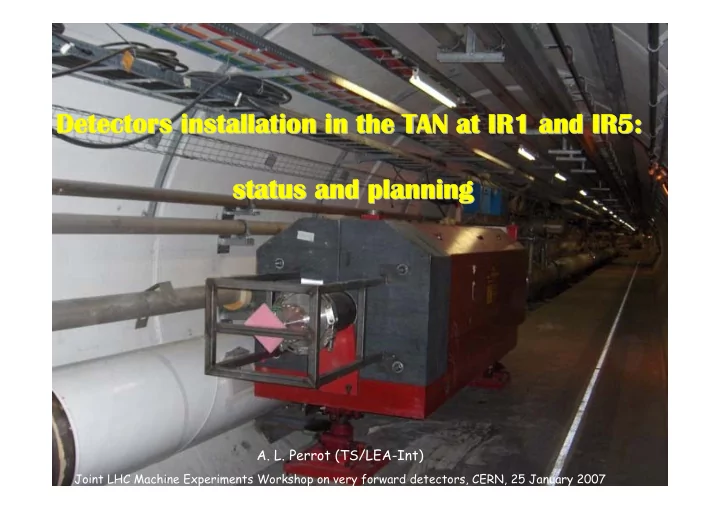
Detectors installation in the TAN at IR1 and IR5: Detectors - - PowerPoint PPT Presentation

detectors installation in the tan at ir1 and ir5
SMART_READER_LITE
LIVE PREVIEW

Detectors installation in the TAN at IR1 and IR5: Detectors - - PowerPoint PPT Presentation

Detectors installation in the TAN at IR1 and IR5: Detectors installation in the TAN at IR1 and IR5: Detectors installation in the TAN at IR1 and IR5: Detectors installation in the TAN at IR1 and IR5: status and planning status and planning


slide-1
SLIDE 1

Detectors installation in the TAN at IR1 and IR5: Detectors installation in the TAN at IR1 and IR5: Detectors installation in the TAN at IR1 and IR5: Detectors installation in the TAN at IR1 and IR5: status and planning status and planning status and planning status and planning

  • A. L. Perrot (TS/LEA-Int)

Joint LHC Machine Experiments Workshop on very forward detectors, CERN, 25 January 2007

slide-2
SLIDE 2

4 Target Absorbers Neutrals (TANs)

D2 Q4 Q4 XRP2 XRP3 XRP1 XRP2 XRP1 XRP3 D2 D2 Q4 Q4

TAN TAN

Q2 Q3 Q1 Q1 Q2 Q3 D1 D1 USC55 UJ53 UJ57 R57

Point 5

D2 Q4

TAN

Q4 D2 UJ13 UJ14 US15 UJ16 UJ17 USA15 Q1 Q2 Q3 D1 RI13 RI17

TAN

Q2 Q3 D1 Q1

Point 1

slide-3
SLIDE 3

In each TAN 1 slot with 10 movable Cu bars

Possibility to add instrumentation

Slot : l1000 x w95 x h605

slide-4
SLIDE 4

LHCf ATLAS ZDC BRAN

Point 1

LHCf: LHC forward physics BRAN: Beam RAdiation Neutrals monitor ZDC: Zero Degree Calorimeter

Point 5

HCAL

BRAN

ECAL

CMS ZDC

ECAL = Electromagnetic CALorimeter HCAL = Hadronic CALorimeter

Courtesy of D. Macina

slide-5
SLIDE 5

Installation of detectors in TAN - introduction

  • Space allocation around the TAN in the LHC tunnel
  • Services
  • Handling / Transport
  • LHCf and BRAN first installation
  • Integration in LHC schedule
  • Radiation monitoring close to the TAN

Several teams involved in the installation:

  • radio-protection (SC/RP),
  • transport (TS/IC),
  • gas installation (TS/LEA), cabling (TS/EL, TS/LEA),
  • LHC operators (AB/OP),
  • LHC planning and commissioning teams (TS/IC, TS/HDO),
  • scientific collabs. (LHCf, BRAN, CMS-ZDC, ATLAS-ZDC).

Coordination (TS/LEA-int)

slide-6
SLIDE 6

Space allocation in the TAN surrounding

monorail space for transport space for survey

All the experiments use about 30 cm above the TAN top surface Ok with the survey team Survey team => move the 3 alignment target spheres (fiducials) located

  • n each TAN top surface
slide-7
SLIDE 7

Services integration inside the LHC, ATLAS & CMS environments

Work performed on TAN: holes drilling for patch-panels installation of LHCf and BRAN (TS/IC,TS/LEA). Common to all experiments:

  • cabling and fibers pulling from the location in the tunnel to the rack control

rooms of ATLAS and CMS experiments (TS/EL, TS/LEA). LHCf + ATLAS ZDC ( & ATLAS RP):

  • cables follow different paths:

request of expts.: shorter path especially for trigger cables; compatibility with the cables already installed/foreseen for the machine and the ATLAS experiment.

  • additional cable trays installation in UPS galleries, machine areas and

ATLAS cavern (TS/EL and TS/LEA),

  • use of cables trays already installed in the ATLAS experimental cavern

(UX15) to surround the ATLAS detector. Services installations = integrated in the LHC schedule Constant contact with the planning officers (TS/IC, TS/LEA) and the hardware commissioning team (TS/HDO).

slide-8
SLIDE 8

D2 Q4

TAN

Q4 D2

UJ13 UJ14

US15

UJ16 UJ17

USA15

Q1 Q2 Q3 D1

RI13

RI17

TAN

Q2 Q3 D1 Q1

Point 1

LHCF and ATLAS ZDC racks

Cabling paths from TANs to LHCf and ATLAS ZDC racks

road 1 road 2

slide-9
SLIDE 9

Cables trays inst. and cabling for LHCf and ATLAS ZDC

LSS1 LSS1 UJ13 ATLAS exp. cavern

slide-10
SLIDE 10

Services integration inside the LHC, ATLAS & CMS environments

LOCKED CAGE TAN

Gas distribution at Point 1

Special agreement with safety dept. to have gas bottles underground Future interventions: replacement of a set of gas bottles LHCf:

  • plugs installation in the tunnel (TS/EL),
  • cooling study for LHCf arm#2 (TS/CV)

BRAN:

  • cabling by TS/EL; coordination by AB/BI.
  • gas installation and distribution (TS/LEA/gas section)
  • locked caged area + change over panel (Pt1-US15 and Pt5-UJ56)
  • gas distribution network between the caged area and the TAN
slide-11
SLIDE 11

CMS-ZDC (&TOTEM):

  • additional cable trays installation from UL55 to USC55 (CR and Laser room)

(TS/EL) , in UJ53 and UJ57 (TS/LEA), in LSS5 (TS/EL).

  • use of cables trays already installed in the machine and rack room area

Services integration inside the LHC, ATLAS & CMS environments

XRP2 XRP3 XRP1 XRP2 XRP1 XRP3 D2 D2 Q4 Q4

TAN TAN

Q2 Q3 Q1 Q1 Q2 Q3 D1 D1

USC55 UJ53 UJ57 R57

Point 5

CMS-ZDC rack

UL55

laser room

slide-12
SLIDE 12

Handling

With which device? Guide line: simplicity + use the same device for Cu bars and all the detectors Experiments request: insertion of the detectors in the TAN in 1 ‘block’ (taking into account the height of electronics, manipulator) => faster installation. 1rst step: mock-ups construction (TAN TS/LEA –detectors physicists coll.) 2nd step: simulations 3rd step: dry run with the first TAN at Pt5 (Apr. 2006) 4th step: adaptation of the forklift arm (design and construction- TS/IC)

BRAN mock-up inserted inside TAN mock-up

Courtesy of F. Delsaux (TS/MME)

Yale 3.5 t at Pt1

slide-13
SLIDE 13

monorail

796 for IP1 786 for IP5

Constraints Tunnel

Point 1: TAN top surface - monorail= 926 mm TAN top surface - hook = 796 mm Point 5: TAN top surface - monorail= 916 mm TAN top surface - hook= 786 mm

Cu bar and detectors dimensions and weight

COPPER BAR 46 kg l=98mm w= 94mm h= 605mm DETECTORS LHCf 20kg l=290mm w= 90mm h=608mm (+ 362 mm for the manipulator) BRAN 41kg l=99mm w= 94mm h=853mm to the top of the hoist ring CMS ZDC ECAL 65 kg l=116mm w= 92mm h=705mm (+ 150 mm for the electronics) CMS ZDC HCAL 200 kg l=711mm w= 92mm h=705mm (+150mm for the electronics) ATLAS ZDC ECAL 80 kg l=123 mm w= 93.8 mm h=738 mm ATLAS ZDC HCAL 240 kg l=450 mm w= 93.8 mm h=738 mm

Handling

slide-14
SLIDE 14

Transport team (TS/IC) solution extension of the usual forklift arm =>enhancement of the available space above the TAN top surface. Transport team (TS/IC) request M12 screwed hole on top surface of each detector.

Courtesy of P. Minginette (TS/IC)

Total gain in height ~ 31cm.

Handling

slide-15
SLIDE 15

Usual forklift arm New extension arm for the usual forklift

Handling

slide-16
SLIDE 16

Courtesy of P. Minginette (TS/IC)

Transport team proposal for CMS-ZDC

  • not possible to have the required M12 screwed hole on top surface of

detector because of electronics boxes all along the surface.

  • TS/IC: draft design of 2 supports.
  • CMS-ZDC team: final design and construction of the 2 new supports
  • Tests performed at CERN with the new supports on 8 Dec. 2006 and
  • n 23 Jan. 2007(TS/IC, CMS-ZDC and TS/LEA)

Handling

slide-17
SLIDE 17

Point 1 (RI132-RI171)

  • Access by Pt1:

Shielding between UJ13-UJ14, and between UJ16-UJ17 => forklift too large to pass

  • Access by Pt 2 and Pt8: ok

Travel underground until TANS= ok (study by O. Choisnet TS/MME)

Courtesy of O. Choisnet (TS/MME)

Transport

slide-18
SLIDE 18

Pt5 (UJ53 –R571)

  • Access by Pt5:
  • nly a ‘normal persons’ lift => forklift too large to pass
  • Access by Pt4 and Pt6: ok

Travel underground until TANS ok

Transport

slide-19
SLIDE 19

Departure from USA15 Installation of the threaded rod Slot on the TAN top surface

LHCf first installation on 15 January 2007

slide-20
SLIDE 20

Detector hold on the forklift arm Removal of the detector chassis and support elevator Holding of the detector towards the TAN slot

slide-21
SLIDE 21

Insertion inside the slot ( guide lines) Insertion inside the slot Removal of the threaded rod LHCf detector inside the TAN

slide-22
SLIDE 22

LHCf detector inside the TAN Cable tray view Installation of the preamplifier (patch-panel)

Successful installation Points to optimise:

  • removal of the detector from the chassis (less screws!)

Transport team proposal: a box with the shape of the actual chassis

  • displace one screw hole than is difficult to reach when BRAN is in TAN.

Manual help to insert/remove the detector inside/from the slot = difficult to be avoided => to be minimised for the installation during LHC runs

slide-23
SLIDE 23

BRAN housing first installation on 22 January 2007

In shipping box Removal of the routing box protection Installation of the 12 mm thread adapter Detector hold on the forklift arm

slide-24
SLIDE 24

Installation of ceramic spacer (rust!) Installation of ceramic spacer Holding of the detector towards the TAN slot

slide-25
SLIDE 25

Insertion inside the slot Stuck during insertion inside the slot!! Removal of a screw

slide-26
SLIDE 26

Insertion inside the slot BRAN and LHCf detectors inside the TAN BRAN detector inside the TAN Final position and removal of the threaded rod

slide-27
SLIDE 27

Installation has been performed but some points have to be optimised:

  • decrease the thickness to allow the detector to ‘slide’ inside the TAN slot

and to reach the bottom surface of the slot.

  • move the gas connections from the tunnel side to the machine side (cryo

line side);

  • move the cables connectors on the routing box towards the machine side;
  • clean all the TAN holes that will be used to fix the BRAN detectors

(ceramic spacer);

  • finalise the cables arrival to the detector.

Manual help to insert/remove the detector inside/from the slot = difficult to be avoided => to be minimised for the installation during LHC runs

BRAN first installation on 22 January 2007

slide-28
SLIDE 28
  • SC/RP agreed use of forklift for start-up installation and low luminosity run

(L<1030 cm-2 s-1)

  • for higher doses rates => - study to optimise the intervention
  • remote procedure study

Contact with integration team in charge of the remote handling for the LHC element (TS/IC- K.Kershaw)

Comments of Radioprotection team

150 120

slide-29
SLIDE 29

LSS1

2 induced radioactivity monitors (PMI) which can be read out remotely

TAN

LSS5

2 induced radioactivity monitors (PMI) which can be read out remotely

TAN

Radiation monitoring in the TAN surrounding

SC/RP + RSO

  • def. work procedure
  • radiological survey before

any interventions

  • RAMSES monitoring close to TANs

Help for

  • design of containers for detect. and

Cu bars storage

  • agreement for storage locations
  • n surface

Courtesy of S. Roesler (SC/RP) Courtesy of S. Roesler (SC/RP)

slide-30
SLIDE 30

Integration in the LHC installation schedule

Detectors status: LHCf arm#1= ready; LHCf arm#2= will be ready beginning of April BRAN= 2 first units ready in April; 2 last units ready in June. CMS-ZDC= 1 set is ready; the second one will be assembled at CERN in March. Point 1 LHCf and BRAN simultaneously LSS1L: first installation / commissioning: 8/01-26/01/2007 bake-out of the machine removal on 24/01/2007 LSS1R: first installation / commissioning: 23/04-11/05/2007 bake-out of the machine removal at the end of the period Point 5 CMS-ZDC and BRAN simultaneously 1 final installation / commissioning period (no prior period)

slide-31
SLIDE 31

Final installations of all the detectors: dates under discussion (draft dates to be re-discussed) Constant discussion with

  • the planning team (TS/IC) and hardware commissioning team (TS/HDO)

in view of the advancement of the machine installation/commissioning status

  • the experiments in view of a possible combined test beam in the SPS

extracted lines We should keep in mind:

  • LHCf, ATLAS ZDC, CMS ZDC => installs./removals during LHC runs
  • BRAN = always in the TANs
  • Temporary removal if bake-out needed to restore good vacuum conditions

Integration in the LHC installation schedule

slide-32
SLIDE 32

Many thanks for collaboration and help to

SC/GS: R. Magnier, SC/RP:

  • S. Roesler, M. Brugger,

TS/CV: M. Kuhn, TS/EL: JP Billon-Grand, L. De Jonge, JC Guillaume, A. Feron TS/HDO: hardware commissioning team: B. Perea Solano, R. Saban, TS/IC:

  • transport /handling team: C. Bertone, P. Minginette, S. Pelletier,
  • J. Sakkinen
  • TAN team (coord. inst.): S. Bartolomé-Jimenez, G. Trinquart
  • infrastructure support: R. Valbuena, K. Kershaw, K. Artoos
  • machine planning officer: K. Foraz, H. Gaillard, S. Weisz
  • designers: JM Bianco, JP Corso, Y. Muttoni, E. Sabin

TS/MME: O. Choisnet, F. Delsaux TS/LEA: - cabling: C. Dechelette, M. Wilhelmsson,

  • workshop: F. G. Murino and his team
  • experiments planning officer: M. Gastal
  • gas inst.: D. McFarlane, M. Wilhelmsson
  • designer: P. A. Préau

TS/SU: H. Mainaud-Durand, JP Quesnel, Laure Sandri, D. Missaen AB/OP: H. Burkhardt, R. Bailey BRAN, CMS-ZDC, LHCf, ATLAS & CMS collaborations.

slide-33
SLIDE 33

addendum

slide-34
SLIDE 34

Installation of the detectors - run scenario

Point 1

LHCf : Phase-1: Parasitic running during LHC commissioning at L< 1030 cm-2 s-1

(radiation hardness => LHCf removed when L=1030 cm-2 s-1)

Phase 2: Parasitic running with TOTEM (L=10 28 cm-2 s-1)

(radiation hardness => LHCf removed at the end of the run)

BRAN: Installation before LHC closure - run during all LHC lifetime ATLAS ZDC: Under discussion (rad.hard. tests to be performed this summer)

Point 5

CMS ZDC: Low L pp runs (1032 cm-2 s-1) + heavy ions runs BRAN: Installation before LHC closure - run during all LHC lifetime

LHCf, ATLAS ZDC, CMS ZDC => installs./removals during LHC runs BRAN= always in the TANs

slide-35
SLIDE 35

Radiation environment at the TAN during LHC runs

TAN average residual dose vs time at L=10 34 cm-2 s-1

Courtesy of N. Mokhov (Fermilab)

Simulations by N. Mokhov

Radiation protection: Intervention doses: ALARA => def. of cooling period (SC/RP) CERN design criterion: 2 mSv/person/intervention

1h 1 day 1 month 1wk 70 100 150 250 1 year 20 45 70 200 30 days 1 month 1wk 1day 1 hour

coolig irrad.

all values in µSv/h

2 9 20 40 1 year 0.2 2 10 30 30 days 1 month 1wk 1day 1 hour

cooling irrd.

all values in mSv/h

1h 1 month 1day 1wk

Averaged over aisle side

  • f the shielding

Averaged over copper bars

slide-36
SLIDE 36

Co-activity of transport, LHCf and operation teams

time

Machine

  • pen

Install. detect 2. Back to surface Go to

  • ther

access point Back to surface

  • Install. facilities + hardware
  • commiss. detect2

Control patrol for side detect 2

  • Install. facilities + hardware
  • commiss. detect 1

Back to surf. Back to surf.

2h 4h30 6h30 7h30 9h30 10h 12h00

Control patrol for side detect 1

16h30 14h30

  • Install. detect 1.

Operation team LHCf team Transport team

LHCf detectors installation (sequential mode) – first proposal

Dry run of the installation in the tunnel and commissioning of the all detectors => should be performed before the LHC machine closure