
SLIDE 1
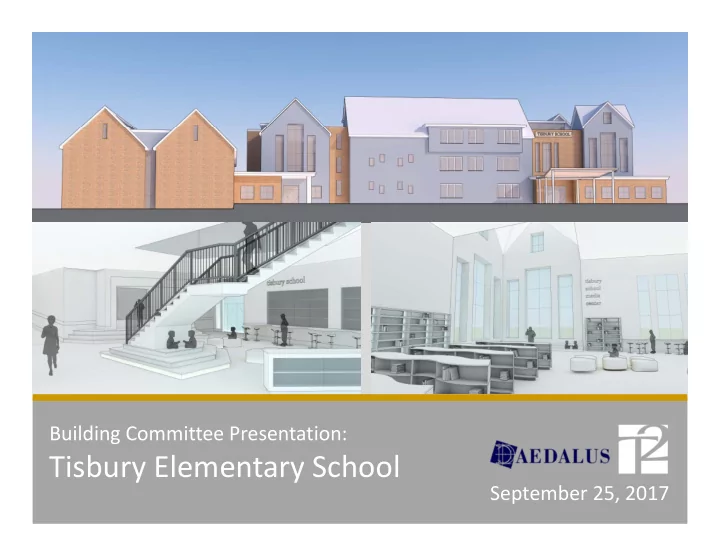
Tisbury Elementary School September 25, 2017 AGENDA| 1. Discussion - - PowerPoint PPT Presentation
SLIDE TITLE| Slide SubTitle Building Committee Presentation: Tisbury Elementary School September 25, 2017 AGENDA| 1. Discussion of Options: i. Option 3B 3story school, existing building to remain during construction ii. Option 3C
i. Option 3B – 3‐story school, existing building to remain during construction ii. Option 3C – 3‐story school, existing gym removed prior to construction
i. Registration ii. Prerequisites
v. Processes – LEED Online, Basecamp
SITE PLAN, SITE SECTION, CONSIDERATIONS
SITE PLAN SITE SECTION CONSIDERATIONS
remain during construction
classrooms and protected at rear of building
topography (130’)
from view
William – 30’+/‐
east residential lots
access ‐ accessibility
recreation areas – visible
drop off zone with loss of parking at the service lane.
EXISTING BUILDING (137’)
NEW 3‐STORY SCHOOL, EXT’G BUILDING TO REMAIN SITE PLAN, SITE SECTION, CONSIDERATIONS
SITE PLAN SITE SECTION CONSIDERATIONS
remain during construction
classrooms and protected at rear of building
topography (130’)
from view
William – 30’+/‐
9’+/‐
east residential lots
access ‐ accessibility
recreation areas – visible
reduced by smaller lots
EXISTING BUILDING (137’)
FIRST FLOOR PLAN
NEW 3‐STORY SCHOOL, EXT’G BUILDING TO REMAIN FLOOR PLANS SECOND FLOOR PLAN
NEW 3‐STORY SCHOOL, EXT’G BUILDING TO REMAIN FLOOR PLANS THIRD FLOOR PLAN
MASSING BIRD’S EYE VIEW EXISTING SCHOOL COMPARED TO NEW SCHOOL
EAST VIEW NORTH WEST VIEW
MASSING
NEW 3‐STORY SCHOOL, EXT’G GYM REMOVED SITE PLAN, SITE SECTION, CONSIDERATIONS
SITE PLAN SITE SECTION CONSIDERATIONS
residential, but provides buffers
with buffers and placement at now elevation on site
separated from Upper and more protected, will need to use stairs to access.
topography (126’)
William ‐ 50’+/‐
45’+/‐
access – overall accessibility
uses vertically
recreation areas
EXISTING BUILDING (137’)
MODULARS
GYM CLRM
FIRST FLOOR PLAN
NEW 3‐STORY SCHOOL, EXT’G GYM REMOVED FLOOR PLANS
SECOND FLOOR PLAN
NEW 3‐STORY SCHOOL, EXT’G GYM REMOVED FLOOR PLANS
THIRD FLOOR PLAN
NEW 3‐STORY SCHOOL, EXT’G GYM REMOVED FLOOR PLANS
MASSING BIRD’S EYE VIEW EXISTING SCHOOL COMPARED TO NEW SCHOOL
MASSING EAST VIEW NORTH WEST VIEW
SITE PLAN, SITE SECTION, CONSIDERATIONS
SITE PLAN SITE SECTION CONSIDERATIONS
first
prevailing windward
classrooms
deliveries
east residential properties
zones
recreation uses
EXISTING BUILDING (137’)
SITE PLAN, SITE SECTION, CONSIDERATIONS
SITE PLAN SITE SECTION CONSIDERATIONS
before construction
prevailing windward
classrooms
deliveries
east residential properties
zones
recreation uses
existing – familiar
EXISTING BUILDING (137’)
FIRST FLOOR PLAN
NEW 3‐STORY SCHOOL LOCATED, EXT’G BUILDING REMOVED FLOOR PLANS
NEW 3‐STORY SCHOOL, EXT’G BUILDING REMOVED FLOOR PLANS SECOND FLOOR PLAN
NEW 3‐STORY SCHOOL, EXT’G BUILDING REMOVED FLOOR PLANS THIRD FLOOR PLAN
MASSING BIRD’S EYE VIEW EXISTING SCHOOL COMPARED TO NEW SCHOOL
MASSING NORTH WEST VIEW SOUTH EAST VIEW
ALL OPTIONS & COST COMPARISON OPTION 3C : Located East Side of Site Gym Removed OPTION 3B : Located East Side of Site OPTION 3D: Located Center of Site – Demo of existing school
DESIGN‐BID‐BUILD (DBB) ‐ PROS ‐
to start of construction
award
design/construction
DESIGN‐BID‐BUILD (DBB) ‐ CONS ‐
value engineering (VE).
the individuals who will supervise the project.
ability for early work packages
award
mainland construction market
VS.
CONSTRUCITON MANAGER AT RISK
CONSTRUCTION MANAGER AT RISK (CMR) ‐ PROS ‐
the team of individuals who will be part of the team
prequalification process
drawing/specification inconsistencies
construction budget
before design completion, reducing project schedule
CONSTRUCTION MANAGER AT RISK (CMR) ‐ CONS ‐
Inspector General (takes 30‐45 days)
construction (adds 2‐3% to initial cost)
VS.
CONSTRUCITON MANAGER AT RISK
COLLABORATIVE OF HIGH PERFORMANCE SCHOOLS (CHPS)
i. Registration & Certifications ii. Prerequisites
v. Certificate Process – LEED Online, Basecamp
Flat Registration Fee Certification Fee Based on Square Footage No Registration Fee Flat Certification Fee
Registration $1,500 Design Review $4,400 Construction Review $1,440
Total $7,340
Registration $0 Verified Design $4,850 Verified Construction $2,700
Total $7,550
15 Prerequisite Credits Unique to LEED –
27 Prerequisite Credits Unique to NECHPS –
and Assistance
Location & Transportation Sustainable Sites Water Efficiency Energy & Atmosphere Materials & Resources Indoor Environmental Quality
Integration and Innovation Operations & Metrics Indoor Environmental Quality Energy Water Sites Materials & Waste Management
sustainability is geared toward LEED
sustainability is LEED based, but also acceptable for NECHPS
assigned LEED Coach independently
sharing through Basecamp
communications and files
separately until they are ready for review
MSBA Reimbursement for LEED Silver (50 points) MSBA Reimbursement for CHPS Verified (110 points)
by the building owner
Project Directory
projects nationally or regionally
Greenbuild or USGBC Massachusetts Chapter
pdf format for duplication
Northeast Energy Efficiency Partnerships
We could learn from the Edgartown school as it is set within/abuts a residential neighborhood. Drop off space, walk ways , parking lot design/landscaping and outdoor activity spaces provide
The main entrance at Edgartown was spacious, is used for public gatherings. The cafeteria and kitchen connect to this space creating a central community space where students pass through and gather on a regular basis. Detailing in the Edgartown main entrance (wainscot panels) helped to give a bit of warmth to the space, and distinguish the area as a unique space. School Nurse area impressive, privacy and access for help from other staff members well considered Community gardens at Edgartown were great. They have a part‐time staff member to oversee them and community support during the summer to help with maintenance. They preserve vegetables for use during the school year. Rugs were being taken out of the Edgartown school and being replaced with vinyl tile flooring.
Nurses Area Hallway
Lower Level Classroom – Change of Flooring from Carpet to Vinyl leaves classrooms looking very sterile
Cafetorium – Cafeteria and Kitchen is well laid
and storage space, impressive equipment.
Heating system works well but costs high, considering switching heating system in next 5 years ‐ will consider Renewable Energy sources Cooling inadequate – Hot classrooms in shoulder months of school year Lighting is poor overall – High Glare fluorescents, have been switching to LED bulbs over time, very little natural interior light Gym Floor ‐ went with synthetic floor to save costs, but would prefer wood floor
The main Oak Bluffs entrance was not as welcoming or comfortable. The second floor overhang ceiling reduced the light and openness of the space. The security entry constrained the space. If we need a security entry it would be best to consider this as part of the initial design rather than a retrofit add on. Halls in OB seemed overly wide. They use the halls for small group activities but this arrangement did not seem to provide much privacy. Library is inviting with comfortable seating indoor and outdoor The class rooms are large and a small class of young kids could feel a bit lost in the space. Science room is connected to Greenhouse Have introduced new Steam Class, just one year so far, spoke briefly with Leah Door who has plenty of ideas for how to best utilize this kind of space, note to discuss our Maker Space design with her.
Entryway
Kindergarten – Well thought out spaces still function and look well
Steam Room – Reusing shop space and reconfiguring
Use Computer screen to show practical videos
Science Room with connecting greenhouse
Heating system does not work well, very high costs to maintain, large part of operating budget Cooling inadequate – Similar to Edgartown Hot classrooms in shoulder months of school year, using fans in windows Lighting is poor overall – High Glare fluorescents, take out light bulbs to reduce glare, wish for better lighting Large space areas outside on different levels not used that much so dead space Length of school prohibits efficiency of movement for staff, administrative staff spend a lot of time walking the length of the building, have set up administrative hubs at different areas Hallways long and dark
Scale of both schools felt too large ‐ classrooms, hallways, entries etc. Both entrances felt like wasted space Libraries should be more front and center to facilitate community access Edgartown school library location was good, 2nd floor but right at the entry. OB library felt remote. Both schools felt too sprawling and layout seemed a bit confusing. Materials used were sterile and synthetic, too much plastic and vinyl Both have added into open space areas a School Store Both have staff rooms in multiple areas throughout the school Liked Connecting Doors between multiple classrooms onside of hallway Overall our decision to go with a 3 Story building eliminates some of our concerns over length of buildings and overly long hallways Material choices are key to creating to inviting spaces Color seemed only noticeable in Kindergarten rooms, need to incorporate varied color choices throughout
SEPTEMBER 26TH
Sustainability Design Working Group
SEPTEMBER 28TH
School Tours (Dearborn School and Hannigan School)
OCTOBER 2ND
Working Group ‐ Security
OCTOBER 5TH – 6TH
Staff/Room Data Meetings
OCTOBER 10TH
School Building Committee Meeting
OCTOBER 23RD
School Building Committee Meeting
JANUARY 3RD
MSBA Schematic Design Submission