Time of Flight Detectors at RHIC Time of Flight Measurements at - - PowerPoint PPT Presentation

time of flight detectors at rhic
SMART_READER_LITE
LIVE PREVIEW

Time of Flight Detectors at RHIC Time of Flight Measurements at - - PowerPoint PPT Presentation

Time of Flight Detectors at RHIC Time of Flight Measurements at RHIC ! TOF detector as a PID devices ! PHENIX-TOF and BRAHMS-TOF PHENIX Time-of-Flight Detector ! Mechanical design and PID capability ! Detector performance in


slide-1
SLIDE 1

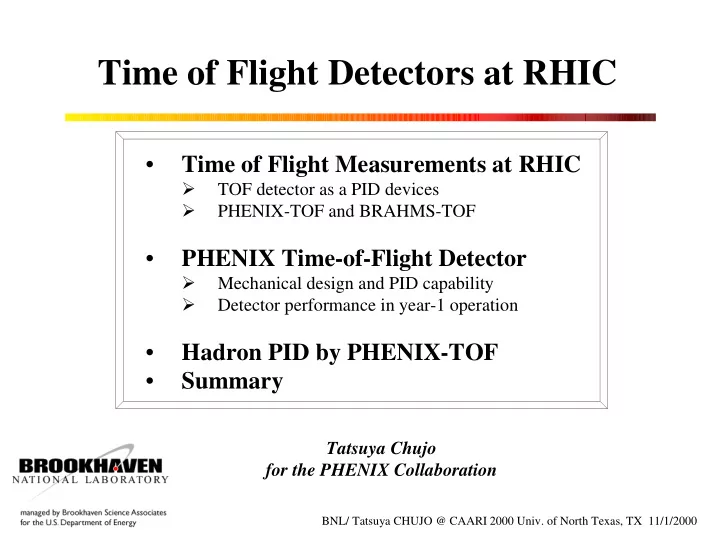
Time of Flight Detectors at RHIC

  • Time of Flight Measurements at RHIC

! TOF detector as a PID devices ! PHENIX-TOF and BRAHMS-TOF

  • PHENIX Time-of-Flight Detector

! Mechanical design and PID capability ! Detector performance in year-1 operation

  • Hadron PID by PHENIX-TOF
  • Summary

BNL/ Tatsuya CHUJO @ CAARI 2000 Univ. of North Texas, TX 11/1/2000

Tatsuya Chujo for the PHENIX Collaboration

slide-2
SLIDE 2
  • Hadronic observables for QGP search

1. Identified single particle spectra and yields 2. Special and temporal evolution of the source, extrapolated by Hanbury-Brown Twiss effect (HBT) 3. Strangeness abundance 4. In-medium modification of φ meson’s property …………

Time of Flight Measurements at RHIC

BNL/ Tatsuya CHUJO @ CAARI 2000 Univ. of North Texas, TX 11/1/2000

Precise measurement of identified hadrons in wide pT range is required to understand the collision dynamics at RHIC

Needed high timing resolution TOF detector at RHIC experiments

slide-3
SLIDE 3

Why PID by TOF Is Important ?

BNL/ Tatsuya CHUJO @ CAARI 2000 Univ. of North Texas, TX 11/1/2000

TOF – TOFexpected[ns]

from T. Ullrich talk at DNP2000

PID by dE/dx in TPC (STAR) PID by TOF (WA98)

  • Limitation of PID capability by dE/dx : p < 1 GeV/c π

π π π/K separation

  • PID by TOF : Clear π

π π π/K/p separation at higher momentum.

1.0 GeV/c

slide-4
SLIDE 4

TOF Detectors in HI Experiments

BNL/ Tatsuya CHUJO @ CAARI 2000 Univ. of North Texas, TX 11/1/2000

AGS-E802 (1987-1996) AGS-E866 (1993-1996) SPS-WA98 ARM II (1995-1996) PHENIX (2000-)

  • TOF is considered as the most

reliable and stable devices for charged particle identification.

slide-5
SLIDE 5

Performance @ CERN WA98 Experiment

  • Achieved timing resolution : σ

σ σ σTOF = 85 ps

  • Demonstrated clear π

π π π/K/p separation.

  • Installed tested WA98-TOF counter in PHENIX.

BNL/ Tatsuya CHUJO @ CAARI 2000 Univ. of North Texas, TX 11/1/2000

σ σ σ σTOF = 85 ps

TOF – TOF expected [ns] Selected high momentum pions

TOF resolution PID performance

slide-6
SLIDE 6

TOF Detectors at RHIC

BNL/ Tatsuya CHUJO @ CAARI 2000 Univ. of North Texas, TX 11/1/2000

TOF

BBC (start timing)

PHENIX Central Arm Detectors

TOFW H2 H1

slide-7
SLIDE 7

PHENIX-TOF vs. BRAHMS-TOF

BNL/ Tatsuya CHUJO @ CAARI 2000 Univ. of North Texas, TX 11/1/2000

* In this talk, only PHENIX-TOF detector are reviewed. H2 TOFW H1

< 8.5 GeV/c < 3.7 GeV/c < 5.0 GeV/c < 2.2 GeV/c

20m 4m

forward rap. 2.0 < η η η η < 3.5 mid rap. 0 < η η η η < 1.2

< 5.7 GeV/c

< 4.0 GeV/c 4 σ K/p separation

< 3.3 GeV/c

< 2.4 GeV/c 4 σ π/K separation 9 m 5m Distance from vertex

forward rap. 1.2 < η η η η < 3.5

mid-rapidity –0.35 < η η η η < 0.35 Acceptance BRAHMS PHENIX

  • BRAHMS : Cherenkov counters are also used

for hadron PID at high momentum

PHENIX : Finely segmented high resolution TOF at mid-rapidty. BRAHMS: Wide kinetic coverage, PID @ high momentum with Cherenkov counter.

slide-8
SLIDE 8

PHENIX-TOF Basic Design

BNL/ Tatsuya CHUJO @ CAARI 2000 Univ. of North Texas, TX 11/1/2000

Acceptance : driven by HBT and φ meson

∆θ = 40 deg. (∆η = 0.7) , ∆φ = 45 deg.

Timing Resolution : pT distribution more than 2 GeV/c and φ meson measurement Segmentation : Keep the occupancy level < 10 %

1500 ≅ dy dNch segments 1000 ≅

~ 100 cm2/segment at 5 m from vertex ∆φ ∆φ ∆φ ∆φ = 45 deg. , ∆η ∆η ∆η ∆η = 0.7 4σ π σ π σ π σ π/K separation at p = 2.4 GeV/c 4σ σ σ σ K/p separation at p = 4.0 GeV/c

(@ flight path = 5m)

Required σ σ σ σTOF < 80 ~ 100 ps for

TOF

slide-9
SLIDE 9

PHENIX-TOF Components

385cm 200cm 200cm

BNL/ Tatsuya CHUJO @ CAARI 2000 Univ. of North Texas, TX 11/1/2000

  • Consists of 960 plastic scintillators
  • PMT readout at both ends of scint. (1920 ch.)
  • Scintillator: Bicron BC404
  • decay constant : 1.8 ns
  • attenuation length : 160cm
  • PMT : Hamamatsu R3478S
  • Rise time : 1.3 ns
  • Transit time : 14 + - 0.36 ns

PMT

96 slats/panel 10 panels

slide-10
SLIDE 10

Features of TOF Mechanical Design

BNL/ Tatsuya CHUJO @ CAARI 2000 Univ. of North Texas, TX 11/1/2000

1. Used Honeycomb Board for scint. stacking

  • Rigid structure with mass-less in 2m x 0.5 m
  • Carbon fiber sheet + “honeycomb” structure
  • Uniform structure
  • 2. Used prism light guide to reduce dead space

PMT

Scintillator slat Prism light guide

slide-11
SLIDE 11

Front End Electronics (FEE)

BNL/ Tatsuya CHUJO @ CAARI 2000 Univ. of North Texas, TX 11/1/2000

  • Custom-made chips of TVC+AMU and QVC+AMU

Overall timing resolution of < 25 ps

  • Use of Analogue Memory Unit (AMU)

Programmable up to 4 µ µ µ µ sec delay w/o coaxial delay cables.

FEE board (16 ch/board)

QVC/AMU 12 bit ADC Format Buffer 12 bit ADC TVC/AMU Discr.

PMT

Block Diagram of FEE

TVC+AMU chip (4ch /chip) Discriminator Sub-board PMT input lemo

  • 16 inputs for PMT signals per board, which are split for

timing and charge measurements

slide-12
SLIDE 12

Front End Electronics (cont.)

Elimination of Cross Talk between adjacent channels

Each channel consists of two independent ch.

  • 1. Signal : connected to PMT
  • 2. Reference: antenna for cross talk elimination

No cross talk in differential output

Channel 1 discriminator time Channel 2 ADC counts 2: Reference 1: Signal 1-2: Difference

BNL/ Tatsuya CHUJO @ CAARI 2000 Univ. of North Texas, TX 11/1/2000

slide-13
SLIDE 13

TEC/TOF Matching

  • σ

σ σ σTOF-TEC = 2cm Corresponding to the TOF resolution of 120 ps

  • Consistent with TOF intrinsic timing resolution without slewing correction.

σ σ σ σTOF-TEC ~ 2 cm Timing resolution will be improved by fine tuning of calibration parameters. σ σ σ σTOF ~ 80 ps

BNL/ Tatsuya CHUJO @ CAARI 2000 Univ. of North Texas, TX 11/1/2000 TEC: Time Expansion Chamber

TOF

slide-14
SLIDE 14

Global Track/TOF Association

Select in 2 σ σ σ σ radius

∆ ∆ ∆ ∆y [cm] ∆ ∆ ∆ ∆z [cm] ∆ ∆ ∆ ∆z [cm] ∆ ∆ ∆ ∆y [cm]

Association window size : dr = 5 cm (~ 2σ σ σ σ of in y-z projection plane)

*Clear correlation between global tracks and TOF hit positions are seen

BNL/ Tatsuya CHUJO @ CAARI 2000 Univ. of North Texas, TX 11/1/2000

slide-15
SLIDE 15

Hadron PID by PHENIX-TOF

PHENIX Preliminary

Proton K+ K- π π π π+

π π π π- p

Clear hadron PID achieved

Note: * No slewing correction * Applied track association cut : dr = 5 cm * No acceptance/efficiency/decay corrections

BNL/ Tatsuya CHUJO @ CAARI 2000 Univ. of North Texas, TX 11/1/2000

Proton

K+ π π π π+

(a.u.) PID cut

PHENIX Preliminary

m2 [GeV/c2]

w/o PID cut

e+ e-

          −       = 1

2 2 2

L TOF p m

slide-16
SLIDE 16

Summary

  • Reviewed PHENIX-TOF detector functionality and performance from the

first RHIC run.

  • Tracking detectors (DC/PC/TEC) and TOF detector had been operated

successfully during the run.

  • TOF intrinsic timing resolution ~120 ps have been achieved by TEC/TOF

hit position matching without slewing correction.

  • Fine tuning of TOF timing calibration parameters will be done.
  • Clear hadron PID have been achieved.
  • Lots of interesting physics will come next.

1) Single particle spectra for π+, π−, K+, K-, p andp(<pT>, centrality dependence) 2) Particle ratio K/π, p/p etc. and their centrality/pT dependence 3) HBT analysis 4) φ K+K- physics

BNL/ Tatsuya CHUJO @ CAARI 2000 Univ. of North Texas, TX 11/1/2000