The Central Curve in Linear Programming Cynthia Vinzant, U. Michigan - - PowerPoint PPT Presentation

the central curve in linear programming
SMART_READER_LITE
LIVE PREVIEW

The Central Curve in Linear Programming Cynthia Vinzant, U. Michigan - - PowerPoint PPT Presentation

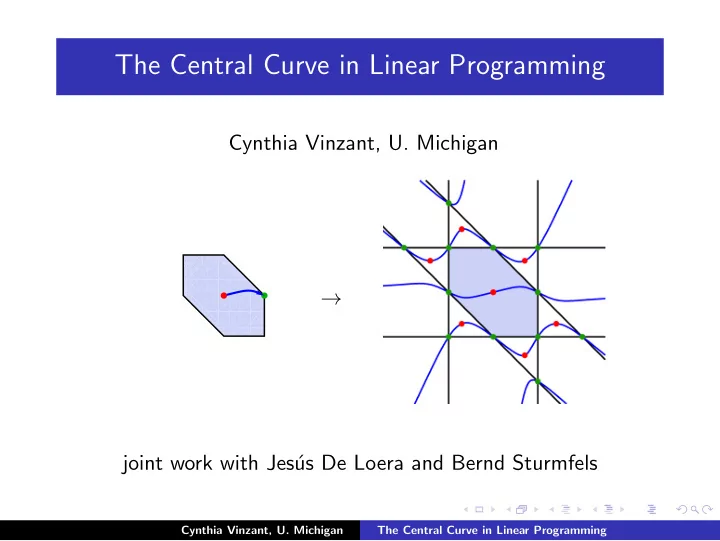
The Central Curve in Linear Programming Cynthia Vinzant, U. Michigan joint work with Jes us De Loera and Bernd Sturmfels Cynthia Vinzant, U. Michigan The Central Curve in Linear Programming The Central Path of a Linear Program Linear

slide-1
SLIDE 1

The Central Curve in Linear Programming

Cynthia Vinzant, U. Michigan → joint work with Jes´ us De Loera and Bernd Sturmfels

Cynthia Vinzant, U. Michigan The Central Curve in Linear Programming

slide-2
SLIDE 2

The Central Path of a Linear Program

Linear Program: Maximizex∈Rn c · x s.t. A · x = b and x ≥ 0.

Cynthia Vinzant, U. Michigan The Central Curve in Linear Programming

slide-3
SLIDE 3

The Central Path of a Linear Program

Linear Program: Maximizex∈Rn c · x s.t. A · x = b and x ≥ 0. Replace by : Maximizex∈Rn fλ(x) s.t. A · x = b, where λ ∈ R+ and fλ(x) := c · x + λ n

i=1 log |xi|.

Cynthia Vinzant, U. Michigan The Central Curve in Linear Programming

slide-4
SLIDE 4

The Central Path of a Linear Program

Linear Program: Maximizex∈Rn c · x s.t. A · x = b and x ≥ 0. Replace by : Maximizex∈Rn fλ(x) s.t. A · x = b, where λ ∈ R+ and fλ(x) := c · x + λ n

i=1 log |xi|.

The maximum of the function fλ is attained by a unique point x∗(λ) in the the open polytope {x ∈ (R>0)n : A · x = b}.

Cynthia Vinzant, U. Michigan The Central Curve in Linear Programming

slide-5
SLIDE 5

The Central Path of a Linear Program

Linear Program: Maximizex∈Rn c · x s.t. A · x = b and x ≥ 0. Replace by : Maximizex∈Rn fλ(x) s.t. A · x = b, where λ ∈ R+ and fλ(x) := c · x + λ n

i=1 log |xi|.

The maximum of the function fλ is attained by a unique point x∗(λ) in the the open polytope {x ∈ (R>0)n : A · x = b}. The central path is {x∗(λ) : λ > 0}. As λ → 0 , the path leads from the analytic center of the polytope, x∗(∞), to the optimal vertex, x∗(0).

Cynthia Vinzant, U. Michigan The Central Curve in Linear Programming

slide-6
SLIDE 6

The Central Path of a Linear Program

The central path is {x∗(λ) : λ > 0}. As λ → 0 , the path leads from the analytic center of the polytope, x∗(∞), to the optimal vertex, x∗(0).

Cynthia Vinzant, U. Michigan The Central Curve in Linear Programming

slide-7
SLIDE 7

The Central Path of a Linear Program

The central path is {x∗(λ) : λ > 0}. As λ → 0 , the path leads from the analytic center of the polytope, x∗(∞), to the optimal vertex, x∗(0). Interior point methods ≈ piecewise-linear approx. of this path

Cynthia Vinzant, U. Michigan The Central Curve in Linear Programming

slide-8
SLIDE 8

The Central Path of a Linear Program

The central path is {x∗(λ) : λ > 0}. As λ → 0 , the path leads from the analytic center of the polytope, x∗(∞), to the optimal vertex, x∗(0). Interior point methods ≈ piecewise-linear approx. of this path Bounds on curvature of the path → bounds on # Newton steps

Cynthia Vinzant, U. Michigan The Central Curve in Linear Programming

slide-9
SLIDE 9

The Central Path of a Linear Program

The central path is {x∗(λ) : λ > 0}. As λ → 0 , the path leads from the analytic center of the polytope, x∗(∞), to the optimal vertex, x∗(0). Interior point methods ≈ piecewise-linear approx. of this path Bounds on curvature of the path → bounds on # Newton steps We can use concepts from algebraic geometry and matroid theory to bound the total curvature of the central path.

Cynthia Vinzant, U. Michigan The Central Curve in Linear Programming

slide-10
SLIDE 10

The Central Curve

The central curve C is the Zariski closure of the central path. It contains the central paths of all polyhedra in the hyperplane arrangement {xi = 0}i=1,...,n ⊂ {A · x = b}. − →

Zariski closure

Cynthia Vinzant, U. Michigan The Central Curve in Linear Programming

slide-11
SLIDE 11

The Central Curve

The central curve C is the Zariski closure of the central path. It contains the central paths of all polyhedra in the hyperplane arrangement {xi = 0}i=1,...,n ⊂ {A · x = b}. − →

Zariski closure

Goal: Study the nice algebraic geometry of this curve and its applications to the linear program

Cynthia Vinzant, U. Michigan The Central Curve in Linear Programming

slide-12
SLIDE 12

History and Contributions

Motivating Question: What is the maximum total curvature of the central path given the size of the matrix A?

Cynthia Vinzant, U. Michigan The Central Curve in Linear Programming

slide-13
SLIDE 13

History and Contributions

Motivating Question: What is the maximum total curvature of the central path given the size of the matrix A? Deza-Terlaky-Zinchenko (2008) make continuous Hirsch conjecture Conjecture: The total curvature of the central path is at most O(n).

Cynthia Vinzant, U. Michigan The Central Curve in Linear Programming

slide-14
SLIDE 14

History and Contributions

Motivating Question: What is the maximum total curvature of the central path given the size of the matrix A? Deza-Terlaky-Zinchenko (2008) make continuous Hirsch conjecture Conjecture: The total curvature of the central path is at most O(n). Dedieu-Malajovich-Shub (2005) apply differential and algebraic geometry to bound the total curvature of the central path.

Cynthia Vinzant, U. Michigan The Central Curve in Linear Programming

slide-15
SLIDE 15

History and Contributions

Motivating Question: What is the maximum total curvature of the central path given the size of the matrix A? Deza-Terlaky-Zinchenko (2008) make continuous Hirsch conjecture Conjecture: The total curvature of the central path is at most O(n). Dedieu-Malajovich-Shub (2005) apply differential and algebraic geometry to bound the total curvature of the central path. Bayer-Lagarias (1989) study the central path as an algebraic object and suggest the problem of identifying its defining equations.

Cynthia Vinzant, U. Michigan The Central Curve in Linear Programming

slide-16
SLIDE 16

History and Contributions

Motivating Question: What is the maximum total curvature of the central path given the size of the matrix A? Deza-Terlaky-Zinchenko (2008) make continuous Hirsch conjecture Conjecture: The total curvature of the central path is at most O(n). Dedieu-Malajovich-Shub (2005) apply differential and algebraic geometry to bound the total curvature of the central path. Bayer-Lagarias (1989) study the central path as an algebraic object and suggest the problem of identifying its defining equations. Our contribution is to use results from algebraic geometry and matroid theory to find defining equations of the central curve and refine bounds

  • n its degree and total curvature.

Cynthia Vinzant, U. Michigan The Central Curve in Linear Programming

slide-17
SLIDE 17

Outline

  • Algebraic conditions for optimality
  • Degree of the curve (and other combinatorial data)
  • Total curvature and the Gauss map
  • Defining equations
  • The primal-dual picture

Cynthia Vinzant, U. Michigan The Central Curve in Linear Programming

slide-18
SLIDE 18

Some details

Here we assume that . . . 1) A is a d × n matrix of rank-d (possibly very special), and 2) c ∈ Rn and b ∈ Rd are generic.

(This ensures that the central curve is irreducible and nonsingular.)

Cynthia Vinzant, U. Michigan The Central Curve in Linear Programming

slide-19
SLIDE 19

Algebraic Conditions for Optimality

. . . of the function fλ(x) = c · x + λ n

i=1 log |xi| in {A · x = b}:

Cynthia Vinzant, U. Michigan The Central Curve in Linear Programming

slide-20
SLIDE 20

Algebraic Conditions for Optimality

. . . of the function fλ(x) = c · x + λ n

i=1 log |xi| in {A · x = b}:

∇fλ(x) = c + λx−1 ∈ span{rows(A)}

Cynthia Vinzant, U. Michigan The Central Curve in Linear Programming

slide-21
SLIDE 21

Algebraic Conditions for Optimality

. . . of the function fλ(x) = c · x + λ n

i=1 log |xi| in {A · x = b}:

∇fλ(x) = c + λx−1 ∈ span{rows(A)} ⇒ x−1 ∈ span{rows(A)} + λ−1c

Cynthia Vinzant, U. Michigan The Central Curve in Linear Programming

slide-22
SLIDE 22

Algebraic Conditions for Optimality

. . . of the function fλ(x) = c · x + λ n

i=1 log |xi| in {A · x = b}:

∇fλ(x) = c + λx−1 ∈ span{rows(A)} ⇒ x−1 ∈ span{rows(A)} + λ−1c ⇒ x−1 ∈ span{rows(A), c}

Cynthia Vinzant, U. Michigan The Central Curve in Linear Programming

slide-23
SLIDE 23

Algebraic Conditions for Optimality

. . . of the function fλ(x) = c · x + λ n

i=1 log |xi| in {A · x = b}:

∇fλ(x) = c + λx−1 ∈ span{rows(A)} ⇒ x−1 ∈ span{rows(A)} + λ−1c ⇒ x−1 ∈ span{rows(A), c} =: LA,c

Cynthia Vinzant, U. Michigan The Central Curve in Linear Programming

slide-24
SLIDE 24

Algebraic Conditions for Optimality

. . . of the function fλ(x) = c · x + λ n

i=1 log |xi| in {A · x = b}:

∇fλ(x) = c + λx−1 ∈ span{rows(A)} ⇒ x−1 ∈ span{rows(A)} + λ−1c ⇒ x−1 ∈ span{rows(A), c} =: LA,c ⇒ x ∈ L−1

A,c

where L−1

A,c denotes the coordinate-wise reciprocal LA,c:

L−1

A,c :=

  • (u−1

1 , . . . , u−1 n )

where (u1, . . . , un) ∈ LA,c

  • Cynthia Vinzant, U. Michigan

The Central Curve in Linear Programming

slide-25
SLIDE 25

Algebraic Conditions for Optimality

. . . of the function fλ(x) = c · x + λ n

i=1 log |xi| in {A · x = b}:

∇fλ(x) = c + λx−1 ∈ span{rows(A)} ⇒ x−1 ∈ span{rows(A)} + λ−1c ⇒ x−1 ∈ span{rows(A), c} =: LA,c ⇒ x ∈ L−1

A,c

where L−1

A,c denotes the coordinate-wise reciprocal LA,c:

L−1

A,c :=

  • (u−1

1 , . . . , u−1 n )

where (u1, . . . , un) ∈ LA,c

  • Proposition. The central curve equals the intersection of the

central sheet L−1

A,c with the affine space

  • A · x = b
  • .

Cynthia Vinzant, U. Michigan The Central Curve in Linear Programming

slide-26
SLIDE 26

Level sets of the cost function

Consider intersecting the central curve C with the level set {c · x = c0}.

Cynthia Vinzant, U. Michigan The Central Curve in Linear Programming

slide-27
SLIDE 27

Level sets of the cost function

Consider intersecting the central curve C with the level set {c · x = c0}. Observations: 1) There is exactly one point of C ∩ {c · x = c0} in each bounded region of the induced hyperplane arrangement. 2) This number is the same for almost any choice of c0.

Cynthia Vinzant, U. Michigan The Central Curve in Linear Programming

slide-28
SLIDE 28

Level sets of the cost function

Consider intersecting the central curve C with the level set {c · x = c0}. Observations: 1) There is exactly one point of C ∩ {c · x = c0} in each bounded region of the induced hyperplane arrangement. 2) This number is the same for almost any choice of c0. Claim: The points C ∩ {c · x = c0} are the analytic centers of the hyperplane arrangement {xi = 0}i∈[n] in {A · x = b, c · x = c0}.

Cynthia Vinzant, U. Michigan The Central Curve in Linear Programming

slide-29
SLIDE 29

Level sets of the cost function and analytic centers

Claim: The points C ∩ {c · x = c0} are the analytic centers of the hyperplane arrangement {xi = 0}i∈[n] in {A · x = b, c · x = c0}.

Cynthia Vinzant, U. Michigan The Central Curve in Linear Programming

slide-30
SLIDE 30

Level sets of the cost function and analytic centers

Claim: The points C ∩ {c · x = c0} are the analytic centers of the hyperplane arrangement {xi = 0}i∈[n] in {A · x = b, c · x = c0}.

⇒ # bounded regions of induced hyperplane arrangement ≤ deg(C)

Cynthia Vinzant, U. Michigan The Central Curve in Linear Programming

slide-31
SLIDE 31

Level sets of the cost function and analytic centers

Claim: The points C ∩ {c · x = c0} are the analytic centers of the hyperplane arrangement {xi = 0}i∈[n] in {A · x = b, c · x = c0}.

⇒ # bounded regions of induced hyperplane arrangement ≤ deg(C)

Theorem: The number of bounded regions in hyperplane arrangement induced by {c · x = c0} equals the degree of the central curve C. Thus, deg(C) ≤ n−1

d

  • , with equality for generic A.

Cynthia Vinzant, U. Michigan The Central Curve in Linear Programming

slide-32
SLIDE 32

Level sets of the cost function and analytic centers

Claim: The points C ∩ {c · x = c0} are the analytic centers of the hyperplane arrangement {xi = 0}i∈[n] in {A · x = b, c · x = c0}.

⇒ # bounded regions of induced hyperplane arrangement ≤ deg(C)

Theorem: The number of bounded regions in hyperplane arrangement induced by {c · x = c0} equals the degree of the central curve C. Thus, deg(C) ≤ n−1

d

  • , with equality for generic A.

For matroid enthusiasts, this number is the absolute value

  • f the M¨
  • bius invariant of

A

c

  • .

Cynthia Vinzant, U. Michigan The Central Curve in Linear Programming

slide-33
SLIDE 33

Combinatorial data

Proudfoot and Speyer (2006) determine the ideal of polynomials vanishing on L−1

A,c and its Hilbert series.

Cynthia Vinzant, U. Michigan The Central Curve in Linear Programming

slide-34
SLIDE 34

Combinatorial data

Proudfoot and Speyer (2006) determine the ideal of polynomials vanishing on L−1

A,c and its Hilbert series.

Using the matroid associated to L−1

A,c, they construct a simplicial

complex containing combinatorial data of this ideal.

  1 1 1 1 1 1 2 4   {123, 1245, 1345, 2345}

h = (1, 2, 2) matrix

A

c

matroid →

“broken circuit” →

h-vector

complex

Cynthia Vinzant, U. Michigan The Central Curve in Linear Programming

slide-35
SLIDE 35

Combinatorial data

Proudfoot and Speyer (2006) determine the ideal of polynomials vanishing on L−1

A,c and its Hilbert series.

Using the matroid associated to L−1

A,c, they construct a simplicial

complex containing combinatorial data of this ideal.

  1 1 1 1 1 1 2 4   {123, 1245, 1345, 2345}

h = (1, 2, 2) matrix

A

c

matroid →

“broken circuit” →

h-vector

complex

⇒ deg(C) = d

i=0 hi

and genus(C) = 1 − d

j=0(1 − j)hj .

Cynthia Vinzant, U. Michigan The Central Curve in Linear Programming

slide-36
SLIDE 36

Total Curvature

Classic differential geometry: The total curvature of any real algebraic curve C in Rm is the arc length of its image under the Gauss map γ : C → Sm−1. This quantity is bounded above by π times the degree of the projective Gauss curve in Pm−1. That is, total curvature of C ≤ π · deg(γ(C)).

Cynthia Vinzant, U. Michigan The Central Curve in Linear Programming

slide-37
SLIDE 37

Total Curvature

Classic differential geometry: The total curvature of any real algebraic curve C in Rm is the arc length of its image under the Gauss map γ : C → Sm−1. This quantity is bounded above by π times the degree of the projective Gauss curve in Pm−1. That is, total curvature of C ≤ π · deg(γ(C)). Dedieu-Malajovich-Shub (2005) apply this to the central curve.

Cynthia Vinzant, U. Michigan The Central Curve in Linear Programming

slide-38
SLIDE 38

Total Curvature

Classic differential geometry: The total curvature of any real algebraic curve C in Rm is the arc length of its image under the Gauss map γ : C → Sm−1. This quantity is bounded above by π times the degree of the projective Gauss curve in Pm−1. That is, total curvature of C ≤ π · deg(γ(C)). Dedieu-Malajovich-Shub (2005) apply this to the central curve. Classic algebraic geometry: deg(γ(C)) ≤ 2 · (deg(C) + genus(C) − 1)

Cynthia Vinzant, U. Michigan The Central Curve in Linear Programming

slide-39
SLIDE 39

Total Curvature

Classic differential geometry: The total curvature of any real algebraic curve C in Rm is the arc length of its image under the Gauss map γ : C → Sm−1. This quantity is bounded above by π times the degree of the projective Gauss curve in Pm−1. That is, total curvature of C ≤ π · deg(γ(C)). Dedieu-Malajovich-Shub (2005) apply this to the central curve. Classic algebraic geometry: deg(γ(C)) ≤ 2 · (deg(C) + genus(C) − 1)

Theorem: The degree of the projective Gauss curve of the central curve C satisfies a bound in terms of matroid invariants: deg(γ(C)) ≤ 2 ·

d

  • i=1

i · hi ≤ 2 · (n − d − 1) · n − 1 d − 1

  • .

Cynthia Vinzant, U. Michigan The Central Curve in Linear Programming

slide-40
SLIDE 40

Equations

Proudfoot and Speyer (2006) also prove that the equations defining L−1

A,c are the homogeneous polynomials

  • i∈supp(v)

vi ·

  • j∈supp(v)\{i}

xj, where v runs over the vectors in kernel A

c

  • f minimal support.

Cynthia Vinzant, U. Michigan The Central Curve in Linear Programming

slide-41
SLIDE 41

Equations

Proudfoot and Speyer (2006) also prove that the equations defining L−1

A,c are the homogeneous polynomials

  • i∈supp(v)

vi ·

  • j∈supp(v)\{i}

xj, where v runs over the vectors in kernel A

c

  • f minimal support.

These correspond to the circuits of the matroid M(LA,c).

Cynthia Vinzant, U. Michigan The Central Curve in Linear Programming

slide-42
SLIDE 42

Equations

Proudfoot and Speyer (2006) also prove that the equations defining L−1

A,c are the homogeneous polynomials

  • i∈supp(v)

vi ·

  • j∈supp(v)\{i}

xj, where v runs over the vectors in kernel A

c

  • f minimal support.

These correspond to the circuits of the matroid M(LA,c). A c

  • =

  1 1 1 1 1 1 2 4  

Cynthia Vinzant, U. Michigan The Central Curve in Linear Programming

slide-43
SLIDE 43

Equations

Proudfoot and Speyer (2006) also prove that the equations defining L−1

A,c are the homogeneous polynomials

  • i∈supp(v)

vi ·

  • j∈supp(v)\{i}

xj, where v runs over the vectors in kernel A

c

  • f minimal support.

These correspond to the circuits of the matroid M(LA,c). A c

  • =

  1 1 1 1 1 1 2 4   Circuit 123 → v =

  • −2

1 1

−2x2x3 + 1x1x3 + 1x1x2.

Cynthia Vinzant, U. Michigan The Central Curve in Linear Programming

slide-44
SLIDE 44

Example

(n = 5, d = 2) A = 1 1 1 1 1

  • c =
  • 1

2 4

  • b =

3 2

  • Cynthia Vinzant, U. Michigan

The Central Curve in Linear Programming

slide-45
SLIDE 45

Example

(n = 5, d = 2) A = 1 1 1 1 1

  • c =
  • 1

2 4

  • b =

3 2

  • Polynomials defining C:

−2x2x3 + x1x3 + x1x2, 4x2x4x5 − 4x1x4x5 + x1x2x5 − x1x2x4, 4x3x4x5 − 4x1x4x5 − x1x3x5 + x1x3x4, 4x3x4x5 − 4x2x4x5 − 2x2x3x5 + 2x2x3x4 x1 + x2 + x3 − 3 x4 + x5 − 2

Cynthia Vinzant, U. Michigan The Central Curve in Linear Programming

slide-46
SLIDE 46

Example

(n = 5, d = 2) A = 1 1 1 1 1

  • c =
  • 1

2 4

  • b =

3 2

  • Polynomials defining C:

−2x2x3 + x1x3 + x1x2, 4x2x4x5 − 4x1x4x5 + x1x2x5 − x1x2x4, 4x3x4x5 − 4x1x4x5 − x1x3x5 + x1x3x4, 4x3x4x5 − 4x2x4x5 − 2x2x3x5 + 2x2x3x4 x1 + x2 + x3 − 3 x4 + x5 − 2

h = (1, 2, 2) ⇒ deg(C) = 5, total curvature(C) ≤ 12π

Cynthia Vinzant, U. Michigan The Central Curve in Linear Programming

slide-47
SLIDE 47

Example

(n = 5, d = 2) A = 1 1 1 1 1

  • c =
  • 1

2 4

  • b =

3 2

  • Polynomials defining C:

−2x2x3 + x1x3 + x1x2, 4x2x4x5 − 4x1x4x5 + x1x2x5 − x1x2x4, 4x3x4x5 − 4x1x4x5 − x1x3x5 + x1x3x4, 4x3x4x5 − 4x2x4x5 − 2x2x3x5 + 2x2x3x4 x1 + x2 + x3 − 3 x4 + x5 − 2

h = (1, 2, 2) ⇒ deg(C) = 5, total curvature(C) ≤ 12π (≤ 16π)

Cynthia Vinzant, U. Michigan The Central Curve in Linear Programming

slide-48
SLIDE 48

Duality

Dual LP: Minimizes∈Rn vTs s.t. B · s = w , s ≥ 0, where B = kernel(A), A · v = b, and B · c = w.

Cynthia Vinzant, U. Michigan The Central Curve in Linear Programming

slide-49
SLIDE 49

Duality

Dual LP: Minimizes∈Rn vTs s.t. B · s = w , s ≥ 0, where B = kernel(A), A · v = b, and B · c = w. The primal-dual central path is cut out by the system of polynomial equations A · x = b , B · s = w, and x1s1 = . . . = xnsn = λ.

Cynthia Vinzant, U. Michigan The Central Curve in Linear Programming

slide-50
SLIDE 50

Duality

Dual LP: Minimizes∈Rn vTs s.t. B · s = w , s ≥ 0, where B = kernel(A), A · v = b, and B · c = w. The primal-dual central path is cut out by the system of polynomial equations A · x = b , B · s = w, and x1s1 = . . . = xnsn = λ. Examine λ → 0 and λ → ∞.

Cynthia Vinzant, U. Michigan The Central Curve in Linear Programming

slide-51
SLIDE 51

Further Questions

Cynthia Vinzant, U. Michigan The Central Curve in Linear Programming

slide-52
SLIDE 52

Further Questions

  • What can be said about non-generic behavior?

Cynthia Vinzant, U. Michigan The Central Curve in Linear Programming

slide-53
SLIDE 53

Further Questions

  • What can be said about non-generic behavior?
  • What is total curvature of just the central path?

(continuous Hirsch conjecture?)

Cynthia Vinzant, U. Michigan The Central Curve in Linear Programming

slide-54
SLIDE 54

Further Questions

  • What can be said about non-generic behavior?
  • What is total curvature of just the central path?

(continuous Hirsch conjecture?)

  • Are there interesting classes of matrices A for which this

curvature bound significantly drops?

Cynthia Vinzant, U. Michigan The Central Curve in Linear Programming

slide-55
SLIDE 55

Further Questions

  • What can be said about non-generic behavior?
  • What is total curvature of just the central path?

(continuous Hirsch conjecture?)

  • Are there interesting classes of matrices A for which this

curvature bound significantly drops?

  • Extensions to semidefinite programs?

Cynthia Vinzant, U. Michigan The Central Curve in Linear Programming

slide-56
SLIDE 56

Further Questions

  • What can be said about non-generic behavior?
  • What is total curvature of just the central path?

(continuous Hirsch conjecture?)

  • Are there interesting classes of matrices A for which this

curvature bound significantly drops?

  • Extensions to semidefinite programs?

Thanks and Happy Birthday to Mike!

Cynthia Vinzant, U. Michigan The Central Curve in Linear Programming